A link exchange is an arrangement where two or more website owners agree to link to each other’s sites, typically with the expectation of mutual SEO benefit. While the concept sounds straightforward, the practice sits in a complicated position within modern search engine guidelines, and the risks and outcomes vary considerably depending on how the exchange is structured, how frequently it is used, and the quality of the sites involved.
Key Takeaways
- Link exchanges range from simple reciprocal arrangements to more complex multi-site schemes, and search engines treat them differently depending on scale and intent.
- Excessive or manipulative link exchanges can violate Google’s spam policies and may negatively affect a site’s search visibility.
- Occasional, editorially relevant reciprocal links are generally considered lower risk than systematic link trading programmes.
- Several alternative link acquisition strategies may offer more sustainable SEO value with a clearer editorial rationale.
- Assessing whether any link building approach is appropriate requires a review of your existing backlink profile, content quality, and competitive landscape.
What Is a Link Exchange?
A link exchange, sometimes called a reciprocal link arrangement or link swap, occurs when two website owners agree to place a hyperlink to each other’s site. The underlying logic is that both parties gain a backlink, which has historically been associated with improved search engine rankings. In its most basic form, Site A links to Site B, and Site B links back to Site A. This type of arrangement has existed since the early days of the web, originally as a way for related sites to share audiences rather than as an SEO tactic.
Over time, link exchanges evolved into more deliberate SEO strategies. Webmasters began approaching each other specifically to trade links, and eventually link exchange directories and networks emerged to facilitate these arrangements at scale. Search engines, particularly Google, responded by updating their algorithms and spam policies to reduce the ranking benefit of links that appeared to exist primarily for manipulation rather than genuine editorial endorsement.
Today, the term covers a spectrum of arrangements. At one end sits the occasional, contextually relevant reciprocal link between two genuinely related sites. At the other end are systematic link trading schemes involving dozens or hundreds of sites, sometimes coordinated through private networks or outreach templates. The SEO implications of these two extremes differ substantially.
Types of Link Exchange Arrangements
Understanding the different structures helps clarify why search engines treat some link exchanges more cautiously than others.
Reciprocal Link Exchanges
A reciprocal link exchange is the most common form: Site A links to Site B, and Site B links to Site A. When this happens naturally between editorially related sites — for example, two complementary businesses in the same industry that genuinely reference each other’s resources — it is generally considered a normal part of the web. Google’s own documentation acknowledges that some reciprocal linking is natural and not inherently problematic. The concern arises when reciprocal linking is done systematically and at scale with the primary purpose of inflating link counts rather than serving readers.
Three-Way or Triangular Link Exchanges
A three-way link exchange attempts to obscure the reciprocal nature of the arrangement. In this structure, Site A links to Site B, Site B links to Site C, and Site C links back to Site A. The intention is to make the links appear non-reciprocal to search engine crawlers. This type of scheme is specifically mentioned in Google’s spam policies as an example of link schemes that may violate their guidelines. The added complexity does not reliably protect against algorithmic or manual detection.
Private Blog Network-Adjacent Arrangements
Some link exchange programmes operate through networks of sites that exist primarily to pass links between participants. These arrangements share characteristics with private blog networks (PBNs) and carry similar risks. If a network of sites is identified as existing primarily for link manipulation, all participating sites may be affected by algorithmic adjustments or manual actions.
Informal or Relationship-Based Exchanges
Not all link exchanges are formal schemes. Two business owners who know each other may naturally mention and link to each other’s work. A supplier and a retailer may reference each other on their respective websites. These informal arrangements, when they reflect a genuine relationship and are not part of a systematic trading programme, are generally considered lower risk. The editorial context and the relevance of the linking pages matter considerably in how such links are interpreted.
How Search Engines Assess Link Exchanges
Google’s approach to link evaluation has evolved significantly since the early 2000s. The Penguin algorithm update, first introduced in 2012 and later integrated into Google’s core ranking systems, specifically targeted manipulative link building practices including link schemes. Google’s current spam policies explicitly list “excessive link exchanges” as an example of link spam. The word “excessive” is important: it implies that occasional, relevant reciprocal links are not automatically treated as spam, but that systematic or large-scale trading programmes are.
Google’s systems attempt to assess whether a link exists because it genuinely serves a reader or because it was placed primarily to manipulate PageRank. Signals that may indicate manipulation include: a high proportion of reciprocal links in a site’s backlink profile, links placed in footers or sidebars rather than within editorial content, links between sites with no topical relationship, and patterns consistent with coordinated outreach campaigns designed to trade links rather than earn them.
It is worth noting that Google cannot always detect every link exchange arrangement, and some sites participating in link trading may not experience immediate visible consequences. However, the risk profile changes as the scale of the programme increases, as algorithm updates are released, and as manual review teams assess sites in competitive niches. The absence of a visible penalty at a given point in time does not confirm that a practice is safe or compliant.
Bing’s webmaster guidelines similarly caution against artificial link building, including reciprocal link schemes, though the specific algorithmic treatment may differ from Google’s approach.
Potential Benefits and Their Limitations
Proponents of link exchanges often point to several potential benefits, but each comes with meaningful limitations that are worth understanding before committing to this approach.
Backlink Acquisition
The primary appeal of a link exchange is that it can produce backlinks without the effort required by editorial outreach or content creation. For sites with a thin backlink profile, any new referring domain may appear to improve third-party authority metrics such as Domain Rating (Ahrefs), Domain Authority (Moz), or Authority Score (Semrush). However, these are proprietary metrics calculated by SEO tool providers, not Google metrics, and an improvement in these scores does not guarantee improved search rankings or organic traffic. The relationship between third-party authority metrics and actual ranking performance is correlational and context-dependent.
Referral Traffic
A link from a genuinely relevant, well-trafficked site can send referral visitors regardless of its SEO value. If a link exchange results in a placement on a site whose audience overlaps with yours, there may be a direct traffic benefit. This benefit is independent of any ranking effect and is more likely when the linking site has meaningful organic or direct traffic of its own.
Relationship Building
Some link exchange conversations begin as relationship-building exercises between complementary businesses. The link itself may be secondary to the professional relationship that develops. In these cases, the value extends beyond SEO and into potential referral partnerships, co-marketing opportunities, or industry visibility.
The limitations are significant. Links acquired through systematic exchanges may carry reduced or no ranking benefit if search engine algorithms identify them as manipulative. A backlink profile that consists heavily of reciprocal links may be assessed as lower quality than one built through diverse, editorially earned placements. And if a site receives a manual action related to link spam, the process of disavowing problematic links and recovering visibility can be time-consuming and uncertain in outcome.
Risks Associated with Link Exchanges
The risks of link exchange programmes are not uniform. They depend on the scale of the programme, the quality of the sites involved, the topical relevance of the linking pages, and the overall composition of the site’s backlink profile.
- Algorithmic devaluation: Google’s systems may identify and discount links that appear to be part of a reciprocal scheme, meaning the links may provide little or no ranking benefit even if they remain live.
- Manual actions: Sites with backlink profiles that show clear patterns of link scheme participation may be subject to manual review. A manual action for unnatural links can significantly reduce a site’s search visibility until the issue is resolved and a reconsideration request is approved.
- Association with low-quality sites: Link exchange outreach often attracts participation from sites with low editorial standards. Accepting links from or linking to low-quality, spammy, or irrelevant sites can harm rather than help a backlink profile.
- Link loss: Links acquired through exchanges can be removed if the other party decides to stop participating, changes their site structure, or closes their site. Unlike editorially earned links, exchange links may have no long-term stability guarantee.
- Opportunity cost: Time and resources spent managing link exchange programmes could be directed toward link acquisition strategies with a clearer editorial rationale and potentially more durable SEO value.

When Reciprocal Links May Be Lower Risk
Not every reciprocal link carries the same risk profile. Several characteristics tend to be associated with reciprocal links that are less likely to be treated as manipulative by search engines.
Topical relevance is one of the most important factors. A reciprocal link between two sites covering closely related subjects — for example, a web design agency and a copywriting studio that regularly collaborate — has a plausible editorial rationale. The link makes sense to a reader, which is a reasonable proxy for whether it makes sense to a search engine.
Placement within editorial content, rather than in footers, sidebars, or link directories, is another relevant factor. A link embedded in a relevant article or resource page is more likely to be interpreted as a genuine recommendation than a link placed in a site-wide footer.
Frequency and proportion also matter. A site that has a small number of reciprocal links among a diverse backlink profile built through various acquisition methods is in a different position from a site whose backlink profile consists predominantly of reciprocal arrangements.
None of these factors guarantee that a reciprocal link will be treated as fully editorial by search engines. They reduce the risk profile relative to systematic link trading, but they do not eliminate it. A site-specific assessment of the existing backlink profile and competitive landscape is more useful than any general rule.
Alternatives to Link Exchanges
For businesses and SEO teams looking to build a backlink profile with a clearer editorial rationale and potentially more durable value, several alternative link acquisition strategies are worth considering. Each has its own requirements, timelines, and suitability factors.
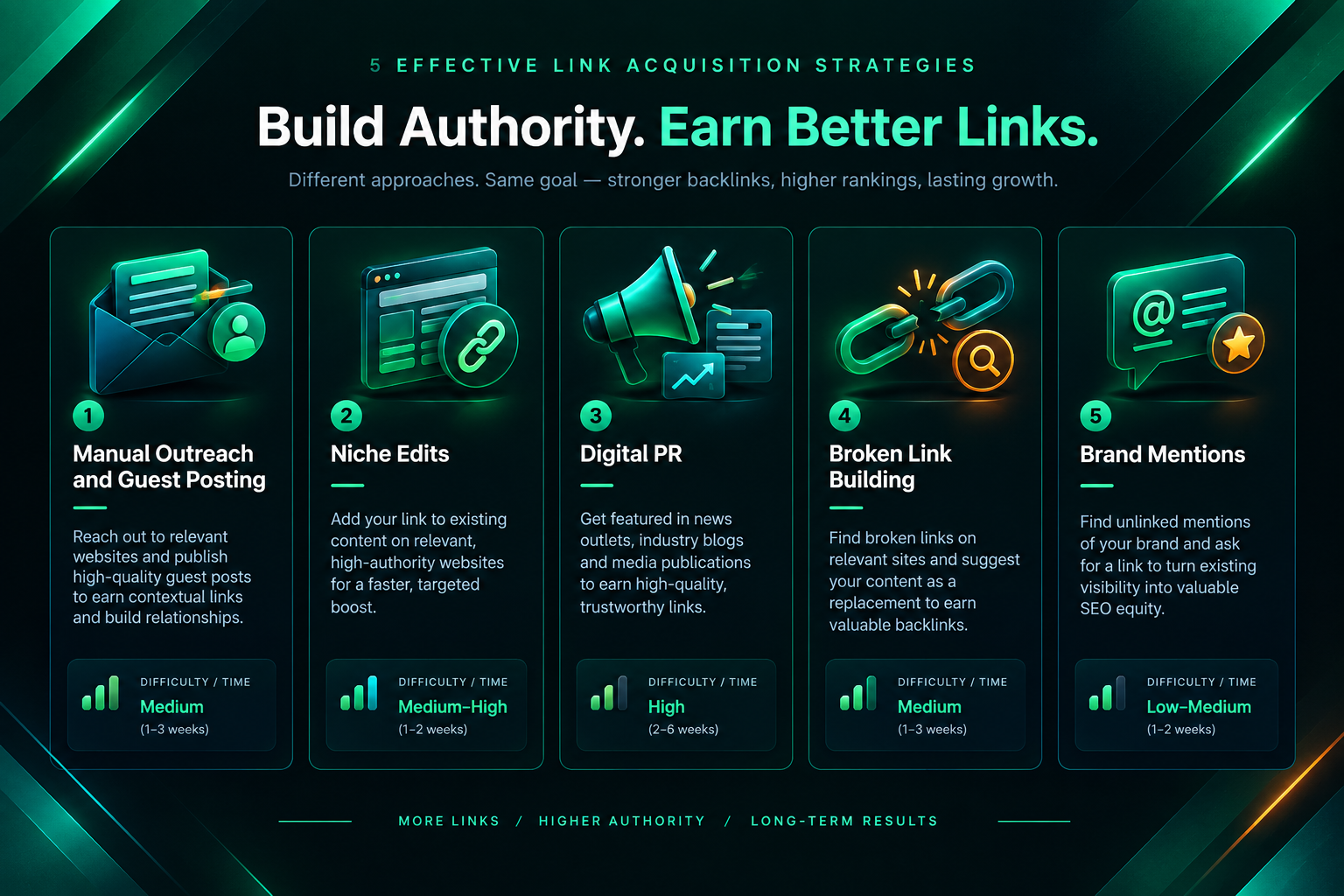
Manual Outreach and Guest Posting
Manual outreach involves identifying relevant, quality websites and pitching original content or collaboration opportunities. Guest posting — contributing an original article to a third-party publication — is one of the most widely used forms of editorial link acquisition. When done with genuine attention to content quality and publisher relevance, guest posting can produce links that are embedded in editorial content on topically relevant sites. The process requires time and a clear understanding of what publishers in a given niche are likely to accept. Delivery timelines vary, and not every outreach campaign produces placements at the expected rate.
Niche Edits and Link Insertions
A niche edit involves adding a link to an existing published article on a third-party site, rather than creating new content. When the existing article is relevant and the link adds genuine value for readers, this approach can produce contextually placed backlinks. The editorial standards applied by the publisher and the relevance of the surrounding content are important quality factors. As with guest posting, the acquisition process typically involves outreach and negotiation, and outcomes depend on the publisher’s willingness to make editorial changes.
Digital PR and Linkable Asset Creation
Digital PR focuses on earning links through newsworthy content, original research, data studies, or creative campaigns that journalists and publishers want to reference. This approach can produce links from high-authority news and media sites that are difficult to acquire through direct outreach. It requires investment in content creation and PR distribution, and results are less predictable than outreach-based methods. However, the links earned tend to have strong editorial rationale and are less likely to be associated with manipulative practices.
Resource Page and Broken Link Building
Resource page link building involves identifying pages on relevant sites that curate useful links for their audience, then requesting inclusion of a genuinely useful resource. Broken link building involves finding broken outbound links on relevant pages and suggesting a working replacement from your own site. Both methods require research and outreach effort, and success rates vary by niche and the quality of the resource being promoted.
Unlinked Brand Mentions
When a site mentions your brand, product, or content without linking to it, outreach requesting a link conversion can be effective. The editorial rationale already exists — the mention demonstrates that the publisher considers your brand worth referencing — and the conversion request is often straightforward. This approach works best for brands with meaningful existing online visibility.
Assessing Your Backlink Profile Before Choosing a Strategy
Before deciding whether to pursue link exchanges, alternative acquisition strategies, or a combination of approaches, a review of the existing backlink profile is a useful starting point. Tools such as Ahrefs, Semrush, and Majestic can provide data on referring domains, anchor text distribution, link types, and the proportion of reciprocal links already present. Google Search Console provides data on links Google has identified to your site, though it does not show all backlinks or their quality assessments.
A backlink profile review can reveal whether a site already has a high proportion of reciprocal links, whether there are toxic or spammy links that may be affecting performance, and whether the existing profile is diverse enough to support additional link acquisition without raising manipulation signals. Low organic visibility may have causes unrelated to the backlink profile — including crawling or indexing issues, content quality problems, search intent mismatches, or strong competition — and link building of any kind is unlikely to resolve those underlying issues on its own.
For sites with existing manual actions related to link spam, addressing those issues through the disavow process and a reconsideration request is generally a prerequisite before pursuing new link acquisition campaigns.
Frequently Asked Questions
Are link exchanges against Google’s guidelines?
Google’s spam policies explicitly list “excessive link exchanges” as an example of link spam. Occasional, editorially relevant reciprocal links between genuinely related sites are generally considered lower risk, but systematic link trading programmes designed primarily to manipulate rankings are likely to be treated as policy violations. The distinction between acceptable and excessive is not defined by a fixed number and depends on context, scale, and intent.
Can a link exchange help my rankings?
It may, depending on the quality and relevance of the sites involved and whether the links are assessed as editorial by search engine algorithms. However, links that are identified as part of a reciprocal scheme may be algorithmically devalued, meaning they provide little or no ranking benefit. Results vary considerably and cannot be guaranteed.
What is the difference between a reciprocal link and a three-way link exchange?
A reciprocal link is a direct mutual arrangement: Site A links to Site B and Site B links to Site A. A three-way or triangular exchange adds a third site to obscure the reciprocal nature: Site A links to Site B, Site B links to Site C, and Site C links to Site A. Google’s spam policies specifically reference both types as examples of link schemes.
How can I tell if my site has too many reciprocal links?
Backlink analysis tools such as Ahrefs, Semrush, or Majestic can help identify the proportion of reciprocal links in your backlink profile. There is no universally agreed threshold, but a profile where reciprocal links represent a large share of referring domains, particularly if those links are on low-quality or irrelevant sites, may warrant review. A qualified SEO professional can assess whether the profile presents a meaningful risk.
Is it safe to accept a link exchange request from another website?
The risk depends on the quality and relevance of the requesting site, the context in which the link would be placed, and how frequently you participate in such arrangements. Accepting a single, relevant, editorially placed link from a quality site in your niche is generally lower risk than participating in a systematic programme. Unsolicited link exchange requests, particularly those sent via template outreach, often come from sites with low editorial standards and are worth approaching with caution.
Do link exchanges work for local SEO?
Local link building often benefits from links from locally relevant sources such as business directories, local news sites, chambers of commerce, and community organisations. Reciprocal links between local businesses may have some relevance if the sites are genuinely related, but the same risk considerations apply. Local SEO outcomes depend on a range of factors beyond backlinks, including Google Business Profile optimisation, citation consistency, and on-page relevance signals.
What should I look for when evaluating a link exchange proposal?
Relevant factors include the topical relevance of the proposing site to your own, the quality and editorial standards of their content, the organic traffic and authority metrics of the site (while recognising these are third-party estimates, not Google metrics), where the link would be placed within their site, and whether the arrangement would be part of a broader systematic programme or an isolated, relationship-based exchange.
Deciding Whether a Link Exchange Fits Your Strategy
Link exchanges occupy an ambiguous position in modern SEO. They are not universally prohibited, but systematic use of them carries meaningful risks that have increased as search engine algorithms have become more sophisticated at identifying manipulative link patterns. For most businesses and SEO teams focused on building a durable, policy-compliant backlink profile, the effort required to manage link exchange programmes may be better directed toward acquisition strategies with a clearer editorial rationale.
That said, the right approach depends on your specific situation: your existing backlink profile, the competitive landscape in your niche, your content quality, your available resources, and your business goals. A site with a diverse, editorially earned backlink profile that occasionally receives a relevant reciprocal link is in a different position from a site that relies on link trading as its primary acquisition method.
If you are evaluating link building options and want to understand which strategies may be appropriate for your site’s current profile and goals, a conversation with an experienced link building specialist — one who will assess your situation before recommending an approach — is a more reliable starting point than any general rule about link exchanges. The most effective link acquisition strategies tend to be those tailored to a specific site’s needs rather than applied uniformly across all situations.