Supplier websites are an often-overlooked source of relevant, editorially placed backlinks for businesses that already have an established commercial relationship with a manufacturer, distributor, or wholesale partner. Because the link originates from a site with a genuine business connection to yours, it can carry stronger topical relevance than a link acquired through cold outreach to an unrelated publisher. This article explains how to approach supplier link acquisition, what quality factors to assess, what realistic outcomes look like, and where the strategy has meaningful limitations.
Key Takeaways
- Supplier backlinks are most valuable when they come from editorially placed, contextually relevant pages on websites with genuine organic visibility and a clean backlink profile.
- The most reliable acquisition method is a direct, relationship-based outreach request supported by a clear reason for the supplier to link to you, such as a dealer locator, case study, or product review page.
- Supplier link campaigns work best as one component of a broader link building strategy rather than a standalone tactic, because the number of eligible suppliers is finite.
- Quality assessment matters more than volume: a small number of well-placed links from authoritative supplier domains can be more useful than many links from low-traffic, thin-content supplier pages.
- Results timelines vary considerably depending on your existing backlink profile, the authority of the supplier domains, and the competitive landscape of your target keywords.
Why Supplier Websites Are a Relevant Link Source
When a business stocks, resells, or integrates a supplier’s products or services, a natural editorial reason for a link already exists. Supplier websites frequently maintain dealer directories, authorised reseller pages, partner showcases, or case study sections that reference their customers by name. These pages are created for legitimate commercial and informational purposes, which means a link placed on them is editorially motivated rather than purely transactional. From a search-engine perspective, links that exist because of a genuine relationship and serve a real user purpose are generally considered more credible than links placed solely for SEO benefit.
The topical relevance of a supplier link is also worth noting. If your business sells industrial equipment and your supplier is a well-known manufacturer in that sector, a link from the manufacturer’s authorised dealer page connects two topically related entities. Topical relevance is one of the factors that can influence how a backlink is interpreted in the context of your overall link profile, though it is not the only factor and does not guarantee a ranking improvement on its own.
Supplier backlinks are also relatively accessible compared with cold editorial outreach, because the relationship foundation already exists. A supplier has a commercial incentive to help its resellers succeed, and featuring them on a dealer or partner page costs the supplier little effort. This makes the initial outreach conversation easier to open than a request to a publisher with whom you have no prior connection.
Types of Supplier Pages That Typically Link Out
Understanding which page types on a supplier’s website are most likely to include outbound links helps you target your outreach more precisely and frame your request in a way that fits the supplier’s existing content structure.
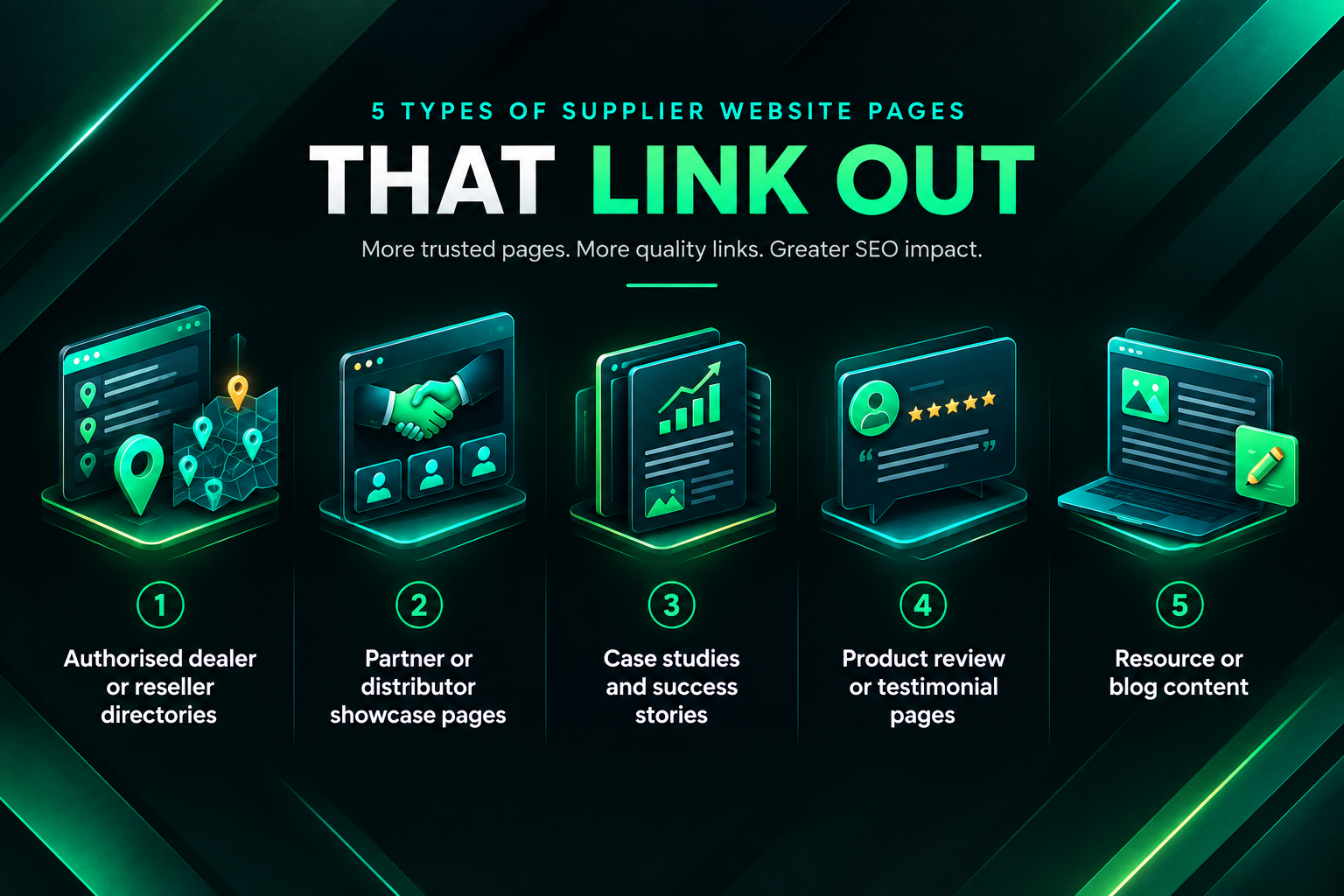
- Authorised dealer or reseller directories: Many manufacturers maintain a searchable or listed directory of businesses that stock their products. These pages often include the reseller’s name, location, and a link to their website. If your business is already listed without a link, requesting one is a straightforward ask.
- Partner or distributor showcase pages: Some suppliers feature selected partners in a more editorial format, including a short description of the partner’s business and a contextual link. These placements tend to carry more SEO value because the surrounding content is richer and more specific.
- Case studies and success stories: If your business has achieved a measurable outcome using a supplier’s product, a co-authored or supplier-published case study is one of the strongest link opportunities available. The page has genuine informational value, the link is contextually embedded, and the content is likely to attract its own inbound links over time.
- Product review or testimonial pages: Suppliers sometimes feature customer testimonials alongside a link to the customer’s website. These pages are less editorially rich but can still provide a relevant, followed link if the supplier’s domain has meaningful authority.
- Resource or blog content: If a supplier publishes educational content about their industry, there may be an opportunity to contribute a quote, data point, or short expert comment that earns a contextual mention and link within an article.
How to Approach Supplier Link Outreach
Supplier link outreach differs from cold editorial outreach in one important respect: the relationship already exists, so the conversation can begin from a position of mutual familiarity rather than a cold introduction. The goal is to make the request easy for the supplier to fulfil and to frame it in terms of benefit to both parties.
Start with an audit of your existing supplier relationships
Before sending any outreach, compile a list of every supplier, manufacturer, or wholesale partner your business works with. For each one, visit their website and check whether they have a dealer directory, partner page, case study section, or blog. Note whether your business is already listed and whether any existing listing includes a link to your website. This audit often reveals quick wins: businesses that are already listed on a supplier’s site but without a hyperlink can simply request that one be added, which requires minimal effort from the supplier.
Assess the quality of each supplier domain before prioritising outreach
Not every supplier website will be worth pursuing as a link source. A supplier with a low-traffic, thin-content website and a weak backlink profile is unlikely to provide a link that meaningfully contributes to your own authority signals. Before investing time in outreach, use an SEO tool such as Ahrefs, Semrush, or Moz to review each supplier domain’s estimated organic traffic, referring domain count, and the quality of its own inbound links. Prioritise suppliers whose websites attract genuine organic search traffic, have a reasonable number of referring domains from credible sources, and publish content that serves real users rather than existing purely for SEO purposes. Proprietary metrics such as Domain Rating (Ahrefs), Domain Authority (Moz), or Authority Score (Semrush) can be useful as a rough filter, but they are third-party estimates rather than Google-provided signals, and they should not be treated as guarantees of link value.
Craft a clear, specific outreach request
When you contact a supplier to request a link, be specific about what you are asking for and why it benefits them. A vague request to “add a link to our website” is less likely to succeed than a targeted message that references a specific page on their site, explains what your business does, and suggests the exact format of the listing or mention. If the supplier already has a dealer directory, point to it directly and ask to be included or to have your existing listing updated with a link. If you are proposing a case study, outline the story briefly and explain why their audience would find it useful. Suppliers are more likely to act on requests that require minimal decision-making on their part.
Offer something of value in return
Supplier link outreach is most effective when it is framed as a mutually beneficial arrangement rather than a one-sided SEO request. Consider what you can offer the supplier in exchange for the placement: a detailed case study that showcases their product, a testimonial they can use in their own marketing, a social media mention, or a reciprocal link from a relevant page on your own website. Reciprocal links between genuinely related businesses are not inherently problematic, but excessive reciprocal linking schemes that exist purely for SEO purposes can attract scrutiny, so this approach should be used selectively and only where a genuine editorial reason exists.
Assessing Backlink Quality from Supplier Websites
Earning a link from a supplier website is only useful if that link meets a reasonable quality threshold. Several factors influence whether a supplier backlink is likely to contribute positively to your link profile or have little measurable effect.
Page-level relevance and context
A link placed within a paragraph of relevant content on a topically appropriate page carries more contextual weight than a link buried in a footer, a generic links page, or a list of unrelated businesses. When evaluating a potential supplier link placement, consider whether the page it will appear on is genuinely relevant to your business and whether the surrounding content gives a search engine useful context about the nature of the link.
Link attributes
Check whether the supplier’s outbound links use the rel=”nofollow”, rel=”sponsored”, or rel=”ugc” attribute. A followed link from a supplier’s dealer directory or case study page is generally more useful for passing authority signals than a nofollow link, though nofollow links can still contribute referral traffic and brand visibility. If a supplier’s entire website uses nofollow on all outbound links, the SEO value of a placement there will be limited.
Organic visibility of the linking page
A link from a supplier page that itself receives organic search traffic is more likely to generate referral visits in addition to any authority signal it may pass. A page with no organic visibility and no inbound links of its own is less likely to contribute meaningfully to either metric. Where possible, prioritise placements on supplier pages that rank for relevant queries or attract traffic from other sources.
Backlink profile of the supplier domain
A supplier domain that has itself earned links from credible, relevant sources is generally a stronger link source than one with a sparse or low-quality backlink profile. Review the supplier’s referring domains using an SEO tool and look for signs of a natural, editorially earned link profile rather than one built through link schemes or low-quality directories.
Realistic Outcomes and Timelines
Supplier backlinks, like most link building tactics, do not produce immediate or guaranteed ranking improvements. Several factors influence whether and when a link from a supplier website contributes to measurable SEO outcomes.
After a link is placed on a supplier’s website, search engine crawlers need to discover and index it before it can influence your link profile. This process can take anywhere from a few days to several weeks depending on how frequently the supplier’s site is crawled. Once indexed, any authority signal the link passes will be incorporated into your overall backlink profile, but the effect on rankings depends on many other factors including the strength of your existing link profile, the quality and relevance of your on-page content, the competitiveness of your target keywords, and the technical health of your website.
For businesses with a relatively thin backlink profile competing in moderately competitive niches, a cluster of well-placed supplier links may contribute to a gradual improvement in rankings for relevant queries over a period of several months. For businesses in highly competitive markets, supplier links alone are unlikely to be sufficient and should be combined with other link acquisition methods such as manual outreach to editorial publishers, digital PR, or content-led link building. Results vary considerably depending on the website, market, and competitive landscape, and no specific outcome can be guaranteed from any link building activity.
It is also worth noting that supplier link campaigns have a natural ceiling. Most businesses work with a finite number of suppliers, and once you have secured links from the most relevant and authoritative ones, the tactic is largely exhausted. This makes supplier link building a useful component of a broader strategy rather than a scalable long-term channel on its own.
Risks and Limitations to Consider
Supplier link building is generally considered a lower-risk approach compared with tactics such as private blog network links or paid placements on unrelated websites, because the links originate from genuine business relationships and are placed on pages with a legitimate editorial purpose. However, some risks and limitations are worth understanding before committing to this approach.
- Link loss: Supplier websites are updated, redesigned, or restructured over time. A dealer directory that exists today may be removed or reorganised in a future website update, taking your link with it. Monitoring your backlink profile periodically using a tool such as Google Search Console or a third-party SEO platform can help you identify lost links and follow up with the supplier if appropriate.
- Low-quality supplier domains: Pursuing links from supplier websites with thin content, low organic visibility, or a poor backlink profile is unlikely to produce meaningful SEO benefit and may add noise to your link profile. Quality assessment before outreach is essential.
- Paid or incentivised links: If a supplier charges a fee for inclusion in their directory or partner page, the resulting link may be considered a paid link under Google’s spam policies. Paid links that pass PageRank without appropriate disclosure or a rel=”sponsored” attribute carry a risk of violating search-engine guidelines. This risk applies regardless of whether the payment is direct or takes the form of a significant non-monetary incentive. Assess each situation carefully and consider whether the placement is genuinely editorial or primarily commercial.
- Reciprocal linking at scale: A small number of reciprocal links between genuinely related businesses is unlikely to be problematic, but a systematic pattern of reciprocal link exchanges across many domains can attract scrutiny. Keep reciprocal arrangements selective and editorially justified.
- Limited scalability: As noted above, the number of eligible supplier domains is finite for most businesses. Supplier link building cannot replace a scalable outreach programme for businesses that need to build a large number of referring domains over time.
When Supplier Link Building May Be a Good Fit
Supplier link acquisition tends to be most suitable for businesses that meet several conditions. Retailers, distributors, and resellers that work with well-known manufacturers in their sector are often the best candidates, because their suppliers are more likely to have authoritative websites with established dealer or partner pages. Businesses in industries such as manufacturing, construction, automotive, technology hardware, and specialist retail frequently find that their supplier ecosystem includes several domains with meaningful organic visibility and credible backlink profiles.
The strategy is also well suited to businesses that are in the early stages of building their backlink profile and want to secure a foundation of relevant, relationship-based links before investing in broader outreach campaigns. Because the outreach conversation starts from an existing relationship, the barrier to securing a placement is lower than with cold editorial outreach, making it a practical starting point for businesses with limited link building experience or resources.
Businesses that have already exhausted their supplier link opportunities and are looking to scale their referring domain count will need to complement this approach with other tactics. Manual outreach to editorial publishers, guest posting on relevant industry websites, digital PR campaigns, and resource-based link building are all methods that can extend reach beyond the supplier ecosystem.
Integrating Supplier Links into a Broader Link Building Strategy
Supplier backlinks are most effective when they form part of a diversified link acquisition strategy rather than the sole focus of a campaign. A healthy backlink profile typically includes links from a range of source types: editorial mentions in industry publications, guest posts on relevant websites, digital PR placements, resource links, and relationship-based links such as those from suppliers and partners. Relying exclusively on any single link type can create an unnatural-looking profile and limits the total number of referring domains you can realistically acquire.
When planning a link building campaign that includes supplier outreach, consider sequencing it alongside other acquisition methods. Supplier links can be pursued in parallel with editorial outreach, or they can serve as a first phase that establishes a baseline of relevant referring domains before a more resource-intensive outreach programme begins. The right sequencing depends on your current backlink profile, your target pages, your competitive landscape, and the resources available for outreach and content creation.
For businesses working with an outsourced link building provider or SEO agency, supplier link acquisition can be incorporated into a managed campaign alongside other outreach methods. A provider with experience in relationship-based outreach can help identify the highest-priority supplier domains, craft outreach messaging, manage follow-up communication, and monitor placement quality. This can reduce the internal workload for businesses that lack the time or expertise to manage outreach independently, though the business itself will typically need to provide information about its supplier relationships and approve outreach messaging before it is sent.
Frequently Asked Questions
Are supplier backlinks considered white-hat by search engines?
Links placed on supplier websites for genuine editorial reasons, such as a dealer directory or a co-authored case study, are generally consistent with the principle that links should reflect a real relationship and serve a user purpose. However, if a supplier charges a fee for inclusion and the link passes PageRank without a rel=”sponsored” attribute, it may conflict with Google’s link spam policies. Each placement should be assessed individually rather than assumed to be automatically compliant.
How many supplier backlinks do I need to see a ranking improvement?
There is no fixed number of supplier links that guarantees a ranking change. The effect depends on the authority and relevance of the linking domains, the competitiveness of your target keywords, the quality of your on-page content, and the overall strength of your existing backlink profile. A site-specific assessment is more useful than a universal link count target.
What if my supplier doesn’t have a dealer or partner page?
If a supplier does not currently have a page that lists their resellers or partners, you can propose one. Frame the suggestion as a resource that helps their customers find local stockists or authorised service providers. Some suppliers will be receptive to this, particularly if you can demonstrate that similar manufacturers in their sector already use this format. Alternatively, a case study or testimonial page is often easier for a supplier to create than a full directory.
Should I link back to my supplier in exchange for a link from them?
A reciprocal link between two genuinely related businesses is not inherently problematic. If your website already links to your supplier’s product pages or brand information for legitimate user-facing reasons, pointing this out during outreach can strengthen your case. However, creating a new link to a supplier purely to secure a link in return, with no editorial justification, is a form of link exchange that search engines may discount or view negatively if it forms a pattern across many domains.
How long does it take to secure a link from a supplier website?
Timelines vary considerably. Some suppliers respond quickly and can add or update a listing within days. Others have internal approval processes, website update schedules, or limited web management resources that extend the timeline to several weeks or months. Following up politely after an initial request is usually necessary, and it is reasonable to allow four to eight weeks before concluding that a particular supplier is unlikely to respond.
Can I outsource supplier link outreach to an agency?
Yes. An experienced link building agency or outsourced provider can manage the outreach process on your behalf, including identifying eligible supplier domains, drafting and sending outreach messages, following up, and reporting on placements secured. You will typically need to provide a list of your supplier relationships and approve the outreach approach before the campaign begins. The agency cannot guarantee that every supplier will agree to link, and the quality of placements will depend on the authority and structure of the supplier websites involved.
Is a Supplier Link Building Strategy Worth Pursuing for Your Business?
Supplier backlinks represent a practical, relationship-grounded link acquisition opportunity for businesses that work with manufacturers, distributors, or wholesale partners whose websites carry genuine authority and organic visibility. The strategy is accessible, editorially motivated, and topically relevant in a way that cold outreach to unrelated publishers often is not. For businesses in the early stages of building a backlink profile, or those looking to supplement an existing campaign with a targeted batch of relevant links, supplier outreach is a reasonable place to invest time and effort.
The limitations are real and worth planning around. The pool of eligible suppliers is finite, quality varies significantly across supplier domains, and the tactic alone is unlikely to be sufficient for businesses competing in highly contested search markets. A thorough quality assessment before outreach, realistic expectations about timelines and outcomes, and integration with other link acquisition methods will give this approach the best chance of contributing meaningfully to your SEO goals.
If you are considering whether supplier link building fits your current situation, a review of your existing backlink profile, your supplier ecosystem, and your competitive landscape is a useful starting point. An SEO professional or outsourced link building provider with experience in relationship-based outreach can help you assess which supplier domains are worth prioritising and how this tactic might complement the rest of your link acquisition strategy.