Expired domain abuse is a link building and site-creation practice that Google has explicitly identified as a spam policy violation. It involves acquiring domains that have lapsed in registration, then exploiting their existing backlink profiles or historical authority to manipulate search rankings. Understanding what expired domain abuse is, how it differs from legitimate domain acquisition, and why search engines treat it as a risk helps business owners, in-house SEO teams, and agency decision-makers make better-informed decisions about their link acquisition strategies.
Key Takeaways
- Expired domain abuse refers to acquiring lapsed domains specifically to exploit their historical backlink equity for ranking manipulation, which Google classifies as a link spam violation.
- Not every use of an expired domain is abusive; the intent, implementation, and resulting user experience are central to how search engines assess the practice.
- Google’s March 2024 spam update explicitly named expired domain abuse as a targeted behaviour, increasing the risk of manual actions or algorithmic demotions for sites using these tactics.
- Legitimate link building strategies that earn editorial placements on live, relevant, high-quality websites carry significantly lower policy risk than expired domain schemes.
- If your backlink profile includes links from sites built on recycled expired domains, a professional backlink audit may help identify and address potential risk.
What Is Expired Domain Abuse?
Expired domain abuse occurs when someone purchases a domain that has lapsed — meaning the previous owner did not renew the registration — and then repurposes it in a way designed to pass historical link equity to another website rather than to serve genuine users. The abusive element is not the act of buying an expired domain itself, but the intent and execution: using the domain’s inherited backlink profile to manipulate search engine rankings without providing real value to visitors.
Google’s spam policies describe expired domain abuse as a specific form of link spam. The practice typically takes one of several forms. A registrant might redirect the expired domain directly to a target site, attempting to funnel whatever PageRank or authority the old domain accumulated. Alternatively, they might rebuild a thin or low-quality website on the expired domain, populate it with AI-generated or scraped content, and then place links pointing to the site they want to rank. In more elaborate schemes, networks of expired domains are assembled into private blog networks (PBNs), each hosting superficially different content but all ultimately serving the same link-passing function.
The defining characteristic of expired domain abuse is that the domain’s value to the scheme comes entirely from its past — its historical backlinks, its indexed pages, or its cached authority signals — rather than from any genuine editorial merit or audience it currently serves.
How Expired Domain Abuse Works in Practice
To understand why this practice is considered manipulative, it helps to understand what happens when a domain expires. When a website owner stops renewing a domain, the domain eventually becomes available for public registration again. During its active life, that domain may have accumulated backlinks from other websites, earned topical relevance signals, and built a crawl history with search engines. These accumulated signals do not immediately disappear when the domain lapses.
Practitioners of expired domain abuse use tools — including commercial backlink analysis platforms such as Ahrefs, Semrush, and Majestic — to identify expired domains with strong referring domain profiles, high historical traffic estimates, or favourable authority metrics. They then register those domains and attempt to inherit the link equity the previous site earned legitimately over years of genuine publishing.
The most common implementation methods include:
- 301 redirects: The expired domain is redirected to a target website, with the intention of passing link signals to the destination.
- Thin content rebuilds: A new site is built on the expired domain with minimal or low-quality content, primarily to host outbound links to target pages.
- PBN integration: Multiple expired domains are assembled into a private blog network, each hosting content that links to a central money site.
- Parasite hosting: The expired domain’s existing indexed pages are partially restored or mimicked to preserve the appearance of an established site while inserting new links.
In each case, the links produced are not earned through editorial merit. No publisher independently decided that the target page deserved a citation. The link exists because someone paid for a domain and engineered a placement — which is precisely what Google’s link spam policies are designed to detect and discount.
Google’s Position on Expired Domain Abuse
Google’s spam policies explicitly list expired domain abuse as a violation. The March 2024 spam update, which Google announced publicly, named expired domain abuse alongside scaled content abuse and site reputation abuse as three priority targets. This update represented a significant escalation in how formally Google categorised the practice, moving it from an implied violation under general link spam guidance to a named, documented policy breach.
Google’s documentation describes expired domain abuse as purchasing expired domains and using them primarily to manipulate search rankings, particularly by hosting low-quality or thin content designed to pass signals to another site. The guidance makes clear that the problem is not domain acquisition itself but the intent to manipulate rather than to serve users.
Sites found to be engaging in expired domain abuse may be subject to manual actions — human-reviewed penalties applied by Google’s spam team — or to algorithmic demotions that reduce the value of links from such domains. In some cases, the expired domain itself may be deindexed or have its link signals discounted entirely, meaning the investment in acquiring and building on the domain produces no lasting SEO benefit and may actively harm the target site’s standing.
It is worth noting that Google’s ability to detect these schemes has improved considerably. Machine learning systems trained on link graph patterns, content quality signals, and domain history data make it increasingly difficult to operate expired domain networks at scale without detection. The risk profile of these tactics has risen substantially compared to earlier periods when such schemes were more reliably effective.
Expired Domain Abuse vs Legitimate Domain Acquisition
Not every purchase of an expired domain constitutes abuse. The distinction matters for businesses that may legitimately acquire a lapsed domain for genuine purposes — for example, reclaiming a previously owned brand domain, acquiring a domain to build a real business on, or purchasing a domain with genuine topical relevance to redirect to a closely related existing site.
Google’s guidance acknowledges this distinction. The key factors that differentiate legitimate acquisition from abuse include:
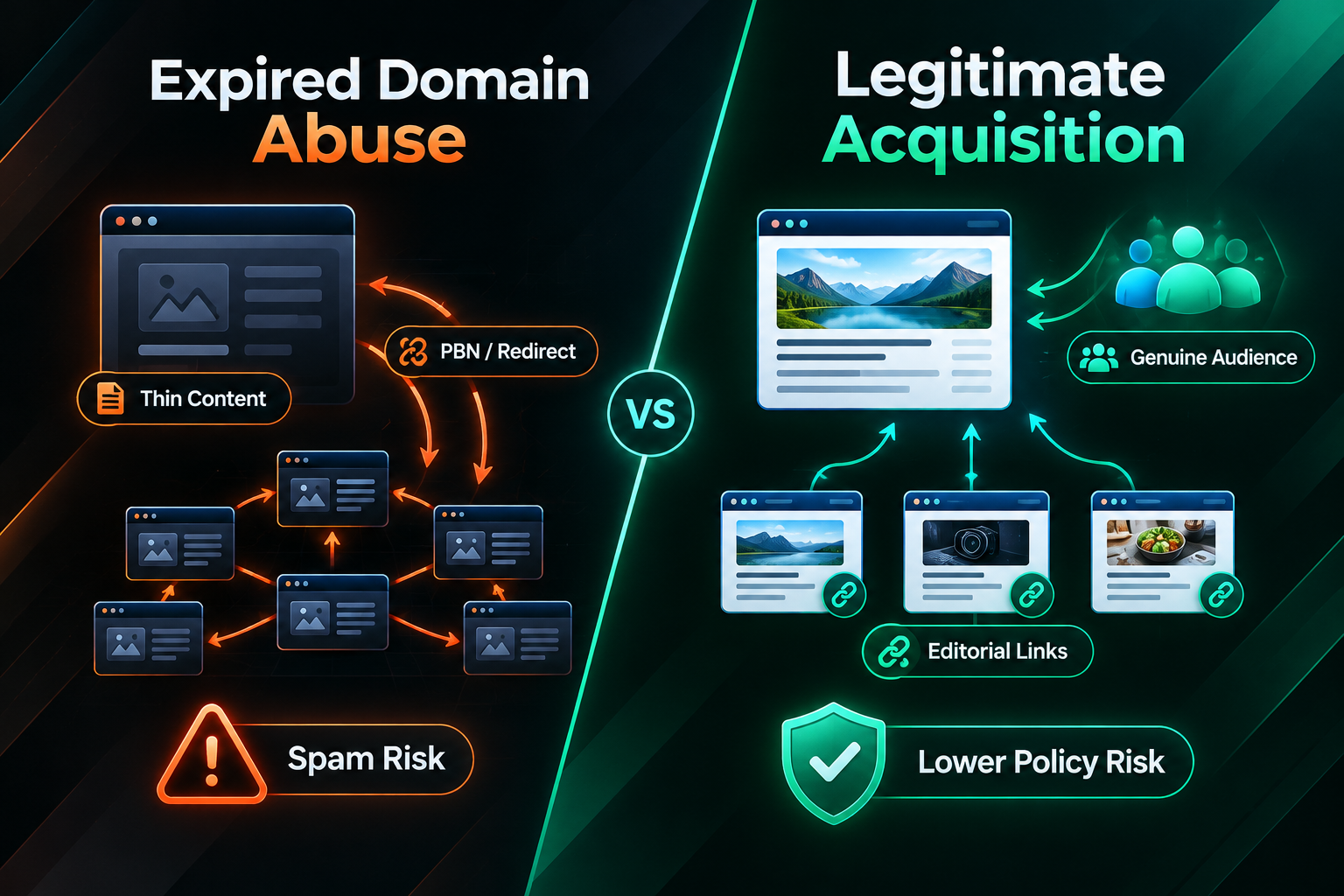
- User value: Does the domain serve a genuine audience with useful, original content, or does it exist primarily to pass link signals?
- Content quality: Is the content on the rebuilt domain substantive and independently valuable, or is it thin, AI-generated, or scraped to fill pages?
- Topical continuity: Is the new use of the domain genuinely related to its historical purpose, or is the domain’s past identity being exploited for unrelated ranking goals?
- Redirect intent: If the domain is redirected, does the destination page represent a natural continuation of what the expired domain offered users, or is the redirect purely a link-passing mechanism?
A business that acquires an expired domain in its own niche, builds a genuinely useful website on it, and earns new backlinks through original content and outreach is not engaging in expired domain abuse. The abuse arises when the historical backlink profile is the primary asset being exploited and no real user value is created.
Why Expired Domain Schemes Remain Attractive Despite the Risks
Despite the policy risks, expired domain tactics continue to be used because they can appear to produce short-term ranking improvements. A domain with hundreds of referring domains pointing to it may temporarily pass signals that lift a target page in search results, particularly in less competitive niches or before Google’s systems have fully assessed the domain’s new use.
The commercial infrastructure supporting these tactics is also well-developed. Domain auction platforms, expired domain discovery tools, and PBN management services make it relatively straightforward to assemble a network of lapsed domains. This accessibility lowers the barrier to entry and means that some practitioners continue to use these methods despite the documented risks.
However, the economics of expired domain schemes have shifted. As Google’s detection improves and manual action rates for link spam increase, the window during which these tactics produce measurable benefit has shortened. The cost of acquiring quality expired domains with strong backlink profiles has also risen as demand from practitioners has increased, compressing the return on investment further. For most businesses, the combination of upfront cost, ongoing maintenance, and escalating detection risk makes expired domain schemes a poor long-term investment compared to sustainable link acquisition methods.
Risks to Your Website from Expired Domain Links
Expired domain abuse creates risk not only for the operators of the schemes but potentially for the websites receiving links from them. If your site’s backlink profile contains a significant volume of links from domains that Google has identified or subsequently identifies as part of an expired domain scheme, those links may be discounted algorithmically or flagged during a manual review.
This risk is particularly relevant for businesses that have previously used link building services without carefully vetting the acquisition methods used. Some lower-cost link building providers use expired domain networks or PBNs as part of their delivery, often without disclosing this to clients. The links may appear in reports as placements on named websites, but the underlying domains may have been acquired specifically to serve as link-passing vehicles.
Signs that links in your profile may originate from expired domain schemes include:
- Referring domains with strong historical metrics but thin, generic, or recently published content that does not match the domain’s apparent history.
- Sites with large numbers of outbound links across unrelated niches, suggesting a link-selling or link-network function.
- Domains whose WHOIS registration date is recent but whose backlink profile suggests years of prior activity under different ownership.
- Content that appears AI-generated, scraped, or templated, with no identifiable editorial team or genuine publishing history.
If you suspect your backlink profile contains links from expired domain networks, a professional backlink audit using tools such as Google Search Console, Ahrefs, or Semrush can help identify patterns. Depending on the volume and nature of the links, options may include disavowing specific domains or working with an SEO professional to assess the overall risk to your site.
How Legitimate Link Building Differs
Understanding expired domain abuse helps clarify what legitimate, sustainable link building actually involves. Editorial link acquisition — whether through manual outreach, guest posting on genuine publisher websites, digital PR, or niche edits on established sites — differs from expired domain schemes in several fundamental ways.
In legitimate outreach-based link building, a real publisher with an existing audience independently decides to include a link to your content because it adds value to their readers. The publisher’s website has a genuine editorial history, a real content team, and an audience that visits for reasons unrelated to your link. The link exists because your content earned it, not because someone purchased a domain and engineered a placement.
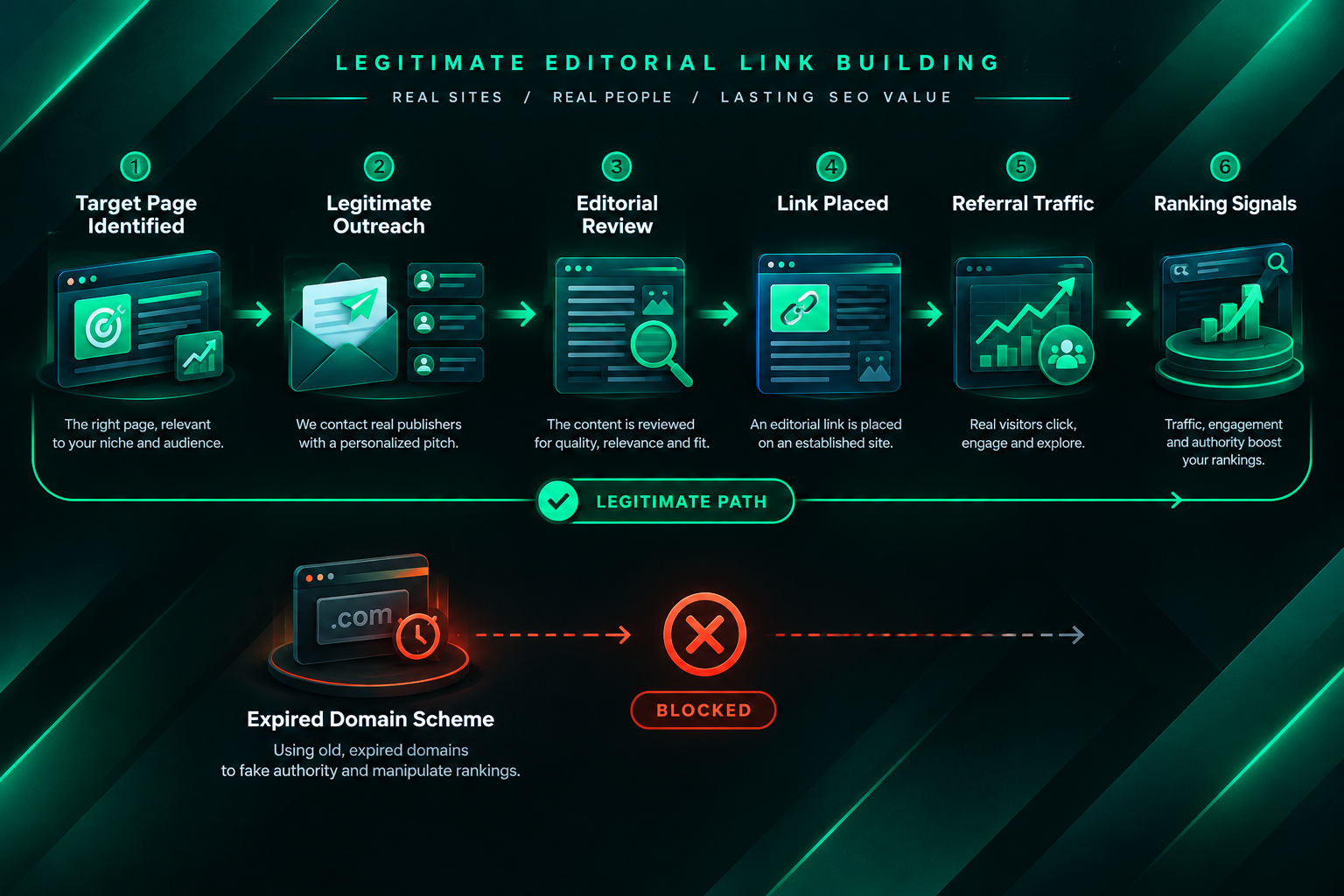
This distinction matters for long-term SEO stability. Links earned through genuine editorial processes are less likely to be discounted or penalised as Google’s spam detection evolves, because they reflect real signals of relevance and authority rather than manufactured ones. They also tend to generate referral traffic from engaged readers, which provides value independent of any ranking effect.
Manual outreach campaigns targeting relevant, established websites in your industry — where a qualified outreach team identifies suitable publishers, pitches genuinely useful content, and secures placements that serve both the publisher’s audience and your SEO goals — represent the approach most clearly aligned with how search engines intend link signals to work. This is more resource-intensive than buying expired domains, but the resulting links carry lower policy risk and are more likely to retain their value as search engine algorithms continue to develop.
What to Ask a Link Building Provider
If you are working with or considering a link building agency or freelancer, understanding their acquisition methods is essential for managing risk. Providers who use expired domain networks or PBNs may not volunteer this information, so asking directly is important.
Useful questions to ask include:
- How do you acquire placements — through direct outreach to publishers, or through a network of sites you own or manage?
- Can you provide the URLs of example placements so I can review the sites independently?
- Do any of the sites in your network use expired or recycled domains?
- How do you assess publisher quality before securing a placement?
- What happens if a link is removed or if a placement site is penalised?
- Are placements disclosed as sponsored or paid where required?
A provider who is transparent about their methods, willing to share example placements, and able to explain their publisher vetting process is more likely to be operating within sustainable, lower-risk practices. Providers who are evasive about acquisition methods or who offer unusually low prices for high volumes of links warrant additional scrutiny.
Frequently Asked Questions
Is buying an expired domain always against Google’s policies?
No. Purchasing an expired domain is not inherently a policy violation. The abuse arises when the domain is used primarily to exploit its historical backlink profile for ranking manipulation rather than to serve genuine users with quality content. Legitimate uses — such as rebuilding a real business on a relevant domain or reclaiming a previously owned brand domain — are not classified as abuse provided the resulting site offers genuine value.
Can Google detect expired domain schemes?
Google has stated that its systems are designed to detect and discount links from sites that exist primarily to manipulate rankings, including those built on expired domains. The March 2024 spam update specifically targeted expired domain abuse, and Google’s machine learning systems analyse link graph patterns, content quality, and domain history signals. Detection is not guaranteed in every case, but the risk of algorithmic demotion or manual action has increased significantly.
What should I do if my backlink profile contains links from expired domain networks?
A professional backlink audit is the appropriate first step. Using tools such as Google Search Console, Ahrefs, or Semrush, an SEO professional can identify patterns consistent with expired domain schemes and assess the potential risk to your site. Depending on the findings, options may include disavowing specific domains through Google Search Console or focusing future link acquisition on higher-quality editorial sources to improve the overall profile.
How does expired domain abuse differ from a private blog network (PBN)?
Expired domain abuse and PBNs are closely related. A PBN is a network of websites controlled by a single operator and used to generate links to a target site. Many PBNs are built specifically on expired domains, making expired domain abuse a common method of constructing and operating a PBN. The terms are sometimes used interchangeably, though expired domain abuse can also refer to single-domain redirects or thin rebuilds that are not part of a larger network.
Are there legitimate SEO uses for expired domains?
Yes. Acquiring an expired domain to rebuild a genuine, content-rich website in a relevant niche, or to redirect to a closely related existing site where the redirect serves users logically, can be legitimate. The key test is whether the domain’s new use creates real value for visitors or whether it exists primarily to pass historical link signals to another site. When in doubt, consulting an SEO professional before investing in an expired domain acquisition is advisable.
Does disavowing links from expired domain networks protect my site?
Disavowing links through Google Search Console instructs Google to ignore specific links when assessing your site. It may reduce risk from low-quality or manipulative links in your profile, but it is not a guaranteed remedy and should be used carefully. Disavowing legitimate links can be counterproductive. A professional audit to distinguish genuinely harmful links from lower-quality but non-abusive ones is recommended before submitting a disavow file.
Assessing Your Link Building Strategy in Light of Expired Domain Risks
Expired domain abuse sits at the higher-risk end of the link acquisition spectrum, and Google’s increasing focus on it as a named spam category makes it a meaningful consideration for any business investing in SEO. The practice may produce short-term visibility gains in some cases, but the combination of policy risk, improving detection, and the potential for manual actions makes it a poor foundation for sustainable organic growth.
For businesses evaluating their link building approach, the practical implication is straightforward: understanding how your links are acquired matters as much as how many links you have. A smaller number of editorially earned placements on genuine, relevant, established websites is likely to provide more durable SEO value than a larger volume of links from sites built on recycled expired domains.
If you are unsure whether your current backlink profile or your provider’s acquisition methods carry expired domain risk, a professional audit and a conversation with a qualified link building specialist can help you assess your position and identify a path forward that aligns with both your ranking goals and your risk tolerance.