HTML comments are a standard part of web development, used by developers to annotate code, temporarily disable markup, or leave notes for colleagues. Occasionally, links end up inside these comments — either intentionally or by accident. If you have encountered a backlink pointing to your site that appears to be wrapped in an HTML comment, or if you are wondering whether hiding links inside comments could serve any SEO purpose, the short answer is that commented-out links are not treated as functional hyperlinks by search engines and do not pass link equity in the way that standard anchor tags do. The longer answer involves understanding how browsers and crawlers process HTML, why this matters for link building strategy, and what risks arise when links are deliberately placed inside comments.
Key Takeaways
- Links placed inside HTML comments are not rendered as clickable hyperlinks by browsers, and Google’s documentation and publicly available crawler behaviour indicate that such links are not followed or credited as standard backlinks.
- Commented-out links do not pass PageRank or link equity in the way that a properly marked-up anchor tag does, making them ineffective as a link building tactic.
- Deliberately inserting links inside HTML comments to manipulate rankings would likely be considered a low-quality or manipulative practice under Google’s spam policies, with no offsetting SEO benefit.
- If a legitimate backlink to your site appears to be inside a comment, it is worth verifying the actual rendered HTML, as crawlers and link analysis tools sometimes misread page structure.
- Effective link building relies on editorially placed, properly marked-up anchor tags on relevant, quality pages — not on technical workarounds that search engines are designed to ignore.
What Are HTML Comments and How Do They Work?
An HTML comment is a piece of code enclosed between <!-- and --> delimiters. Browsers parse HTML comments and deliberately exclude their contents from the rendered page. A user visiting a webpage will not see the text or links inside a comment unless they inspect the page source directly. Comments are widely used in web development for documentation, version notes, and temporarily disabling sections of code without deleting them.
Because the browser does not render the content of an HTML comment, any anchor tag placed inside a comment is not presented to the user as a clickable link. The hyperlink reference attribute and the anchor text exist only in the raw source code. This distinction — between what exists in source code and what is rendered and functional — is central to understanding how search engine crawlers evaluate links.
Search engine crawlers such as Googlebot fetch and parse HTML, but they are designed to evaluate the rendered state of a page, not simply its raw source. Google has publicly stated that Googlebot renders pages similarly to a modern browser, which means it processes the DOM (Document Object Model) as a browser would. Since browsers exclude HTML comment content from the DOM, a link inside a comment is not part of the functional page structure that a crawler would follow or credit.
Do Search Engines Follow or Credit Links Inside HTML Comments?
Based on publicly available information from Google and observable crawler behaviour, links placed inside HTML comments are not followed as standard hyperlinks and do not pass PageRank or link equity. Google’s John Mueller has addressed similar questions about non-rendered links on multiple occasions, consistently indicating that links which are not part of the rendered page are not treated as functional links for ranking purposes.
The mechanism is straightforward: for a link to be credited as a backlink, it generally needs to be a properly formed anchor element (<a href="...">) that is part of the rendered DOM, is not blocked by a nofollow attribute or robots directives, and is accessible to the crawler. A link inside an HTML comment fails the first condition — it is not part of the rendered DOM — so the subsequent conditions are irrelevant.
It is worth noting that different search engines may process HTML differently, and crawler behaviour can evolve. However, the consensus among SEO practitioners and the available technical evidence strongly supports the position that HTML comment links carry no link equity. Treating this as an established technical limitation rather than a guaranteed universal rule is the responsible approach, but no credible evidence suggests that commented-out links function as effective backlinks in any major search engine.
Some SEO tools that analyse raw HTML source rather than rendered output may occasionally report a link inside a comment as a detected backlink. This is a tool-level parsing artefact, not evidence that the search engine is crediting the link. If you encounter such a report in a tool like Ahrefs, Semrush, or Majestic, it is worth checking the actual page source and rendered output to confirm whether the link is genuinely commented out or whether the tool has misidentified the markup structure.
Why Someone Might Place Links Inside HTML Comments
There are a few scenarios in which links end up inside HTML comments, not all of them intentional or malicious.
Accidental or Legacy Code
Developers sometimes comment out sections of a page during a redesign or content update, inadvertently including links that were previously active. These links remain in the source code but are no longer functional. From an SEO perspective, any link equity those links previously passed is lost once they are commented out, and any external links pointing to the page are unaffected by internal comment structure.
Attempted Link Manipulation
Occasionally, individuals attempt to insert links inside HTML comments on third-party websites — for example, through comment fields, user-generated content areas, or compromised CMS installations — in the hope that crawlers will credit the link. This approach is ineffective for the technical reasons described above and would also constitute a manipulative link building practice under Google’s spam policies. Even if such links were somehow credited, the risk of a manual action or algorithmic penalty would far outweigh any theoretical benefit.
Misunderstanding of How Crawlers Work
Some older SEO advice, now thoroughly outdated, suggested that hiding links in various ways could pass equity without being visible to users. Search engines have long since addressed these techniques. Placing links in HTML comments, in white text on white backgrounds, or in other non-visible locations is the kind of cloaking or hidden-link practice that Google’s spam policies explicitly address. The technical ineffectiveness of HTML comment links makes this a moot point in practice, but it is worth understanding the policy context.
What This Means for Your Backlink Profile
If a link analysis tool reports that a referring domain has a link to your site inside an HTML comment, the practical implication is that this link is unlikely to be contributing to your backlink profile in any meaningful way. You do not need to disavow such links, as they are not passing equity. However, if you are auditing your backlink profile and notice a pattern of low-quality or suspicious link placements — including commented-out links — it may be worth investigating whether those domains are associated with a broader low-quality link building campaign that could include other, more impactful placements.
Backlink profile audits are most useful when they distinguish between links that are genuinely passing equity and those that are not. A link inside an HTML comment, a link on a page blocked by robots.txt, a link with a nofollow attribute, and a link on a page that is not indexed all have different implications for your profile. Treating all detected links as equivalent can lead to unnecessary disavow actions or misplaced concern about links that have no practical effect.
For businesses working with an outsourced link building provider or managing an in-house SEO campaign, understanding these distinctions helps you evaluate the quality and relevance of reported placements. A placement that appears in a link report but is inside an HTML comment is not a successful placement — it is either an error or a sign of low-quality work.
The Difference Between Rendered and Non-Rendered Links
Understanding the distinction between rendered and non-rendered links is useful beyond the specific case of HTML comments. Several types of links may appear in raw HTML source but not function as standard backlinks:
- Links inside HTML comments — not rendered by browsers or processed as functional links by crawlers.
- Links in
<noscript>tags — rendered only when JavaScript is disabled; crawler treatment may vary depending on the rendering environment. - Links in hidden elements — elements with
display: noneorvisibility: hiddenapplied via CSS; Google has indicated these may be treated with less weight or ignored. - Links blocked by robots.txt on the linking page — the crawler may not access the page at all, so the link is not discovered.
- Links on non-indexed pages — if the linking page is not indexed, the link’s equity contribution is uncertain and likely minimal.
- Links with
nofollow,ugc, orsponsoredattributes — Google treats these as hints rather than directives, but they generally reduce or eliminate PageRank transfer.
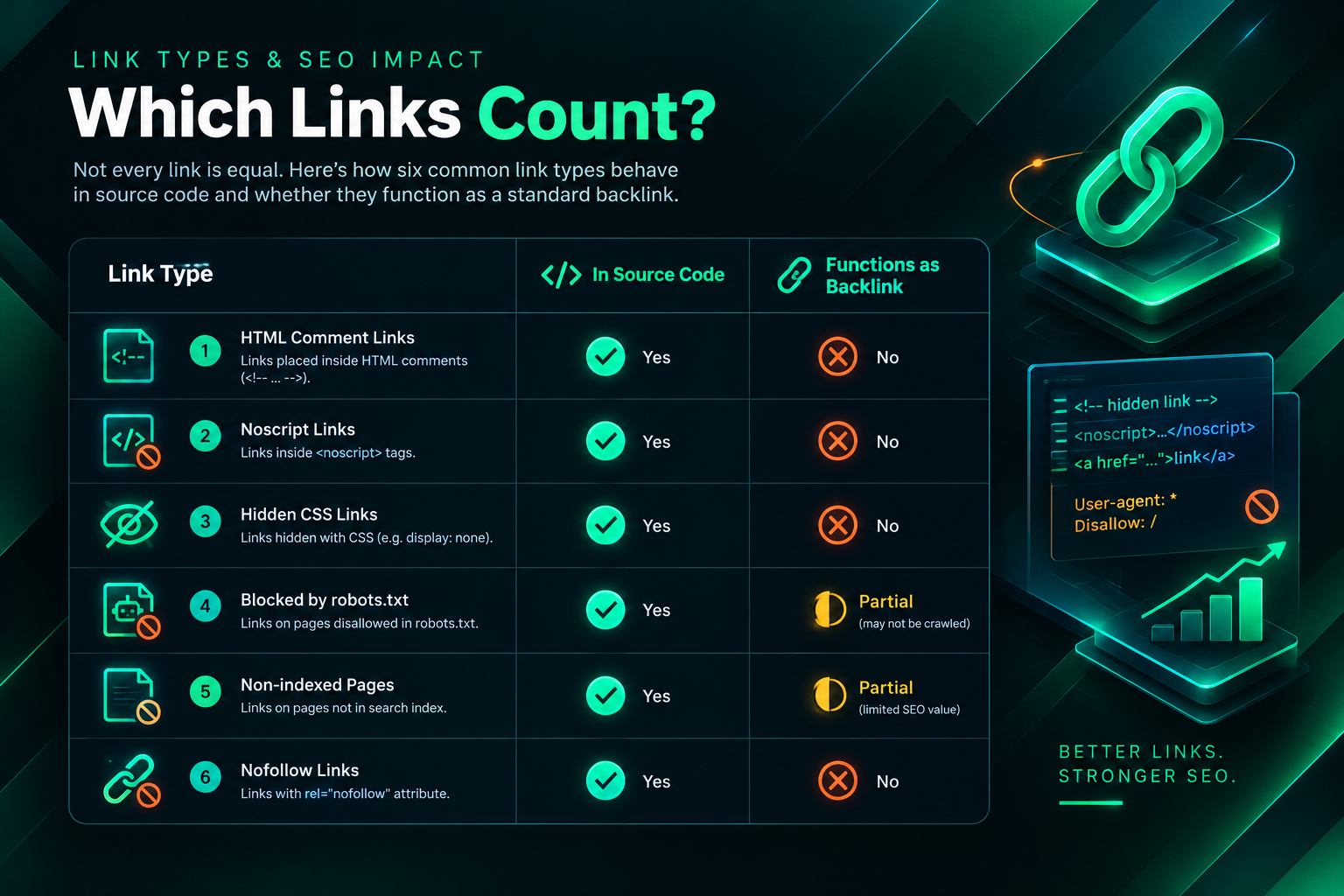
Each of these scenarios requires a different assessment. HTML comment links are among the clearest cases: the technical mechanism that would allow equity transfer simply does not apply. Other scenarios, such as JavaScript-rendered links or links in hidden elements, involve more nuance and may warrant closer investigation depending on the specific implementation.
Implications for Link Building Strategy
The fact that HTML comment links carry no SEO value reinforces a broader principle: link building effectiveness depends on links being properly formed, rendered, accessible to crawlers, and placed in a context that search engines can evaluate. Tactics that attempt to circumvent this — whether through comment links, hidden text, or other non-visible placements — do not produce the intended result and may introduce compliance risks.
Effective link acquisition focuses on earning or placing editorially relevant anchor tags on quality, indexed pages. The key characteristics of a link that may contribute to a backlink profile include:
- A properly formed
<a href>element that is part of the rendered DOM. - Placement on a page that is crawlable and indexed by the target search engine.
- Relevant topical context on the linking page and within the surrounding content.
- A link attribute that does not explicitly signal to the crawler to disregard the link.
- A linking domain with a credible, relevant backlink profile of its own.
Manual outreach, guest posting on relevant publications, digital PR, and niche edits on established pages are examples of link acquisition methods that, when executed well, can produce links meeting these criteria. These approaches involve identifying suitable publishers, building relationships or pitching content, and securing placements that are genuinely part of the page’s editorial content — not hidden in code that browsers and crawlers are designed to ignore.
For businesses evaluating outsourced link building services, this technical context is relevant when assessing reported placements. A credible provider should be able to demonstrate that acquired links are live, rendered, and accessible — not buried in page elements that search engines do not process as functional links.
Assessing Link Quality: What to Check Beyond the URL
When reviewing backlinks — whether acquired through an outreach campaign or discovered during an audit — checking the rendered state of the linking page is a useful step that many link audits overlook. A link that appears in a tool’s backlink report may not be functioning as expected if the linking page has been modified since the tool last crawled it.
Practical checks for a reported backlink include:
- View the live page in a browser and confirm the link is visible and clickable.
- Inspect the page source to verify the anchor tag is not inside an HTML comment or other non-rendered element.
- Use Google Search Console’s URL Inspection tool to check whether the page is indexed and how Googlebot last rendered it.
- Confirm the linking page is not blocked by a
noindexdirective or robots.txt rule. - Check the link attribute —
dofollow,nofollow,sponsored, orugc— and assess whether it aligns with the agreed placement type.

These checks are straightforward but meaningful. A link that passes all five is in a position to contribute to your backlink profile in the way a standard editorial link is expected to. A link that fails at step one or two — because it is inside an HTML comment or otherwise not rendered — is not contributing regardless of the domain’s authority metrics.
Frequently Asked Questions
Can Google see links inside HTML comments?
Google’s crawler can read raw HTML source, which means it can technically detect the presence of a URL inside a comment. However, because Googlebot processes pages similarly to a browser — and browsers exclude HTML comment content from the rendered DOM — links inside comments are not treated as functional hyperlinks. They are not followed or credited as standard backlinks.
Will a link inside an HTML comment hurt my SEO?
A link inside an HTML comment on another site pointing to your domain is unlikely to harm your SEO, because it is not being processed as a functional link. It would not contribute to your backlink profile, but it also would not trigger a penalty on its own. If you are concerned about a pattern of suspicious link placements, a full backlink audit is the appropriate next step rather than disavowing individual commented-out links.
Do link building tools accurately detect links inside HTML comments?
Some tools that parse raw HTML source rather than rendered output may report links inside HTML comments as detected backlinks. This is a parsing limitation of the tool, not evidence that the search engine is crediting the link. Tools like Ahrefs, Semrush, and Majestic each have their own crawling and indexing methodologies, and their reported link counts do not always reflect what search engines are actually crediting.
Is placing links inside HTML comments a black-hat SEO technique?
Deliberately inserting links inside HTML comments on third-party sites to manipulate rankings would be considered a manipulative link building practice and would likely fall under Google’s spam policies. In practice, it is also technically ineffective, since such links do not pass equity. The combination of policy risk and zero SEO benefit makes it a tactic with no reasonable justification.
If a developer comments out a section of my page that contained internal links, does that affect my internal link structure?
Yes. If internal links are inside HTML comments, they are not rendered and are therefore not functional for users or crawlers. This can affect how PageRank flows through your site and how crawlers discover linked pages. If a developer has commented out navigation or content links during a site update, restoring those links or replacing them with properly rendered alternatives is advisable from both a usability and crawlability perspective.
How do I check whether a backlink is inside an HTML comment?
Visit the linking page in a browser and use the browser’s “View Page Source” function (usually Ctrl+U or Cmd+U). Search for your domain name in the source. If the URL appears between <!-- and --> delimiters, the link is inside an HTML comment and is not a functional backlink. You can also use the browser’s developer tools to inspect the rendered DOM and confirm whether the anchor element is present in the live page structure.
What This Means for Evaluating Link Placements and Providers
The question of whether HTML comment links count for SEO is ultimately a specific instance of a broader question: what makes a backlink functional and potentially valuable? The answer involves rendered markup, crawlability, indexation, topical relevance, and link attributes — not simply the presence of a URL in a page’s source code.
For businesses managing link building campaigns, whether in-house or through an outsourced provider, this understanding supports better quality control. Verifying that acquired links are live, rendered, and accessible is a basic but important step in assessing whether a reported placement is delivering what was agreed. A provider that reports placements without being able to demonstrate that the links are functional and indexed is not delivering a complete service.
If you are reviewing a link building campaign or considering outsourcing link acquisition, it is reasonable to ask how placements are verified, what checks are performed after publication, and how the provider handles cases where a link is later modified or removed. These questions apply regardless of the acquisition method — manual outreach, guest posting, niche edits, or digital PR — and help distinguish providers who take quality seriously from those who prioritise volume over verifiable results.
Links that are properly placed, rendered, and accessible on relevant, quality pages remain the foundation of effective link building. Technical workarounds that attempt to circumvent how search engines process HTML — including placing links inside comments — do not offer a shortcut to that foundation. Understanding why they do not work is useful both for avoiding wasted effort and for evaluating the quality of any link building work being done on your behalf.