Co-marketing partnerships offer a way to earn backlinks that is grounded in genuine business relationships rather than transactional link exchanges. When two complementary businesses collaborate on content, research, tools, or campaigns, each party has a natural reason to link to the shared asset — and so do the third-party publishers who cover it. This article explains how co-marketing link building works in practice, what makes it effective, where it falls short, and how to assess whether it suits your current SEO and business goals.
Key Takeaways
- Co-marketing partnerships can generate editorially earned backlinks by creating genuinely useful shared assets that attract links from both partners and independent publishers.
- Link quality depends on partner selection, content relevance, and the editorial standards of the sites that cover the collaboration — not simply on the partnership itself.
- The strategy requires meaningful upfront investment in relationship building and content production, with SEO effects typically becoming measurable weeks to months after publication.
- Co-marketing is most suitable for businesses with established content capabilities, a relevant audience to offer a partner, and a topic area where collaborative research or tools add genuine value.
- Results vary considerably depending on niche, partner authority, content quality, and how actively both parties promote the shared asset.
What Is Co-Marketing Link Building?
Co-marketing link building is the practice of earning backlinks as a by-product of a formal or informal collaboration between two or more businesses. Unlike guest posting, where one party writes content for another’s website, co-marketing involves both parties contributing to a shared asset — a joint research report, a co-authored guide, a combined tool, a webinar, or a co-branded data study. Because both businesses have a stake in the output, both typically link to it from their own domains, and the combined promotional reach increases the likelihood that journalists, bloggers, and industry publications will also reference it.
The distinction from a link exchange is important. A straightforward reciprocal link arrangement — where site A links to site B in exchange for a return link — is explicitly listed in Google’s spam policies as a link scheme when done at scale or primarily for ranking purposes. Co-marketing, by contrast, produces a substantive piece of content or a genuine business collaboration that earns links because it is useful, not because the parties agreed to swap URLs. The editorial merit of the asset is what separates co-marketing backlinks from manipulative link schemes, and that distinction matters both for search-engine compliance and for the long-term value of the links acquired.
Why Co-Marketing Partnerships Attract Backlinks
Backlinks earned through co-marketing tend to come from three distinct sources, each with different characteristics. The first source is the partner’s own website — a contextual link placed within a blog post, resource page, or press release announcing the collaboration. These links are typically do-follow, placed editorially within relevant content, and hosted on a domain with its own established authority and audience. The second source is shared promotional activity: both partners distribute the asset through email newsletters, social channels, and industry communities, which increases the number of people who encounter it and may independently link to it. The third and often most valuable source is organic third-party coverage — journalists, analysts, and bloggers who discover the asset through promotion or search and reference it in their own content without any direct outreach.
The combination of these three link sources is what makes co-marketing a potentially strong link acquisition method for certain businesses. A well-executed joint research report, for example, may earn a contextual link from the partner’s domain, several links from industry newsletters that cover the findings, and ongoing organic citations as the data is referenced in future articles. Each of these link types contributes differently to a backlink profile: partner links add topical relevance and domain diversity, while third-party editorial links from independent publishers carry the strongest signals of genuine endorsement.
Choosing the Right Co-Marketing Partner
Partner selection is the single most consequential decision in a co-marketing link building campaign. A poorly chosen partner can produce links that add little SEO value, damage brand credibility, or create the appearance of a coordinated link scheme if the collaboration lacks genuine editorial substance.
A suitable co-marketing partner typically shares a complementary — rather than directly competing — audience. A project management SaaS company and a time-tracking tool, for example, serve overlapping user bases without competing for the same customers. This complementarity means both parties have a genuine incentive to promote the shared asset to their respective audiences, which increases the total reach and the likelihood of earning third-party links. Topical relevance between the two domains also matters: links from a partner whose content is thematically aligned with your target pages carry more contextual weight than links from an unrelated business that happens to have a high domain authority score.
When assessing a potential partner’s website, consider the following factors:
- Topical relevance: Does the partner’s content overlap meaningfully with your target pages and industry?
- Organic visibility: Does the partner’s domain attract genuine organic traffic, suggesting that search engines index and value its content?
- Editorial standards: Does the partner publish substantive, well-researched content rather than thin or promotional material?
- Backlink profile quality: Does the partner’s own link profile consist of editorially earned links from recognisable publications, or does it show signs of manipulative link building?
- Audience size and engagement: Does the partner have an active email list, social following, or community that will genuinely distribute the shared asset?
- Brand alignment: Is the partner’s reputation and positioning compatible with your own brand values?
Third-party SEO tools such as Ahrefs, Semrush, or Majestic can provide useful signals — including referring domain counts, estimated organic traffic, and topical authority indicators — but these proprietary metrics are not Google ranking factors and should be treated as directional indicators rather than definitive quality scores. A domain with a modest authority score but a highly engaged niche audience may produce more valuable co-marketing links than a high-metric domain with little genuine readership.
Co-Marketing Content Formats That Generate Backlinks
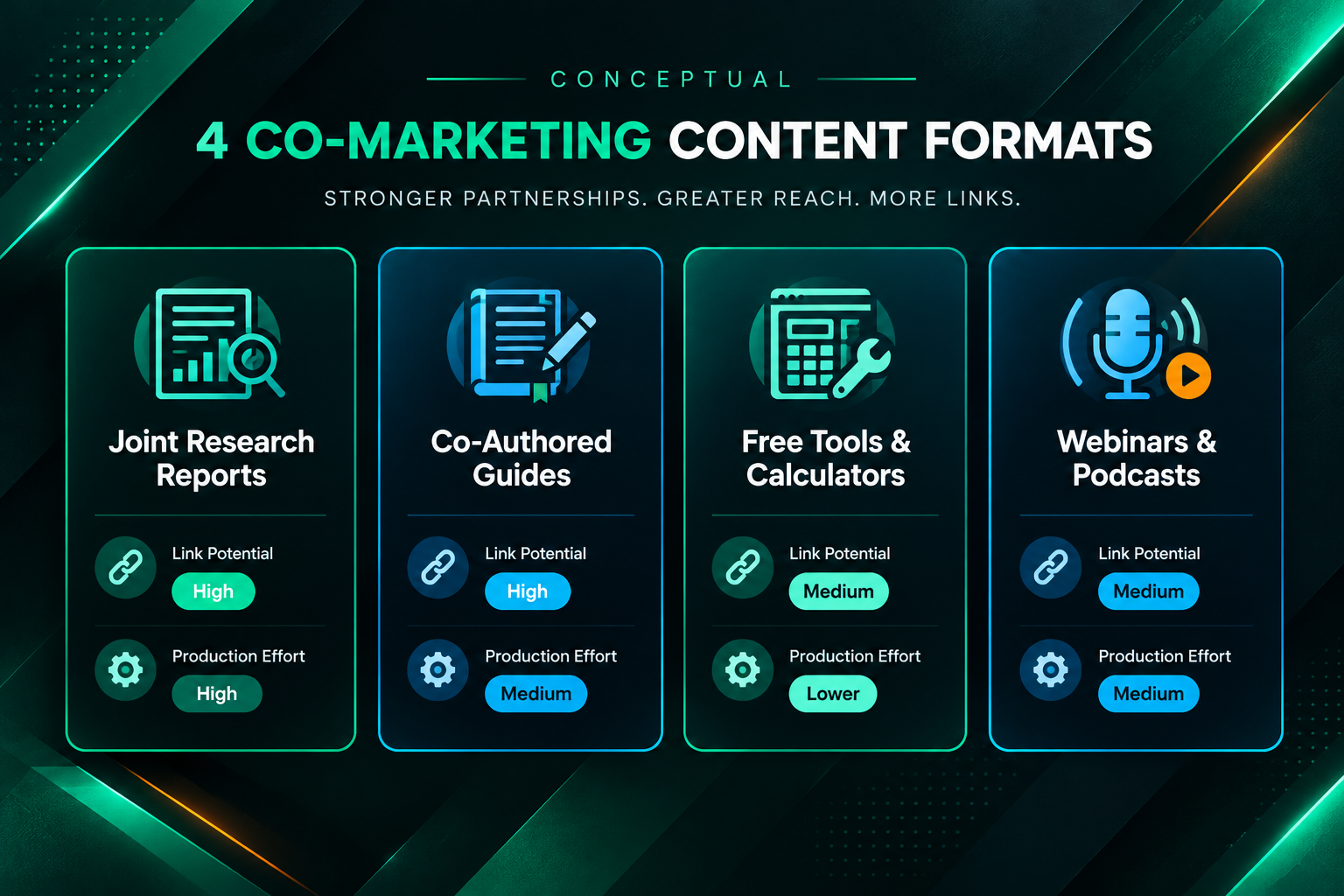
Not all co-marketing content formats are equally effective at attracting backlinks. The most linkable formats tend to be those that produce original data, provide a unique utility, or offer a perspective that neither party could credibly publish alone.
Joint Research Reports and Data Studies
Original research is consistently among the most cited content types in SEO and content marketing. A co-authored industry survey or data study benefits from the combined credibility of two known brands, a larger combined sample size or data set, and the promotional reach of two separate audiences. When the findings are genuinely novel or counterintuitive, they attract citations from journalists and analysts who need a credible source to reference. The link acquisition potential of a joint research report extends well beyond the initial publication date, as the data may be referenced in future articles for months or years.
Co-Authored Guides and Resource Pages
A comprehensive guide produced by two complementary experts can attract links from educational resources, industry directories, and other publishers who want to point their readers to authoritative reference material. The key requirement is that the guide must cover the topic more thoroughly or from a more useful angle than existing resources — otherwise it will not earn organic citations beyond the partners’ own promotional links.
Free Tools and Calculators
Interactive tools developed jointly — such as a cost calculator, an assessment framework, or a comparison widget — tend to attract sustained backlinks because they provide ongoing utility. Publishers link to useful tools repeatedly over time, and a well-designed tool can accumulate referring domains long after its initial launch. The development investment is higher than for written content, but the link acquisition potential is correspondingly greater for businesses in niches where practical tools are valued.
Webinars, Podcasts, and Events
Co-hosted webinars and podcast episodes generate links primarily through event listings, recap articles, and promotional posts on both partners’ websites. The link volume is typically lower than for research or tools, but the relationship-building value is high, and a successful event can lead to ongoing collaboration that produces additional linkable assets over time.
The Co-Marketing Outreach and Campaign Workflow
Building backlinks through co-marketing partnerships involves a more extended workflow than standard link outreach, because the relationship must be established before the linkable asset exists. A typical campaign moves through several stages.

Identifying and qualifying partners: Research potential partners using industry publications, conference speaker lists, complementary tool directories, and your existing professional network. Assess each candidate against the partner quality criteria described above before making contact.
Initial outreach and relationship building: The first contact should focus on the mutual value of the collaboration rather than the link acquisition goal. Explain the proposed asset, why your audiences overlap, and what each party contributes. Decision-makers at potential partner companies are more likely to engage when the proposal is framed around shared audience value and brand exposure rather than SEO metrics.
Agreeing on scope and responsibilities: Define clearly who contributes what — data, writing, design, distribution — and agree on timelines, co-branding, and how each party will link to and promote the finished asset. A brief written agreement reduces the risk of misaligned expectations later in the process.
Content production and review: Both parties should review the final asset before publication to ensure accuracy, brand alignment, and editorial quality. The quality of the content directly affects how many third-party publishers will link to it, so this stage should not be rushed.
Coordinated publication and promotion: Publish the asset on an agreed date and coordinate simultaneous promotion across both partners’ channels. Timing the outreach to relevant journalists and industry newsletters around the publication date maximises the window for earning third-party coverage.
Ongoing link monitoring: Use Google Search Console or a third-party backlink monitoring tool to track new referring domains as they appear. Monitor whether partner links remain live over time, as editorial changes or website migrations can occasionally cause previously placed links to be removed or altered.
Realistic Results, Timelines, and Limitations
Co-marketing link building is not a fast link acquisition method. The relationship-building and content production phases typically take four to twelve weeks before a single link is placed, depending on the complexity of the asset and the responsiveness of the partner. After publication, search engines need to crawl and index the new links before any ranking effects become measurable, which can add several additional weeks. Meaningful changes in organic rankings or traffic — where they occur — are generally not observable until two to four months after a campaign begins, and outcomes depend heavily on the existing backlink profile, content quality, technical SEO condition, and competitive landscape of the target pages.
The number of backlinks generated by a single co-marketing campaign varies considerably. A joint research report promoted to a large combined audience in a data-hungry industry might earn dozens of referring domains over several months. A co-authored guide in a niche with limited media coverage might earn only the partner link and a handful of organic citations. Setting realistic expectations before a campaign begins — based on the partner’s audience size, the asset format, and the industry’s linking behaviour — helps avoid disappointment and allows for better resource allocation.
It is also worth noting that co-marketing links, like all backlinks, do not guarantee ranking improvements. Low organic visibility may have causes unrelated to the backlink profile, including crawling or indexing problems, weak or outdated on-page content, search-intent mismatches, internal linking gaps, or strong competition from well-established pages. A site-specific SEO assessment is advisable before committing significant resources to any link acquisition strategy.
Risks and Quality Considerations
Co-marketing partnerships carry a different risk profile from other link building methods, but they are not without potential issues.
Partner quality risk: If a partner’s website has a poor backlink profile, a history of spam-related issues, or content that does not meet editorial standards, the link from their domain may carry limited value or, in extreme cases, contribute negatively to your own profile’s perceived quality. Thorough partner vetting before committing to a collaboration reduces this risk.
Reciprocal link appearance: When both partners link to the shared asset from their own domains, the arrangement can superficially resemble a reciprocal link exchange. The key mitigating factor is the existence of a substantive, independently valuable asset that justifies both links editorially. If the collaboration produces only thin or promotional content, the links are harder to distinguish from a coordinated scheme.
Execution risk: Co-marketing campaigns depend on the active participation of an external party. Partners may deprioritise the project, miss agreed deadlines, or produce lower-quality contributions than expected. Building contingency time into the project plan and maintaining clear communication throughout reduces but does not eliminate this risk.
Link longevity: Partner links placed in blog posts or resource pages can be removed during website redesigns, content audits, or CMS migrations. Monitoring placed links periodically and maintaining the partner relationship makes it easier to address removals when they occur.
Who May Benefit Most from Co-Marketing Link Building
Co-marketing link building tends to be most effective for businesses that already have some content production capability, a defined audience that is valuable to potential partners, and a topic area where collaborative research or tools would be genuinely useful to readers. SaaS companies, B2B service providers, e-commerce brands with strong editorial content, and professional services firms operating in data-rich industries are often well-positioned to pursue this approach.
Businesses that may find co-marketing link building less suitable include those with very limited content resources, those operating in highly commoditised niches where few publishers cover industry topics, and those whose brand positioning makes it difficult to identify complementary partners without creating competitive conflicts. Early-stage websites with minimal organic visibility may also find it harder to attract high-quality partners, since the value proposition of the collaboration partly depends on the audience reach each party brings.
Alternatives and Complementary Strategies
Co-marketing is one of several white-hat link acquisition methods available to businesses and SEO teams. Understanding how it compares to alternatives helps in allocating resources appropriately.
Manual guest post outreach involves pitching original articles to relevant publishers in exchange for a contextual backlink. Guest posting can be executed more quickly than co-marketing and does not require a long-term partner relationship, but the links are typically limited to the single placement rather than the multi-source link acquisition that a successful co-marketing campaign can produce.
Digital PR focuses on creating newsworthy content — data studies, surveys, reactive commentary — and pitching it to journalists and editors. Digital PR and co-marketing overlap when a joint research report is pitched to media, but digital PR does not require a formal partner relationship and can be executed independently.
Niche edits involve placing a link within existing published content on a relevant website. This method can produce contextually relevant links more quickly than co-marketing but relies on the editorial standards and quality of the target publication.
Resource page link building targets pages that curate useful tools, guides, or references in a given industry. A well-produced co-marketing asset — particularly a free tool or comprehensive guide — can serve as the basis for resource page outreach after its initial publication.
Many effective link building campaigns combine several of these methods rather than relying on a single approach. Co-marketing partnerships can anchor a campaign by producing a high-quality linkable asset, while guest posting and digital PR outreach amplify the asset’s reach and generate additional referring domains from independent publishers.
Frequently Asked Questions
Does co-marketing link building comply with Google’s link spam policies?
Co-marketing links that are placed editorially within substantive, genuinely useful content are generally consistent with the principle of earning links rather than buying or exchanging them. However, no link acquisition method is automatically exempt from search-engine review. Links that appear to be part of a coordinated scheme — particularly if the collaboration produces thin or promotional content — may be assessed differently. The editorial quality and genuine utility of the shared asset are the most important factors in distinguishing co-marketing from a link scheme.
How many backlinks can a single co-marketing campaign realistically generate?
This varies considerably depending on the asset format, the combined audience size of both partners, the industry’s linking behaviour, and how actively the asset is promoted. A joint research report in a data-driven B2B industry might earn ten to fifty or more referring domains over several months. A co-authored guide in a smaller niche might earn three to ten. There is no reliable universal figure, and claims of guaranteed link counts should be treated with scepticism.
How long does it take to see SEO results from co-marketing links?
The full campaign timeline — from partner identification to measurable ranking changes — typically spans three to six months or longer. Relationship building and content production take several weeks before publication. After links are placed, search engines need time to crawl, index, and assess them. Ranking and traffic changes, where they occur, are generally not reliably measurable until two to four months after the links go live, and results depend on many factors beyond the backlinks themselves.
Can smaller businesses pursue co-marketing partnerships effectively?
Smaller businesses can pursue co-marketing partnerships, but the value proposition they offer to potential partners needs to be clearly defined. A smaller brand with a highly engaged niche audience, proprietary data, or a specific technical capability may be an attractive partner even without large traffic numbers. The key is identifying what your business can genuinely contribute to a collaboration rather than relying solely on domain authority metrics.
Should co-marketing links be disclosed as sponsored or paid?
Co-marketing links placed within editorially produced content that both parties created together are generally not considered paid placements in the same way as advertorial or sponsored content. However, if any financial arrangement accompanies the link placement — such as one party paying the other for inclusion — the relevant search-engine and regulatory disclosure requirements may apply. When in doubt, consult the applicable guidelines for your market and publishing context.
How do I track whether co-marketing links are contributing to SEO performance?
Google Search Console can show new referring domains and any changes in impressions or clicks for target pages after links are placed. Third-party tools such as Ahrefs or Semrush can track new referring domains, anchor text distribution, and estimated organic traffic trends. Attributing ranking or traffic changes specifically to co-marketing links is difficult because many factors influence search performance simultaneously; monitoring trends over a three-to-six-month window after publication provides a more reliable picture than short-term observations.
Is Co-Marketing Link Building the Right Approach for Your Business?
Co-marketing partnerships can be a genuinely effective link acquisition strategy for businesses that are willing to invest in relationship building, content production, and coordinated promotion. The links earned through a well-executed collaboration tend to be editorially placed, topically relevant, and distributed across multiple referring domains — characteristics that are broadly associated with a healthy, natural-looking backlink profile. The strategy also produces business benefits beyond SEO, including brand exposure to a new audience, strengthened industry relationships, and a reusable content asset.
The limitations are equally real. Co-marketing requires more time and coordination than most other link building methods, results are not guaranteed, and the quality of the outcome depends heavily on partner selection and content execution. Businesses without established content capabilities or a clearly defined audience may find the strategy difficult to execute effectively without external support.
If you are considering co-marketing as part of a broader link acquisition strategy, a useful starting point is assessing your existing content assets, identifying two or three potential partners whose audiences genuinely overlap with yours, and evaluating whether your team has the capacity to manage the collaboration internally or would benefit from working with an experienced link building partner. A qualified SEO provider can help assess whether co-marketing fits your current backlink profile, competitive position, and business goals — and how it might complement other link acquisition methods to build a more complete and sustainable campaign.