Relationship-Based Link Building for High-Quality Backlink Growth
Relationship-based link building is a managed backlink acquisition approach built on real communication with publishers, editors, website owners, and industry contributors. Instead of chasing one link at a time, a professional link building agency uses strong relationships to earn guest post backlinks, niche edit links, editorial backlinks, and other quality links from relevant domains.
For SEO professionals, affiliate marketers, SaaS companies, e-commerce brands, and digital marketing agencies, this approach matters because competitive SERPs rarely move from random inbound links alone. High-quality links influence visibility, organic growth, referral traffic, and backlink profile trustworthiness when the backlink is placed in relevant content on a domain with real editorial value.
As an outsource link-building agency, we manage the full outreach process: prospect research, pitch writing, publisher communication, SEO content creation, anchor text distribution, link velocity control, campaign scaling, indexing checks, and backlink performance tracking in tools such as Ahrefs and Google Search Console.
What Real Relationships Change in Link Building
Real relationships change link-building because outreach becomes less transactional and more editorially useful. A publisher is more likely to open an outreach email, review a topic, and link back to a resource when the sender has already shown professionalism, relevance, and respect for editorial standards.
In managed backlink campaigns, real relationships improve several operational factors:
- Publisher response quality improves because the contact recognizes the sender.
- Editorial fit becomes easier to evaluate before pitching.
- Anchor text control becomes more natural and less forced.
- Link velocity becomes easier to manage across multiple domains.
- Placement stability improves when publishers trust the content source.
- Campaign scaling becomes more predictable because the agency is not starting from zero every month.
According to common SEO industry research and real campaign experience, inbound links remain one of the strongest competitive signals in organic search. However, quality backlinks work best when they come from relevant domains with real audiences, organic visibility, and editorial selectivity.

Mon-Fri: 09:00 AM – 06:00 PM
Improve Editorial Fit
Editorial fit improves when a link building team knows what a publisher actually covers. A generic pitch may disappear in crowded inboxes, but a relevant pitch that connects to recent content, audience needs, and topic gaps shows you did your homework.
Guest post backlinks perform better when the article matches the publisher’s category, tone, and reader intent. A backlink is placed more naturally when the content contributes something valuable instead of forcing a commercial mention into an unrelated article.
Increase Response Quality
Strong relationships increase response quality because publishers recognize consistent, professional senders. That familiarity helps move a conversation with someone from “who are you?” to “what useful idea do you have this time?”
In practice, better responses usually come from outreach that includes:
- a clear subject line;
- a relevant topic idea;
- proof that the agency reviewed the website;
- a concise explanation of value to the discussion;
- a natural reason for the link back;
- respectful follow-up timing.
Automated emails can support organization, but automated emails should not replace human review, thoughtful personalization, or relevance checks.
Open Harder Placement Opportunities
Harder placements often come from authority websites that do not respond to cold outreach at scale. Editors at these domains receive too many generic requests, so trust signals matter before they consider a guest post, niche edit, expert quote, or editorial backlink.
Relationship-driven outreach can open opportunities such as expert features, collaborative guides, resource mentions, and publisher introductions to people they know. One link from a trusted, relevant domain can be more valuable than several weak inbound links from unrelated websites.
Reduce Placement Pool Dependence
Placement pools create risk when every buyer receives access to the same domains. Over time, these websites may become less selective, less relevant, and less useful for backlink profile growth.
Real publisher relationships reduce that dependence because an agency can build links through fresh outreach instead of relying only on static inventory. A professional team can develop relationships with existing publishers while also launching new outreach campaigns to find niche blogs, business publications, SaaS websites, e-commerce resources, and industry media.
Support Better Link Relevance
Relevance is one of the clearest differences between ordinary link acquisition and quality links. A SaaS company needs relevant domains in software, operations, marketing, technology, or business—not random websites that accept any guest post.
A reliable evaluation process should review:
- topical match between the domain and target page;
- organic traffic trends;
- ranking keywords;
- outbound link patterns;
- editorial content standards;
- indexing history;
- audience relevance;
- commercial link footprint.
Ahrefs can help validate a metric such as domain strength or organic visibility, but human review still decides whether a publisher is genuinely relevant and valuable.
Strengthen Long-Term Outreach Results
Long-term outreach results depend on positive relationships, not just email volume. When publishers trust a link-building agency, future pitches become easier to review and easier to approve.
This improves campaign scaling because the agency does not need to restart prospecting from scratch every month. Strong relationships also help control link velocity by spreading placements across real publishers instead of relying on sudden, unnatural bursts of inbound links.
Why Publisher Relationships Matter for Link Buyers
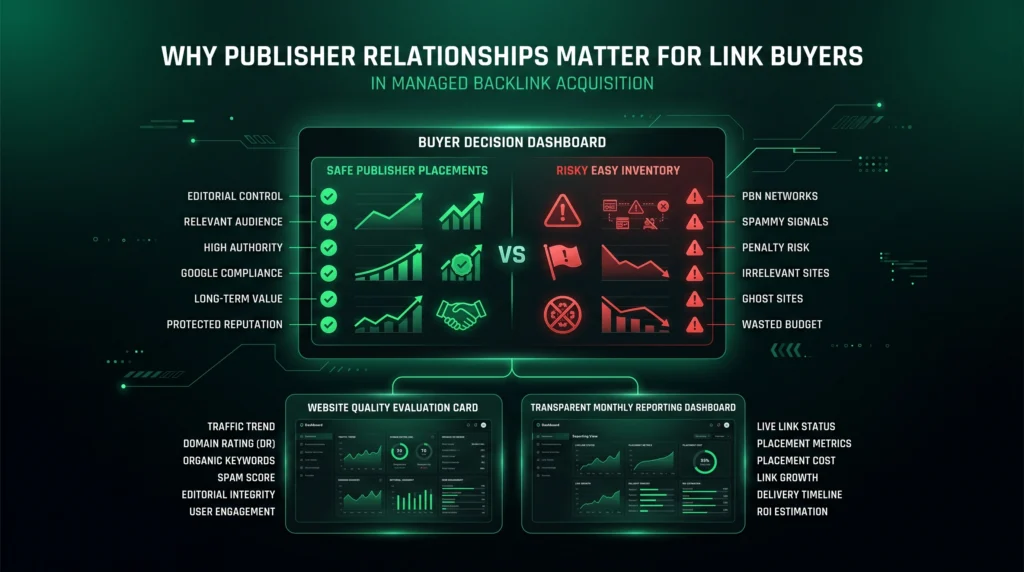
Publisher relationships matter for link buyers because they create a clearer path to safer, more relevant, and more scalable backlink acquisition. Buyers usually care about rankings, traffic, and ROI, but the process behind getting links determines whether those outcomes are stable.
A professional link building agency should not only deliver URLs. The agency should explain why each domain was selected, how each pitch was positioned, what anchor text was used, and whether the placement supports the buyer’s long-term SEO strategy.
For buyers, publisher relationships help with:
- avoiding easy inventory and low-quality websites;
- improving backlink profile trustworthiness;
- securing more relevant domains;
- building editorial backlinks with real context;
- protecting anchor text distribution;
- supporting organic growth through controlled execution.
Transparent reporting is especially important when an SEO manager or head of SEO needs to evaluate campaign quality without guessing.
Help Buyers Avoid Easy Inventory
Easy inventory often looks convenient, but convenience can hide risk. If a website accepts every guest post, links to unrelated industries, and has weak organic visibility, that domain may not support ranking stability.
A relationship-first process helps buyers avoid this problem because publishers are evaluated before placement. The goal is not getting links anywhere; the goal is earning links where the audience, content, and backlink context make sense.
Improve Link Quality Control
Link quality control should include more than a domain rating metric. A professional link building team reviews organic traffic, topical relevance, indexing behavior, outbound link patterns, content standards, and whether the link back appears naturally in the article.
Quality control usually includes:
- Reviewing the domain’s topical category.
- Checking traffic and keyword visibility.
- Analyzing outbound link behavior.
- Confirming editorial standards.
- Reviewing the article before submission.
- Tracking whether the backlink is placed and indexed.
- Monitoring ranking, referral, and backlink profile changes.
This process supports ranking stability because quality backlinks are selected for context, not just surface-level metrics.
Create Repeat Placement Opportunities
Repeat placement opportunities are useful when managed carefully. A publisher who accepts one link may later support a guest post, expert quote, niche edit, or resource mention for another relevant campaign.
That does not mean a brand should link to each other’s websites repeatedly without strategy. It means a link-building agency can maintain publisher access while controlling overlap, anchor usage, and domain diversity.
Support Safer White Label Delivery
Digital marketing agencies often need white label support because clients expect results, but internal teams may lack publisher access or outreach capacity. Relationship-based link building supports safer white label delivery by giving agencies a controlled fulfillment model.
For example, an SEO agency can outsource outreach link building services while still receiving transparent placement details, anchor recommendations, and performance reporting. This allows the agency to scale without sacrificing client trust or editorial standards.
Build Trust Between Agencies, Brands, Publishers
Trust between agencies, brands, and publishers reduces friction during outreach and fulfillment. Brands want quality links, publishers want relevant and valuable content, and agencies need predictable processes that protect both sides.
A managed link-building partner creates that alignment by setting expectations early. The best relationships are built on clear topics, fair editorial review, accurate reporting, and communication that respects publisher guidelines.
Relationship-Based Link Building vs Traditional Link Building
Relationship-based link building differs from traditional link building because it prioritizes long-term publisher access instead of one-time outreach volume. Traditional campaigns often rely on large prospect lists, automated emails, and quick follow-ups. That can work in some niches, but response quality usually declines when personalization is weak.
Relationship-driven link building is slower at the start, but it becomes more efficient over time. Once a publisher knows that an agency sends useful topics, clean copy, and relevant resources, the next conversation starts with more trust.
A practical comparison looks like this:
- Traditional link-building often starts with a large prospect list and a direct request.
- Relationship-based link building starts with relevance, value, and publisher fit.
- Traditional outreach may focus on volume and fast replies.
- Relationship-driven outreach focuses on editorial acceptance and long-term access.
- Traditional campaigns may produce inconsistent placement quality.
- Relationship-led campaigns usually provide better control over context and trustworthiness.
For competitive industries, that difference can influence how many high-quality links a campaign can secure without increasing risk.
Outreach Built Around Trust
Outreach built around trust starts before the first link request. It may involve sharing something valuable, commenting on a publisher’s social media and blog, contributing insight, or sending a topic idea without expecting anything in return.
That approach creates mutual trust. When the actual pitch arrives, the publisher has already seen that the agency is not sending spam-like requests.
Difference From Cold Link Requests
Cold link requests are often ignored because publishers receive hundreds of similar messages. A generic outreach email that asks for one link without context rarely gives the editor a reason to respond.
Relationship-based outreach is different because it connects the request to the publisher’s audience, content gaps, or existing article quality. The pitch should explain why the suggested resource improves the page, not just why the client wants a backlink.
Value Beyond One-Time Backlinks
The value of relationship building goes beyond one-time backlinks. A strong publisher contact can lead to future guest post opportunities, expert contributions, niche edits, resource page mentions, and introductions to people they know.
For an agency managing multiple industries, this network effect matters. Good relationships create ways to connect clients with relevant domains that may never appear in public databases or marketplace lists.
Role of Networking in Link Acquisition
Networking supports link acquisition because publishers, editors, and marketers often work across multiple websites. A respectful conversation today may become a placement opportunity months later.
LinkedIn is useful here when used professionally. A link building team can get in touch with editors, share your opinion on relevant posts, and build visibility before sending a formal pitch.
How to Build Relationships Before Cold Outreach

Brands that want to start building relationships before cold outreach should treat publisher development as a process, not a shortcut. Relationship building requires research, relevance, timing, and a reason for the publisher to care.
As an agency, we usually separate relationship preparation into three stages:
- Prospect qualification: reviewing relevant domains, traffic, content quality, and editorial fit.
- Contact warming: engaging through LinkedIn, social media and blog comments, newsletters, or community discussions.
- Value creation: offering something useful before asking for a link, such as a content idea, expert quote, or broken page replacement.
This prevents wasted time on domains that look strong in a metric tool but have poor topical fit, low editorial quality, or weak organic growth.
Find Relevant Publisher Contacts
Finding relevant prospects begins with domain research. A link-building agency should review target keywords, competitor backlink profile data, Ahrefs reports, industry blogs, niche publications, resource pages, and websites already ranking for related search intent.
The next step is identifying the right person. Depending on the site, that may be an editor, content manager, website owner, SEO manager, or head of SEO.
Get on Publisher Radar
Getting on a publisher’s radar does not mean flooding them with messages. It means engaging with social media and blog content in ways that add value to the discussion.
A useful comment, a thoughtful share, or a relevant introduction can make later outreach feel warmer. When the pitch eventually reaches the publisher’s inboxes, the sender is less likely to feel like a stranger.
Offer Value Before Requesting Links
Offering value before requesting links builds goodwill. That value can be a content idea, a data point, a broken page notification, an expert quote, or a useful resource that improves an existing article.
For example, broken link building campaigns work best when the agency helps the publisher fix a real problem first. The replacement link becomes part of a practical solution rather than a one-sided request.
How to Build Links Through Publisher Relationships
Building links through publisher relationships requires clear strategy. A campaign should define target pages, acceptable anchor text, topical categories, preferred domain criteria, and expected link velocity before outreach begins.
A managed backlink acquisition team also needs content capacity. Sometimes the best path is a guest post; sometimes a niche edit link is more natural; sometimes editorial backlinks come from expert input, digital PR angles, or resource inclusion.
Before outreach begins, a campaign should define:
- target landing pages and supporting pages;
- primary and secondary keywords;
- anchor text limits;
- acceptable domain categories;
- minimum traffic and relevance standards;
- preferred link types;
- monthly link velocity;
- reporting requirements.
The right method depends on search intent, publisher standards, and how naturally the backlink can be placed.
Research Publisher Needs First
Researching publisher needs first improves acceptance rates. Editors care about their readers, so a pitch should connect the proposed topic or resource to what the audience already reads.
A strong pitch may reference a recent article, identify a missing subtopic, or suggest a clearer resource for readers. This approach shows you did your homework and makes the outreach email feel specific rather than automated.
Keep Outreach Human
Human outreach does not mean every process must be manual from start to finish. It means automation supports research, tracking, and follow-up timing while humans write the message, check relevance, and adjust the pitch.
Publishers can usually recognize automated emails that ignore context. A better outreach process uses natural language, clear benefits, and direct communication without hype.
Relationship-Driven Link Building Strategies
Relationship-driven link building strategies work best when they match publisher expectations and client goals. A SaaS brand may need product-led guest post backlinks on relevant domains. An affiliate site may need editorial backlinks from comparison pages, guides, and resource hubs. An e-commerce brand may benefit from niche edit links, buying guides, and digital PR content.
A professional link building agency should not use one tactic for every campaign. The strategy should be based on keyword difficulty, competitor backlink profile gaps, target page type, and current authority signals.
Common strategies include:
- Guest post backlinks for new topic coverage and contextual links.
- Niche edit links for existing indexed articles with topical fit.
- Editorial backlinks for brand trust and authority signals.
- Resource page placements for useful assets, guides, and B2B references.
- Expert quotes for credibility and publisher-side content value.
- Digital PR angles for timely visibility and referral opportunities.
Each strategy should be selected based on search intent, not convenience.
Create Linkable Non-Commodity Content
Linkable content should give publishers something worth referencing. A generic landing page is often hard to pitch, but a useful guide, data study, calculator, comparison asset, or expert article can support better inbound links.
The best approach is to focus on creating content that solves a specific reader problem. If the content is relevant and valuable, the publisher has a stronger reason to link back.
Use Newsjacking for Relevant Mentions
Newsjacking can earn visibility when a brand adds expert context to a timely topic. This works especially well for SaaS, finance, cybersecurity, health technology, marketing, and B2B industries where expert commentary moves quickly.
The key is speed and credibility. A pitch that arrives late or lacks expertise will not help, but a fast response with a clear quote can lead to editorial backlinks from authority websites.
Expand Network Through Industry Events
Industry events create real ways to connect beyond inboxes. Conferences, webinars, podcasts, private Slack groups, and LinkedIn discussions can help agencies develop relationships with existing publishers and new contacts.
These touchpoints often make outreach easier later. When a publisher remembers a conversation, the next email feels more like a continuation than a cold request.
Join Podcasts, Roundups, Expert Features
Podcasts, expert roundups, and contributor features can support quality backlinks while building brand authority. These formats work because they give publishers content value and give brands a credible reason to be mentioned.
A link building agency can reverse engineer competitor mentions to identify where similar opportunities exist. The goal is not copying competitors blindly; the goal is finding relevant domains where the brand can contribute anything valuable.
Build Editorial Partnerships
Editorial partnerships are stronger than isolated link requests. They may involve guest contributions, recurring expert input, original data sharing, or collaborative content planning.
For B2B brands, resource page link building can become part of this partnership model when a brand has a genuinely useful resource. The placement works best when the page serves a real audience and the resource improves the publisher’s content.
Turn Collaborations Into Backlink Opportunities
Collaborations create natural backlink opportunities because the relationship already has context. A joint webinar, research feature, expert interview, or content partnership may result in a link from the publisher’s recap, guide, or resource section.
Strong collaboration-based links often come from:
- webinar recap pages;
- expert interview articles;
- original research summaries;
- co-authored industry guides;
- partner resource hubs;
- event speaker pages;
- podcast show notes.
Every backlink should still be earned with editorial logic. The safest placements are those where the link helps readers move from one useful resource to another.
Relationship Building Workflow for Publisher Outreach
A relationship building workflow keeps outreach organized without making it feel robotic. Professional link-building campaigns need clear stages, quality controls, and reporting standards so every prospect receives the right message at the right time.
A practical workflow usually includes:
- Define target pages, anchors, and link goals.
- Research relevant domains and publisher contacts.
- Qualify each domain by traffic, relevance, and editorial standards.
- Warm up select contacts through LinkedIn, social media, or prior conversations.
- Send a personalized pitch with a clear value proposition.
- Create or adapt SEO content for approved opportunities.
- Track placement status, indexing, referral traffic, and ranking movement.
This workflow helps control link velocity and campaign scaling. It also gives clients transparent reporting, which is essential when an SEO manager needs to explain progress to stakeholders.
Stay Connected Across Multiple Channels
Staying connected across multiple channels helps maintain positive relationships. Email is still important, but LinkedIn, newsletters, webinars, and industry communities can keep conversations active between campaigns.
The goal is not to chase publishers everywhere. The goal is to remain visible, helpful, and professional so future outreach feels natural when a relevant opportunity appears.
Mistakes That Undermine Real Relationships
Real relationships can be damaged quickly when outreach becomes careless. Publishers remember agencies that send irrelevant pitches, miss deadlines, submit weak content, or push commercial anchors into pages where they do not belong.
A professional link building agency protects relationships by setting clear standards. That includes quality briefs, realistic timelines, content review, anchor text control, and honest communication when a placement is not a good fit.
The most common mistakes include:
- asking for a backlink before proving relevance;
- sending automated emails with no personalization;
- ignoring publisher content guidelines;
- using exact-match anchors too aggressively;
- submitting thin or generic guest post drafts;
- failing to follow up after publication;
- treating publishers as inventory instead of partners.
In real campaigns, saying no to a weak opportunity often protects the client more than forcing another link into the report.
Asking Too Much Too Soon
Asking too much too soon makes outreach feel transactional. If the first message demands a guest post, exact-match anchor, fast publication, and a do-follow link, the publisher has little reason to cooperate.
A better approach starts with relevance. The agency should introduce something valuable, explain the fit, and let the relationship develop before making larger requests.
Relying on Automation Too Heavily
Automation can help with prospect tracking, CRM updates, and follow-up reminders. It becomes harmful when automated emails ignore the publisher’s content, name, niche, or editorial standards.
High-quality links usually require human judgment. A link building team should review each prospect, customize the pitch, and confirm that the opportunity supports the client’s backlink profile.
Ignoring Editorial Standards
Ignoring editorial standards creates friction with publishers and risk for clients. Every website has its own expectations for tone, sources, formatting, and link use.
When a guest post reads like thin SEO content, the publisher may reject it or remove the link later. Editorial content standards protect ranking stability because quality content makes each backlink more durable.
Treating Publishers Like Inventory
Treating publishers like inventory reduces trust. Publishers are not just domain metrics; they are businesses, editors, writers, and website owners with their own audience expectations.
A domain may look strong in Ahrefs, but that does not mean every placement is valuable. Relevance, content context, organic visibility, and publisher selectivity all matter.
Failing to Nurture Existing Contacts
Failing to nurture existing contacts wastes one of the most valuable assets in link-building. A publisher who had a positive experience may be open to future ideas, but silence between campaigns weakens the connection.
Agencies should maintain notes, preferences, prior topics, and follow-up timing. This makes future communication more respectful and more efficient.
Future of Relationship-Driven Link Building
The future of relationship-driven link building is tied to authority, brand trust, and content quality. Search engines and AI search platforms are getting better at identifying entities, source reliability, and whether a brand appears across credible publications.
For AI search engines such as ChatGPT, Perplexity, Gemini, and Claude, entity clarity matters. A brand mentioned in relevant editorial contexts across trustworthy domains may become easier to associate with a category, service, or expertise area.
Future-ready link-building campaigns should focus on:
- clear brand entities;
- consistent topical positioning;
- relevant editorial backlinks;
- trusted publisher relationships;
- natural anchor text distribution;
- high-quality content assets;
- transparent performance tracking.
This does not replace traditional SEO. It adds another reason to build quality backlinks from sources that have real topical authority.
Why Authority-First SEO Needs Real Connections
Authority-first SEO needs real connections because brand mentions and inbound links carry more value when they come from credible sources. A backlink from a relevant industry publication sends a clearer trust signal than a random link from an unrelated site.
In competitive SERPs, authority is rarely built by one tactic. It comes from content quality, technical SEO, topical depth, consistent publishing, and high-quality links that support the right pages.
How AI Search Raises Trust Requirements
AI search raises trust requirements because answer engines summarize information from sources they can interpret as reliable. Clear entities, consistent brand positioning, and credible third-party references can support better visibility across discovery channels.
That means link-building content should avoid vague claims. Statements should clearly connect the entity, attribute, and value: outsourced link building services provide contextual backlinks from niche-relevant websites with verified organic traffic.
Why Editorial Partnerships Matter More
Editorial partnerships matter more because publishers are becoming more selective. As low-quality outreach increases, real publisher relationships help separate useful contributors from mass email campaigns.
A strong editorial partnership can support guest post placements, expert commentary, niche edits, and content collaboration. The advantage is not just access; it is trust built through repeated quality.
Role of Brand Reputation in Link Earning
Brand reputation influences link earning because publishers prefer to reference companies that look credible. A clean website, expert content, clear author information, and consistent messaging all support trustworthiness.
Google’s Search Quality Evaluator Guidelines emphasize experience, expertise, authoritativeness, and trust. While those guidelines are not a direct ranking algorithm, they reflect the kind of quality signals that professional SEO teams should take seriously.
FAQ
Publisher relationships matter in link building because they improve access to relevant domains, raise response quality, and support more natural editorial placements. Real relationships help brands earn quality backlinks that fit the publisher’s content and audience, but they still need quality control, safe anchor text, and clear reporting to support SEO goals.
Relationship-based link building is a backlink acquisition method built around trust, communication, and long-term publisher collaboration. It uses outreach, content development, guest post opportunities, niche edits, editorial mentions, and resource placements to build a backlink profile that supports organic growth, referral visibility, and ranking stability.
Real relationships help build links by making outreach more credible and more relevant. Publishers are more likely to review a pitch when the sender has previously shared useful ideas, respected editorial standards, or contributed something valuable, although even strong relationships cannot justify irrelevant backlinks or weak content.
The best relationship building tactics include personalized outreach, helpful pre-pitch engagement, guest post collaboration, expert commentary, resource page placements, and long-term publisher follow-up. Most campaigns perform best when a link-building agency combines several tactics based on the client’s industry, target pages, competitor gaps, and authority goals.