
Successful Broken Link Building Campaign With Outreach
A successful broken link building campaign turns dead resources into editorial backlink opportunities through research, content alignment, and respectful outreach. As an outsource link building agency, we manage the complete workflow for SEO professionals, affiliate marketers, SaaS companies, e-commerce brands, digital marketing agencies, and website owners that need reliable acquisition without building an in-house team.
The campaign is operational, not theoretical. Our team checks each broken URL, reviews the publisher, evaluates the backlink profile, prepares content as a replacement, controls anchor text, and reports on indexing, ranking movement, and placement stability.
A managed campaign usually includes:
- Broken backlink research across competitors, topics, and resource pages
- Publisher qualification based on relevance, traffic, and editorial standards
- Replacement content planning for pages that deserve citation
- Personalized outreach to editors, authors, and website owners
- Performance tracking with anchor text, URL status, and ranking notes
What Is Managed Broken Link Building Campaign
A managed broken link building campaign is an outsourced SEO service where a link building agency finds broken backlinks, qualifies the referring pages, creates or selects replacement content, and contacts publishers with a relevant fix. The service also covers building a list, outreach emails, follow-ups, reporting, and performance review.
The workflow is controlled from discovery to verification:
- Find a broken link or dead page with real referring domains.
- Review original page intent and surrounding context.
- Match the opportunity to a client asset or create a stronger resource.
- Contact the right publisher with a clear link building email.
- Track acceptance, live placement, indexing, ranking impact, and stability.
Managed broken link building often works beside guest posting services, niche edits, editorial backlinks, and digital PR. Each strategy earns placements differently, but broken link outreach is powerful because the publisher already has a user-experience issue to fix.

Mon-Fri: 09:00 AM – 06:00 PM
Dead Link Building Vs Broken Link Building
Dead link building and broken link building overlap, but they are not identical in execution. Dead link building usually starts with finding a dead page, while broken link building includes discovery, qualification, content matching, and outreach around the broken resource.
Practical differences include:
- Dead link building focuses on a link to a dead page and the missing resource behind it.
- Broken link building evaluates the broken URL, the publisher, the surrounding copy, and the replacement page.
- Dead resource research often begins with 404 pages, expired domains, and deleted assets.
- Broken link outreach turns the issue into a publisher-friendly recommendation.
A professional team will check for broken pages with tools like Ahrefs Site Explorer, Screaming Frog, Semrush, a broken link checker, and the Check My Links Chrome extension. Manual validation matters because some URLs are temporarily unavailable, redirected incorrectly, or blocked by technical settings rather than truly gone.
Role Of Broken Link Outreach In SEO
Broken link outreach is the process of contacting publishers, editors, bloggers, and website owners to know about the broken link and suggest a better resource. The outreach email should identify the page, mention the broken URL, and explain why the suggested content is useful for readers.
In SEO, broken link outreach supports backlink acquisition by creating a clear value exchange. The publisher improves a page with a working resource, while the client earns a contextual backlink from a relevant website. When the opportunity fits the topic and reader intent, the placement can support authority, referral visits, and ranking growth.
Benefits Of Broken Link Building For Search Visibility
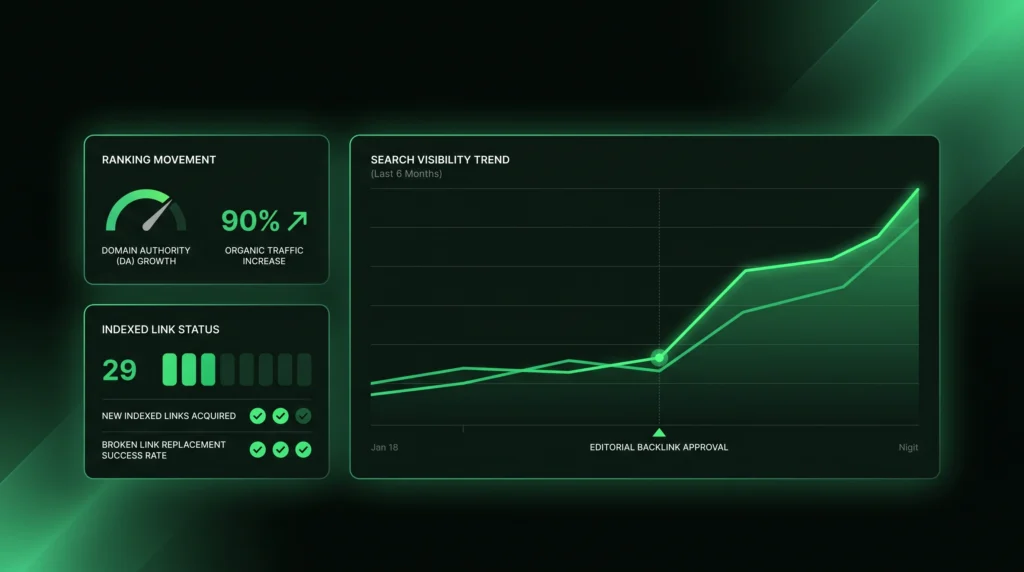
The benefits of broken link building come from relevance, timing, and editorial logic. A publisher is more likely to update a page when there is already a broken URL on the page and a useful alternative is offered. That makes broken link building an effective way to get backlinks without relying on generic cold pitches.
For competitive SEO campaigns, high-quality backlinks still influence discovery, authority signals, and ranking potential. Industry studies consistently show that stronger backlink profiles correlate with better organic performance in competitive SERPs, although content quality and search intent remain essential.
Key benefits include:
- Contextual backlink acquisition from pages already discussing the topic
- Improved publisher experience because outreach solves a real issue
- Safer anchor text distribution through natural surrounding copy
- Better use of content assets that can replace outdated resources
- Long-term SEO value when placements come from traffic-verified websites
High-Authority Contextual Backlinks
High-authority contextual backlinks are earned inside relevant content, not placed in footers, directories, or unrelated pages. In broken link building, contextual placement matters because the replacement resource should serve the same purpose as the original page.
Our agency reviews publisher traffic, topic fit, indexing status, editorial quality, and outbound link patterns before outreach begins. A high metric alone is not enough. A website must show real content standards and audience relevance before it enters the campaign.
Link Equity Recovery Plus Referral Traffic
Broken backlinks can represent lost equity for publishers and missed authority signals for brands with better replacement resources. When a page sends users to a dead destination, the experience is weak and the citation no longer supports the reader. Replacing the broken link with a useful resource restores practical value.
Referral traffic is not guaranteed from every backlink, but context improves the chance of qualified visits. A placement inside a niche guide, educational article, or resource page can send users who already care about the subject. That traffic may be smaller than paid traffic, but it often carries stronger intent.
A managed backlink campaign tracks more than acquisition volume. We monitor indexing, anchor text, referring domains, keyword movement, ranking changes, and placement stability so clients understand which backlinks contribute to long-term growth.
Brand Trust And E-E-A-T Growth
Broken link building supports E-E-A-T when replacement content shows real expertise, accurate information, and editorial usefulness. A weak replacement page does not become trustworthy simply because an outreach specialist promotes it. The resource must deserve the citation.
For SaaS companies, affiliate publishers, e-commerce brands, and agencies, trust depends on where the backlink appears and what surrounds it. A relevant editorial backlink from a traffic-verified website carries more credibility than a random mention on an unrelated blog.
Broken Link Building In 2026: Scalability And Strategy
Broken link building in 2026 is still effective, but it requires better targeting than older mass outreach methods. Publishers are selective, inboxes are crowded, and generic outreach templates are easy to ignore. The scalable version depends on better prospect data, stronger replacement content, and thoughtful segmentation.
A campaign becomes scalable when repeatable systems are paired with manual quality control. Automation can help find dead resources, but human specialists still need to decide whether the link on their site should point to a client page. That judgment affects success rate, placement quality, and ranking stability.
Why Broken Link Building Still Works
Broken link building still works because the pitch is based on a real website issue. The publisher has a broken resource that no longer helps users, and the outreach email offers a practical fix. That is more compelling than asking for a backlink without an editorial reason.
The web keeps changing. Companies delete pages, migrate sites, update URL structures, retire products, and remove old resources. Those changes create broken backlinks across SaaS, finance, marketing, cybersecurity, health, legal, e-commerce, and B2B services.
What Makes Broken Link Building Scalable
Broken link building becomes scalable when the agency can repeat research, qualification, outreach, and reporting without lowering standards. The best workflow combines Ahrefs broken link data, manual review, publisher segmentation, and measured follow-ups.
A scalable workflow usually requires:
- Prospect research through Site Explorer, broken link checker tools, and manual SERP review
- Qualification rules for traffic, relevance, page quality, and outbound links
- Content matching based on original page intent and reader needs
- Outreach segmentation by publisher priority and topic depth
- Reporting discipline for live placements, anchors, indexing, and ranking movement
When Campaign Should Pivot To Other Link Building Strategies
A campaign should pivot when broken link building opportunities are too limited, irrelevant, or difficult to convert in a specific niche. Some industries have fewer public resource pages, fewer informational publishers, or fewer dead links on other websites.
Guest post campaigns work well when a client needs topical authority across a content cluster. Niche edits work well when existing articles already cover the client’s subject. Digital PR works well when the brand has data, research, or a story that journalists can cite.
Manual Work Vs AI-Assisted Workflow
AI can support broken link building by grouping prospects, summarizing archived resources, drafting outreach emails, and identifying patterns in broken backlinks. However, AI cannot fully replace manual judgment. A specialist must check the broken URL, review the publisher, compare replacement content, and decide whether the pitch is credible.
AI-assisted workflows are most useful when they reduce repetitive work. AI can classify opportunities by topic, but an outreach strategist should still approve the final prospect list. This keeps the campaign efficient without weakening editorial standards.
Broken Link Building Opportunities Discovery
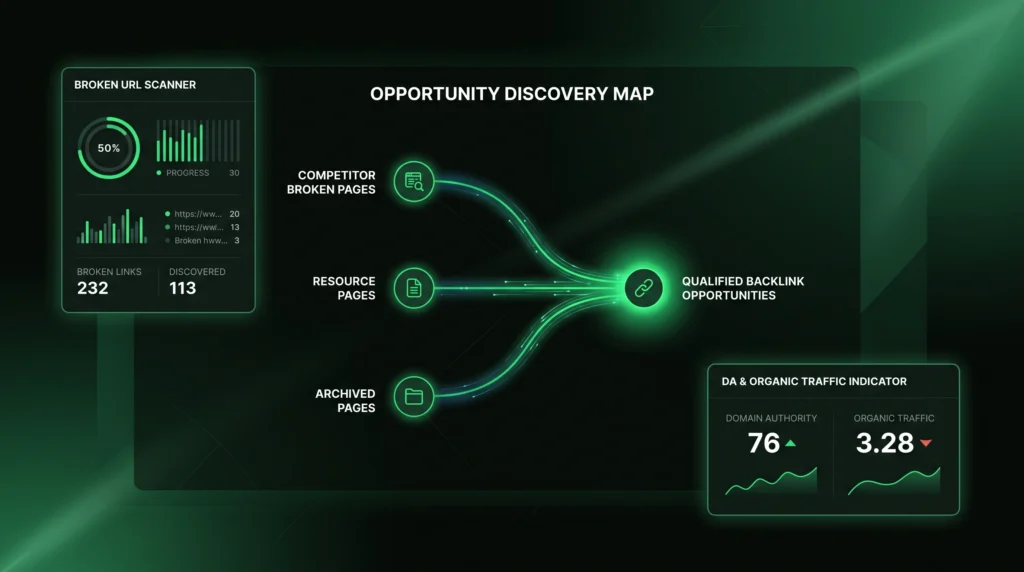
Broken link building opportunities discovery starts with finding broken pages that already have backlinks or finding broken links on resource pages, articles, and listicles relevant to the client’s niche. The agency then decides whether the client has, or can create, a resource that deserves to replace the broken link.
Useful discovery sources include:
- Competitor 404 pages with referring domains
- Broken outbound links on resource pages and industry roundups
- Topic-based dead resources found through keyword research
- Archived pages that reveal why publishers cited the original resource
- Old listicles with outdated tools, guides, or company pages
Competitor Broken Pages With Backlinks
Competitor broken pages with backlinks are often the best starting point. A competitor may have deleted an old guide, discontinued a product page, migrated content poorly, or changed a URL without preserving equity. Those broken backlinks can become replacement opportunities if the client has a stronger live resource.
The process is straightforward:
- Enter competitor domains into Ahrefs Site Explorer.
- Review broken pages with referring domains.
- Export pages with meaningful backlink profile strength.
- Check each broken URL manually.
- Compare original page intent with the client’s content.
- Build outreach targets from websites linking to the dead resource.
Resource Pages Plus Listicles
Resource pages and listicles often contain many outbound links, which makes them useful for broken link building research. These pages are designed to help users discover resources, so publishers are often willing to fix a dead reference when the replacement is relevant.
Resource page outreach can also overlap with broken link outreach. A team may check resource pages for broken links, find a broken link on the page, and recommend a live replacement. This is where resource page link building becomes a natural complement to broken link building.
Topic-Based Broken Pages
Topic-based broken pages are found by searching for dead resources around a keyword or industry topic. Instead of starting with competitors, the agency starts with the subject matter. This approach works well when the client wants backlinks to a specific content asset, such as a guide, comparison page, template, calculator, or research page.
For example, a SaaS company may want backlinks to a guide about onboarding metrics. The agency can look for broken resources about onboarding, customer success, retention, or product adoption. The team then checks which websites are linking to the dead page and whether those websites are relevant.
Archived Page Research For Lost Resources
Archived page research helps the agency review the original page before recommending replacement content. Tools like the Wayback Machine can show what the dead resource used to contain. This matters because a broken URL alone does not explain why publishers cited the old asset.
The original page may have included statistics, templates, definitions, examples, tools, or a unique framework. If the replacement content does not match that intent, the publisher may ignore the pitch. If the new content improves the old resource, the outreach has a stronger value proposition.
Competitive 404 Mining
Competitive 404 mining focuses on finding broken pages across competitor websites, industry blogs, old campaigns, and discontinued content hubs. The agency searches for 404 pages that still attract referring domains. Those pages often reveal editorial opportunities with existing context.
This tactic works because many companies remove pages without reclaiming or redirecting their backlinks. Their lost authority becomes a discovery source for brands with better content operations. However, the replacement must still be relevant and ethical.
Building A List Of Qualified Link Prospects
Building a list of qualified link prospects is more than exporting domains from an SEO tool. A professional agency reviews every prospect for relevance, authority, traffic, editorial standards, and placement feasibility. The goal is to give outreach specialists a list they can use with confidence.
A qualified prospect list should capture:
- Publisher domain and target URL
- Broken URL and status code
- Original page topic and replacement asset
- Organic traffic estimate and ranking context
- Contact person or editorial inbox
- Anchor text recommendation and placement notes
- Priority score based on relevance and authority
Referring Domain Quality Checks
Referring domain quality checks determine whether a backlink prospect is worth pursuing. We review organic traffic, topical coverage, indexing, spam indicators, outbound link patterns, and content quality. A high domain metric alone is not enough.
A traffic-verified website with relevant content and real editorial standards is usually more valuable than a high-metric site filled with unrelated paid posts. In practice, many low-quality domains appear strong in tools but provide little ranking value. Manual review protects the campaign from that mistake.
Topical Relevance Review
Topical relevance review determines whether the publisher’s page, website, and audience match the client’s target market. Search engines evaluate citations in context, so a backlink from a relevant page usually has more strategic value than a random placement from an unrelated website.
An e-commerce skincare brand benefits more from beauty, wellness, or lifestyle publications than from unrelated technology blogs. A B2B SaaS company benefits more from marketing, sales, operations, or software content than from a generic directory.
Link Reason Analysis
Link reason analysis asks one simple question: why did people link to the original page? The answer shapes both replacement content and outreach messaging. Publishers cite definitions, data, tools, examples, templates, visuals, quotes, and practical guides for different reasons.
If people link because the original page had statistics, the replacement content should include credible and updated data. If people link because the old resource had a checklist, the replacement should provide a better checklist. If the original page explained a topic clearly, the replacement should be more complete and easier to reference.
Publisher Priority Scoring
Publisher priority scoring helps manage outreach order. Not every prospect deserves the same amount of time. A high-value publisher with strong traffic, topical relevance, and clean editorial standards may deserve a tailored outreach sequence, while a lower-value prospect may be placed in a lighter tier.
Our scoring model considers relevance, traffic, authority, editorial quality, placement probability, and commercial risk. The model is simple, but it keeps decisions consistent across large campaigns. Better prospects receive more careful personalization.
Outreach Contact Identification
Outreach contact identification is the process of finding the right person to contact about the broken link. The best contact may be an editor, content manager, website owner, marketing lead, or author of the page. Sending the email to the wrong person lowers response rates.
A good link building email should reference the exact page, the broken URL, and the suggested replacement. The message should also make it easy for the publisher to verify the issue. Specificity builds trust.
Low-Quality Target Exclusion
Low-quality target exclusion protects ranking stability. Some websites exist mainly to sell placements, publish thin guest post content, or host unrelated outbound links. Those websites may accept placements quickly, but fast approval is not the same as long-term value.
We exclude targets with obvious spam patterns, irrelevant content, poor indexing, unnatural outbound links, and no signs of a real audience. Search engines evaluate source quality, relevance, and link patterns, so quality control is not optional. It is part of responsible SEO execution.
Replacement Content Creation For Linkable Assets
Replacement content creation is where broken link building becomes a content marketing strategy. A publisher will not update a page just because the existing URL is broken. The publisher needs a better destination that serves the same reader intent.
A strong replacement page should be accurate, useful, easy to reference, and aligned with the original page purpose. It should also be strong enough to earn citations from other websites beyond the broken link campaign. This is how one content asset can support multiple backlink strategies.
Original Dead Page Analysis
Original dead page analysis helps the agency reconstruct what the old resource offered. We review archived versions, anchor text from referring pages, surrounding copy, and the context of citations to the dead page. This reveals what publishers expected users to find after clicking.
Without this step, the replacement recommendation can miss the mark. A page about “SEO reporting templates” should not be replaced with a broad SEO services page. A broken link to a research report should not be replaced with a generic blog post.
Search Intent Matching
Search intent matching ensures that the replacement content satisfies the same need as the broken URL. If the publisher cited a beginner guide, the replacement should not be overly technical. If the publisher cited a pricing comparison, the replacement should include clear decision-making information.
This matters for both users and rankings. A backlink from a relevant page can help search engines associate the target URL with a topic, but the content must also satisfy visitors. Poor intent match can produce weak engagement and low editorial acceptance.
Old Resource Improvement
Old resource improvement means creating content that does more than replace the broken page. The new content should be current, easier to read, better structured, and more complete. Publishers are more likely to update a citation when the replacement offers a visible upgrade.
A stronger resource may include updated statistics, clear definitions, expert commentary, original examples, better visuals, downloadable templates, and stronger internal structure. These improvements make the page more useful for readers and easier for publishers to justify.
E-E-A-T Alignment
E-E-A-T alignment means the replacement content should demonstrate experience, expertise, authoritativeness, and trust. For agency clients, this can include author credentials, transparent methodology, cited sources, clear examples, original insights, and accurate terminology. The content should feel like it was written by someone who understands the industry.
In sensitive niches such as finance, health, legal, and cybersecurity, trust signals are especially important. Publishers are less likely to cite content that makes unsupported claims or lacks editorial credibility. Search engines also treat these niches with higher quality expectations.
Linkable Points Framework
A linkable points framework identifies the specific reasons a publisher would cite a page. These reasons become the foundation for outreach messaging. A replacement page may be linkable because it includes data, definitions, diagrams, templates, checklists, tools, or expert explanations.
For example, “our guide is relevant” is weak. “Our guide includes a 12-step checklist and updated examples for SaaS onboarding teams” is stronger. The second statement gives the publisher a concrete reason to update the link.
Existing Content Repurposing
Existing content repurposing is often faster than creating a new page from scratch. Many clients already have strong guides, reports, tools, or blog posts that can serve as replacement content. The agency’s job is to identify which assets match broken link opportunities.
Sometimes the content needs light optimization before outreach. We may improve headings, add missing definitions, strengthen examples, update statistics, or add a clearer section that matches the broken resource. These changes can improve both conversion and ranking potential.
Broken Link Outreach Emails And Outreach Templates
Broken link outreach emails must be specific, respectful, and useful. A publisher should immediately know which page contains the issue, which broken link needs attention, and why the suggested replacement is relevant. The best link building email saves the editor time.
Outreach templates help maintain consistency, but templates should not remove personalization. Editors can spot fake flattery and irrelevant pitches quickly. A professional link building agency uses templates as frameworks, not scripts, while stronger outreach often depends on publisher relationships in link building and consistent editorial communication.
Personalized Subject Lines
Personalized subject lines improve open rates because they signal relevance. A subject line can mention the publisher’s page topic, the broken link issue, or the specific resource category. It should be clear, not clever for the sake of being clever.
Effective subject lines often use a simple pattern: page topic, problem, and value. “Broken resource on your SEO tools page” is clearer than a vague pitch. “Quick note about a dead resource in your marketing guide” gives the editor immediate context.
Sniper, Shotgun, Hybrid Outreach Strategy
A sniper outreach strategy uses deep personalization for high-value prospects. A shotgun strategy sends broader outreach to a larger list. A hybrid strategy combines both, using more personalization for top-tier publishers and lighter customization for lower-priority prospects.
For managed campaigns, hybrid outreach is usually the most practical. High-value websites deserve manual research, while mid-tier prospects can receive structured personalization based on page topic, broken URL, and replacement content. This approach balances quality and scale.
Broken Link Outreach Template
A strong broken link outreach template should be short, direct, and helpful. It should avoid pretending to be a casual reader if the sender represents a link building agency. Transparency tends to create better long-term publisher relationships.
A practical template structure is:
- Mention the exact page.
- Identify the broken URL.
- Explain why the resource appears outdated or unavailable.
- Suggest a relevant replacement.
- Keep the call to action simple.
A practical email might say that we noticed a broken link on your site, found that it points to a dead page, and thought a current guide could be useful if you decide to update the link. The tone should be professional, not pushy.
Follow-Up Sequences
Follow-up sequences improve campaign performance because many editors miss the first email. However, follow-ups should be limited and respectful. Two follow-ups are often enough for most broken link building campaigns.
The first follow-up can restate the issue briefly. The second can close the loop and avoid pressure. If a publisher does not respond, the agency should move on rather than damage sender reputation.
Reply Tracking Plus Prospect Status
Reply tracking plus prospect status management keeps the campaign organized. Every prospect should have a status such as contacted, opened, replied, negotiating, live, declined, or no response. This prevents duplicate outreach and helps the agency evaluate performance.
Tracking also reveals patterns. If a template has low replies, the messaging may need improvement. If a content asset has low acceptance, the replacement may not be strong enough. If one industry segment performs better, the campaign can shift focus.
Relationship Building With Site Owners
Relationship building with site owners turns one placement into future collaboration. A publisher who accepts a helpful broken link replacement may later be open to a guest post, niche edit, expert quote, or editorial mention. That is why respectful outreach matters.
Agencies that burn publisher relationships for short-term backlinks usually create long-term risk. Professional link building depends on trust, clear communication, and editorial standards. Real publishers care about their audience, and good agencies respect that.
FAQ
Broken link building works as a managed campaign by finding broken backlinks, qualifying opportunities, creating or selecting replacement content, and contacting publishers with a useful suggestion. The agency manages research, outreach, follow-ups, tracking, and reporting, but not every broken URL is worth pursuing because relevance, publisher quality, and replacement strength determine campaign value.
Yes, broken link building is still effective in 2026 when the campaign is manual, relevant, and content-led. It works because websites continue to remove pages, change URLs, and leave broken outbound links, but results decline when agencies use generic emails or suggest weak replacement pages.
Ahrefs Site Explorer, Screaming Frog, Semrush, a broken link checker, and the Check My Links Chrome extension help find broken link building opportunities. These tools identify broken backlinks, broken outbound links, and pages for broken resource research, but manual review is still needed to confirm relevance and replacement fit.
Agencies vet broken link prospects by checking topical relevance, organic traffic, authority metrics, indexing, editorial quality, outbound links, anchor context, and placement feasibility. A smaller website can still be valuable when it is niche-relevant and well maintained, so domain metrics should support—not replace—manual judgment.
Broken link building is hard to scale because good opportunities require manual validation, content matching, and credible outreach. A repeatable workflow helps agencies scale research and email operations, but editorial judgment still matters because irrelevant prospects or weak replacement content reduce acceptance rates.
A campaign should use other link building strategies when broken link opportunities are too limited, too competitive, or not relevant to the client’s target pages. Guest posting, niche edits, editorial backlinks, digital PR, and resource page outreach may perform better depending on the niche, content assets, and ranking goals.


