When a writer contributes a guest post to a third-party website, a question that often goes unasked until a dispute arises is: who actually owns that content? The answer has real consequences for both the contributing writer and the publishing site, and it affects how the content can be reused, syndicated, or removed. Understanding copyright ownership in the context of guest posting is essential for anyone running a content-based link building campaign, managing a publication, or contributing articles as part of an SEO strategy.
Key Takeaways
- Copyright in a guest post typically belongs to the author at the moment of creation, unless a written agreement transfers ownership to the publisher.
- A written contract or contributor agreement is the most reliable way to define who owns the content, what rights are licensed, and under what conditions the post can be reused or removed.
- Work-for-hire arrangements, where a business commissions a writer to produce content, generally assign copyright to the commissioning party rather than the individual writer.
- Without a clear agreement, both parties may face uncertainty over republication rights, content removal, and the long-term status of any backlinks embedded in the post.
- For SEO campaigns involving guest posting, copyright clarity matters not only for legal protection but also for link retention and content strategy planning.
How Copyright Applies to Guest Posts by Default
Copyright protection attaches to an original written work automatically at the moment it is created and fixed in a tangible form. In most jurisdictions, including the United States and the United Kingdom, no registration is required for copyright to exist. This means that when a writer drafts a guest post, copyright in that article belongs to the writer from the outset, regardless of where it is eventually published.
Publishing a guest post on a third-party website does not, by itself, transfer copyright to that website. The act of submission and publication is a practical arrangement, not a legal transfer of ownership. Unless the writer explicitly signs over copyright through a written agreement, the publisher receives only whatever rights the writer chooses to grant, which may be an implied or express licence to display the content on their site.
This default position is frequently misunderstood. Publishers sometimes assume that hosting content on their domain gives them full ownership, while writers sometimes assume they can freely republish their guest posts elsewhere. Both assumptions can lead to disputes, particularly when the relationship between the writer and the publisher changes or ends.
What Changes Copyright Ownership
Copyright ownership in a guest post can shift from the default author-owns position in two main ways: through a written assignment of copyright, or through a work-for-hire arrangement.
Written Assignment of Copyright
A copyright assignment is a formal transfer of ownership from the author to another party. For a guest post, this would typically appear in a contributor agreement or content submission contract. If a writer signs a document stating that copyright in the submitted article transfers to the publisher upon acceptance or payment, the publisher becomes the legal copyright owner. The writer retains no ownership rights unless the agreement specifically reserves them, such as the right to include the piece in a personal portfolio.
Assignments must generally be in writing to be enforceable. A verbal agreement that a publisher owns the content is unlikely to hold up if challenged. This is why reviewing any contributor agreement carefully before submitting content is important, particularly for writers who intend to repurpose their work or who want to retain control over where the content appears.
Work-for-Hire Arrangements
A work-for-hire arrangement arises when a business or individual commissions a writer to produce content as part of an employment relationship or under a qualifying written contract. In a work-for-hire situation, the commissioning party, not the writer, is treated as the legal author and copyright owner from the beginning.
In the context of guest posting and link building, work-for-hire is common when an SEO agency or business hires a freelance writer to produce articles that will be submitted to third-party sites. The agency or business typically owns the content, and the writer is compensated for their labour rather than for an ongoing ownership stake in the article. Whether a specific arrangement qualifies as work-for-hire depends on the jurisdiction and the precise terms of the contract, so legal advice is appropriate when the stakes are significant.
Licensing Without Transfer
Many guest posting arrangements fall into a middle ground: the writer retains copyright but grants the publisher a licence to use the content. A licence can be exclusive or non-exclusive, limited in time or perpetual, and restricted to specific uses or broadly permissive. A non-exclusive licence, for example, would allow the writer to republish the article on their own site or submit it elsewhere, while an exclusive licence would prevent them from doing so for the duration of the agreement.
Licensing is often the most practical arrangement for both parties. The publisher gets the right to display and benefit from the content, while the writer retains underlying ownership. The specific terms of the licence determine what each party can and cannot do with the article after publication.
Why This Matters for Guest Post Link Building
For businesses and SEO teams using guest posting as a link acquisition strategy, copyright ownership has practical implications that go beyond legal formality. The backlinks embedded in a guest post are only as durable as the post itself. If a publisher removes or significantly edits the article, the links disappear or change, which can affect the backlink profile of the target page.
Content Removal and Link Retention
If the writer retains copyright and the publisher has only a licence, the writer may, in theory, be able to withdraw that licence and request removal of the content. Whether this is practically enforceable depends on the terms of any agreement and the jurisdiction involved, but it illustrates why publishers benefit from clear written agreements that define the duration and irrevocability of the licence.
Conversely, if the publisher owns the content outright through an assignment or work-for-hire arrangement, the writer has no legal basis to demand removal. The publisher can keep the article live, edit it, or take it down entirely at their discretion. For link building purposes, this means the longevity of a placed link is partly a function of who owns the content and what the relationship between the parties looks like over time.
Republication and Duplicate Content Considerations
A writer who retains copyright and has granted only a non-exclusive licence may believe they are free to republish the same article on their own website or on other platforms. From a copyright standpoint, this may be permissible depending on the agreement. From an SEO standpoint, however, publishing identical content in multiple locations can create duplicate content issues that may affect how search engines index and rank the pages involved. This is a separate concern from copyright, but the two questions often arise together when writers want to reuse guest post content.
Publishers who accept guest posts should consider whether their contributor agreements address republication rights, and writers should understand that retaining copyright does not automatically mean republishing the content elsewhere is without SEO consequence.
Attribution and Authorship
Copyright ownership is also relevant to attribution. A writer who retains copyright generally has a moral right to be identified as the author of the work, though the enforceability of moral rights varies significantly by jurisdiction. In practice, most guest posts include a byline and author bio, which serves both attribution and SEO purposes, such as building topical authority and supporting E-E-A-T signals. However, attribution in a byline does not itself determine copyright ownership; those are separate questions.
What a Contributor Agreement Should Cover
Whether you are a publisher accepting guest contributions or a writer submitting articles as part of a link building campaign, a clear written contributor agreement reduces the risk of disputes and clarifies the rights of each party. A well-drafted agreement typically addresses the following areas.
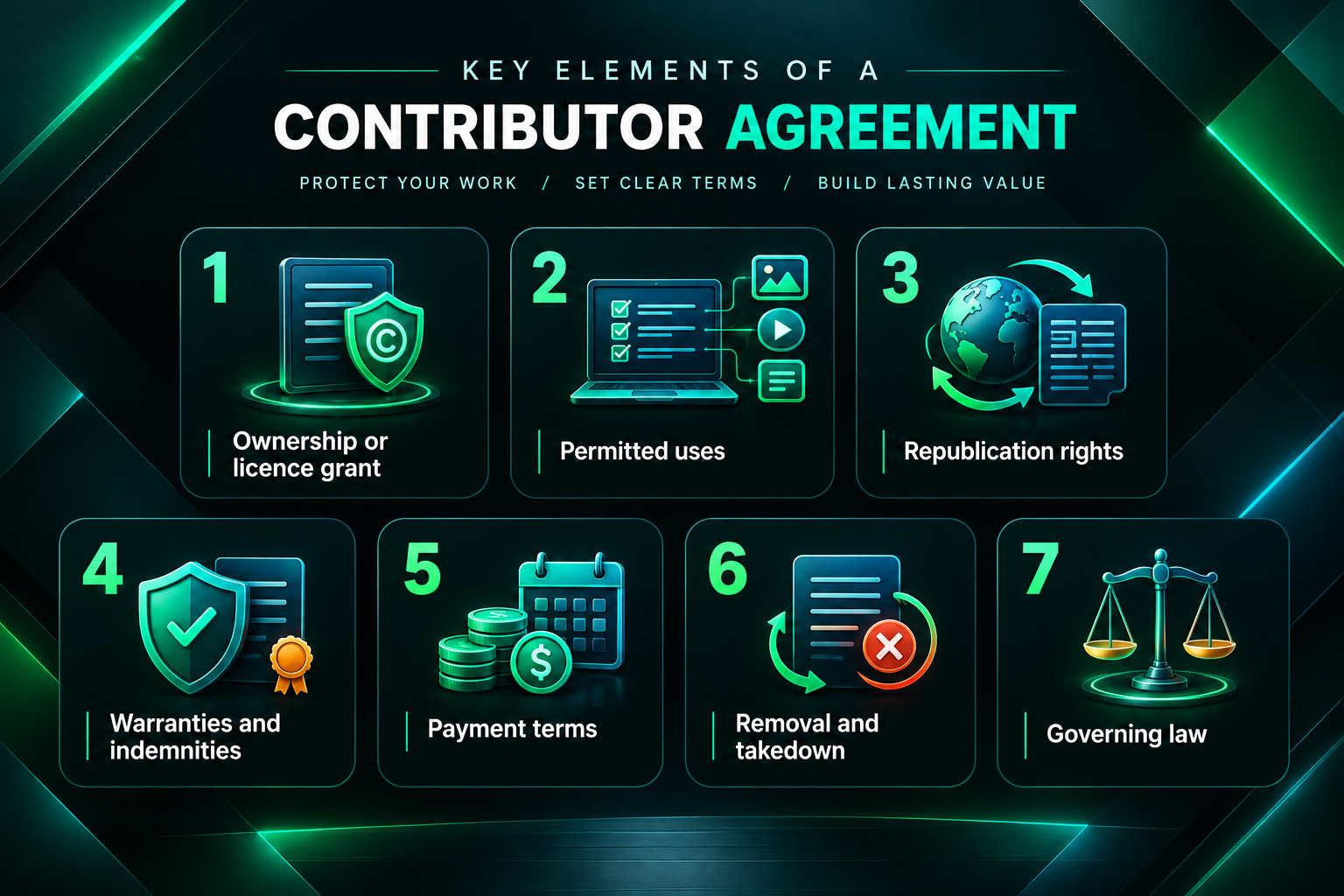
- Ownership or licence grant: Does the writer assign copyright to the publisher, or does the writer retain copyright and grant a licence? If a licence, is it exclusive or non-exclusive, and for how long?
- Permitted uses: What can the publisher do with the content? Can they edit it, translate it, syndicate it, or use it in other formats?
- Republication rights: Can the writer republish the article elsewhere, and if so, after what period or under what conditions?
- Warranties and indemnities: The writer typically warrants that the content is original, does not infringe third-party rights, and is not defamatory. This protects the publisher from legal claims arising from the content.
- Payment terms: If the writer is being paid, the agreement should specify the amount, timing, and whether payment affects copyright ownership.
- Removal and takedown: Under what circumstances can either party request or require removal of the content, and what happens to any embedded links if the content is removed?
- Governing law: Which jurisdiction’s laws apply to the agreement, particularly relevant for international guest posting arrangements.
For straightforward guest posting relationships, a short and clear contributor agreement is usually sufficient. The goal is not to create a complex legal document but to ensure both parties share the same understanding of their rights and obligations before the content is published.
Common Scenarios and Who Likely Owns the Content
Because guest posting arrangements vary widely, it is useful to consider how copyright ownership typically plays out in different practical situations. The following scenarios illustrate the general principles, though the outcome in any specific case depends on the precise terms agreed and the applicable law.
Scenario 1: Freelance Writer Pitches and Submits Without a Contract
A writer approaches a website, pitches an article idea, and submits the finished piece without signing any agreement. The publisher posts the article with a byline. In this situation, the writer almost certainly retains copyright. The publisher has an implied licence to display the content, but the scope of that licence is unclear. Neither party has a written record of what was agreed, which creates uncertainty for both sides if the relationship later becomes contentious.
Scenario 2: Publisher Requires a Signed Contributor Agreement Assigning Copyright
A large publication requires all contributors to sign an agreement transferring copyright to the publisher as a condition of submission. The writer signs and submits the article. Copyright now belongs to the publisher. The writer may retain the right to include the piece in a portfolio if the agreement says so, but they cannot republish it or demand its removal without the publisher’s consent.
Scenario 3: SEO Agency Commissions a Writer to Produce Guest Post Content
An SEO agency hires a freelance writer under a written contract to produce articles for placement on third-party sites as part of a client’s link building campaign. The contract specifies that the work is produced on a work-for-hire basis and that copyright belongs to the agency. The agency owns the content, can submit it to publishers, and retains control over how it is used. The writer is compensated for their time and has no ongoing ownership interest in the articles.
Scenario 4: Writer Retains Copyright and Grants a Non-Exclusive Licence
A writer and publisher agree in writing that the writer retains copyright but grants the publisher a non-exclusive, perpetual licence to display the article. The writer is free to republish the article elsewhere, though they should consider the SEO implications of doing so. The publisher can keep the article live indefinitely but cannot prevent the writer from using the content in other ways.
Practical Implications for SEO and Link Building Campaigns
For businesses running guest posting campaigns as part of a broader link acquisition strategy, copyright considerations are worth building into the campaign workflow rather than treating as an afterthought.
When content is commissioned from freelance writers for placement on third-party sites, establishing clear work-for-hire terms in writing ensures the commissioning business controls the content and can make decisions about its use without needing the writer’s ongoing consent. This is particularly relevant when multiple writers are involved across a large-scale outreach campaign.
When evaluating publishers for guest post placement, it is worth understanding whether the publisher’s contributor guidelines include any copyright terms. Some high-authority publications require copyright assignment as a condition of acceptance, which may affect how the content can be used after placement. Others have no formal policy, leaving the default copyright position in place.
Link retention is a practical concern in any guest posting campaign. While copyright ownership does not guarantee that a link will remain live, a clear agreement that defines the publisher’s right to keep the content published provides more certainty than an informal arrangement. Publishers who own the content outright are generally less likely to face pressure from a writer to remove it, though they may still choose to update, edit, or remove content for editorial reasons unrelated to copyright.
For agencies offering white-label link building services, copyright clarity is also relevant to client relationships. If an agency produces content on behalf of a client and that content is placed on third-party sites, the agency should ensure its contracts with both writers and clients clearly define who owns the content and what happens to it if the client relationship ends.
Frequently Asked Questions
Can a publisher remove a guest post without the writer’s permission?
If the publisher owns the copyright, either through an assignment or a work-for-hire arrangement, they can remove the content at their discretion. If the writer retains copyright and has only granted a licence, the publisher’s right to remove the content depends on the terms of that licence. In practice, most publishers make editorial decisions about content independently, and writers have limited practical recourse unless a specific agreement addresses removal.
Does a byline mean the writer owns the copyright?
Not necessarily. A byline identifies the author for attribution purposes but does not determine copyright ownership. Copyright ownership depends on whether there is a written agreement transferring or licensing rights, and on whether the content was produced under a work-for-hire arrangement. A writer can be credited as the author while the publisher legally owns the copyright.
Can a writer republish their guest post on their own website?
This depends on the agreement between the writer and the publisher. If the writer retains copyright and has granted only a non-exclusive licence, republication may be permissible from a copyright standpoint. However, publishing identical content in multiple locations can create duplicate content considerations from an SEO perspective, and some publisher agreements explicitly prohibit republication. Writers should review any contributor agreement before reusing content elsewhere.
What happens to the backlinks in a guest post if the content is removed?
If a guest post is removed from a publisher’s site, any backlinks embedded in that post cease to exist. This affects the backlink profile of the target page and may, over time, influence the page’s link equity. Copyright ownership does not prevent a publisher from removing content for editorial or business reasons, which is one reason why link retention is never fully guaranteed in any guest posting campaign.
Is a verbal agreement about copyright ownership enforceable?
In most jurisdictions, a copyright assignment must be in writing to be enforceable. A verbal agreement that a publisher owns the content is generally not sufficient to transfer copyright. Licensing arrangements may sometimes be implied from conduct, but written agreements provide far greater certainty for both parties and are strongly advisable for any ongoing guest posting relationship.
Does paying for a guest post automatically transfer copyright to the payer?
Payment alone does not transfer copyright. Copyright ownership depends on the terms of the agreement, not the fact of payment. If a business pays a writer to produce a guest post without a written work-for-hire agreement or copyright assignment, the writer may still retain copyright despite having been paid. Clear written terms are necessary to ensure the intended ownership arrangement is legally effective.
What to Clarify Before Your Next Guest Posting Campaign
Copyright ownership in guest posts is a practical issue that affects content strategy, link retention, and the long-term management of any outreach campaign. The default legal position, that the author owns the copyright unless a written agreement says otherwise, is straightforward in principle but frequently overlooked in practice. Both publishers and contributors benefit from addressing ownership, licensing, and republication rights in writing before content is submitted or published.
For businesses and SEO teams using guest posting as a link acquisition method, building copyright clarity into the content commissioning process reduces uncertainty and supports more predictable campaign outcomes. Agencies managing guest posting on behalf of clients should ensure their contracts with writers, clients, and where possible publishers, reflect the intended ownership and usage arrangements for all content produced.
If your organisation runs regular guest posting campaigns and has not yet reviewed the copyright terms in your contributor agreements or writer contracts, that review is a worthwhile step before scaling outreach activity. Where the legal or contractual questions are complex, particularly in cross-border arrangements or high-value content relationships, seeking qualified legal advice is appropriate. Copyright clarity will not guarantee link permanence or SEO outcomes, but it does provide a more stable foundation for the content relationships that underpin a guest posting strategy.