Plagiarism in guest posts is a more common problem than many publishers and link building teams expect. Whether you are reviewing content submitted by a freelance writer, a client, or an outreach partner, publishing a plagiarised article can damage your site’s editorial reputation, create duplicate content issues, and undermine the SEO value of any links placed within it. This guide explains how to check a guest post for plagiarism effectively, which tools are worth using, what the results actually mean, and how to handle content that does not pass review.
Key Takeaways
- Plagiarism checks should be a standard step in any guest post review workflow, not an afterthought applied only when something looks suspicious.
- No single plagiarism detection tool catches every form of copied or spun content; combining automated checks with a manual review produces more reliable results.
- A similarity score from a detection tool is a starting point, not a verdict — context and source comparison matter before you reject or request a rewrite.
- Duplicate content and AI-generated text that closely mirrors existing sources present distinct but related risks that require different review approaches.
- Establishing a clear editorial policy before accepting guest posts reduces the volume of problematic submissions and sets expectations for contributors.
Why Plagiarism Checks Matter for Guest Posts
Guest posts occupy a specific position in the content ecosystem. A publisher accepts an article written by an external contributor, typically in exchange for a byline and one or more backlinks. Because the publisher did not write the content themselves, they have limited visibility into how it was produced. This creates a straightforward opportunity for unscrupulous contributors to submit content that has been copied from another source, lightly reworded, or assembled from multiple existing articles without meaningful original input.
From a publisher’s perspective, the risks are practical. Search engines index content across the web and can identify when substantially similar text appears on multiple domains. While duplicate content does not automatically trigger a manual penalty, it can dilute the perceived originality of a page and reduce its likelihood of ranking well. More directly, if a publisher’s site becomes associated with low-quality or recycled content, it may attract editorial scrutiny and lose the trust of its readership and linking partners over time.
From a link building perspective, a backlink placed within plagiarised content carries additional risk. If the host page is later deindexed, penalised, or simply ignored by search engines due to quality concerns, the link’s potential SEO value is reduced or eliminated. For agencies and in-house SEO teams managing outreach campaigns, this makes plagiarism checking a quality control step, not merely an editorial courtesy.
What Counts as Plagiarism in a Guest Post
Plagiarism in guest posts is not limited to direct copying. Understanding the different forms helps reviewers know what to look for beyond an obvious copy-paste.
Direct copying
This is the most straightforward form: sentences or paragraphs taken verbatim from another source without attribution. Detection tools handle this well, and it is usually easy to confirm by searching a flagged phrase in a browser.
Paraphrasing without attribution
A contributor rewrites another article’s structure, arguments, and specific points using different words. The ideas and their sequence are borrowed, but the wording is changed enough to reduce similarity scores. This form is harder to detect automatically and often requires a manual review of the source material.
Content spinning
Spinning tools replace words with synonyms and rearrange sentences to produce text that reads differently from the original but contains no original thought. Spun content often reads awkwardly and may score low on plagiarism checkers while still being derivative. Reviewing for readability and coherence alongside a similarity check helps identify this.
Mosaic or patchwork plagiarism
The contributor assembles an article by combining passages from several different sources, making each individual section appear original when checked against any single source. A thorough plagiarism tool that checks against a broad index is more likely to surface this, though manual review of the article’s structure and sourcing is also useful.
AI-generated content that mirrors existing text
Large language models are trained on existing web content and can produce passages that closely resemble published material without directly copying it. This sits in a grey area: it may not register as plagiarism in the traditional sense, but it raises originality concerns. Some detection platforms now include AI-content identification features, though these tools have variable accuracy and should be treated as one signal among several rather than a definitive verdict.
Tools for Checking Guest Post Plagiarism
Several established tools are widely used for plagiarism detection in editorial and SEO workflows. Each has different strengths, index sizes, and pricing structures.
Copyscape
Copyscape is one of the most widely recognised plagiarism detection tools for web content. It compares submitted text against indexed web pages and returns matching URLs with highlighted passages. The premium version allows batch checking and API access, which is useful for teams processing multiple guest post submissions. Copyscape does not check against academic databases, so it is best suited to identifying content copied from other websites rather than published research.
Grammarly’s plagiarism checker
Grammarly includes a plagiarism detection feature in its premium tier that checks text against billions of web pages. It is convenient for reviewers already using Grammarly for proofreading, as both checks can be completed in one pass. The similarity report highlights matched phrases and links to source pages, making it straightforward to verify flagged sections manually.
Quetext
Quetext uses what it describes as DeepSearch technology to identify both direct matches and contextual similarities. It provides a percentage similarity score alongside colour-coded highlights and source links. The free tier allows a limited number of checks per month, while the paid plan removes those restrictions. Quetext is a reasonable option for smaller publishers or teams that do not need bulk processing.
Turnitin
Turnitin is primarily used in academic settings and checks against a large database that includes academic papers, journals, and previously submitted documents. For most web-based guest post workflows, Turnitin is not the most practical choice, but it may be relevant if a contributor is submitting research-heavy content that could have been lifted from academic sources.
Semrush Writing Assistant
Semrush’s Writing Assistant includes an originality check alongside readability and SEO scoring. For teams already using Semrush for keyword research and site auditing, this integration can streamline the review process. The originality feature checks for duplicate content against web sources and provides a score within the same interface used for other content quality assessments.
Small SEO Tools and free alternatives
A range of free online plagiarism checkers exist, including tools from Small SEO Tools, PlagScan, and DupliChecker. These can be useful for occasional checks but typically have word-count limits, smaller indexes, and less reliable detection than paid alternatives. For a high-volume guest post programme, relying solely on free tools introduces meaningful quality control risk.
How to Run a Plagiarism Check Step by Step
Running an effective plagiarism check on a guest post involves more than pasting text into a tool and reading a percentage score. A structured process produces more reliable results and reduces the chance of publishing problematic content.
-
- Receive the submission in a consistent format. Ask contributors to submit content as a plain text document or Google Doc. Formatted files can sometimes cause issues with text extraction in detection tools.
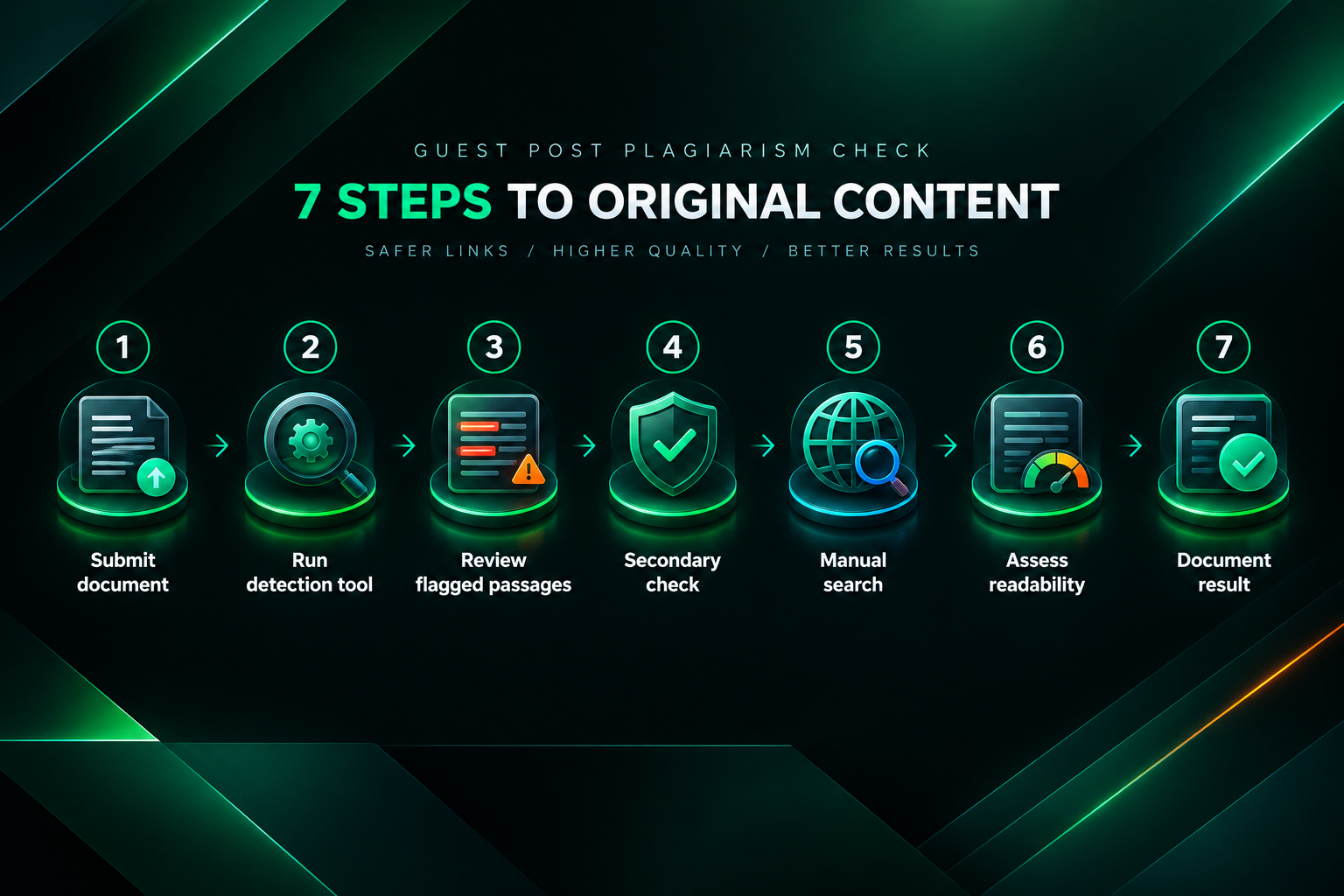
- Run the full article through your primary detection tool. Use a paid tool with a broad web index for the initial check. Note the overall similarity score and any flagged sections.
- Review flagged passages against their cited sources. Click through to each matched URL and compare the flagged text in context. Some matches are legitimate: common phrases, properly quoted material, or standard industry terminology will often appear as matches. These do not indicate plagiarism.
- Run a secondary check if the first result is borderline. If the similarity score is in a grey area — typically between 10% and 25% depending on the tool and content type — run the article through a second tool to cross-reference the findings.
- Search suspicious phrases manually. For passages that read unusually well or seem inconsistent with the rest of the article’s style, copy a distinctive sentence into a search engine with quotation marks. This can surface exact matches that a tool may have missed if the source page was not indexed at the time of the check.
- Assess readability and coherence for signs of spinning. Spun content often has awkward phrasing, inconsistent terminology, or sentences that do not flow naturally. If the article reads strangely despite a low similarity score, treat this as a flag for further review.
- Document the result. Record the tool used, the date, the similarity score, and any flagged sources. This creates an audit trail and helps identify contributors who repeatedly submit borderline content.
Interpreting Similarity Scores
A similarity score from a plagiarism detection tool is not a binary pass or fail. Understanding what the score represents helps reviewers make proportionate decisions rather than rejecting legitimate content or approving problematic submissions.
Most tools express similarity as a percentage of the submitted text that matches content found elsewhere. A score of 0% is unusual for any substantive article, because common phrases, product names, technical terms, and standard sentences will almost always produce some matches. A score below roughly 10% is generally considered low risk for web content, though this threshold varies by tool and content type.
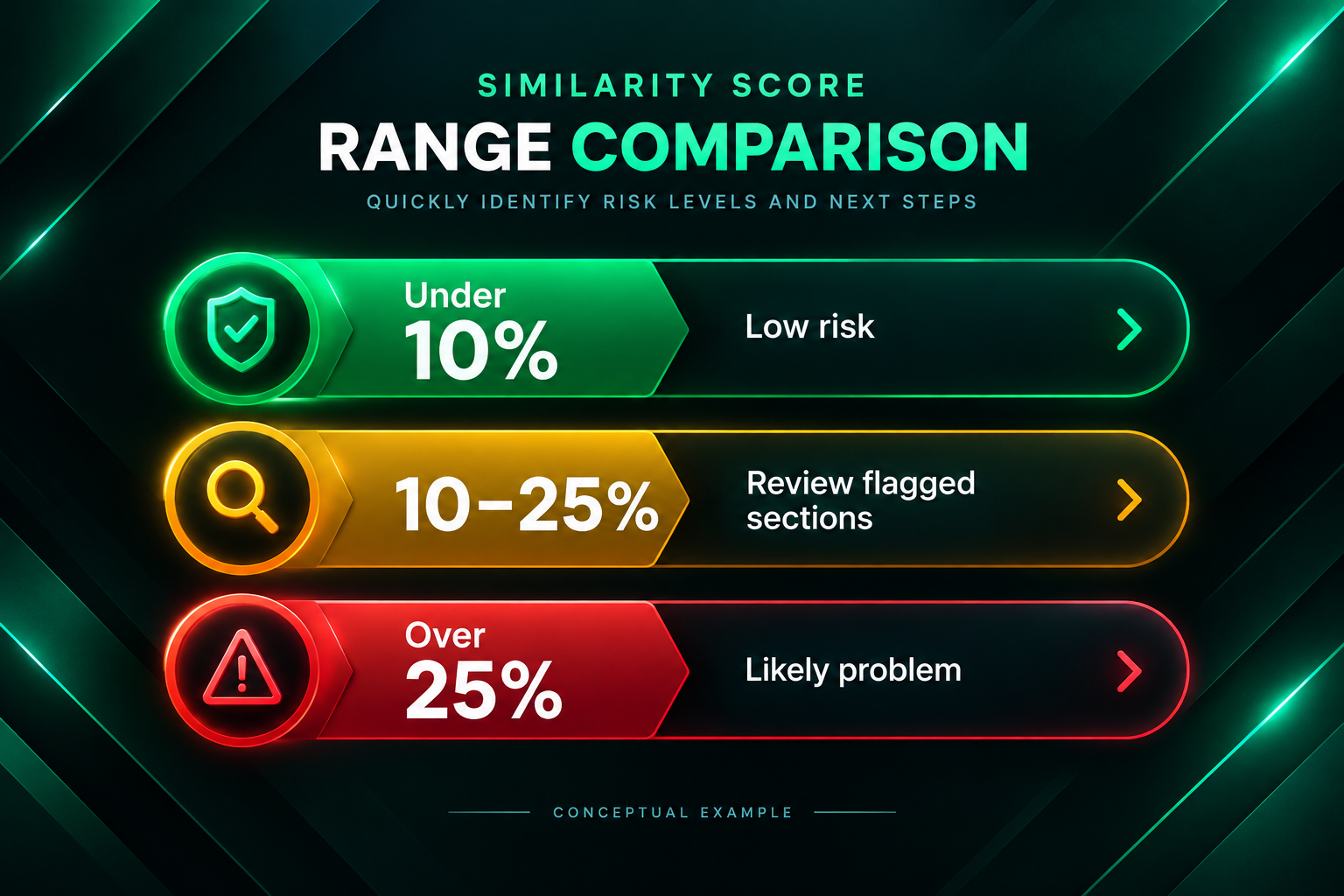
Scores between 10% and 25% warrant closer inspection. The reviewer should examine which sections are flagged and whether the matches are incidental — shared terminology, quoted statistics with attribution, or standard explanatory phrases — or whether they represent borrowed arguments and structure. A score in this range does not automatically mean the content is plagiarised.
Scores above 25% are a stronger signal that the content requires significant revision or rejection, particularly if the flagged sections are substantive paragraphs rather than isolated phrases. However, even a high score should be verified against the matched sources before a final decision is made. An article that quotes extensively from a single authoritative source with proper attribution may score high without being plagiarised in the editorial sense.
What to Do When a Guest Post Fails a Plagiarism Check
When a submission returns a result that indicates a genuine plagiarism problem, the response should be proportionate to the severity and the contributor relationship.
Request a rewrite with specific feedback
For borderline cases or first-time contributors, returning the article with specific feedback about the flagged sections is a reasonable first step. Explain which passages are problematic, link to the matched sources, and ask the contributor to rewrite those sections with original analysis. This approach preserves the contributor relationship while maintaining editorial standards.
Reject the submission
For submissions where a substantial portion of the content is copied or spun, rejection is the appropriate response. A clear, professional explanation of why the content was rejected — without accusation — is sufficient. Retaining a record of the submission and the detection results is advisable in case the contributor disputes the decision.
Review the contributor’s previous submissions
If a contributor has previously had content published on your site and a new submission fails a plagiarism check, it is worth reviewing earlier articles to confirm they were original. Detection tools can be run retrospectively on published content, and search engines can be used to check whether published text appears elsewhere.
Update your contributor guidelines
A plagiarism failure is a useful prompt to review your editorial policy. If your contributor guidelines do not explicitly state that submitted content must be original and unpublished, adding that requirement reduces ambiguity and gives you a clear basis for rejection if a future submission is problematic.
Plagiarism Checks in a Link Building Context
For SEO agencies and in-house teams managing guest post outreach campaigns, plagiarism checking is part of a broader content quality assessment process. A guest post that passes a plagiarism check but is thin, poorly structured, or irrelevant to the target audience still represents a weak placement. Plagiarism detection is one layer of quality control, not a substitute for editorial judgement about content value.
When outsourcing guest post content creation — whether to freelance writers, content agencies, or specialist link building providers — it is reasonable to ask what quality control processes are in place. A reputable provider should be able to confirm that submitted content is checked for originality before delivery and that writers are briefed to produce genuinely original work rather than reworded versions of existing articles.
Publishers who accept guest posts as part of their own editorial model should also consider the reputational dimension. A site that becomes known for publishing recycled or low-quality content will find it harder to attract credible contributors and may see its own authority diminish over time. Consistent plagiarism checking, combined with clear contributor guidelines and a genuine editorial standard, protects the long-term value of the site as a placement destination.
It is also worth noting that the SEO value of a backlink is influenced by the quality of the page it appears on. A link placed in a well-written, original, topically relevant article on an authoritative site is generally considered more valuable than a link in a thin or duplicate-content page. Plagiarism checking therefore supports not just editorial integrity but the practical effectiveness of a link building campaign.
Building a Repeatable Review Workflow
For teams handling a consistent volume of guest post submissions, an ad hoc approach to plagiarism checking creates inconsistency and increases the risk of problematic content slipping through. A documented workflow reduces that risk and makes quality control easier to delegate.
A practical workflow for a guest post programme might include a submission checklist that contributors complete before sending content, confirming that the article is original and has not been published elsewhere. On the reviewer’s side, a standard operating procedure that specifies which tool to use, what similarity threshold triggers a secondary check, and how results should be documented creates consistency across the team. Integrating plagiarism checking into a broader content review checklist — alongside checks for factual accuracy, topical relevance, link placement quality, and readability — ensures that originality is assessed alongside other quality factors rather than in isolation.
For agencies managing white-label link building campaigns or delivering guest posts on behalf of clients, a documented quality control process is also a useful differentiator. Being able to demonstrate that content is checked for originality before delivery supports the credibility of the service and reduces the risk of client complaints about content quality.
Frequently Asked Questions
What similarity percentage is acceptable in a guest post?
There is no universal threshold, but most editorial reviewers treat a similarity score below 10% as low risk. Scores between 10% and 25% warrant closer inspection of the flagged sections. Scores above 25% are a stronger signal of a problem, though the matched content should always be reviewed in context before a final decision is made. Common phrases, properly attributed quotes, and standard industry terminology will produce matches that are not genuine plagiarism.
Can plagiarism checkers detect AI-generated content?
Standard plagiarism detection tools are designed to identify text that matches existing published content. AI-generated text may not match any specific source directly, so it can score low on a traditional plagiarism check even if it lacks original thought. Some platforms now include separate AI-content detection features, but these have variable accuracy. Reviewing AI-generated content for originality of argument and genuine editorial value is a more reliable approach than relying solely on automated detection.
Does duplicate content automatically cause a Google penalty?
Google’s documented guidance distinguishes between duplicate content and deliberate manipulation. Duplicate content does not automatically trigger a manual action, but it can affect how pages are indexed and ranked. When substantially similar content appears on multiple domains, search engines may choose to index only one version, which can reduce the visibility of the other. For guest posts specifically, publishing content that has already appeared elsewhere reduces its originality and may limit its SEO contribution.
Should I check guest posts for plagiarism before or after editing?
Running a plagiarism check on the submitted version before editing is generally more useful. Editing the content first may obscure the original similarity patterns and make it harder to identify the source of any copied passages. Once the check is complete and any issues are resolved, a final editorial review can be conducted on the revised version.
How do I handle a contributor who disputes a plagiarism finding?
Provide the contributor with the specific flagged passages and the matched source URLs so they can review the evidence themselves. In some cases, a contributor may have independently written similar content or may have used a source they believed was in the public domain. Reviewing the matched content together often resolves the dispute. If the evidence of copying is clear and the contributor continues to dispute it, maintaining your editorial decision and documenting the exchange is the appropriate response.
Is it worth checking older published guest posts for plagiarism?
Retrospective checks can be worthwhile if you have reason to believe that previously published content may have been copied, or if a contributor whose earlier work was accepted has since submitted a problematic article. Tools like Copyscape allow you to check a published URL against the web, which can identify whether your content has been copied by others or whether the original submission was itself derived from another source.
Making Plagiarism Checks a Standard Part of Guest Post Quality Control
Checking a guest post for plagiarism is a straightforward process when the right tools and a consistent workflow are in place. The combination of a reliable detection tool, a clear similarity threshold for escalation, and a manual review of flagged passages covers the majority of cases that arise in a typical guest post programme. No automated tool catches every form of derivative content, which is why human editorial judgement remains an essential part of the process — particularly for identifying spun content, mosaic plagiarism, and AI-generated text that lacks original analysis.
For publishers, the motivation is primarily editorial: maintaining the originality and credibility of the site protects its long-term value as a content destination. For SEO teams and link building agencies, the motivation is also practical: a backlink placed in original, high-quality content on a reputable site is more likely to contribute meaningfully to a campaign than one placed in recycled or thin content. Treating plagiarism checking as a non-negotiable step in the guest post review process — rather than an occasional precaution — supports both goals simultaneously.
If you are managing a guest post programme at scale and want to discuss how content quality control fits into a broader link acquisition strategy, speaking with an experienced link building team can help you identify where your current process may have gaps and how to address them efficiently.