Moz Spam Score is a proprietary metric that estimates how closely a website resembles sites that have been penalised or removed from search engine indexes. It is widely used during backlink audits and link prospecting, but it is frequently misunderstood. This article explains what the metric measures, how it is calculated, what the numbers actually mean, and how to use it responsibly when evaluating links or running a link building campaign.
Key Takeaways
- Moz Spam Score is a proprietary Moz metric, not a Google signal. A high score does not confirm that Google has penalised a site.
- The score is based on machine-learning analysis of features shared by sites that were previously penalised or deindexed, not on direct access to Google’s systems.
- A score alone is rarely sufficient to accept or reject a link. Context, topical relevance, editorial quality, and the broader backlink profile all matter.
- Spam Score is one useful data point in a backlink audit, but it should be used alongside other quality signals rather than as a standalone filter.
- Sites with high Spam Scores are not automatically harmful, and sites with low scores are not automatically safe or valuable.
What Moz Spam Score Actually Measures
Moz Spam Score is expressed as a percentage from 0% to 100% and reflects how many features a given website shares with sites that Moz identified as having been penalised or removed from Google’s index. Moz developed the metric using a machine-learning model trained on a large set of penalised and deindexed domains. The model identified patterns, referred to as spam flags, that appeared disproportionately on those sites. A website’s Spam Score reflects how many of those flags are present on that domain.
It is important to understand what the metric does not measure. Moz Spam Score does not reflect a direct signal from Google, Bing, or any other search engine. It does not confirm that a site has received a manual action or an algorithmic penalty. It does not measure content quality, editorial standards, or the genuine authority of a website. The score is a probabilistic estimate based on observed patterns, and like any model, it produces both false positives and false negatives. A legitimate, well-run website can receive a high Spam Score if it happens to share structural or link-profile characteristics with penalised sites. Conversely, a low-quality or manipulative site may score low if it avoids the specific patterns the model was trained to detect.
How the Spam Score Is Calculated
Moz has published a general description of the methodology without disclosing the full list of spam flags or their individual weightings. According to Moz’s own documentation, the model was trained by comparing a large sample of penalised or deindexed domains against a control group of sites that remained indexed. The algorithm identified features that were statistically more common among the penalised group. These features are referred to as spam flags, and each site is assessed against them.
Moz has indicated that the spam flags relate to characteristics such as the ratio of followed to nofollowed links pointing to a site, the diversity of anchor text in the inbound link profile, the number of external links on pages within the site, the presence of thin or low-quality content signals, and domain-level patterns such as the use of certain top-level domains or hosting configurations. The exact list of flags and their current weighting are not publicly disclosed, which means the metric cannot be reverse-engineered or gamed in a straightforward way, but it also means that practitioners cannot always explain precisely why a particular site scores as it does.
The score is recalculated periodically as Moz crawls the web and updates its link index. This means a site’s Spam Score can change over time as its link profile, content, or technical configuration changes, or as Moz’s model is updated.
Understanding the Score Ranges
Moz groups Spam Score into three broad bands that provide a starting point for interpretation. Sites scoring between 1% and 30% are considered low spam, meaning they share relatively few characteristics with penalised sites. Sites scoring between 31% and 60% fall into a medium spam band, suggesting a moderate number of shared features. Sites scoring between 61% and 100% are considered high spam, indicating a substantial overlap with the patterns Moz associated with penalised or deindexed domains.
These bands are useful as a rough triage tool, but they should not be treated as definitive verdicts. Moz itself has noted that a high Spam Score does not mean a site is spammy, and a low score does not mean a site is trustworthy. The score is a signal, not a judgment. A site in the high band warrants closer manual review, but that review may reveal a legitimate website that happens to have an unusual link profile or a particular technical configuration. Similarly, a site in the low band still requires assessment of its content quality, topical relevance, and editorial standards before a link from it can be considered genuinely useful.
Spam Score in the Context of Backlink Audits
Backlink audits are one of the most common use cases for Moz Spam Score. When reviewing an existing link profile, SEO practitioners often use Spam Score as a first-pass filter to identify domains that may warrant closer inspection. A large cluster of high-scoring referring domains can indicate that a site has accumulated links from low-quality sources, whether through past link building activity, negative SEO, or organic accumulation from low-quality directories and scrapers.
However, using Spam Score as the sole criterion for disavowing links is not recommended. Google’s own guidance on disavow files suggests that the tool should be used cautiously and only when there is clear evidence of unnatural or harmful links. Disavowing links based purely on a third-party metric score, without manual review, risks removing links that are genuinely neutral or even beneficial. A more reliable approach is to use Spam Score to prioritise which domains to review manually, then assess each domain based on its content, editorial standards, link placement context, and the plausibility of a genuine editorial relationship.
When conducting a backlink audit for a site that has experienced a significant drop in organic visibility, Spam Score data can be one input among several. Other factors worth examining include whether the drop coincided with a known algorithm update, whether there are crawling or indexing issues, whether content quality or search intent alignment has changed, and whether the site’s technical SEO condition has deteriorated. A decline in rankings or traffic is rarely explained by a single factor, and attributing it to a high average Spam Score across referring domains without further evidence is an oversimplification.
Using Spam Score During Link Prospecting and Outreach
During link prospecting, Spam Score is often used to screen potential link targets before outreach begins. If a domain scores very high, it may be worth deprioritising in favour of sites with cleaner profiles. This can save outreach time and help maintain a more defensible link profile. However, the same caution applies here as in auditing: a high score is a prompt for further review, not an automatic disqualification.
When evaluating a prospective link target, Spam Score should be considered alongside other signals. These include the site’s Domain Authority or similar domain-level metrics from other tools, the quality and relevance of its published content, whether it has a genuine editorial team or identifiable authors, whether it accepts paid placements without disclosure, the diversity and relevance of its existing outbound links, and whether it appears in relevant search results for topics related to your industry. A site that scores 45% on Spam Score but publishes well-researched, topically relevant content with a clear editorial process may be a more valuable link source than a site scoring 10% that publishes thin, generic content across dozens of unrelated topics.
For agencies and in-house teams running manual outreach campaigns, Spam Score can be integrated into a publisher vetting workflow as one checkpoint among several. The goal is not to achieve a portfolio of links exclusively from sites with scores below a certain threshold, but to build a backlink profile that reflects genuine editorial relationships, topical relevance, and a reasonable distribution of domain quality signals.

How Spam Score Relates to Other Link Quality Metrics
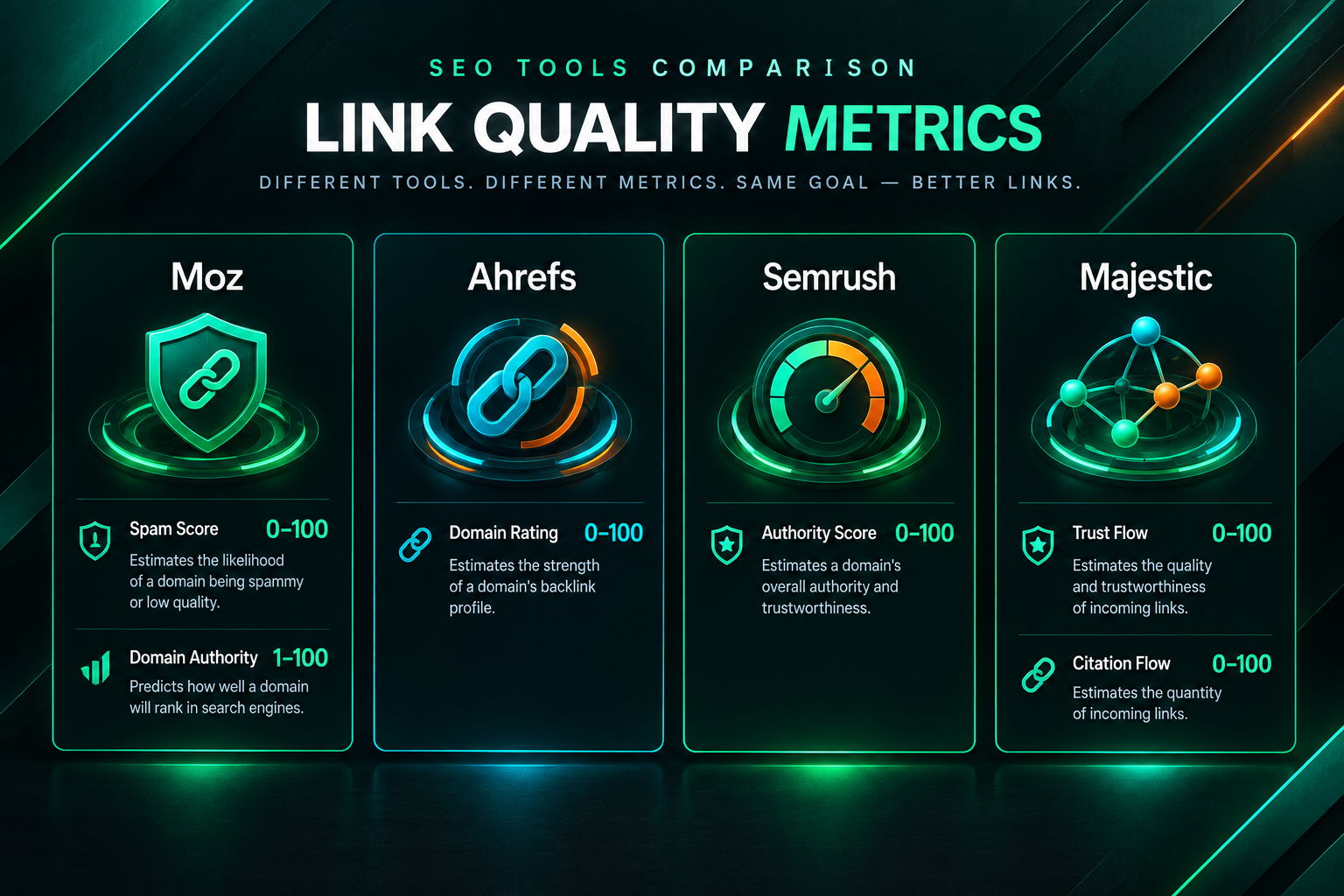
Moz Spam Score is one of several third-party metrics used to assess link quality, and it is worth understanding how it relates to others. Domain Authority, also from Moz, estimates the overall strength of a domain’s link profile relative to other sites in Moz’s index. It is a different type of signal: Domain Authority attempts to predict ranking potential, while Spam Score attempts to identify risk. A site can have a high Domain Authority and a high Spam Score simultaneously, which would suggest a large and active link profile that also shares characteristics with penalised sites.
Ahrefs provides a Domain Rating metric that reflects the strength of a site’s backlink profile based on the quantity and quality of referring domains. Semrush offers an Authority Score that combines link profile data with organic traffic signals. Majestic provides Trust Flow and Citation Flow, which measure the quality and quantity of links respectively. None of these metrics are provided by Google, and none of them directly reflect how Google evaluates a site. They are proprietary estimates built on each tool’s own crawl data and methodology, and they can differ significantly for the same domain.
When assessing link quality for a campaign, using multiple metrics together tends to produce a more reliable picture than relying on any single score. A site that scores poorly across several independent tools is more likely to represent a genuine quality concern than one that scores poorly on only one metric. Conversely, a site that performs reasonably well across multiple signals and passes manual editorial review is generally a more defensible link target, regardless of its Spam Score in isolation.
Common Misconceptions About Moz Spam Score
Several persistent misconceptions affect how Spam Score is used in practice. The first is that a high Spam Score means Google has penalised the site. This is not accurate. Moz’s model was trained on sites that were penalised at the time of training, but the score reflects pattern similarity, not confirmed penalty status. A site may have recovered from a past penalty, or it may never have been penalised at all despite sharing certain characteristics with sites that were.
The second misconception is that links from high-scoring sites will automatically harm a receiving site’s rankings. Google’s systems are designed to ignore links they consider low-quality rather than to penalise the recipient for receiving them. While a pattern of clearly manipulative or low-quality links can attract algorithmic or manual scrutiny, a handful of links from sites with elevated Spam Scores is unlikely to cause measurable harm in most cases. The risk profile depends on the volume, pattern, and nature of the links, not on a single metric threshold.
The third misconception is that achieving a low average Spam Score across a backlink profile is a meaningful SEO goal in itself. The purpose of link building is to earn links that may contribute to improved search visibility, referral traffic, and domain authority signals over time. Optimising for a third-party metric score rather than for genuine editorial quality and topical relevance is unlikely to produce meaningful SEO outcomes and may lead to poor decisions about which links to pursue or disavow.
Practical Limitations of Spam Score
Moz Spam Score has several practical limitations that are worth acknowledging. The metric depends on Moz’s crawl coverage, which does not index the entire web. Sites that Moz has not crawled recently may have outdated scores that do not reflect their current link profile or content quality. Newly registered domains may have no score at all until Moz has gathered sufficient data.
The model was trained on a specific set of penalised sites at a particular point in time. As Google’s algorithms evolve and as the characteristics of spammy sites change, the patterns the model was trained to detect may become less representative of current risk. Moz updates the model periodically, but there is an inherent lag between changes in the web’s link landscape and updates to the metric.
Spam Score also does not account for the specific context of a link placement. A link embedded in a relevant, well-written article on a site with a moderate Spam Score may be more valuable and less risky than a sitewide footer link on a site with a very low Spam Score. The metric operates at the domain level and cannot assess the quality of individual pages, the relevance of specific placements, or the editorial intent behind a link.
How Link Building Campaigns Should Account for Spam Score
For businesses and agencies running link building campaigns, Spam Score is most useful as a triage and review tool rather than as a hard filter. A sensible approach is to flag domains above a certain threshold, such as 60%, for mandatory manual review before outreach or placement approval, while treating domains in the medium range as candidates for standard editorial assessment. Domains in the low range still require review for content quality, topical relevance, and editorial standards, but they do not require the same level of scrutiny as high-scoring sites.
When outsourcing link building, it is reasonable to ask a provider how they incorporate Spam Score and other quality signals into their publisher vetting process. A provider that relies exclusively on Spam Score thresholds without manual editorial review is applying a blunt instrument. A more thorough approach combines metric-based screening with manual assessment of content quality, site relevance, editorial transparency, and link placement context. This is particularly important for campaigns targeting competitive niches, regulated industries, or sites with existing manual actions or a history of aggressive link building.
Ongoing monitoring of a backlink profile, including periodic review of Spam Score distributions across referring domains, can help identify patterns that warrant attention. If a site’s referring domain profile shifts significantly toward higher-scoring domains over a short period, this may indicate that the site is attracting links from low-quality sources and could benefit from a more targeted audit. However, this kind of monitoring should inform decisions rather than trigger automatic disavow actions without further investigation.
Frequently Asked Questions
Is Moz Spam Score the same as a Google penalty?
No. Moz Spam Score is a proprietary metric produced by Moz, not by Google. It reflects how closely a site resembles sites that were penalised or deindexed at the time Moz trained its model. A high score does not confirm that Google has issued a manual action or that the site has been algorithmically demoted. Confirming a Google manual action requires checking Google Search Console directly.
Should I disavow all links from sites with a high Spam Score?
Not automatically. Google recommends using the disavow tool cautiously and only when there is clear evidence of unnatural or harmful links. Using Spam Score as the sole criterion for disavowal risks removing neutral or beneficial links. A better approach is to use the score to prioritise domains for manual review, then make disavow decisions based on a fuller assessment of each domain’s quality and the nature of the link.
What is considered a high Moz Spam Score?
Moz categorises scores from 61% to 100% as high spam, 31% to 60% as medium spam, and 1% to 30% as low spam. These bands are a starting point for triage, not definitive quality verdicts. A site in the high band warrants closer review, but the score alone does not confirm that the site is harmful or that links from it will damage a receiving site’s rankings.
Can a legitimate website have a high Spam Score?
Yes. A legitimate, well-run website can receive a high Spam Score if it shares structural or link-profile characteristics with sites that were penalised when Moz trained its model. For example, a site in a niche where link profiles tend to look unusual, or a site that has accumulated a large number of low-quality inbound links organically, may score high without being a low-quality or manipulative site. Manual review is always necessary to make a reliable assessment.
Does Moz Spam Score affect my site’s Google rankings?
No. Moz Spam Score is not a Google signal and does not directly influence how Google ranks a site. Google uses its own internal systems to assess link quality and site trustworthiness. Improving your Moz Spam Score does not guarantee any change in Google rankings, and a high score does not confirm that Google views your site negatively.
How often is Moz Spam Score updated?
Moz recalculates Spam Score periodically as it crawls the web and updates its link index. The exact update frequency is not publicly disclosed and may vary by domain depending on crawl priority. Scores can change as a site’s link profile, content, or technical configuration changes, or when Moz updates its underlying model.
Should I use Spam Score when choosing sites for guest posting?
Spam Score can be a useful screening signal during guest post prospecting, but it should not be the only criterion. A site’s content quality, topical relevance, editorial standards, existing audience, and the context of the link placement are all important factors. A site with a moderate Spam Score that publishes high-quality, relevant content and has a genuine editorial process may be a more valuable guest posting target than a low-scoring site with thin or irrelevant content.
Using Moz Spam Score Responsibly in Link Evaluation
Moz Spam Score is a genuinely useful tool when applied with appropriate context. It can help prioritise which domains to review during a backlink audit, flag potential quality concerns during link prospecting, and support a more systematic approach to publisher vetting in link building campaigns. Its value lies in its ability to surface patterns that might otherwise require significant manual effort to identify.
Its limitations are equally real. The metric is a probabilistic estimate based on historical patterns, not a direct measure of Google’s assessment of a site. It operates at the domain level and cannot evaluate individual link placements, content quality, or editorial intent. It can produce false positives for legitimate sites and false negatives for sites that have learned to avoid the specific patterns the model detects. Treating it as a definitive quality verdict, rather than as one signal among several, leads to poor decisions in both directions: disavowing useful links and accepting low-quality ones that happen to score well.
For businesses evaluating their backlink profiles or planning link acquisition campaigns, the most reliable approach combines metric-based screening with manual editorial review, attention to topical relevance, and an understanding of the broader SEO context. If you are working with a link building provider or considering outsourcing link acquisition, asking how they incorporate quality signals like Spam Score into their publisher assessment process is a reasonable and worthwhile question. A provider that can explain their vetting methodology clearly, including how they balance metric thresholds with manual editorial judgment, is better positioned to build a link profile that holds up over time.