Competitor backlink analysis is the process of examining the backlink profiles of websites that rank above yours for target keywords, with the goal of understanding what types of links may be contributing to their search visibility and identifying opportunities your own site has not yet pursued. Done well, it gives you a structured starting point for link acquisition rather than guessing which publishers, topics, or link types are worth pursuing in your niche.
Key Takeaways
- Competitor backlink analysis reveals the referring domains, link types, and content assets that may be supporting a competitor’s organic visibility, giving your link building strategy a more informed foundation.
- Third-party metrics such as Domain Rating (Ahrefs), Domain Authority (Moz), and Authority Score (Semrush) are proprietary estimates, not Google signals, and should be used as directional filters rather than definitive quality indicators.
- A backlink gap analysis compares your referring domain profile against multiple competitors to surface link opportunities your site has not yet earned.
- Analysis findings are most useful when they inform outreach priorities, content development, and publisher targeting rather than being treated as a list of links to replicate automatically.
- Competitor link profiles can include paid placements, sponsored content, and lower-quality links alongside genuinely editorial ones, so manual review of individual placements remains important before pursuing any opportunity.
What Competitor Backlink Analysis Actually Involves
At its core, competitor backlink analysis means pulling the backlink data for one or more competing websites and examining the referring domains, anchor text distribution, link types, and content that attracted those links. The practical output is a clearer picture of which publishers are linking to sites in your space, which content formats tend to earn links, and where your own backlink profile has meaningful gaps relative to competitors who outrank you.
The analysis is typically conducted using SEO tools such as Ahrefs, Semrush, or Moz, each of which maintains its own crawled index of the web. These tools surface referring domains, estimated domain-level authority metrics, anchor text, link attributes such as follow or nofollow, and the specific pages receiving links. Google Search Console provides verified backlink data for your own site but does not show competitor profiles, so third-party tools are necessary for competitive research.
It is worth being clear about what these tools measure. Metrics like Domain Rating, Domain Authority, and Authority Score are proprietary calculations based on each tool’s own crawl data and link graph models. They are not provided by Google, they do not directly reflect Google’s internal assessments, and they can vary significantly between tools for the same domain. They are useful as rough filters for identifying higher-authority referring domains, but they should not be treated as guarantees of ranking impact or link quality.
Choosing the Right Competitors to Analyse
The most useful competitors for backlink analysis are not necessarily your direct business competitors. They are the websites that currently rank on page one for the specific keywords and pages you are trying to improve. A local service business may find that its search competitors include directories, review platforms, and industry publications rather than other businesses of the same type. An e-commerce site competing for product category terms may be up against large retailers, comparison sites, and affiliate publishers.
Selecting three to five ranking competitors per target keyword cluster gives you enough data to identify patterns without creating an unmanageable volume of links to review. Prioritise competitors whose content and business model are reasonably similar to yours, since their link profiles are more likely to reflect opportunities that are genuinely accessible to you. A domain with thousands of referring domains built over many years through digital PR campaigns and brand mentions may not represent a realistic short-term benchmark for a newer site.
It is also worth distinguishing between competitors who rank because of their backlink profile and those who rank primarily because of content depth, brand authority, or technical SEO advantages. Backlink analysis alone cannot tell you which factor is dominant, and assuming that replicating a competitor’s links will produce the same rankings oversimplifies how search engines evaluate pages.
How to Conduct the Analysis Step by Step
Step 1: Export Referring Domain Data
Start by entering each competitor’s domain into your chosen SEO tool and exporting the referring domains report rather than the full backlinks report. Referring domains shows you the number of unique websites linking to a competitor, which is generally more useful than raw backlink counts, since a single domain can generate many individual links. Filter for active links and, where the tool allows, sort by the domain-level authority metric to identify the most prominent referring sources first.
Step 2: Run a Backlink Gap Analysis
Most major SEO tools include a backlink gap or link intersect feature that compares your referring domain profile against several competitors simultaneously. The output shows domains that link to one or more of your competitors but not to your site. This is one of the most actionable outputs of competitor backlink analysis because it surfaces specific websites that have already demonstrated a willingness to link to content in your niche, making them more realistic outreach targets than cold prospects with no relevant linking history.
Prioritise gap domains that link to multiple competitors rather than just one. A referring domain that links to three or four competing sites is a stronger signal of editorial relevance to your topic than one that links to a single competitor for reasons that may be unrelated to your niche.
Step 3: Categorise Link Types and Acquisition Methods
Not all backlinks in a competitor’s profile were acquired the same way, and understanding the acquisition method matters for deciding whether an opportunity is worth pursuing. Common link types you will encounter include editorial mentions within relevant articles, guest post bylines, resource page inclusions, directory listings, digital PR coverage, links from tools or data assets, and links from partner or sponsor pages. Some placements may be paid or sponsored, which carries its own considerations under search engine guidelines on link schemes.
Categorising the link types in a competitor’s profile helps you understand which acquisition methods are most prevalent in your niche and which may be most realistic for your own site. A competitor with a large proportion of links from high-authority news publications may have achieved those through a sustained digital PR programme, which requires a different investment and content strategy than a competitor whose links come primarily from niche industry blogs through guest posting.
Step 4: Identify Linkable Content Assets
Examine which specific pages on competitor sites are attracting the most referring domains. These are often not the homepage or core service pages. Frequently linked pages tend to be original research, data studies, comprehensive guides, free tools, industry statistics pages, or well-structured resource hubs. Understanding which content formats attract links in your niche informs your own content development priorities, since creating genuinely useful assets that serve a similar function gives you a reason to reach out to the same publishers with something worth linking to.
This step is sometimes called a content gap analysis when applied to link-attracting assets. If several competitors have earned links to original survey data or industry benchmarks and your site has no equivalent, that represents both a content opportunity and a potential link acquisition opportunity once the asset exists.
Step 5: Assess Individual Placements Before Pursuing Them
Bulk exporting competitor backlinks and treating every referring domain as a target is a common mistake. Individual placement quality varies considerably within any competitor’s profile. A domain with a high authority metric may host thin content, carry heavy advertising, publish links indiscriminately, or have a history of link selling. Conversely, a lower-metric domain that is genuinely relevant to your topic and publishes carefully edited content may offer more meaningful editorial value.
When reviewing individual placements, consider the topical relevance of the linking page to the content being linked, whether the surrounding content is substantive and well-maintained, whether the site appears to publish links selectively or at volume, and whether the link attribute is follow or nofollow. A nofollow or sponsored attribute does not automatically make a link worthless for referral traffic or brand visibility, but it is a relevant factor when the primary goal is passing link equity to a target page.
Anchor Text Patterns and What They Suggest
Reviewing the anchor text distribution across a competitor’s backlink profile can reveal how other sites describe and reference their content. A competitor with a high proportion of branded anchor text and natural descriptive phrases alongside a smaller proportion of exact-match keyword anchors typically reflects an organically developed profile. A profile dominated by exact-match commercial keyword anchors may reflect a more aggressive link building approach, which carries different risk considerations.
Anchor text analysis is useful for understanding how publishers in your niche naturally reference content, which can inform how you frame outreach requests and what anchor text you suggest or accept. However, prescribing specific anchor text ratios as a formula for avoiding search engine penalties is not supported by reliable evidence, and attempting to engineer an exact distribution can itself appear unnatural. The more useful takeaway is whether your own anchor text profile looks broadly consistent with how publishers in your niche naturally link.
Turning Analysis Into a Link Acquisition Plan
The output of a competitor backlink analysis is only useful if it translates into a prioritised and realistic outreach plan. A common failure mode is spending significant time on analysis and then attempting to pursue too many opportunities simultaneously without a clear prioritisation framework.
A practical approach is to segment your gap opportunities into tiers based on topical relevance, the realistic likelihood of earning a link, and the potential value of the placement. Tier one might include resource pages and roundup articles on highly relevant sites where your content clearly fits an existing gap. Tier two might include guest posting opportunities on niche publications where you can contribute original expertise. Tier three might include digital PR targets that would require a dedicated content asset to pursue effectively.
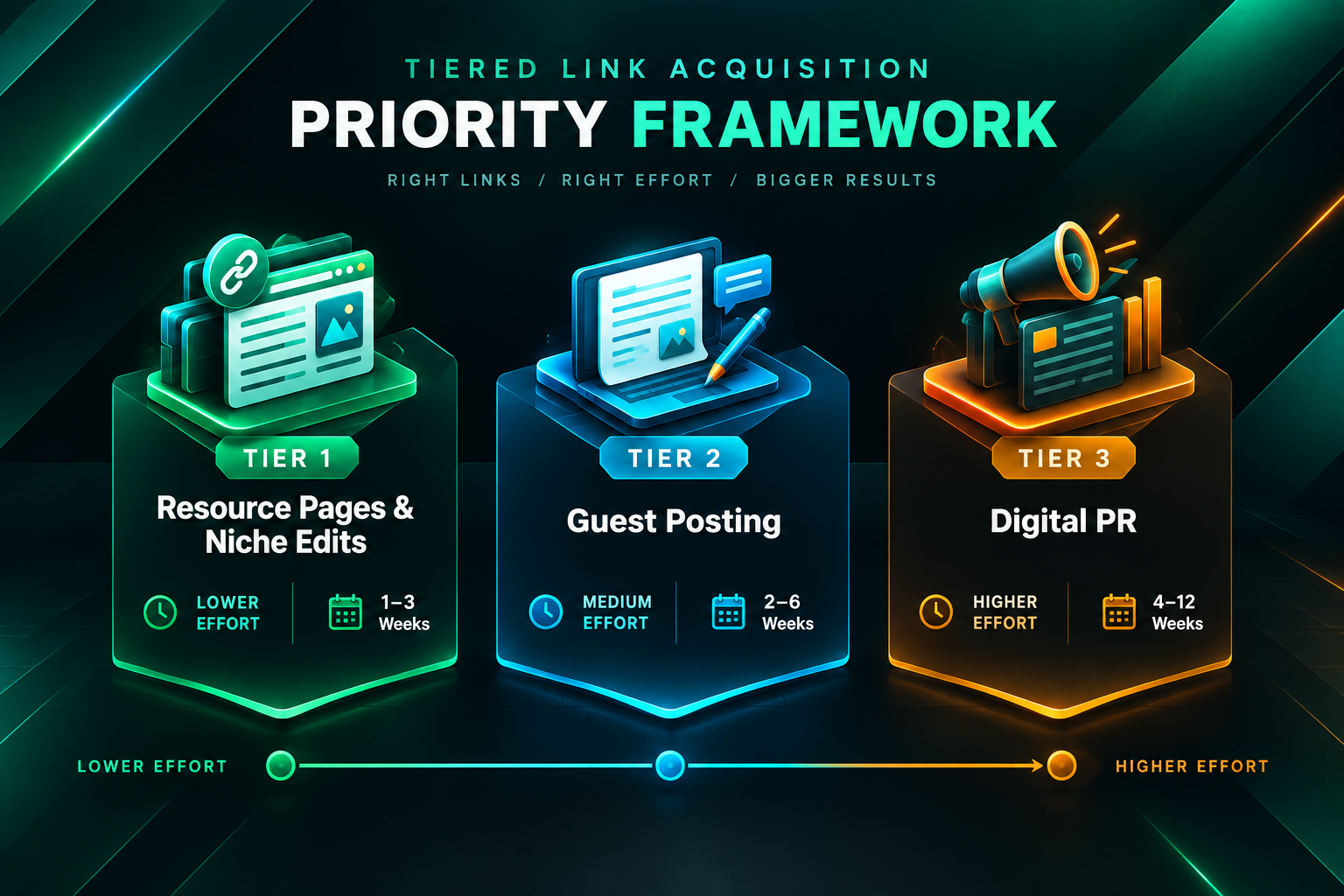
Each tier requires a different outreach approach, a different content investment, and a different timeline. Resource page and niche edit outreach can sometimes produce placements within a few weeks if the publisher is responsive. Guest post outreach typically involves a pitch, editorial review, content creation, and publication process that may take several weeks to a few months per placement. Digital PR campaigns built around original data or research may take longer to develop but can generate multiple links from a single asset.
It is also worth being realistic about conversion rates. Even well-targeted outreach to relevant publishers does not guarantee a response or a placement. Response rates vary by niche, the quality of the pitch, the relevance of the content offered, and the publisher’s current editorial priorities. Building a pipeline of outreach targets rather than pursuing a small number of prospects sequentially gives a campaign more resilience.
Limitations of Competitor Backlink Analysis
Competitor backlink analysis is a useful research method, but it has meaningful limitations that are worth understanding before committing significant resources to it.
Third-party SEO tool indexes are not complete. No tool crawls every page on the web, and the coverage of smaller or newer referring domains varies between tools. A link that appears in Ahrefs may not appear in Semrush, and vice versa. This means that any competitor backlink report is a sample of the actual link profile rather than a complete picture. Cross-referencing two tools can improve coverage for important competitors.
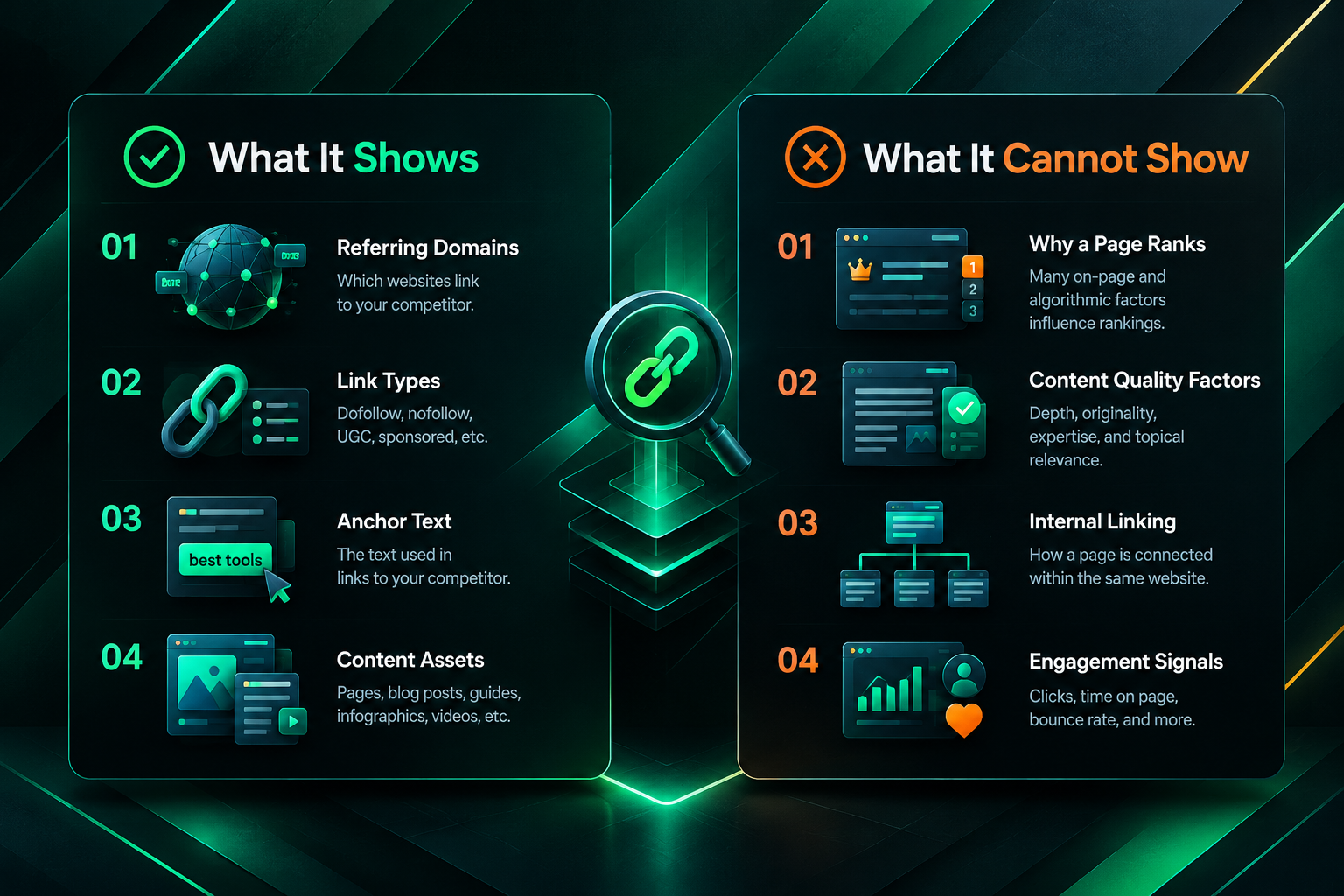
Backlink data does not explain why a competitor ranks. A page may rank because of content quality, topical authority built across many pages, internal linking structure, user engagement signals, or a combination of factors that a backlink report cannot surface. Assuming that acquiring similar links will produce similar rankings treats backlinks as the sole ranking variable, which is not consistent with how search engines evaluate pages in practice.
Competitor link profiles also include links that may be actively harmful to replicate. Paid link placements, links from low-quality directories, and links from sites that appear to sell placements at volume may be present in any competitor’s profile. Pursuing these without manual review introduces risk rather than reducing it. Search engine guidelines on link schemes apply regardless of whether a competitor appears to have used similar tactics without visible consequence.
Finally, the competitive landscape changes. A referring domain that linked to a competitor six months ago may have changed its editorial policy, removed the link, or declined in relevance. Treating a historical backlink export as a static opportunity list without checking current link status and publisher quality can lead to wasted outreach effort.
When Competitor Backlink Analysis Is Most Useful
Competitor backlink analysis tends to deliver the most actionable insight in specific situations. It is particularly useful when you are entering a new niche or launching a new site and need to understand the link landscape before building an outreach strategy. It is also useful when organic rankings for a target keyword cluster have plateaued despite reasonable content quality, and you want to understand whether the referring domain gap between your site and ranking competitors is a likely contributing factor.
For established sites with existing link building programmes, periodic competitor analysis can surface new publishers that have started linking to competitors, identify content assets that are attracting links in your niche, and highlight whether your referring domain growth is keeping pace with competitors over time.
It is less useful as a standalone activity when a site has significant technical SEO issues, thin or poorly structured content, or a manual action from a search engine. In those situations, addressing the underlying issues is likely to have more impact than acquiring additional backlinks, and a site-specific audit is a more appropriate starting point than a competitive link review.
Outsourcing Competitor Backlink Analysis and Link Acquisition
For businesses and agencies without the in-house capacity to conduct thorough competitor research and manage outreach campaigns, outsourcing this work to a specialist provider is one option worth considering. A provider with experience in your niche can conduct the analysis, identify realistic opportunities, manage publisher outreach, and handle the content requirements for guest posts or other placements, reducing the internal workload significantly.
When evaluating a provider, it is reasonable to ask how they assess publisher quality beyond domain-level metrics, how they categorise and prioritise gap opportunities, what their outreach process looks like, and how they handle placements that do not meet quality standards after initial assessment. Transparency about the acquisition method, the types of sites targeted, and the link attributes used is important for understanding what you are getting and whether it aligns with your risk tolerance and goals.
White-label link building services allow agencies to offer link acquisition to their own clients under their own brand, with the provider handling research, outreach, and reporting. This can be a practical arrangement for agencies that want to offer link building without building a dedicated in-house outreach team, though the same quality assessment questions apply regardless of the delivery model.
Frequently Asked Questions
How many competitors should I analyse for backlink research?
Three to five competitors per target keyword cluster is a practical range for most sites. Analysing too few may miss important publisher patterns, while analysing too many creates a volume of data that is difficult to act on. Focus on sites that rank consistently for your priority keywords rather than sites that appear only occasionally in the top results.
Which SEO tool is best for competitor backlink analysis?
Ahrefs, Semrush, and Moz are the most widely used tools for this purpose, each with its own crawl index and proprietary metrics. No single tool has complete coverage of the web, and the referring domain counts and authority metrics they report can differ for the same domain. Using two tools for important competitors can improve the completeness of your data. The best tool for your situation depends on your budget, the other SEO tasks you need it for, and which tool’s interface and reporting format you find most useful.
Does having fewer referring domains than a competitor mean I need more links?
A referring domain gap between your site and a ranking competitor is one possible contributing factor to a ranking difference, but it is not the only one. Content quality, topical relevance, internal linking, technical SEO health, and other factors also influence rankings. A site-specific assessment is more reliable than assuming that closing the referring domain gap will automatically produce ranking improvements.
Should I try to get links from every site that links to my competitors?
No. Competitor backlink profiles contain a mix of high-quality editorial placements, paid or sponsored links, low-quality directory listings, and links that may have been acquired through methods that carry search engine policy risk. Manual review of individual placements before pursuing them is important. Prioritise topically relevant, editorially selective publishers over volume.
How long does it take to see results from link building informed by competitor analysis?
Timelines vary depending on the number of placements acquired, the authority and relevance of the referring domains, how quickly search engines crawl and index new links, and the competitive landscape for your target keywords. Some sites observe measurable changes in rankings or organic traffic within a few months of acquiring relevant links; others see slower or less pronounced changes. Results are not guaranteed and depend on many factors beyond the backlink profile alone.
Can competitor backlink analysis help with content planning?
Yes. Identifying which content types and formats attract the most referring domains in your niche is one of the more practical outputs of the analysis. If original research, data tools, or comprehensive guides consistently attract links from relevant publishers in your space, that is useful information for prioritising content investment alongside outreach.
Using Competitor Backlink Analysis as a Starting Point, Not a Blueprint
Competitor backlink analysis is a research method, not a ranking formula. It gives you a structured way to understand the link landscape in your niche, identify publishers that have already demonstrated relevance to your topic, and surface content gaps that may be worth addressing. That is genuinely useful information for building a more informed link acquisition strategy than one based purely on guesswork or generic outreach lists.
The limitations are real, though. Third-party tool data is incomplete, authority metrics are proprietary estimates rather than Google signals, and a competitor’s backlink profile does not explain all the reasons they rank. Pursuing competitor links without manual quality assessment introduces risk, and treating the analysis as a mechanical replication exercise misses the more important question of whether your content gives publishers a genuine reason to link to you.
The most effective use of competitor backlink analysis is as an input to a broader strategy that also considers content quality, topical relevance, publisher relationships, and realistic outreach conversion rates. If you are considering outsourcing the research and outreach process, discussing your specific goals, target pages, and competitive context with a qualified provider before committing to a campaign is a reasonable first step.