Social media links appear on some of the highest-traffic platforms on the internet, so it is natural to wonder whether they carry the same weight as a link from an editorial website. The short answer is that social media links are technically backlinks in the sense that they point from one site to another, but they are almost universally tagged as nofollow, which means search engines like Google do not pass PageRank through them in the same way they do through standard editorial links. Understanding exactly what that means for your SEO strategy, and where social media genuinely does and does not contribute, can help you allocate your link building budget more effectively.
Key Takeaways
- Social media links are technically backlinks, but they carry the nofollow attribute on virtually every major platform, meaning they do not pass PageRank directly to your site.
- Google has stated that nofollow links from social platforms are not counted as ranking signals in the same way editorial dofollow links are, though the relationship between social signals and rankings remains a topic of ongoing discussion among SEO practitioners.
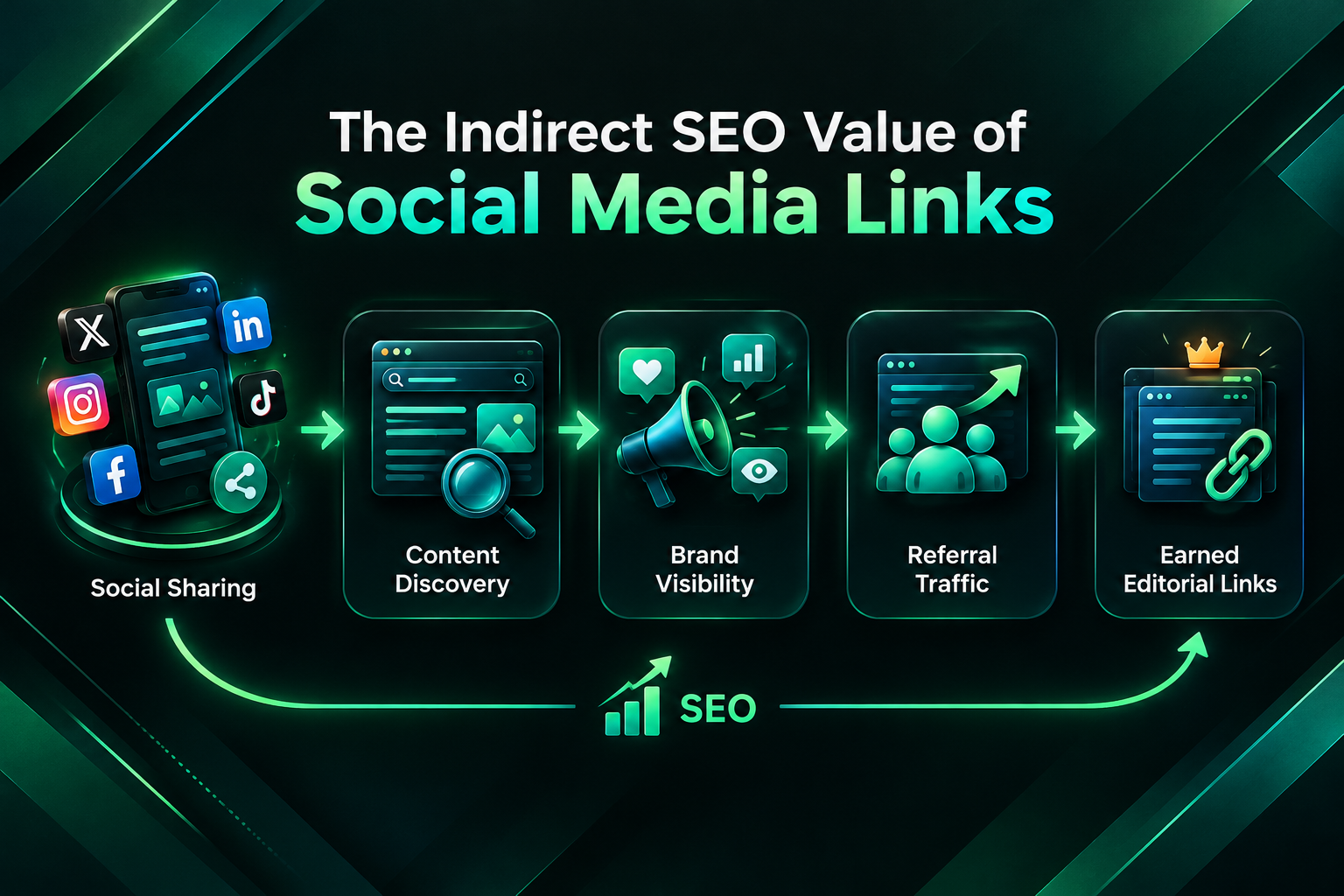
- Social media activity can contribute indirectly to SEO through increased brand visibility, referral traffic, content discovery, and the likelihood that other publishers will find and link to your content editorially.
- For websites that need to build domain authority and improve rankings in competitive niches, editorial backlinks from relevant, quality websites remain the more reliable and measurable link building investment.
- A balanced approach treats social media as a content distribution and brand-building channel rather than a substitute for a structured link acquisition strategy.
What Is a Backlink and How Do Social Media Links Fit?
A backlink is any hyperlink on an external website that points to a page on your site. By that definition, a link shared on Facebook, posted in a LinkedIn article, or embedded in a tweet is technically a backlink. However, the SEO value of a backlink depends heavily on its link attribute, the authority and relevance of the linking domain, the context in which the link appears, and whether search engines choose to follow and credit it.
The two most important link attributes in this context are dofollow and nofollow. A dofollow link instructs search engine crawlers to follow the link and, in Google’s model, to pass a portion of the linking page’s PageRank to the destination. A nofollow link includes the rel="nofollow" attribute, which historically told crawlers not to follow the link or pass ranking credit. Google updated its nofollow guidance in 2019 to treat nofollow as a hint rather than a directive, meaning crawlers may choose to follow nofollow links in some circumstances, but the practical effect on PageRank transfer remains limited and is not guaranteed.
Every major social media platform — including Facebook, Twitter/X, LinkedIn, Instagram, Pinterest, YouTube, and Reddit — applies the nofollow attribute to user-generated links by default. Some platforms, such as Reddit, have introduced the ugc (user-generated content) attribute, which is a more specific signal introduced alongside Google’s 2019 update. The ugc attribute tells Google the link was placed by a user rather than the site’s editorial team, which further reduces the likelihood of ranking credit being passed.
Do Social Media Links Directly Improve Search Rankings?
Based on publicly available guidance from Google, social media links do not directly improve search rankings through PageRank transfer. Google’s John Mueller has addressed this topic on multiple occasions, consistently stating that social media signals — including likes, shares, and follower counts — are not used as direct ranking factors. The nofollow and ugc attributes on social platform links reinforce this position technically.
Some SEO practitioners have observed correlations between high social media engagement and improved rankings, but correlation is not causation. A piece of content that performs well on social media is often high-quality, widely shared, and likely to attract genuine editorial links from other websites — and it is those editorial links, rather than the social shares themselves, that may contribute to ranking improvements. Attributing a ranking gain to social media activity alone, without accounting for the editorial links that social visibility may have generated, overstates the direct SEO value of social platforms.
Bing has historically suggested that social signals may play a more direct role in its ranking algorithm than Google’s, though the extent and consistency of this influence is not fully documented. For most SEO campaigns targeting Google search results, social media links should not be treated as a substitute for editorial link acquisition.
The Indirect SEO Value of Social Media Links
While social media links do not pass PageRank directly, dismissing them entirely would be an oversimplification. Social platforms contribute to SEO in several indirect ways that are worth understanding before deciding how to allocate your content and outreach resources.
Content Discovery and Crawling
Search engine crawlers do visit social media platforms and can discover new URLs through links shared there. If you publish a new piece of content and share it on social media before any other site has linked to it, the social link may help crawlers find and index the page faster than they would through organic link discovery alone. This is a crawling and indexing benefit rather than a ranking benefit, but faster indexing means your content can begin competing in search results sooner.
Brand Visibility and Earned Editorial Links
One of the most meaningful indirect SEO contributions of social media is its role in amplifying content to audiences that include journalists, bloggers, researchers, and other publishers. When a piece of content reaches the right audience through social sharing, it increases the probability that someone with an editorial website will find it, reference it, and link to it without any outreach required. These earned editorial links — which are typically dofollow and contextually relevant — carry genuine ranking value. Social media functions as a distribution channel that makes this kind of organic link acquisition more likely, even if the social links themselves do not pass authority.
Referral Traffic and Engagement Signals
Social media links can drive meaningful referral traffic to your website. While referral traffic from social platforms is not a confirmed direct ranking factor, it contributes to user engagement metrics such as time on page, pages per session, and return visits. High-quality referral traffic that engages with your content may also increase the likelihood of newsletter sign-ups, content shares, and brand searches — all of which can support broader SEO and business goals over time. Brand search volume, in particular, is an area where some SEO researchers believe Google may use engagement signals as a quality indicator, though this remains a hypothesis rather than confirmed policy.
Brand Entity Signals
Consistent brand mentions and links across social platforms may contribute to Google’s understanding of your brand as a legitimate entity. Google’s Knowledge Graph and entity-based understanding of the web means that a brand with a coherent, active presence across multiple authoritative platforms — including social networks — may be easier for Google to verify and trust. This is a brand-level signal rather than a page-level ranking factor, and its direct impact on rankings is difficult to isolate, but it is a reasonable consideration for businesses building long-term organic visibility.
Social Media Links vs. Editorial Backlinks: A Practical Comparison
| Characteristic | Social Media Links | Editorial Backlinks |
|---|---|---|
| Link attribute | Nofollow or UGC (universal) | Dofollow (typically, when earned editorially) |
| PageRank transfer | Not passed directly | Passed when dofollow and indexed |
| Direct ranking impact | Not confirmed by Google | Documented as a significant ranking factor |
| Referral traffic potential | High on active platforms | Variable; depends on publisher audience |
| Content discovery benefit | Yes, can accelerate indexing | Yes, through crawler link-following |
| Topical relevance signal | Limited | Strong when contextually placed |
| Acquisition method | Content sharing, community engagement | Manual outreach, guest posting, digital PR, niche edits |
| Scalability | High; low marginal cost per share | Moderate; requires outreach effort or budget |
| Link longevity | Variable; posts can be deleted or buried | Generally more stable on established publishers |
| Risk of search engine penalty | Very low for organic sharing | Low for white-hat methods; higher for paid or manipulative placements |
Why Nofollow Links Are Not Completely Worthless
The SEO community has debated the value of nofollow links for years, and the consensus has shifted somewhat since Google’s 2019 update. Before that update, nofollow was a strict directive and most practitioners treated nofollow links as having zero SEO value. After the update, Google began treating nofollow as a hint, meaning it reserves the right to follow and potentially credit nofollow links in some circumstances, though it does not guarantee doing so.
From a practical standpoint, a diverse backlink profile that includes a natural proportion of nofollow links — from social platforms, forums, directories, and press mentions — tends to look more organic than a profile consisting entirely of dofollow editorial links. An unnaturally clean backlink profile, where every single link is a dofollow editorial placement, can itself appear manipulative to search engine algorithms. Social media links contribute to this natural diversity without requiring any additional effort beyond your existing content distribution activities.
Nofollow links from high-authority social platforms can also appear in Google Search Console’s link report, which means they are being acknowledged at some level even if PageRank is not being passed. For brand monitoring and backlink profile analysis purposes, tracking these links through tools such as Ahrefs, Semrush, or Majestic can provide useful data on content reach and brand mention patterns.
Which Social Platforms Have the Most Relevance for SEO?
Not all social platforms are equal in their indirect SEO contribution. The relevance of a given platform depends on your industry, target audience, and content format.
LinkedIn is particularly relevant for B2B websites, SaaS companies, and professional service providers. Content shared on LinkedIn can reach decision-makers, industry journalists, and researchers who may link to it from their own publications. LinkedIn articles and posts also tend to rank in Google search results for branded and professional queries, which can support brand visibility even when the links themselves are nofollow.
Reddit and Quora
Reddit and Quora apply ugc attributes to user-generated links, but both platforms can drive highly targeted referral traffic when content is shared in relevant communities. A link shared in a relevant subreddit or as a genuinely helpful Quora answer can reach an audience with strong topical interest, increasing the probability of editorial link acquisition from engaged readers. Reddit threads also frequently appear in Google search results, which can extend the visibility of your content beyond the platform itself.
YouTube
YouTube video descriptions and pinned comments can include links to your website. These links are nofollow, but YouTube is one of the highest-authority domains on the internet, and videos frequently rank in both YouTube search and Google search. A well-optimized YouTube video that links to a relevant page on your site can drive consistent referral traffic and support brand entity recognition over time.
Twitter/X and Facebook
Twitter/X and Facebook links are nofollow and offer limited direct SEO value, but both platforms remain important for content distribution and audience reach. Content that gains traction on these platforms is more likely to be seen by publishers and journalists who may link to it editorially. For digital PR campaigns in particular, Twitter/X remains a platform where journalists and editors are active, making it a useful channel for amplifying newsworthy content.
How Social Media Fits Into a Broader Link Building Strategy
For businesses and SEO teams trying to improve organic rankings in competitive markets, social media activity alone is unlikely to move the needle on domain authority metrics or keyword rankings. The most effective approach treats social media as one component of a broader content and link acquisition strategy rather than a standalone SEO tactic.
A structured link building campaign typically focuses on acquiring editorial backlinks through methods such as manual outreach, guest posting on relevant industry publications, niche edits within existing content, and digital PR. These methods, when executed with attention to publisher quality, topical relevance, and link placement context, are more likely to produce measurable improvements in referring domain counts, domain-level authority metrics, and — over time, depending on competition and other SEO factors — keyword rankings and organic traffic.
Social media supports this process by distributing content to wider audiences, increasing the probability of organic link acquisition, and building the brand signals that make a website more recognizable and trustworthy to both search engines and potential linking publishers. When a publisher receives an outreach email from a brand they have already encountered through social media, the outreach is more likely to be taken seriously. In this way, social media activity can improve the efficiency of manual outreach campaigns without replacing them.
For websites in the early stages of building their backlink profile, combining consistent social media content distribution with a targeted editorial link acquisition campaign is a reasonable approach. The social activity builds brand awareness and content reach while the editorial links build the domain authority and topical relevance signals that search engines use more directly as ranking inputs.
Common Misconceptions About Social Media and SEO
Several persistent misconceptions about social media links and SEO are worth addressing directly, as they can lead to misallocated budgets and unrealistic expectations.
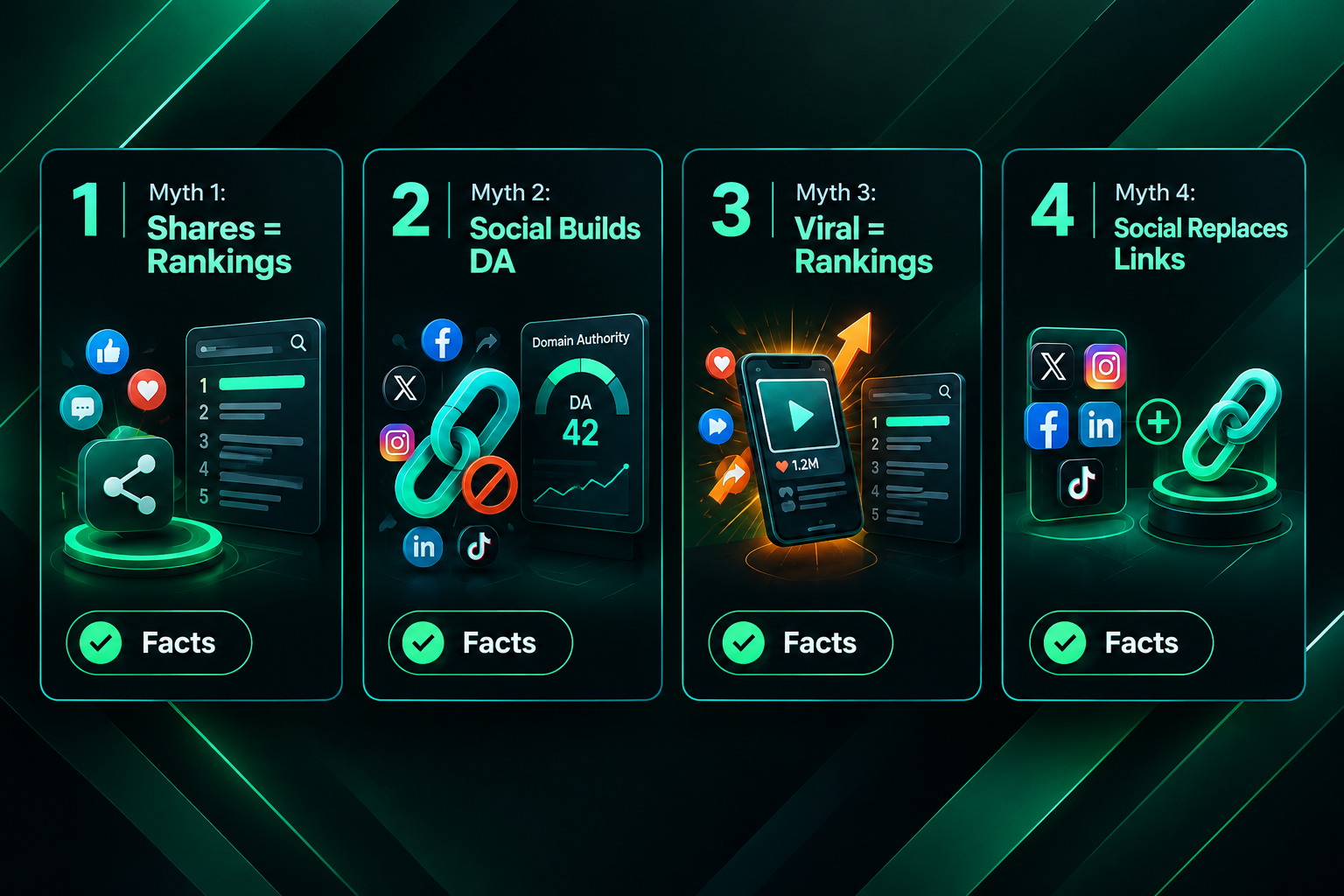
- “More social shares mean better rankings.” Social share counts are not a confirmed Google ranking factor. A page with thousands of social shares but few editorial backlinks will generally rank below a page with strong editorial links and moderate social activity in a competitive niche.
- “Social media links build domain authority.” Third-party domain authority metrics such as Ahrefs’ Domain Rating, Moz’s Domain Authority, and Semrush’s Authority Score are calculated primarily from dofollow backlink profiles. Nofollow social media links have minimal or no effect on these metrics.
- “Going viral on social media will automatically improve my rankings.” Viral social content can improve rankings indirectly if it generates editorial links, but the viral event itself does not produce a ranking benefit. The editorial links that may follow a viral moment are what matter for SEO.
- “I don’t need link building if I’m active on social media.” For competitive keyword targets, editorial backlinks from relevant, authoritative websites remain one of the most important ranking inputs. Social media activity does not substitute for a structured link acquisition strategy in most competitive markets.
Assessing Your Link Building Priorities
Before deciding how much emphasis to place on social media versus editorial link acquisition, it is worth assessing your website’s current situation. A site with strong content, good technical SEO, and a growing social media presence but a thin backlink profile is likely to benefit more from a focused editorial link building campaign than from additional social media investment. Conversely, a site with a reasonable backlink profile but low brand visibility may benefit from increased social media distribution to amplify content reach and support organic link acquisition.
Low organic visibility can have multiple causes beyond a weak backlink profile, including crawling or indexing problems, content that does not match search intent, weak internal linking, or strong competition from established domains. A site-specific SEO audit is the most reliable way to identify which factors are limiting performance before committing to a particular strategy. Link building is not always the first or only priority, and social media is rarely a sufficient substitute for addressing fundamental technical or content issues.
For businesses working with an SEO agency or considering outsourcing their link acquisition, understanding the distinction between social media links and editorial backlinks helps set realistic expectations for what a link building campaign can and cannot achieve. A reputable provider will focus on acquiring contextually relevant, editorially placed links from quality publishers — not on social media activity — and will be transparent about the timelines and limitations involved.
Frequently Asked Questions
Are social media links counted as backlinks by Google?
Social media links are technically backlinks in that they point from one domain to another, but Google applies the nofollow or ugc attribute to virtually all social platform links. Google has stated that nofollow links are not used to pass PageRank, so social media links do not contribute to rankings in the same way editorial dofollow links do. They may still be crawled and can contribute indirectly through content discovery and brand visibility.
Can social media links help my website get indexed faster?
Yes, in some cases. Search engine crawlers visit social media platforms and can discover new URLs through links shared there. Sharing new content on social media shortly after publication may help crawlers find and index the page more quickly, though this is a crawling benefit rather than a ranking benefit.
Do LinkedIn links have any SEO value?
LinkedIn links are nofollow and do not pass PageRank directly. However, LinkedIn is a high-authority domain, and content shared there can reach journalists, researchers, and publishers who may link to it editorially. LinkedIn articles can also rank in Google search results, providing additional brand visibility. The indirect SEO value of LinkedIn is generally higher for B2B and professional service websites than for consumer-facing brands.
Should I focus on social media or link building for SEO?
For improving keyword rankings in competitive markets, editorial link building from relevant, quality websites is generally more effective than social media activity alone. Social media is better understood as a content distribution and brand-building channel that can support link acquisition indirectly. Most effective SEO strategies use both, with social media amplifying content reach and editorial link building providing the authority signals that search engines weight most heavily.
Does a nofollow link from a high-authority social platform have any value?
Nofollow links from high-authority platforms do not pass PageRank, but they can contribute to a natural-looking backlink profile, drive referral traffic, and support content discovery. Since Google’s 2019 update treating nofollow as a hint rather than a directive, there is some possibility that crawlers may follow these links in certain circumstances, though PageRank transfer is not guaranteed. The primary value of high-authority social platform links remains indirect rather than direct.
Can social media activity replace a link building campaign?
For most websites competing in established niches, social media activity alone is unlikely to replicate the ranking benefits of a structured editorial link building campaign. Social platforms do not pass PageRank, and domain authority metrics are driven primarily by dofollow editorial backlinks. Social media can complement a link building campaign by increasing content reach and brand recognition, but it is not a functional substitute for acquiring editorial links from relevant, quality publishers.
Deciding Where Social Media Fits in Your SEO Strategy
Social media links are real backlinks in a technical sense, but their direct contribution to search rankings is limited by the nofollow and ugc attributes that every major platform applies. Google does not treat social media links as PageRank-passing ranking signals, and third-party domain authority metrics are not meaningfully influenced by social platform links. For businesses and SEO teams focused on improving organic rankings in competitive markets, editorial backlinks from relevant, quality websites remain the more reliable and measurable investment.
That said, social media is not irrelevant to SEO. Its value lies in content distribution, brand visibility, referral traffic, faster content discovery, and the indirect probability of earning editorial links from publishers who encounter your content through social channels. Treating social media as a distribution layer that supports your link acquisition strategy — rather than a replacement for it — is the most accurate and practical way to integrate it into your overall approach.
If your website has a thin backlink profile and you are competing for keywords with established domains, a structured editorial link building campaign is likely to produce more measurable SEO results than increased social media activity. Understanding this distinction helps you allocate resources where they are most likely to move the metrics that matter. If you are unsure where your website’s link profile stands relative to your competition, a professional backlink audit and campaign assessment can provide a clearer picture before you commit to a particular strategy.