A backlink profile is the complete collection of external links pointing to a website, along with the characteristics that define their quality, relevance, and diversity. Understanding your backlink profile matters because search engines like Google use links as one of several signals when evaluating a page’s authority and relevance. Before building new links or auditing an existing campaign, it helps to understand what a healthy profile looks like, what warning signs to watch for, and which factors genuinely influence how links are assessed.
Key Takeaways
- A backlink profile includes every external link pointing to your site, along with attributes such as link source quality, anchor text distribution, referring domain diversity, and link placement context.
- Profile quality matters more than raw link count. A small number of editorially relevant links from authoritative, topically related sources may carry more weight than a large volume of low-quality links.
- Third-party metrics such as Domain Rating (Ahrefs), Domain Authority (Moz), and Trust Flow (Majestic) are useful for comparative analysis but are not Google ranking signals and should not be treated as guarantees of performance.
- A weak or unnatural-looking backlink profile can result from over-optimised anchor text, links from irrelevant or low-quality sources, or an unnatural acquisition pace — all of which may attract search engine scrutiny.
- Assessing your backlink profile before starting a link building campaign helps identify gaps, risks, and realistic priorities rather than building links without strategic context.
What a Backlink Profile Actually Contains
A backlink profile is not simply a list of URLs. It is a structured dataset that describes the origin, context, and attributes of every inbound link a website has accumulated. SEO tools such as Ahrefs, Semrush, Moz, and Majestic each crawl the web independently and compile this data into reports that allow you to analyse your link landscape in detail. Because each tool has its own crawler and index, the numbers they report will differ, and none of them reflects Google’s own link graph exactly.
The core components of a backlink profile include the total number of backlinks, the number of unique referring domains, the pages on your site that receive links (known as link targets or destination pages), the anchor text used in each link, the link attributes applied (such as dofollow, nofollow, sponsored, or ugc), and the topical and geographic context of the linking pages. Each of these dimensions tells a different part of the story about how your site has acquired links and whether that pattern looks natural to a search engine evaluating it algorithmically.
Referring domains — the number of distinct websites linking to you — are generally considered a more meaningful indicator than raw backlink count. A single domain can generate hundreds of links, but those links typically carry diminishing incremental value compared to links from a broad set of independent, relevant sources. This is why link building strategies that prioritise referring domain diversity tend to be more sustainable than those focused purely on link volume.
How Backlink Profile Structure Affects SEO
Search engines assess backlink profiles as part of a broader evaluation of a page’s trustworthiness and relevance. Google’s documentation describes links as a way for pages to vouch for one another, and the quality and context of that endorsement matters. A well-structured backlink profile tends to reflect genuine editorial interest from a range of relevant sources, accumulated at a pace consistent with the site’s content output and growth trajectory.
Profile structure influences SEO in several interconnected ways. The topical relevance of linking pages helps search engines understand what a site is about and which queries it should be considered for. The authority of linking domains — assessed through third-party metrics as a proxy, since Google’s PageRank is not publicly available — provides a rough signal of how credible those endorsements might be. The distribution of anchor text across a profile affects how naturally the link acquisition appears; a profile where most links use the same exact-match commercial keyword phrase as anchor text may look manipulated, while a profile with varied, contextually appropriate anchor text tends to look more organic.
It is important to note that backlinks are one ranking factor among many. Content quality, technical SEO health, search intent alignment, internal linking, and user experience signals all contribute to how a page performs in search results. A strong backlink profile cannot compensate for weak content or significant technical problems, and improving a backlink profile alone does not guarantee ranking improvements. The relationship between links and rankings is well-documented as correlational in industry research, but causation is difficult to isolate in any individual case.
Key Quality Factors in a Backlink Profile
Assessing backlink profile quality requires looking at several factors together rather than relying on any single metric. The following dimensions are the most commonly evaluated when auditing or planning a link building campaign.
Referring Domain Authority and Relevance
Links from websites that are themselves well-established, frequently cited, and topically relevant to your industry tend to carry more weight than links from unrelated or low-traffic sites. Third-party metrics such as Domain Rating (DR) from Ahrefs, Domain Authority (DA) from Moz, Authority Score from Semrush, and Trust Flow from Majestic each attempt to model this in different ways. These metrics are useful for comparative benchmarking and for filtering obviously low-quality sources, but they are proprietary calculations, not Google signals, and a high score does not guarantee that a link will influence rankings positively. Topical relevance — whether the linking page covers subject matter related to your own — is a dimension that metrics alone do not fully capture and requires manual review.
Anchor Text Distribution
Anchor text is the clickable text used in a hyperlink. A natural backlink profile typically contains a mix of branded anchors (your company or website name), generic anchors (such as “click here” or “read more”), partial-match anchors that include a keyword alongside other words, and a smaller proportion of exact-match keyword anchors. When exact-match commercial anchors dominate a profile, it can appear as though links were acquired specifically to manipulate rankings for those terms, which may attract algorithmic or manual scrutiny. There is no universally correct ratio, and the appropriate distribution varies by industry, website age, and competitive context. Prescribing fixed percentages without a site-specific assessment is not reliable practice.
Link Placement and Editorial Context
Where a link appears on a page and how it is integrated into the surrounding content affects its perceived quality. A link embedded naturally within the body of a relevant article, where it adds genuine value for the reader, is generally considered more editorially credible than a link in a footer, sidebar, or author bio. Links that appear in content written specifically to host them — without genuine editorial selection — occupy a different category from links earned because a publisher independently chose to reference a resource. This distinction matters both for how search engines may evaluate the link and for the long-term sustainability of the placement.
Link Attributes: Dofollow vs Nofollow and Beyond
A dofollow link passes link equity — sometimes called “link juice” — from the linking page to the destination. A nofollow link includes an HTML attribute that historically instructed search engines not to follow or count the link for ranking purposes, though Google has since described nofollow as a hint rather than a directive. Additional attributes introduced by Google in 2019 — sponsored for paid or affiliate links and ugc for user-generated content — provide further context about link origin. A healthy backlink profile typically contains a mix of link attributes, reflecting the natural variety of contexts in which links are acquired. A profile consisting almost entirely of dofollow links from guest posts or paid placements may look less organic than one that includes editorial mentions, directory listings, and social references alongside more deliberate link building activity.
Referring Domain Diversity and Geographic Distribution
A profile drawing links from a wide range of independent domains, across different website types and geographic regions, generally looks more natural than one concentrated in a narrow set of sources. For businesses targeting specific markets, the geographic distribution of referring domains can also be relevant — links from locally relevant or regionally authoritative sources may support local or regional search visibility more effectively than links from unrelated international domains. Similarly, links from a variety of content types — editorial articles, resource pages, industry directories, news sites, and partner pages — tend to reflect a more organic acquisition pattern than links concentrated in a single format.
Spam and Toxic Link Signals
Some backlinks may come from sources that search engines associate with manipulative link schemes: link farms, private blog networks (PBNs), low-quality article directories, or sites with no clear editorial purpose. These links may not help rankings and, in sufficient volume or in combination with other manipulative signals, may contribute to algorithmic filtering or a manual action from Google. Identifying and addressing these links — typically through disavow files submitted via Google Search Console — is a standard part of a backlink audit. However, the threshold at which low-quality links cause measurable harm is not publicly defined, and disavowing links carries its own risks if applied too broadly. A site-specific assessment is advisable before taking action.
How to Analyse Your Backlink Profile
Backlink profile analysis typically begins with exporting data from one or more SEO tools and reviewing it against the quality dimensions described above. Because no single tool captures every link Google has indexed, cross-referencing data from Ahrefs, Semrush, or Majestic alongside Google Search Console’s Links report provides a more complete picture. Google Search Console shows links Google has chosen to report, which may differ from what third-party crawlers have found.
A practical audit workflow generally covers the following areas: reviewing the total referring domain count and its growth trend over time; identifying the pages on your site that attract the most links and whether those are your strategically important pages; examining anchor text distribution for signs of over-optimisation; assessing the topical relevance and authority of the top referring domains; identifying any links from clearly low-quality or irrelevant sources; and comparing your profile against competitors in the same niche to understand relative link gaps.
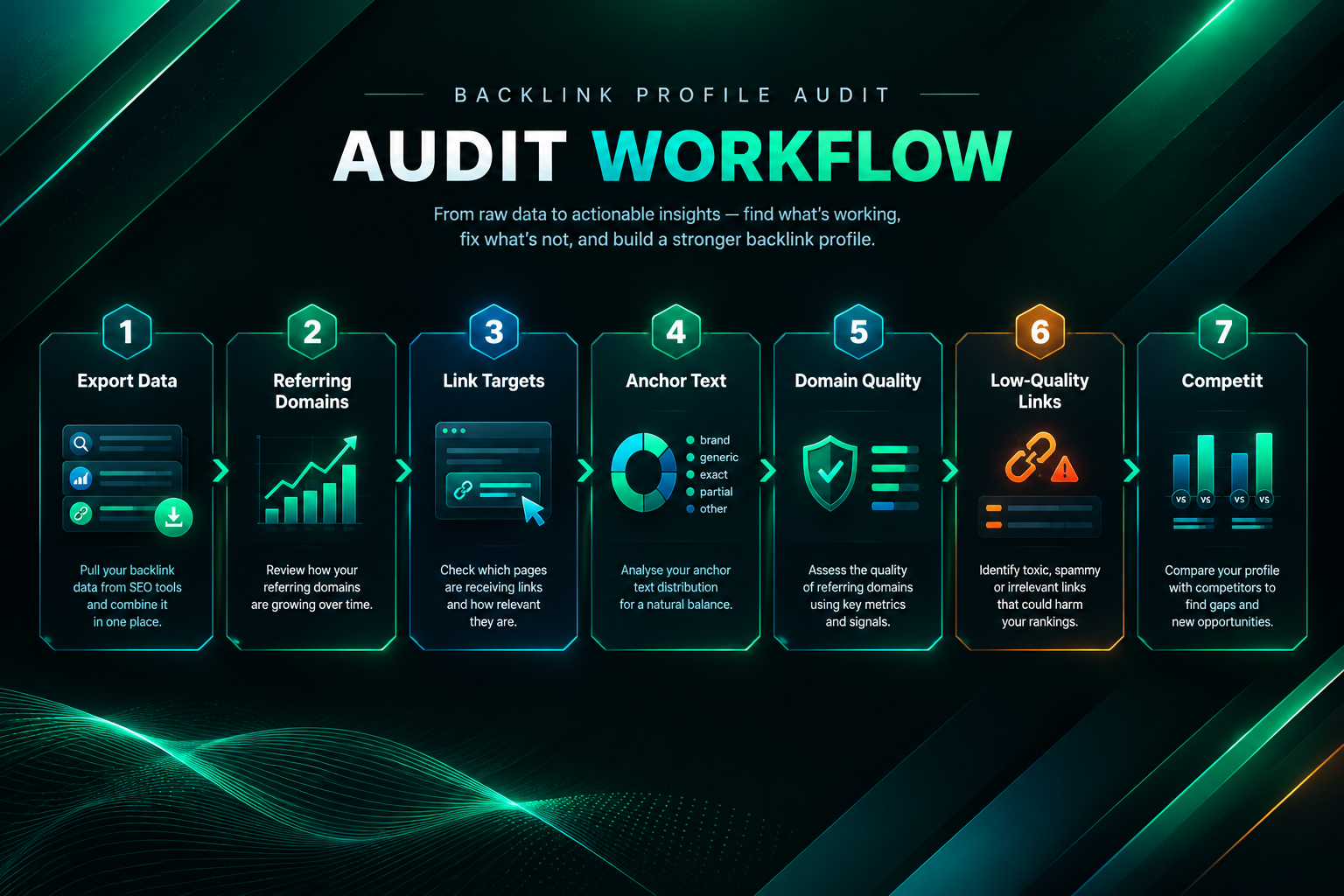
Competitor backlink analysis is a useful component of this process. By reviewing the referring domains and link targets of competing pages that rank well for your target keywords, you can identify the types of sources and content formats that attract links in your industry, as well as gaps in your own profile where relevant link acquisition may be beneficial. This analysis informs campaign strategy rather than providing a guaranteed formula for ranking improvement.
Common Backlink Profile Problems and What They Indicate
Several patterns in a backlink profile may indicate problems worth addressing before or during a link building campaign.
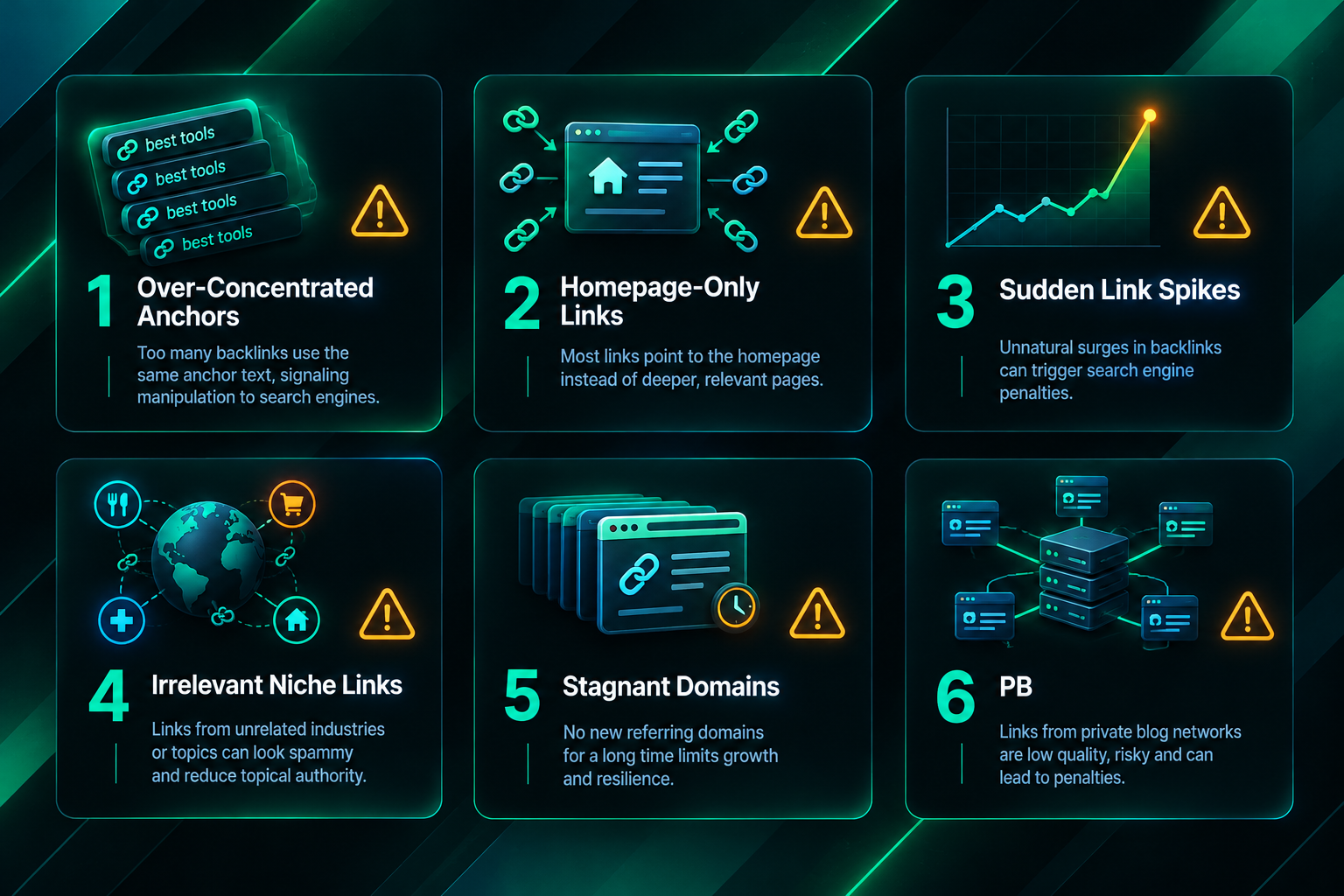
- Over-concentrated anchor text: A high proportion of exact-match commercial keyword anchors may suggest previous manipulative link building and can attract algorithmic scrutiny.
- Links concentrated on the homepage only: A profile where almost all links point to the homepage, with few or no links to internal pages, may indicate missed opportunities for deep linking to product, service, or content pages that need ranking support.
- Sudden spikes in link acquisition: A sharp, unexplained increase in referring domains over a short period — particularly if those domains are low-quality — may look unnatural and could attract review.
- High proportion of links from irrelevant niches: Links from sites with no topical connection to your industry may contribute little to relevance signals and, in large volumes, may dilute the profile’s coherence.
- Stagnant or declining referring domain count: If referring domains are not growing, or if links are being lost faster than they are acquired, the profile may be weakening relative to competitors who are actively building links.
- Links from known link networks or PBNs: These carry a higher risk of algorithmic devaluation or manual action and are generally worth identifying and disavowing where clearly identifiable.
It is worth noting that not every problem in a backlink profile requires immediate action. Some low-quality links may have negligible impact, and aggressive disavow activity can sometimes remove links that were contributing positively. Prioritising the most significant issues and making decisions based on a thorough audit rather than automated “toxic score” alerts from tools is generally a more reliable approach.
Backlink Profile Structure and Link Building Strategy
Understanding your current backlink profile is a prerequisite for planning an effective link building campaign. Without this baseline, it is difficult to identify which pages need link support, which anchor text patterns to avoid reinforcing, which types of referring domains are already well-represented, and which gaps represent the most meaningful opportunities.
For example, a site with a strong homepage profile but few links to its core service or product pages may benefit from a campaign focused on deep linking — acquiring links that point directly to those target pages rather than to the homepage. A site with a narrow referring domain base concentrated in a single content format may benefit from diversifying into different link types such as digital PR placements, resource page links, or industry directory listings alongside guest post outreach.

The pace of link acquisition also matters. Building a large number of links in a short period — particularly if those links share similar characteristics — can look unnatural compared to a site’s historical acquisition rate. A campaign that builds links gradually, from a variety of relevant sources, at a pace consistent with the site’s content and growth activity, tends to produce a more sustainable profile over time. This does not mean link building must be slow, but it does mean that volume alone is not a reliable measure of campaign quality.
When working with an outsourced link building provider, sharing your backlink profile data at the outset allows the provider to tailor the campaign to your actual needs rather than applying a generic approach. This includes aligning anchor text choices with your existing distribution, targeting referring domain types that complement rather than duplicate your current profile, and prioritising the pages that will benefit most from additional link equity.
Backlink Profile Monitoring Over Time
A backlink profile is not static. Links are gained and lost continuously as publishers update content, remove pages, or change their linking practices. Monitoring your profile on a regular basis — typically monthly for active campaigns — allows you to identify lost links that may be worth reclaiming, spot new links that may require review, track the growth of referring domains against campaign targets, and detect any unusual patterns that warrant investigation.
Link reclamation — identifying recently lost links and reaching out to publishers to restore them — is a lower-effort way to recover link equity that was previously contributing to your profile. This is particularly relevant for links from high-authority or highly relevant sources where the loss may have a measurable impact on the pages they were pointing to.
Reporting on backlink profile changes over time also helps distinguish between the effects of link building activity and other factors affecting organic performance. Because rankings and traffic are influenced by many variables simultaneously — algorithm updates, competitor activity, content changes, technical issues — attributing specific ranking movements to individual link acquisitions is rarely straightforward. Tracking referring domain growth, anchor text distribution changes, and link target coverage alongside organic performance metrics provides a more complete picture than link counts alone.
Frequently Asked Questions
What is the difference between a backlink and a referring domain?
A backlink is a single hyperlink from one page to another. A referring domain is the website that hosts one or more of those links. A single referring domain can generate many backlinks — for example, if a site links to you from ten different articles. Referring domain count is generally considered a more meaningful measure of profile breadth than total backlink count, because links from the same domain tend to carry diminishing incremental value.
How many backlinks does a website need to rank?
There is no fixed number. The links needed to compete for a given keyword depend on the competitiveness of the query, the quality and relevance of existing links pointing to competing pages, the content quality and technical health of your own site, and many other factors. Comparing your referring domain count and link quality against the pages currently ranking for your target keywords provides a more useful benchmark than any universal figure.
Are nofollow links worth acquiring?
Nofollow links do not pass link equity in the traditional sense, though Google has described the nofollow attribute as a hint rather than an absolute directive since 2019. Nofollow links from relevant, high-traffic sources can still drive referral traffic, support brand visibility, and contribute to a natural-looking link profile. A profile consisting exclusively of dofollow links may itself look unusual, so a mix of link attributes is generally considered healthier than optimising purely for dofollow placements.
What tools can I use to analyse my backlink profile?
The most widely used tools for backlink profile analysis include Ahrefs, Semrush, Moz, and Majestic. Each has its own crawler, index size, and proprietary metrics, so the data they report will differ. Google Search Console provides a Links report showing links Google has chosen to surface, which is a useful complement to third-party tool data. Using more than one source gives a more complete picture of your profile.
Can a bad backlink profile cause a Google penalty?
A backlink profile with a high proportion of links from manipulative or low-quality sources may contribute to algorithmic filtering — where Google discounts or ignores those links — or, in more serious cases, a manual action if Google’s spam team determines that the site has engaged in link schemes. Manual actions are documented in Google Search Console. Not every low-quality link causes a penalty, and the threshold varies. If you suspect a manual action, reviewing the Search Console manual actions report and conducting a thorough backlink audit is the appropriate starting point.
How often should I audit my backlink profile?
For most websites running active link building campaigns, a monthly review is a reasonable baseline. Sites that have experienced significant ranking drops, algorithm updates, or previous link-related issues may benefit from more frequent monitoring. A full audit — covering anchor text distribution, referring domain quality, link target coverage, and lost link identification — is typically conducted quarterly or when a significant change in organic performance occurs.
What Your Backlink Profile Tells You Before You Build a Single Link
A backlink profile audit is most valuable not as a retrospective exercise but as a strategic starting point. Before committing to a link building campaign, understanding your current profile tells you which pages are already well-supported and which are underserved, whether your anchor text distribution leaves room for targeted keyword anchors or requires more branded and generic variation, which referring domain types are already represented and which gaps are worth filling, and whether any existing links may be creating risk that should be addressed before new links are added.
This baseline assessment shapes every subsequent decision: which pages to target, which anchor text to use, which types of publishers to approach, and at what pace to build. Without it, link building activity risks reinforcing existing weaknesses or creating new ones rather than addressing the gaps that matter most for organic performance.
If you are planning a link building campaign and want to ensure it is built on an accurate understanding of your current profile, working with a provider who begins with a profile review rather than immediately acquiring links is a meaningful quality signal. A campaign grounded in your actual backlink data is more likely to complement your existing strengths and address genuine gaps than one that applies a generic template regardless of where your site currently stands.