Sitewide backlinks appear on every page of a linking website, typically in the footer, sidebar, or navigation area. Because a single placement can generate hundreds or thousands of individual backlink URLs, they look very different from a standard editorial link pointing from one page to another. Understanding what sitewide backlinks are, how search engines interpret them, and when they may help or hurt a campaign is essential before deciding whether they belong in a link building strategy.
Key Takeaways
- A sitewide backlink is a link placed in a template element such as a footer or sidebar, causing it to appear on every page of the linking domain rather than on a single page.
- Search engines such as Google have historically treated sitewide links with caution, often consolidating their value or discounting repeated instances from the same domain.
- Sitewide links acquired through paid arrangements or link schemes carry a higher risk of violating Google’s spam policies than editorially placed single-page links.
- Legitimate sitewide links do exist, particularly in web design credits, plugin attributions, and genuine partner relationships, but context and intent matter significantly.
- For most link building campaigns, single-page editorial links from topically relevant, high-quality publishers are a more reliable and lower-risk approach.
What Is a Sitewide Backlink?
A sitewide backlink is a hyperlink placed within a website’s global template rather than within the body of a specific page or article. Because the template renders on every URL the site publishes, one physical link placement produces a separate backlink instance for each indexed page. A website with 500 published pages will therefore show 500 referring URLs in a backlink analysis tool such as Ahrefs or Semrush, even though the link originates from a single placement decision.
The most common locations for sitewide links are the footer, the sidebar widget area, and occasionally the header or navigation menu. Footer links are particularly associated with web design agency credits, where a developer places a link back to their own website in the site they built for a client. Sidebar links frequently appear in blog rolls, partner directories, or sponsored widget placements. Navigation links are less common but do appear in affiliate or franchise relationships where a parent brand links to affiliated sites from every page.
From a technical standpoint, a sitewide link is not a distinct link type in HTML. The link itself uses a standard anchor tag. What makes it “sitewide” is purely its placement within a repeated template element. This distinction matters because the link’s SEO implications depend heavily on how search engines choose to interpret and weight repeated links from the same domain.
How Search Engines Interpret Sitewide Links
Google’s documentation and public statements from its search quality teams have addressed sitewide links on several occasions. The general position is that when multiple links from the same domain point to the same destination, Google may consolidate their value rather than treating each instance as an independent editorial endorsement. In practice, this means that 500 footer link instances from a single domain are unlikely to pass 500 times the link equity of one contextual link from the same domain.
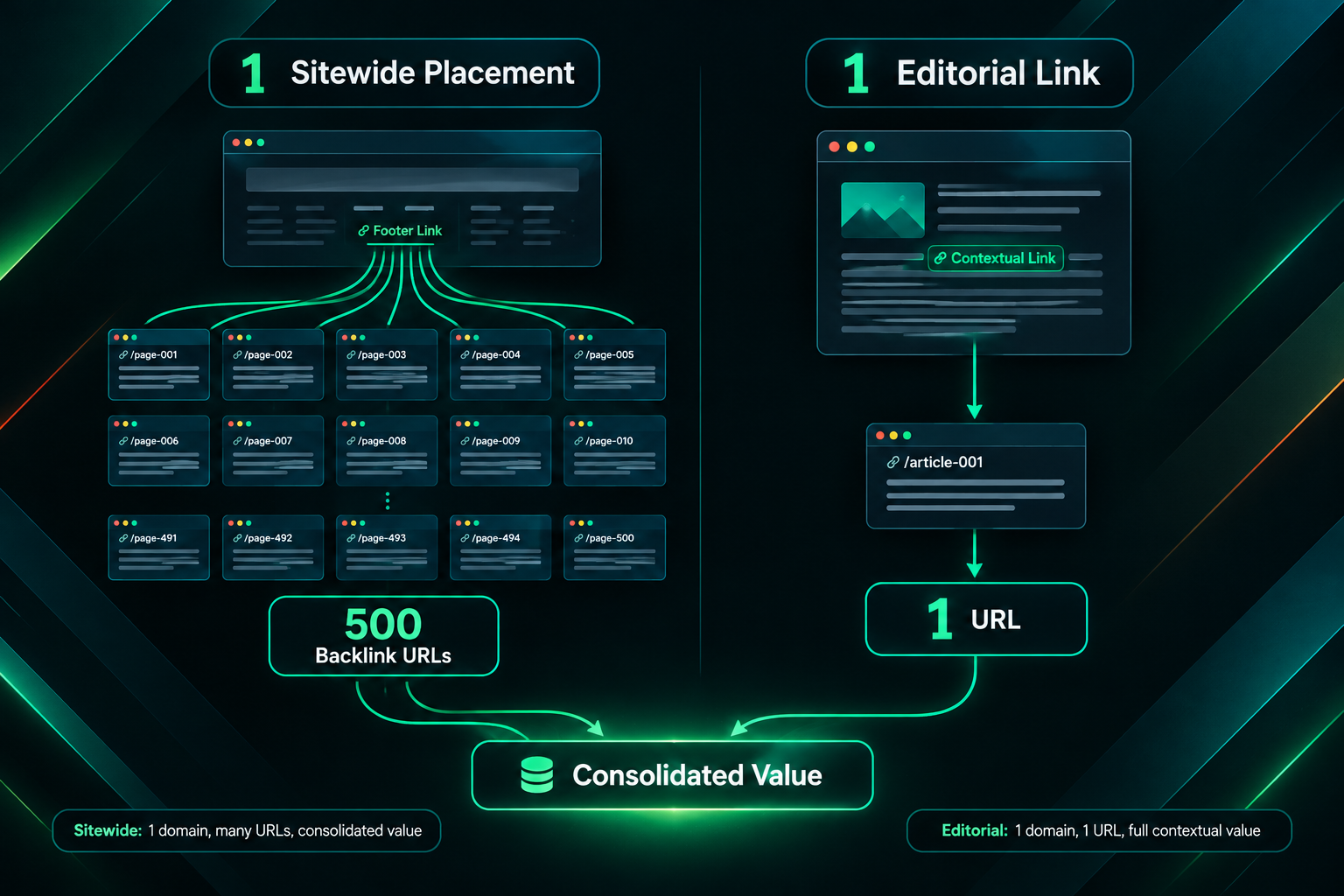
Google’s John Mueller has stated in various public forums that footer links are generally given less weight than in-content links, partly because footer placements are less likely to reflect genuine editorial intent and partly because sitewide patterns are a known signal associated with manipulative link schemes. This does not mean footer links pass zero value, but it does mean the SEO benefit per referring domain is likely lower than an equivalent in-content editorial placement.
Bing’s Webmaster Guidelines similarly caution against links that appear to be placed primarily for search engine manipulation rather than user value. While Bing’s specific treatment of sitewide links is less publicly documented than Google’s, the underlying principle of evaluating link intent and context applies across major search engines.
Backlink analysis tools such as Ahrefs, Semrush, and Majestic each handle sitewide links differently in their reporting interfaces. Ahrefs, for example, groups sitewide links and may display them as a single referring domain with a note about the number of backlinks, while still counting each URL separately in raw backlink counts. Understanding this distinction is important when evaluating a backlink profile, because a high backlink count with a low referring domain count can indicate heavy sitewide link presence rather than broad editorial coverage.
Types of Sitewide Links and Their Typical Contexts
Not all sitewide links carry the same risk or the same potential value. The context in which a sitewide link appears, and the relationship between the linking site and the destination, significantly affects how it is likely to be interpreted.
Web Design and Development Credits
A web design agency or freelance developer placing a small footer credit such as “Website by [Agency Name]” with a link back to their own site is one of the most common legitimate sitewide link scenarios. These links reflect a genuine business relationship and are generally understood by search engines as attribution rather than manipulation. However, when agencies place these credits on large numbers of client sites specifically to build their own backlink profile at scale, the pattern can attract scrutiny.
Plugin and Theme Attributions
WordPress themes and plugins sometimes include a footer link back to the developer’s website as a condition of using a free product. These links are sitewide by nature and can accumulate across thousands of websites. Google has historically treated these with caution, and some theme developers have moved toward optional attribution or rel=”nofollow” links to reduce the risk of their link profile appearing manipulative.
Paid Footer and Sidebar Placements
Purchasing a footer or sidebar link placement specifically to acquire backlinks is the highest-risk category of sitewide link. Google’s spam policies explicitly address paid links that pass PageRank, and a sitewide paid placement is particularly visible because it generates an unusually high backlink-to-referring-domain ratio. Sites that sell these placements and sites that buy them both risk manual actions or algorithmic penalties if the pattern is identified.
Genuine Partner and Affiliate Relationships
Some sitewide links reflect authentic business relationships, such as a franchise network linking to its parent brand from every location page, or a software reseller displaying a partner badge with a link in the sidebar. These links may carry legitimate value, but they are most defensible when the relationship is transparent, the link is relevant to the page content, and the placement is not primarily motivated by search engine manipulation.
Potential Benefits of Sitewide Backlinks
Despite the risks and limitations, sitewide links are not universally harmful or valueless. In specific circumstances, they may offer some practical advantages worth considering.
- Brand visibility across a partner site: A sitewide link in a sidebar or footer means the linking website’s entire audience has repeated exposure to the linked brand, which may support referral traffic and brand recognition even if the direct SEO value is limited.
- Anchor text consistency: Because the same anchor text appears across every instance, sitewide links can reinforce a specific brand name or keyword association, though this also means any anchor text problems are amplified across every page.
- Legitimate attribution value: For web designers, developers, and plugin creators, sitewide credits serve a genuine business purpose and can contribute to a backlink profile when they arise naturally from real client relationships.
- Efficient coverage from a single relationship: In cases where a sitewide link is genuinely appropriate, one placement decision results in coverage across the entire linked domain without requiring individual page-level outreach.
These potential benefits are most relevant when the sitewide link arises from a genuine relationship, appears on a topically relevant and high-quality domain, and is not the primary or sole link building tactic in use. Relying on sitewide links as a core strategy is unlikely to produce the same results as a diversified approach built around editorial placements.
Risks and Limitations of Sitewide Backlinks
The risks associated with sitewide backlinks are significant enough that most professional link building campaigns treat them with caution or avoid them entirely as a deliberate acquisition tactic.
Spam Policy Exposure
Google’s spam policies identify link schemes as a violation of its guidelines. Paid sitewide placements, footer links acquired through link exchanges, and sidebar links placed primarily for PageRank manipulation all fall within the scope of these policies. A manual action resulting from a link scheme can suppress rankings across an entire website, and recovery typically requires identifying and removing or disavowing the problematic links before submitting a reconsideration request. The disavow process itself is time-consuming and does not guarantee immediate recovery.
Inflated Backlink Counts Without Proportionate Value
A sitewide link from a 300-page website creates 300 backlink entries in a raw backlink report, which can make a backlink profile appear stronger than it actually is. When a prospective client, investor, or SEO auditor examines the profile and identifies that a large proportion of backlinks come from a small number of referring domains via sitewide placements, it raises questions about the quality and diversity of the link acquisition strategy. A healthy backlink profile generally shows a reasonable ratio of referring domains to total backlinks.
Reduced Per-Link Value
Because search engines consolidate the value of repeated links from the same domain, the marginal SEO benefit of each additional sitewide link instance is likely very low. Investing budget or outreach effort in a sitewide placement may therefore deliver less ranking influence than an equivalent investment in a single well-placed editorial link from a relevant, authoritative publisher.
Anchor Text Over-Optimisation Risk
If a sitewide link uses exact-match keyword anchor text, that same anchor text is repeated across every page of the linking site. An over-optimised anchor text profile is a known risk factor for algorithmic and manual penalties. A single sitewide placement with aggressive anchor text can therefore create a disproportionate anchor text imbalance across an entire backlink profile.
Link Loss at Scale
If the linking website removes the sitewide element, updates its template, or goes offline, all instances of the link disappear simultaneously. A campaign that relies heavily on sitewide placements is therefore more vulnerable to sudden large-scale link loss than one built on individual editorial placements spread across many different publishers.
How to Identify Sitewide Links in a Backlink Profile
Auditing a backlink profile for sitewide links is a standard part of any thorough link quality assessment. The most reliable method is to examine the ratio of total backlinks to referring domains. A website with 10,000 backlinks but only 50 referring domains almost certainly has significant sitewide link presence. Backlink analysis tools such as Ahrefs, Semrush, and Majestic all provide referring domain counts alongside total backlink counts, making this ratio straightforward to calculate.
Within a tool like Ahrefs, filtering the backlink report by “one link per domain” and then comparing that filtered count to the unfiltered count reveals how many links are sitewide. Sorting by the number of backlinks per referring domain and looking for domains contributing unusually high link counts will surface the most prominent sitewide sources. Majestic’s Trust Flow and Citation Flow metrics can also help assess whether high-volume referring domains are contributing meaningful quality or simply inflating raw counts.
When reviewing individual sitewide links, check the placement location (footer, sidebar, or navigation), the anchor text used, whether the link carries a rel=”nofollow” or rel=”sponsored” attribute, and whether the linking domain is topically relevant to the destination. Links that are paid, use keyword-rich anchor text, and appear in footers of unrelated websites represent the highest-risk combination and are strong candidates for disavowal if they cannot be removed.
Sitewide Links and the Disavow Tool
Google’s disavow tool allows website owners to request that specific links or entire domains be excluded from consideration when Google assesses a site’s backlink profile. Google recommends using the disavow tool only when a site has a significant number of spammy, artificial, or low-quality links that cannot be removed through direct outreach to the linking site’s owner.
Sitewide links from low-quality or clearly manipulative sources are a common reason for disavow submissions. Because a single sitewide domain can contribute hundreds or thousands of individual backlink URLs, disavowing at the domain level (using the “domain:” prefix in the disavow file) is generally more efficient than listing individual URLs. However, disavowing legitimate sitewide links, such as genuine web design credits from reputable agencies, is unnecessary and could remove links that contribute positively to the profile.
It is worth noting that Google has stated it is generally good at ignoring low-quality links without a disavow file, and that the disavow tool is most relevant for sites that have received a manual action or have reason to believe their link profile is causing active harm. A site-specific assessment by an experienced SEO professional is advisable before submitting a disavow file, as incorrectly disavowing quality links can reduce rather than improve performance.
Alternatives to Sitewide Backlinks
For businesses and agencies looking to build a strong, sustainable backlink profile, several link acquisition approaches offer better risk-adjusted outcomes than deliberate sitewide link building.
Editorial Guest Posts
Manual outreach to relevant publishers for guest post placements produces in-content links from specific, topically relevant articles. These links appear within the body of a page rather than in a template element, which generally means they are treated as stronger editorial signals. Guest posting requires more effort per placement than a sitewide arrangement, but the resulting links are more defensible, more diverse, and less likely to trigger algorithmic or manual scrutiny.
Niche Edits and Link Insertions
Niche edits involve adding a link to an existing published article on a relevant website. Because the link appears within established content that may already have its own backlink profile and search visibility, niche edits can deliver contextual relevance efficiently. Like guest posts, niche edits produce single-page links rather than sitewide placements, keeping the referring domain to backlink ratio healthy.
Digital PR and Earned Links
Digital PR campaigns aim to earn links through newsworthy content, original research, data studies, or expert commentary that journalists and publishers choose to reference. These links are editorially given rather than arranged, which makes them among the most defensible link types from a search engine policy perspective. Digital PR is typically more resource-intensive and less predictable in volume than outreach-based methods, but the links it produces tend to come from high-authority news and media domains.
Resource and Partner Page Links
Many websites maintain resource pages, partner directories, or recommended tool lists that link to relevant external sites. Securing a placement on a genuine resource page produces a single-page link from a relevant context. These placements are often more durable than editorial links because resource pages are updated less frequently than blog content, and the link is less likely to be removed as part of a content refresh.
Frequently Asked Questions
Do sitewide backlinks still count in Google’s algorithm?
Google has indicated that it consolidates the value of multiple links from the same domain rather than treating each instance as an independent signal. Sitewide links are not ignored entirely, but their per-instance value is likely much lower than a single in-content editorial link from the same domain. The overall contribution of a sitewide link to rankings depends on the quality of the linking domain, the relevance of the relationship, and whether the link appears natural in context.
Are footer links always bad for SEO?
Footer links are not automatically harmful. Legitimate footer links, such as web design credits, accessibility statements, or genuine partner attributions, are a normal part of the web. The risk increases when footer links are paid placements using keyword-rich anchor text on unrelated websites, or when they form part of a deliberate link scheme. Context, intent, and the quality of the linking domain all affect how a footer link is likely to be treated.
How can I tell if a competitor is using sitewide links?
Examining a competitor’s backlink profile in a tool such as Ahrefs or Semrush and comparing their total backlink count to their referring domain count will reveal whether sitewide links are present. A high backlink-to-referring-domain ratio, combined with multiple backlinks from the same domain pointing to the same destination, is a strong indicator of sitewide placements. Clicking through to the actual linking pages will confirm whether the links appear in footer, sidebar, or navigation elements.
Should I disavow sitewide links I didn’t build?
Not necessarily. Google states that it is generally capable of ignoring low-quality links without a disavow file, and that unnecessary disavow submissions can remove links that are contributing positively. If a site has received a manual action related to unnatural links, or if a thorough audit identifies a significant volume of clearly manipulative sitewide links, disavowing at the domain level may be appropriate. A qualified SEO professional should review the profile before any disavow file is submitted.
Can a web design agency safely use sitewide footer credits for link building?
A small number of genuine client credits placed naturally as part of real design work are unlikely to cause problems. However, placing footer credits across a very large number of client sites primarily to build a backlink profile at scale, particularly using keyword-rich anchor text rather than a brand name, is the kind of pattern that can attract scrutiny. Agencies in this situation may consider using rel=”nofollow” on credits or making attribution optional to reduce risk.
What anchor text should a sitewide link use?
Where a sitewide link is legitimate and appropriate, branded anchor text (the company or website name) is the safest choice. Exact-match keyword anchor text in a sitewide placement is amplified across every page of the linking site, which can create an over-optimised anchor text profile and increase the risk of algorithmic or manual action. Brand-name anchors are less likely to trigger these concerns and are more consistent with how genuine attribution links are typically written.
Deciding Whether Sitewide Links Belong in Your Strategy
Sitewide backlinks occupy a specific and relatively narrow legitimate role in link building. They arise naturally from genuine business relationships such as web design credits, plugin attributions, and authentic partner arrangements, and in those contexts they are a normal part of the web’s link graph. As a deliberate link acquisition tactic, however, they carry meaningful risks that most professional campaigns are designed to avoid.
The core issue is that sitewide links are easy to identify as a pattern, both for search engine algorithms and for human reviewers. A backlink profile dominated by sitewide placements, particularly paid footer links with keyword-rich anchor text on unrelated websites, is one of the clearer signals of a manipulative link scheme. The potential short-term gains from such placements are generally outweighed by the risk of algorithmic suppression or a manual action that can take significant time and effort to resolve.
For businesses building a long-term organic search presence, the more reliable path is a diversified backlink profile built through editorial guest posts, niche edits, digital PR, and genuine relationship-based placements. These approaches produce single-page links from relevant publishers, maintain a healthy referring domain to backlink ratio, and are more consistent with the kind of link profile that search engines are designed to reward.
If your existing backlink profile contains a significant volume of sitewide links, whether acquired deliberately or inherited from a previous SEO campaign, a thorough link audit is a sensible starting point. Understanding which sitewide links are legitimate, which are low-quality, and which may be actively harmful allows for an informed decision about whether outreach for removal or a disavow submission is warranted. An experienced link building partner can help assess the profile and recommend a proportionate response based on the specific situation rather than a one-size-fits-all approach.