Public datasets offer one of the more durable raw materials for digital PR campaigns. When you transform government statistics, academic records, or open data into a genuinely newsworthy story, journalists and editors have a concrete reason to link back to your analysis rather than simply mention your brand. This article explains how to find and use public datasets effectively, what makes a data-led pitch earn editorial coverage, and where the approach has realistic limits for link building purposes.
Key Takeaways
- Public datasets can support digital PR campaigns that earn editorial backlinks from news sites, industry publications, and authoritative blogs when the analysis is genuinely newsworthy.
- The quality of the story matters more than the size of the dataset; a small, well-framed insight from a credible source will usually outperform a large but unfocused data dump.
- Sourcing data from government portals, academic repositories, and official open-data platforms strengthens editorial credibility and reduces the risk of factual challenges.
- Data-led digital PR typically requires meaningful investment in research, writing, and outreach; results vary considerably depending on the topic, timing, and target publications.
- This approach works best alongside a broader link building strategy rather than as a standalone tactic, particularly for websites that need links across multiple page types.
What Is Data-Led Digital PR and Why Does It Attract Backlinks?
Digital PR is a link acquisition method that earns editorial coverage by giving journalists, editors, and content creators something genuinely useful to report. When that something is a credible data analysis, the publication has a factual basis for its story and a natural reason to cite the source. That citation is the backlink. Unlike a guest post, where a link is negotiated as part of a content exchange, an editorial link earned through data-led PR is typically placed at the journalist’s discretion because the data adds value to their readers. This distinction matters for link quality assessment: editorially placed links on established news and media sites tend to carry strong contextual signals, though their SEO impact still depends on many other factors including the target page, the surrounding content, and the overall backlink profile.
Public datasets are particularly well suited to this approach because they are verifiable, freely available, and carry institutional credibility. A journalist can check your methodology against the original source, which reduces the friction of editorial approval. Proprietary survey data can also work, but it requires additional trust-building because the publication cannot independently verify the raw numbers. Public data sidesteps that barrier, making it easier to pitch to outlets that have strict editorial standards.
Where to Find Reliable Public Datasets
The most credible sources for digital PR data analysis are those that journalists already recognise and trust. Starting with well-known institutional sources reduces the likelihood of a pitch being rejected on data-quality grounds.
Government and Official Statistical Portals
National statistical agencies publish a wide range of economic, demographic, health, housing, and labour-market data on a regular release schedule. In the United Kingdom, the Office for National Statistics (ONS) publishes datasets covering population, employment, inflation, and regional economic activity. In the United States, the Census Bureau, Bureau of Labor Statistics, and data.gov provide comparable coverage. The European Union’s Eurostat portal covers member-state comparisons. These sources are updated on predictable schedules, which means you can plan campaigns around known release dates and pitch your analysis as a timely response to new figures.
Academic and Research Repositories
Universities and research institutions publish datasets alongside peer-reviewed studies. Repositories such as the Harvard Dataverse, UK Data Service, and Zenodo host datasets across social sciences, environmental research, public health, and economics. These sources carry academic credibility and often contain longitudinal data that allows trend analysis, which tends to generate stronger story angles than a single-point snapshot.
Open Data Platforms and NGOs
Organisations such as the World Bank, World Health Organization, OECD, and Our World in Data publish structured datasets on global development, health outcomes, education, and environmental indicators. These are particularly useful for campaigns targeting international publications or for brands operating in sectors where global comparisons are editorially relevant. Many NGOs also publish annual reports with underlying data that can be reanalysed from a different angle.
Freedom of Information Requests
In jurisdictions with freedom of information legislation, submitting a formal request to a public body can yield data that has not been published elsewhere. This approach requires more lead time, typically several weeks to months depending on the authority and the complexity of the request, but the resulting dataset is exclusive. Exclusivity is a meaningful editorial advantage because it gives a publication a story that competitors cannot immediately replicate. The trade-off is that FOI-derived data requires careful handling to ensure the analysis is accurate and the framing is fair.
Turning Raw Data into a Linkable Story
Accessing a public dataset is the starting point, not the end product. The editorial value comes from the analysis and the story angle, not from the data itself. Most public datasets are available to anyone, so the competitive advantage lies in identifying an insight that is genuinely surprising, practically useful, or directly relevant to a current news cycle.
Identifying a Newsworthy Angle
A useful test is to ask whether the finding would be interesting to a reader who has no prior knowledge of your brand or industry. If the answer is yes, the angle has editorial potential. Common approaches include ranking analysis, where you order geographic areas, industries, or demographic groups by a metric and identify the best and worst performers; trend analysis, where you compare figures across time to identify a meaningful shift; and correlation analysis, where you examine the relationship between two variables that have not previously been compared in public. Each of these formats gives a journalist a clear headline and a data point they can quote directly.
Avoid angles that are only interesting to people already familiar with your product or service. A finding that your target customers care about is not the same as a finding that a general-interest journalist will cover. The pitch needs to serve the publication’s audience first.
Methodology Transparency
Publishing a clear methodology section alongside your analysis is important for editorial credibility. Journalists who cover data stories are accustomed to scrutinising methodology, and editors at high-authority publications may ask for it before agreeing to cover the story. The methodology should explain which dataset was used, the date range covered, any exclusions or adjustments made, and how the key metric was calculated. Transparency reduces the risk of a factual challenge after publication and increases the likelihood that the publication will link to your analysis page rather than simply paraphrase the finding without attribution.
Creating a Dedicated Asset Page
The backlink target for a data-led digital PR campaign is typically a dedicated page on your website that hosts the full analysis, the methodology, and ideally a downloadable version of the processed dataset. This page serves as the citation destination. It should be well-structured, load quickly, and be accessible without a registration barrier. A page that requires sign-up before a journalist can view the full data is unlikely to earn a link because it creates friction at the point of editorial verification. The page should also be internally linked from relevant sections of your website so that any link equity it receives can flow to related content.
Outreach Strategy for Data-Led Digital PR
Even a well-constructed data story will not earn coverage without a targeted outreach process. The outreach approach for data-led digital PR differs from standard guest post outreach in several important ways.
Identifying the Right Journalists and Editors
Data stories are typically covered by journalists who specialise in data journalism, economics, social affairs, or the specific sector your analysis addresses. Pitching a housing-market dataset to a technology reporter is unlikely to succeed regardless of the quality of the analysis. Building a targeted media list requires research into which journalists have recently covered similar data stories, which publications have a data desk or regularly feature data-driven content, and which editors commission explainer or analysis pieces rather than only breaking news.
Tools such as media databases can help identify relevant contacts, but manual research into recent bylines and publication archives tends to produce more accurate targeting. A pitch sent to the right journalist at the right publication is considerably more likely to result in coverage than a mass-distributed press release.
Crafting the Pitch
A digital PR pitch for a data story should lead with the most surprising or counterintuitive finding, explain why it is relevant to the publication’s audience, and provide a clear link to the full analysis. It should be concise, typically no longer than three short paragraphs, and should make it easy for the journalist to understand the story without needing to read the full dataset. Offering exclusivity to a single high-authority publication for a defined period, such as 48 hours before wider distribution, can increase the likelihood of coverage from that outlet, though this approach requires careful timing management.
Timing and News Hooks
Pitching a data story in response to a current news event, a seasonal pattern, or a known data release can significantly improve pickup rates. If a government agency is due to publish unemployment figures, an analysis of regional employment trends from a related public dataset may be timely enough to attract coverage from outlets already planning to report on the official release. This reactive approach requires preparation in advance, including having the analysis ready before the news hook arrives rather than starting the research after the event.
Assessing the Quality of Links Earned Through Data PR
Not all coverage from a data-led campaign will result in a followed editorial link. Some publications use nofollow or sponsored attributes on all external links as a matter of policy. Others may mention the finding without linking to the source page. Understanding this before a campaign begins helps set realistic expectations.
When editorial links are earned, their value for link building purposes depends on factors including the authority and topical relevance of the linking domain, the placement context within the article, the anchor text used, and whether the link points to a page that is already indexed and crawlable. Third-party metrics such as Domain Rating from Ahrefs or Domain Authority from Moz can provide a rough indication of a site’s link profile strength, but these are proprietary estimates rather than Google-provided signals, and they should not be treated as direct predictors of ranking improvement. A link from a well-established national newspaper is generally considered more editorially significant than a link from a low-traffic blog, but the actual SEO impact of any individual link depends on many other factors that vary by website and competitive context.
Realistic Benefits and Limitations of This Approach
Data-led digital PR can be an effective method for earning links from high-authority editorial sources that are difficult to reach through standard outreach or guest posting. Publications that do not accept guest contributions or paid placements may still cover a genuinely newsworthy data story. This makes the approach particularly relevant for brands in competitive sectors where editorial links from major publications are a meaningful differentiator.
The limitations are equally important to understand. A single campaign does not guarantee coverage, and even well-constructed pitches are frequently declined. Pickup rates vary considerably depending on the topic, the timing, the quality of the media list, and factors outside the campaign’s control such as competing news stories. The lead time from dataset identification to published coverage can range from several weeks to several months, which makes this a slower link acquisition method than some alternatives. The approach also requires meaningful investment in research, data analysis, writing, and outreach, either from an in-house team or an external provider with relevant expertise.
Data-led digital PR is generally less suitable as a method for building links to product pages, category pages, or transactional content, because journalists are unlikely to link to a commercial page as a citation for a data story. The links typically point to the analysis asset page, which means the SEO benefit to commercial pages depends on internal linking structure and how effectively link equity is distributed across the site.
Integrating Public Dataset Campaigns into a Broader Link Building Strategy
Digital PR campaigns using public datasets work best as one component of a diversified link building strategy rather than as the sole acquisition method. For most websites, a combination of approaches is more likely to build a well-rounded backlink profile than relying on a single tactic. Guest posting and manual outreach can build links to specific target pages more directly, while data-led digital PR can earn high-authority editorial links that strengthen domain-level signals over time.
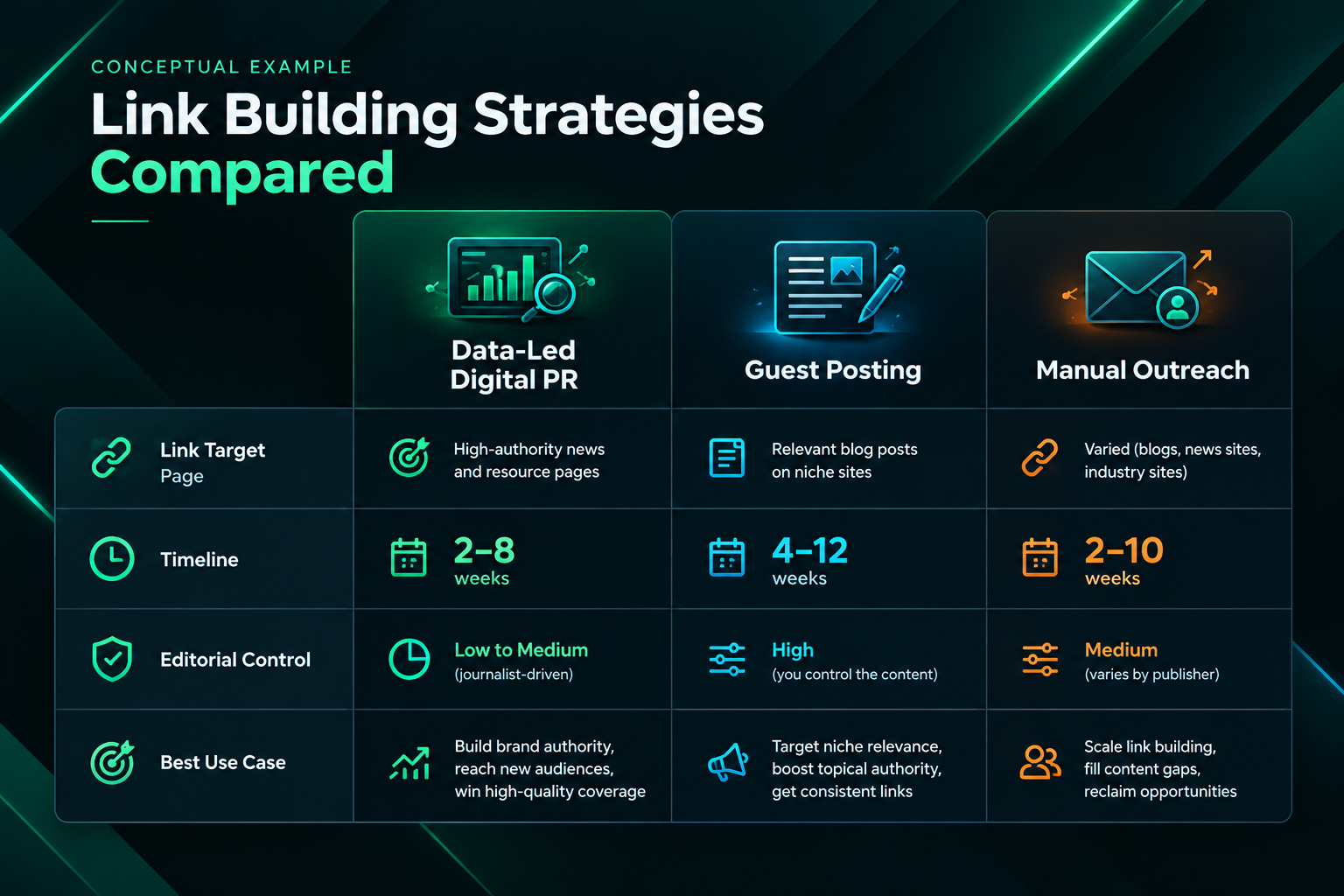
For agencies managing link building on behalf of clients, data-led digital PR can be a differentiating service for clients in sectors where editorial coverage is commercially valuable, such as financial services, property, health, and consumer goods. The campaign workflow, from dataset sourcing and analysis through to outreach and reporting, requires coordination between research, content, and PR functions, which is one reason many businesses choose to work with specialist providers rather than building this capability entirely in-house.
When evaluating whether a data-led digital PR campaign is appropriate for a specific website, relevant factors include the existing backlink profile, the target pages that would benefit most from additional link equity, the brand’s credibility in its sector, the availability of relevant public datasets, and the budget available for research and outreach. A website with significant technical SEO issues or thin content may not see meaningful ranking improvements from additional links alone, regardless of their quality, until those underlying issues are addressed.
Common Mistakes That Reduce Campaign Effectiveness
Several avoidable errors reduce the likelihood of a data-led digital PR campaign earning editorial coverage. Choosing a dataset that is already widely reported reduces the novelty of the analysis and makes it harder to justify coverage. Framing the story around the brand rather than the data finding makes the pitch read as advertising rather than editorial content. Publishing the analysis on a page that is slow to load, difficult to navigate, or hidden behind a registration wall reduces the likelihood of a journalist linking to it. Sending a generic press release to a large undifferentiated list of contacts produces lower pickup rates than a targeted pitch to a smaller number of relevant journalists.
Overstating the findings is a particular risk with data analysis. Describing a correlation as a cause-and-effect relationship, or presenting a finding from a small or unrepresentative dataset as a definitive conclusion, can damage editorial credibility and lead to corrections or retractions that remove the backlink. Accurate, appropriately qualified language in the analysis and the pitch protects both the campaign’s integrity and the brand’s reputation.
Frequently Asked Questions
Do links earned through data-led digital PR count as editorial links?
Links placed by a journalist or editor because the data adds value to their article are generally considered editorial links, meaning they are placed at the publication’s discretion rather than as part of a paid or negotiated arrangement. Whether a specific link carries a followed or nofollowed attribute depends on the publication’s own linking policy, which varies by outlet and cannot be controlled by the campaign team.
How long does a data-led digital PR campaign typically take?
The timeline from dataset identification to published coverage varies considerably. Dataset sourcing and analysis may take one to three weeks depending on complexity. Outreach and follow-up typically runs for several weeks. Publication timelines depend on the editorial cycle of each outlet. A realistic expectation for a first campaign is two to four months from briefing to initial coverage, though some stories are picked up more quickly when they align with a current news cycle.
Can public dataset campaigns work for small or newer websites?
Smaller or newer websites can run data-led digital PR campaigns, but the brand recognition factor is less favourable. Journalists are more likely to cover analysis from a recognised brand or institution. A newer website may need to invest more in the quality and novelty of the analysis to compensate for lower brand authority. Building some initial domain credibility through other link acquisition methods before running a major data PR campaign may improve results.
What types of pages should the data analysis link to?
The most natural citation target is the dedicated analysis or research page that hosts the full dataset and methodology. Linking directly to a product or category page from a data story is unusual and may reduce editorial credibility. The SEO benefit to commercial pages comes through internal linking from the analysis page, so the internal link structure of the website matters for how effectively link equity is distributed.
Is it necessary to use exclusive data, or can publicly available datasets work?
Publicly available datasets can work well, particularly when the analysis angle is original and the findings are not already widely reported. Exclusivity, whether from a freedom of information request or a proprietary survey, increases the editorial appeal because it gives a publication a story that competitors cannot immediately replicate. However, exclusivity is not a prerequisite for coverage, and many successful data PR campaigns are built on publicly available sources.
How do I measure the success of a data-led digital PR campaign?
Relevant metrics include the number of editorial placements achieved, the authority and topical relevance of the linking domains, the number of followed versus nofollowed links, changes in the referring domain count to the target page, and any measurable changes in organic visibility for the target page over time. Attributing ranking or traffic changes specifically to a digital PR campaign is difficult because many other factors influence organic performance simultaneously. Monitoring should continue for several months after coverage is published, as links are sometimes added by publications that pick up the story later.
Is a Data-Led Digital PR Strategy Right for Your Link Building Goals?
Using public datasets for digital PR can be a genuinely effective way to earn editorial backlinks from high-authority publications that are otherwise difficult to reach. The approach rewards investment in research quality, story framing, and targeted outreach, and it can produce links with strong contextual signals when executed well. The realistic limitations are that pickup rates are variable, the timeline is longer than some other link acquisition methods, and the links typically point to research asset pages rather than commercial pages directly.
For businesses and agencies evaluating whether this approach fits their current goals, the most relevant questions are whether the target website has relevant public datasets to work with, whether the brand has sufficient credibility to support editorial pitching, and whether the internal or external team has the research and outreach capability to execute the campaign to a standard that meets editorial requirements. For websites that need links across a range of page types and on a more predictable timeline, combining data-led digital PR with manual outreach or guest posting is likely to produce a more balanced backlink profile than either approach alone.
If you are considering a data-led digital PR campaign as part of a broader link building strategy, discussing the approach with an experienced provider can help clarify whether it is well matched to your website’s current profile, competitive context, and business objectives.