Structured data markup has become a standard part of technical SEO, and as more websites implement schema.org vocabulary, a reasonable question arises: do the URLs referenced inside structured data count as backlinks, and do they pass any ranking benefit? The short answer is that links embedded in structured data are generally not treated the same way as crawlable HTML hyperlinks, but the full picture is more nuanced and worth understanding before drawing conclusions about your link building strategy.
Key Takeaways
- URLs referenced inside JSON-LD or other structured data formats are not equivalent to standard HTML anchor links and are unlikely to pass link equity in the way that crawlable backlinks do.
- Google has indicated that links within structured data markup are not treated as standard hyperlinks for the purpose of PageRank or link signal evaluation.
- Structured data serves a different purpose than link acquisition: it helps search engines understand page content and can influence rich result eligibility, but it is not a substitute for a genuine backlink profile.
- Attempting to manipulate rankings by embedding links inside schema markup would conflict with Google’s spam policies and is unlikely to produce the intended effect.
- Earning editorially placed, contextually relevant backlinks from authoritative external pages remains the primary mechanism through which link equity is transferred between websites.
What Structured Data Actually Is
Structured data is a standardized format for providing information about a page and its content to search engines. The most widely used vocabulary is schema.org, and the most common implementation format is JSON-LD, a JavaScript notation embedded in a script tag within the page’s HTML. Other formats include Microdata and RDFa, which annotate HTML elements directly. The purpose of structured data is to give search engines explicit, machine-readable context about entities on a page: a product, a recipe, an event, a person, an organization, or a review, among many others.
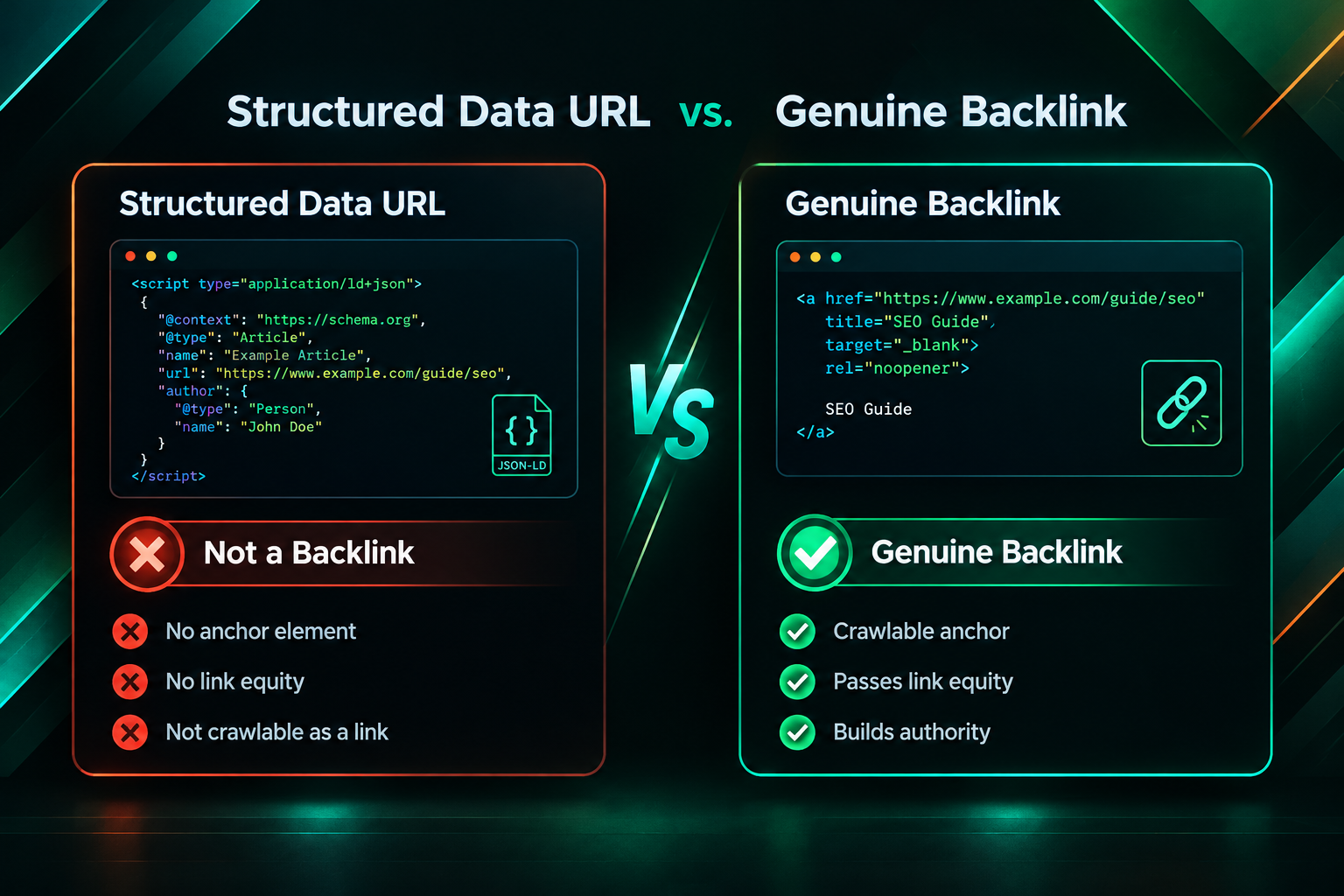
Within a structured data block, it is common to include URLs. A JSON-LD Organization schema, for example, might reference a company’s official website via the url property. A Product schema might include a link to a manufacturer’s page. A BreadcrumbList schema references the URLs of parent pages in a site hierarchy. These URL references are properties within a data object, not anchor elements in the rendered HTML that a user can click or that a browser renders as a navigable link.
This distinction matters because Google’s link graph — the system that evaluates which pages link to which other pages and how much authority flows between them — is built primarily from crawlable anchor elements in HTML. A URL that appears as a string value inside a JSON-LD script block occupies a fundamentally different position in the document than an <a href> element that a crawler follows and a user can interact with.
How Google Treats URLs Inside Structured Data
Google’s documentation and public statements from its Search Relations team have consistently indicated that URLs referenced within structured data properties are not treated as standard hyperlinks for the purpose of passing PageRank or link signals. John Mueller, a Search Advocate at Google, has addressed this topic in various public forums over the years, noting that links in structured data are not equivalent to editorial links in the body of a page. While these statements are not formal policy documents, they reflect the practical position that schema markup is evaluated as metadata about a page rather than as a source of link equity.
From a technical standpoint, this makes sense. Google’s crawlers are designed to follow anchor elements with href attributes. A URL string inside a JSON-LD property is parsed differently: it helps Google understand what entity a page is describing, not which pages are endorsing which other pages. The endorsement signal — the core of what makes a backlink valuable — comes from an editorial decision by a publisher to link to another resource, expressed through a clickable anchor element in content that users can see and interact with.
It is also worth noting that even if Googlebot were to extract and follow URLs found inside structured data, that would not automatically mean those URLs receive link equity. Google applies a range of signals to determine whether a link should be treated as an editorial endorsement, including the link’s position in the document, its accessibility to users, and whether it appears to have been placed with the intent to manipulate rankings. A URL buried in a script block would be unlikely to satisfy the criteria for a meaningful link signal regardless of whether it is technically discovered.
The Difference Between Link Discovery and Link Equity
Two concepts are sometimes conflated in discussions about structured data and backlinks: link discovery and link equity. Understanding the difference clarifies why structured data URLs are largely irrelevant to link building.
Link discovery refers to Googlebot finding a URL and adding it to the crawl queue. It is possible that Google may discover URLs referenced in structured data and crawl those pages, particularly if the URL is not already known. However, discovery alone does not confer any ranking benefit. Googlebot discovers URLs through many mechanisms — sitemaps, internal links, external links, and potentially structured data properties — but discovery is simply the first step in indexing, not a signal of authority or relevance.
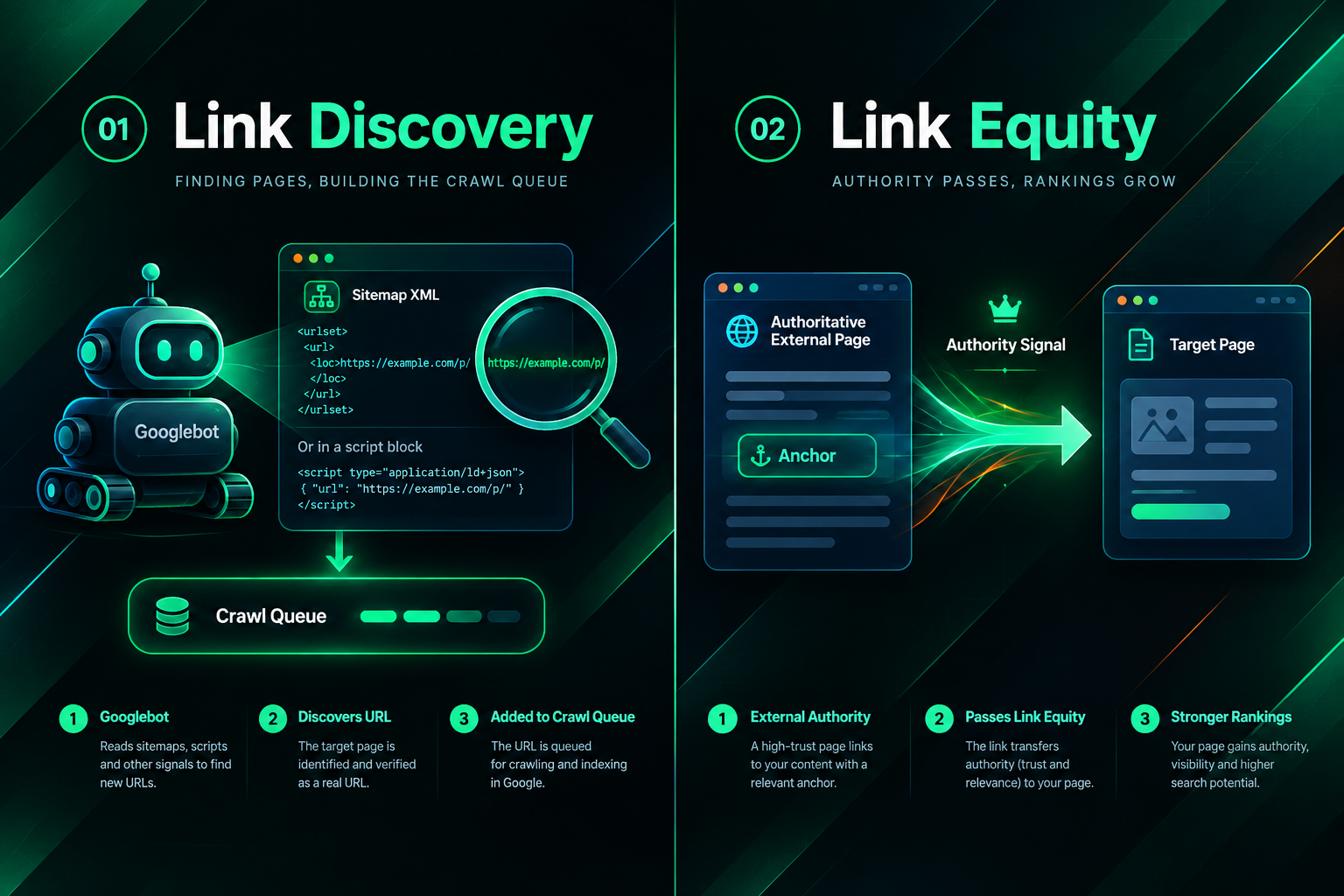
Link equity (sometimes called link juice or PageRank flow) refers to the authority signal that passes from one page to another through an editorial link. This signal is associated with the quality, relevance, and trustworthiness of the linking page, the anchor text used, the position of the link in the content, and the link’s attributes such as whether it carries a rel=”nofollow” or rel=”sponsored” annotation. None of these characteristics apply meaningfully to a URL string inside a JSON-LD property, which is why structured data URLs are not considered a source of link equity.
For websites trying to build a stronger backlink profile, this distinction is important. Adding URLs to your own structured data does not create backlinks pointing to those URLs from external sources. And if a third-party website includes your URL in its structured data, that reference is unlikely to function as a backlink in the traditional sense, even if it is technically a mention of your domain.
Can Structured Data Influence SEO Indirectly?
While structured data does not function as a backlink mechanism, it can influence SEO in other ways that are worth acknowledging. Correctly implemented schema markup can make a page eligible for rich results in Google Search, such as star ratings for reviews, price information for products, FAQ dropdowns, event details, and recipe cards. Rich results can improve a page’s visibility and click-through rate in search results, which may indirectly affect organic traffic and engagement metrics.
Structured data can also help Google better understand the entities associated with a page, which may support topical relevance signals and entity recognition. For example, an Organization schema that clearly identifies a business’s name, location, and industry may help Google associate the website with relevant search queries more confidently. This is a content comprehension benefit, not a link equity benefit, but it is a legitimate reason to implement structured data correctly.
The key point is that structured data and link building address different aspects of SEO. Structured data helps search engines understand what a page is about and can improve how it appears in search results. Link building helps establish a page’s authority and trustworthiness relative to competing pages. Both matter, but they are not interchangeable, and structured data cannot substitute for a genuine, editorially earned backlink profile.
Why This Question Arises in Link Building Contexts
The question of whether structured data links count as backlinks tends to arise in a few specific contexts. One is curiosity about whether implementing schema markup on a page that references external URLs might inadvertently create outbound links with SEO implications. Another is whether receiving a mention in a third party’s structured data — for example, being listed as a supplier in a Product schema or as a contributor in an Article schema — constitutes a backlink worth pursuing.
A third context, which is worth addressing directly, is whether structured data could be used as a tactic to artificially create backlinks or pass link signals without the editorial overhead of genuine outreach. This approach would not be effective for the reasons already explained, and it would also conflict with Google’s spam policies, which prohibit attempts to manipulate PageRank through artificial or deceptive means. Search engines are designed to evaluate the quality and intent of links, and a URL embedded in a script block does not carry the editorial endorsement that makes a backlink meaningful.
For businesses and SEO teams evaluating their link acquisition strategy, the practical implication is straightforward: structured data is a technical SEO tool, not a link building channel. Treating it as one would divert attention and resources from the methods that actually build link equity.
What Actually Constitutes a Backlink
A backlink, in the context of search engine optimization, is an anchor element on an external page that links to your website using an href attribute. The link must be crawlable — meaning it is not blocked by robots.txt, not hidden behind JavaScript that Googlebot cannot render, and not annotated with a rel=”nofollow” attribute that instructs crawlers to disregard it for ranking purposes. Even among crawlable, followed links, the degree of link equity passed varies considerably based on the authority of the linking page, the topical relevance of the linking content, the position of the link within the page, and the anchor text used.
Editorial links — those placed because a publisher genuinely found the linked content useful or relevant — are generally considered the most valuable type of backlink. These are the links that manual outreach campaigns, guest posting, digital PR, and content-led link acquisition strategies are designed to earn. They represent a third-party endorsement that search engines can interpret as a signal of quality and relevance.
Links acquired through other means, such as directory submissions, forum profiles, or comment sections, may carry less weight or no weight at all, depending on how search engines evaluate the linking page and the context of the link. Links that appear to have been placed artificially or in exchange for payment without appropriate disclosure may be treated as spam under Google’s link spam policies, potentially resulting in manual actions or algorithmic devaluation.
Structured Data and Backlinks: Practical Implications for Your SEO Strategy
Understanding that structured data URLs do not function as backlinks has several practical implications for how you allocate SEO effort and budget.
First, implementing structured data correctly remains worthwhile for its intended purpose: improving search engine comprehension of your content and increasing eligibility for rich results. This is a technical SEO task that should be handled as part of on-page and technical optimization, not conflated with link acquisition.
Second, if your website needs to strengthen its backlink profile, the path forward involves earning links from external pages through methods that produce genuine editorial placements. Manual outreach to relevant publishers, guest posting on topically appropriate websites, digital PR campaigns that generate coverage and citations, and content strategies designed to attract natural links are all approaches that can contribute to a stronger link profile over time. Each of these methods requires effort, quality content, and often specialist expertise to execute effectively.
Third, assessing the quality of your existing backlink profile using tools such as Ahrefs, Semrush, or Majestic can help identify whether link acquisition is actually the limiting factor for your organic visibility. Low rankings may also reflect weak or outdated content, technical crawling or indexing issues, search intent mismatches, strong competition, or internal linking gaps. A site-specific assessment is necessary before concluding that more backlinks are the primary need.
Fourth, if you are working with an external link building provider or considering outsourcing link acquisition, understanding the distinction between structured data and genuine backlinks helps you evaluate provider claims more critically. A provider that suggests structured data placements as a link building deliverable is describing something that is unlikely to function as intended. Effective link building involves securing editorially placed anchor links on external pages with genuine authority and topical relevance.
Evaluating Backlink Quality Beyond the Structured Data Question
The structured data question is a useful entry point into a broader topic: what makes a backlink genuinely valuable? Third-party metrics such as Domain Rating from Ahrefs, Domain Authority from Moz, Authority Score from Semrush, and Trust Flow from Majestic are commonly used to estimate the relative strength of a linking domain. These metrics are proprietary calculations based on each tool’s own link index and methodology. They are not Google metrics, and an improvement in any of these scores does not guarantee a corresponding improvement in search rankings or organic traffic.
That said, these metrics can serve as useful proxies when assessing whether a potential linking domain is likely to carry meaningful authority. A link from a well-established, topically relevant website with a strong backlink profile of its own is generally more likely to contribute positively to your link profile than a link from a newly registered domain with no organic traffic. Topical relevance — the degree to which the linking page’s content relates to the content of the page being linked to — is also considered an important factor in how search engines interpret link signals.
Link placement within a page matters as well. A link embedded naturally within the body of a relevant article, surrounded by contextually related content, is generally considered more valuable than a link in a footer, sidebar, or author bio. Anchor text — the visible, clickable text of the link — provides additional context about the linked page’s topic, though over-optimized anchor text patterns can attract scrutiny under Google’s spam policies.
None of these quality factors apply to URLs referenced in structured data, which reinforces why structured data is not a meaningful link building channel.
Frequently Asked Questions
Does adding my website URL to a third party’s JSON-LD schema create a backlink to my site?
Not in the traditional sense. A URL referenced as a property value inside a JSON-LD block is not an anchor element and is unlikely to pass link equity. It may result in Googlebot discovering your URL, but discovery is not the same as receiving a link signal.
Can I use structured data to pass link equity between my own pages?
Internal links in structured data are subject to the same limitations as external ones. Standard HTML anchor elements within your page content are the appropriate mechanism for internal linking and passing equity between your own pages.
If Google crawls a URL found in structured data, does that help the linked page rank?
Crawling and indexing a page is a prerequisite for ranking, but it does not itself improve rankings. The ranking benefit of a backlink comes from the link equity signal, not from the act of crawling.
Should I stop implementing structured data if it doesn’t help with link building?
No. Structured data serves legitimate purposes including rich result eligibility and improved entity understanding. It should be implemented correctly for those purposes, independently of link acquisition strategy.
How do I know if my website actually needs more backlinks?
A site-specific SEO audit is the appropriate starting point. Low organic visibility may result from content quality issues, technical problems, search intent mismatches, or competitive factors, not necessarily from an insufficient backlink profile. Diagnosing the actual cause before investing in link acquisition is advisable.
What is the most reliable way to earn backlinks that actually pass link equity?
Editorially placed anchor links within relevant content on authoritative external pages are generally considered the most reliable source of link equity. These are typically earned through manual outreach, guest posting on relevant publications, digital PR, or creating content that naturally attracts citations from other websites.
What to Consider When Building Links That Actually Work
The structured data question ultimately points toward a more fundamental principle: link equity flows through editorial decisions made by real publishers, expressed as crawlable anchor elements in content that users can see and interact with. No technical shortcut — whether structured data, hidden links, or automated placements — reliably replicates the signal that a genuine editorial link provides.
For businesses and SEO teams looking to strengthen their backlink profiles, the practical path involves identifying the pages that would benefit most from additional link equity, understanding the topical landscape of relevant publishers, and executing outreach or content strategies that give those publishers a genuine reason to link. This process takes time, requires quality content and credible outreach, and produces results that vary depending on the website’s existing authority, the competitiveness of the target market, and the quality of the placements secured.
If your team lacks the capacity or specialist expertise to manage link acquisition campaigns effectively, working with an experienced link building provider can be a practical option. When evaluating providers, look for transparency about their acquisition methods, the types of placements they secure, how they assess publisher quality, and what reporting they provide. A provider that focuses on editorially placed, contextually relevant anchor links on genuine external pages is describing a fundamentally different service from one that relies on structured data references, directory submissions, or link networks.
Structured data is a valuable technical SEO tool. Backlinks are a separate discipline. Keeping these two clearly distinct helps you invest your SEO resources where they are most likely to produce measurable results.