Game websites occupy a competitive and often misunderstood corner of the SEO landscape. Whether you are an indie developer launching your first title, a studio managing multiple game pages, or a publisher trying to grow organic visibility for a gaming portal, earning quality backlinks requires a deliberate strategy rather than a passive hope that coverage will arrive on its own. This article explains the main methods game developers and gaming businesses use to acquire backlinks, what makes each approach realistic or difficult, and what to consider before committing time or budget to a link building campaign.
Key Takeaways
- Game websites can earn backlinks through a range of methods including digital PR, guest posting, resource link building, community engagement, and manual outreach — each with different effort levels, timelines, and suitability depending on the site’s stage and goals.
- Link quality matters more than link volume; a small number of editorially placed links from relevant, authoritative gaming publications or tech sites typically carries more SEO weight than a large number of low-quality directory or forum links.
- Many effective link building tactics for game sites depend on having strong content assets — such as a press kit, a compelling game trailer, original research, or a free demo — that give publishers and journalists a genuine reason to link.
- Results from link building are rarely immediate; depending on competition, existing backlink profile, and technical SEO health, measurable ranking or traffic changes may take several months to become visible.
- Link building alone does not fix crawling issues, weak content, or search-intent mismatches; a site-specific assessment is advisable before prioritising backlink acquisition over other SEO improvements.
Why Backlinks Matter for Game Websites
Backlinks — links from external websites pointing to your game site — remain one of the signals that search engines use when evaluating the authority and relevance of a page. For game websites, this matters because the gaming niche is crowded. Established review outlets, large gaming portals, and well-funded studios have accumulated years of backlink equity. A newer game site or indie developer competing for organic search visibility in the same space faces a meaningful gap that content quality alone may not close quickly.
It is important to be precise about what backlinks can and cannot do. A stronger backlink profile may help a game page rank more competitively for relevant search queries, which can contribute to organic traffic growth over time. However, backlinks do not directly guarantee rankings, and their impact depends on many other factors including the technical health of the site, the quality and relevance of the content on the target page, the competitiveness of the keyword, and whether the site has any existing manual actions or spam-related issues. Game developers who treat link building as one part of a broader SEO strategy — rather than a standalone fix — tend to have more realistic expectations.
The Main Ways Game Developers Earn Backlinks
There is no single method that works universally for every game website. The most effective approach depends on the type of game, the size of the development team, the available budget, the existing backlink profile, and the target audience. The following methods represent the most commonly used and practically viable link acquisition strategies in the gaming space.
Game Review Coverage and Press Outreach
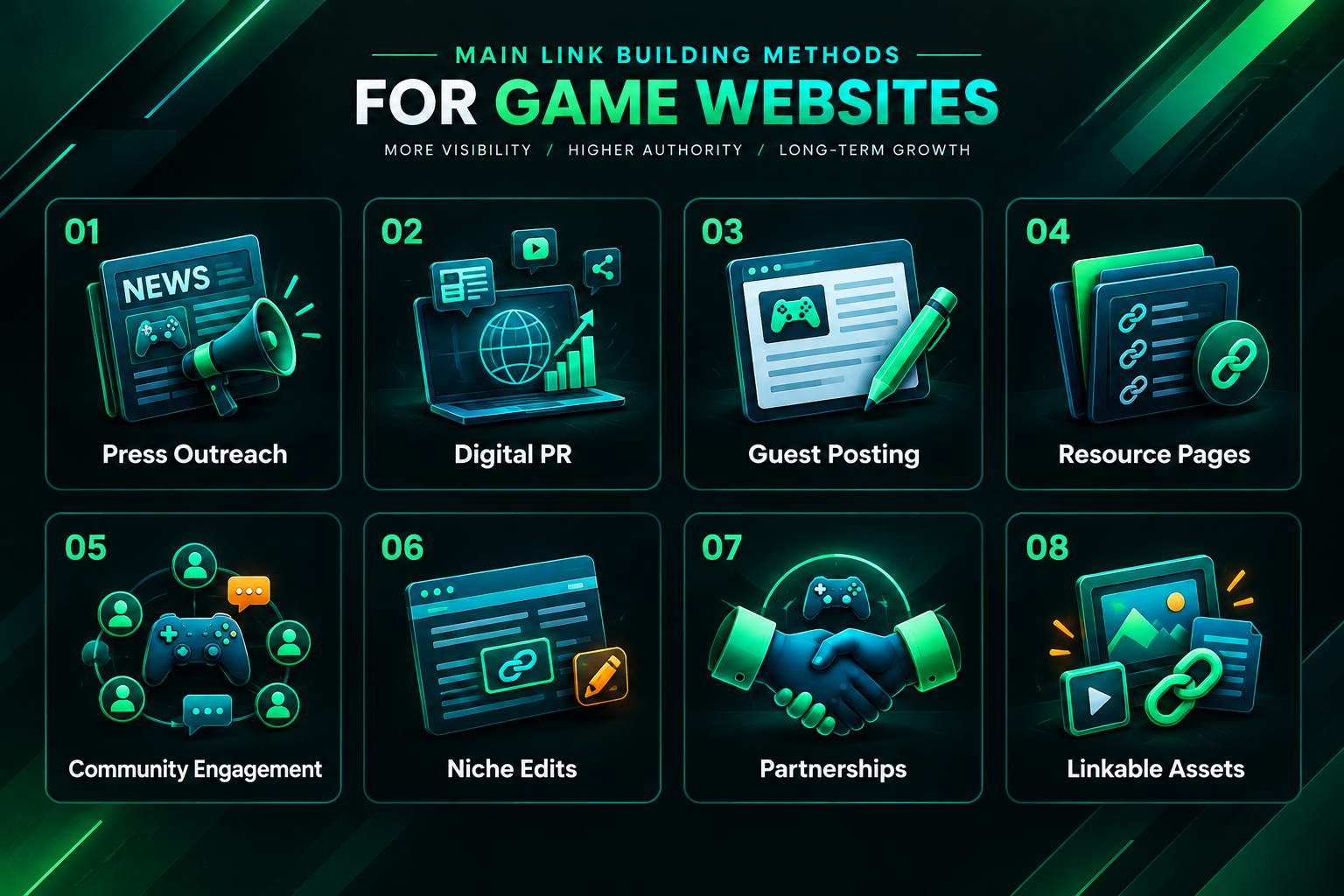
One of the most natural sources of backlinks for a game website is editorial review coverage. When a gaming publication, YouTube channel with a written companion post, or independent reviewer publishes a review of your game and links back to the official game page or developer site, that link is typically editorially placed — meaning it was given because the content was genuinely relevant, not because it was paid for or arranged through a link exchange. These links tend to carry meaningful SEO value because they come from topically relevant sources with established audiences.
Earning review coverage requires proactive press outreach. This usually involves building a media list of relevant gaming journalists, bloggers, and content creators, then sending personalised pitches with a press kit that includes a game description, screenshots, a trailer, system requirements, and a review key or demo access. The quality of the press kit and the timing of the outreach — ideally timed around a launch, major update, or announcement — significantly affects response rates. Smaller indie developers often find that niche gaming blogs and mid-tier outlets are more accessible than major publications, and links from those sources can still contribute meaningfully to a backlink profile.
Digital PR and Newsjacking
Digital PR for game websites involves creating content or stories that are genuinely newsworthy and distributing them to journalists and editors who cover gaming, technology, or entertainment. This might include announcing a significant milestone such as a Kickstarter funding goal being reached, releasing original data about player behaviour, publishing a behind-the-scenes development story, or responding to a trending topic in the gaming industry with a relevant expert comment.
When a journalist picks up the story and publishes it with a link back to the game site or developer blog, the resulting backlink is editorially earned. Digital PR campaigns can generate multiple links from a single asset or story, which makes them relatively efficient when they succeed. However, success is not guaranteed. Many pitches go unanswered, and the gaming press receives a high volume of outreach. A story needs a genuine hook — something that is timely, surprising, data-driven, or emotionally resonant — to stand out. Game developers who invest in original research, such as a survey of player preferences or an analysis of gaming trends, often find this type of content generates more sustained link interest than a standard launch announcement.
Guest Posting on Gaming and Tech Publications
Guest posting involves writing an original article for a third-party website in exchange for a byline and, typically, a contextual link back to the developer’s site. For game developers, relevant guest posting targets include gaming blogs, indie developer communities, game design publications, technology sites that cover software development, and entertainment media that accepts contributor content.
The value of a guest post link depends heavily on the quality and relevance of the publishing site. A guest article on a well-regarded game design blog that links to a developer’s portfolio or game page is likely to carry more SEO relevance than a guest post on a general lifestyle site with no connection to gaming. When evaluating potential guest posting opportunities, it is worth assessing the site’s topical focus, the quality of its existing content, its organic traffic (which tools like Ahrefs or Semrush can estimate), and whether its backlink profile appears natural. Metrics such as Domain Rating (Ahrefs), Domain Authority (Moz), or Authority Score (Semrush) can provide a rough indication of a site’s link equity, but these are third-party estimates rather than Google-provided signals, and they should not be treated as guarantees of ranking benefit.
Guest posting at scale requires significant content production effort. Writing high-quality, original articles that meet the editorial standards of reputable publications takes time, and many sites have specific contributor guidelines that must be followed. Some developers outsource this outreach and content production to a specialist link building service, which can manage publisher identification, pitch writing, article creation, and placement on their behalf.
Resource Page and Directory Link Building
Some websites maintain curated resource pages — lists of useful tools, games, developer resources, or community links — that are relevant to the gaming industry. Earning a placement on a well-maintained, topically relevant resource page can provide a useful backlink, particularly if the page is regularly updated and linked to from other authoritative sources.
Resource link building involves identifying these pages through search queries such as “best indie game resources” or “game development tools list”, then reaching out to the site owner with a personalised message explaining why your game or developer resource would be a valuable addition. The success rate for this type of outreach varies considerably. Pages that are actively maintained and have clear submission criteria tend to be more responsive than abandoned resource lists. It is also worth noting that not all directory or resource page links carry equal SEO value; links from low-quality or spammy directories may provide little benefit and could, in some cases, contribute to a problematic backlink profile if accumulated in large numbers.
Community Engagement and Forum Participation
Gaming communities on platforms such as Reddit, Discord, and dedicated game forums represent a significant opportunity for brand visibility and referral traffic, though the SEO value of links from these sources varies. Many forum and community platform links carry a nofollow or ugc (user-generated content) link attribute, which means search engines may treat them differently from editorially placed dofollow links. However, genuine community participation can still contribute to a game’s online presence in indirect ways: it can drive referral traffic, build brand awareness, attract the attention of journalists or bloggers who discover the game through community discussions, and generate organic mentions that may eventually lead to editorial links.
The key distinction here is between genuine participation and link dropping. Posting links to a game site in community spaces without contributing meaningfully to the discussion is generally unwelcome and may result in posts being removed or accounts being banned. Developers who engage authentically — answering questions, sharing development updates, participating in feedback threads — tend to build the kind of community goodwill that supports organic link acquisition over time.
Niche Edits and Link Insertions
Niche edits, sometimes called link insertions, involve adding a link to an existing published article on a third-party website rather than creating new content. For game websites, this might mean identifying a relevant article about indie game development, gaming history, or a specific game genre, and arranging for a contextual link to be inserted into that article pointing to a relevant page on the developer’s site.
When done through genuine editorial agreement — where the site owner agrees that the link adds value to their existing content — niche edits can be an efficient way to earn contextual backlinks without the content production overhead of guest posting. However, it is important to distinguish between editorially motivated link insertions and paid link placements. Google’s spam policies state that buying or selling links that pass PageRank is against their guidelines, and paid niche edits that are not disclosed as sponsored content carry a degree of policy risk. The level of risk depends on factors including the quality of the linking site, the naturalness of the placement, and the scale of the campaign. Developers and their SEO partners should be aware of this distinction when evaluating niche edit services.
Partnerships, Collaborations, and Cross-Promotion
Game developers often have natural opportunities to earn backlinks through industry relationships. Collaborating with another developer on a project, being featured in a game bundle, participating in a game jam, or partnering with a gaming peripheral brand can all generate legitimate editorial links from partner websites, event pages, and press coverage. These links tend to be highly relevant because they come from within the gaming ecosystem and are typically placed in a genuine editorial context.
Similarly, if a game is featured on a platform such as Steam, itch.io, or the Epic Games Store, the platform page itself may link to the developer’s official site. While the SEO value of links from large platforms varies depending on how those platforms structure their pages and link attributes, the referral traffic from these placements can be substantial and may indirectly support link acquisition by increasing the game’s visibility among journalists and content creators.
Linkable Asset Creation
A linkable asset is a piece of content that is specifically designed to attract backlinks because it provides genuine value to a target audience. For game developers, linkable assets might include a free game demo, an original soundtrack available for download, a detailed post-mortem of the development process, an interactive tool related to the game’s theme, original research about the gaming market, or a high-quality visual asset such as concept art or a making-of documentary.
The logic behind linkable asset creation is that content which is genuinely useful, entertaining, or informative gives other websites a reason to link to it without being asked. A well-executed game development post-mortem, for example, might be linked to by game design blogs, developer communities, and educational resources over an extended period. The challenge is that creating a genuinely compelling linkable asset requires significant investment in time and creative effort, and not every asset will attract the volume of links anticipated. Promotion of the asset through outreach and social channels is usually necessary to generate initial visibility.
Assessing Backlink Quality for Game Websites
Not all backlinks contribute equally to a game site’s SEO profile. When evaluating the quality of a potential or existing backlink, several factors are worth considering. Topical relevance — whether the linking site covers gaming, technology, entertainment, or a related subject — is an important indicator of how contextually appropriate the link is. A link from a gaming publication is generally more relevant to a game website than a link from an unrelated niche, even if the unrelated site has a higher domain-level authority metric.
The placement context also matters. A link embedded naturally within the body of a relevant article, where it adds genuine value to the reader, is typically more meaningful than a link placed in a footer, sidebar, or author bio with no surrounding context. The link attribute — whether it is dofollow, nofollow, or sponsored — affects how search engines may treat the link, though the practical impact of nofollow links on rankings remains a subject of ongoing discussion among SEO practitioners.
Third-party metrics from tools such as Ahrefs, Semrush, Moz, or Majestic can help identify potentially strong or weak linking domains, but these metrics are estimates based on each tool’s own data and algorithms. They are not provided by Google and should not be treated as direct proxies for ranking benefit. A site with a high Domain Rating may still provide a low-value link if the placement is irrelevant, buried, or surrounded by low-quality content.
Realistic Timelines and What to Expect
Link building for game websites is rarely a quick process. Press outreach campaigns may take several weeks to generate coverage, and even when links are placed, search engines need time to crawl and index the new links before any potential ranking effect becomes measurable. In competitive gaming niches, meaningful organic ranking improvements from a link building campaign may take three to six months or longer to become visible, and the outcome depends on many factors beyond the backlinks themselves — including the quality of the content on the target page, the site’s technical SEO health, and the strength of competing pages.
Developers who are launching a new game and hoping for immediate organic traffic from link building are likely to be disappointed. Link building is more effective as a sustained, ongoing activity than as a one-time pre-launch push. Building a backlink profile gradually over time, through a combination of press outreach, guest posting, digital PR, and community engagement, tends to produce more durable results than a concentrated burst of link acquisition followed by inactivity.
Risks and Quality Considerations
Some link building tactics carry meaningful risks that game developers should understand before pursuing them. Purchasing links from link farms, private blog networks (PBNs), or low-quality link marketplaces may produce short-term metric improvements but can expose a site to search engine penalties if the links are identified as manipulative. Google’s spam policies explicitly address link schemes, and sites that are found to be participating in such schemes may receive manual actions that reduce or remove their organic visibility.
Even tactics that are generally considered lower-risk, such as guest posting and niche edits, can become problematic if pursued at scale through low-quality publishers, if the content is thin or irrelevant, or if the anchor text distribution appears unnatural. A diverse, contextually relevant backlink profile built through genuine editorial relationships is generally considered more sustainable than one built primarily through paid placements or templated outreach at high volume.
Before starting a link building campaign, it is worth auditing the existing backlink profile to identify any potentially harmful links that may already be affecting the site’s standing. Tools such as Google Search Console, Ahrefs, or Semrush can help identify unusual patterns in the backlink profile, though interpreting these patterns accurately often requires SEO experience.
When to Consider Outsourcing Link Building for a Game Website
Many game developers and small studios do not have the time, contacts, or outreach expertise to run a sustained link building campaign alongside the demands of game development. Outsourcing link building to a specialist provider can make sense when the internal team lacks the capacity to manage publisher research, personalised outreach, content production, and placement tracking consistently over time.
A reputable outsourced link building service for game websites should be able to demonstrate a clear acquisition process, provide transparency about the publishers they work with, explain how they assess link quality, and set realistic expectations about timelines and outcomes. It is reasonable to ask a provider how they identify relevant gaming and tech publishers, what their editorial standards are, how they handle link replacement if a placement is removed, and what reporting they provide. Providers who guarantee specific ranking outcomes or promise unusually fast results should be approached with caution, as these claims are difficult to substantiate and may indicate lower-quality practices.
White-label link building services — where an agency manages link acquisition on behalf of another agency’s clients — are also available for SEO agencies that work with gaming clients but do not have in-house link building capacity. These arrangements allow agencies to offer link building as part of a broader SEO service without building an outreach team from scratch.
Frequently Asked Questions
Do game websites need backlinks to rank in search engines?
Backlinks are one of many signals that search engines use when evaluating pages. Whether a game website needs more backlinks depends on its existing profile, the competitiveness of its target keywords, and whether other SEO factors — such as content quality, technical health, and internal linking — are already in good shape. A site-specific assessment is more useful than a blanket recommendation.
What types of websites are most valuable for linking to a game site?
Links from topically relevant sources — gaming publications, game review sites, developer communities, technology blogs, and entertainment media — tend to be more contextually appropriate than links from unrelated niches. Relevance, editorial quality, and natural placement context are generally more important than a high domain-level authority metric alone.
How long does it take for backlinks to affect rankings for a game website?
There is no fixed timeline. After a link is placed, search engines need to crawl and index it, and any potential ranking effect may take weeks or months to become measurable. In competitive gaming niches, sustained link building over several months is typically needed before meaningful organic visibility changes become apparent. Results vary depending on the site, the competition, and other SEO factors.
Is it safe to buy backlinks for a game website?
Purchasing links that pass PageRank without disclosure is against Google’s spam policies and carries a risk of manual action or algorithmic demotion. The level of risk depends on the quality of the links, the scale of the campaign, and how natural the placements appear. Developers should understand this risk before pursuing paid link placements and should distinguish between paid editorial content (which should be disclosed) and genuinely earned editorial links.
Can a game developer build backlinks without a budget?
Yes, though it requires significant time investment. Tactics such as press outreach with a strong press kit, community engagement, linkable asset creation, and genuine relationship building with gaming journalists and bloggers can generate editorial backlinks without direct payment for placements. The trade-off is that these approaches require consistent effort and may produce results more slowly than a managed outreach campaign.
What is a press kit and why does it matter for link building?
A press kit is a collection of materials — typically including a game description, key features, screenshots, a trailer, developer biography, and contact information — that makes it easy for journalists and reviewers to cover a game. A well-prepared press kit reduces the friction for a journalist to write about a game and increases the likelihood that coverage will include a link back to the official game page or developer site.
Should link building be the first SEO priority for a new game website?
Not necessarily. If a game website has significant technical SEO issues, thin or poorly structured content, or pages that do not match the search intent of target queries, addressing those issues first may produce more immediate improvements than link building. Backlinks are most effective when the pages they point to are already well-optimised and capable of converting organic visitors into players or customers.
Choosing a Link Building Approach That Fits Your Game and Goals
Game developers have more link building options available to them than is sometimes assumed, but no single method is universally appropriate. Press outreach and digital PR tend to produce the most editorially credible links and can generate coverage that also drives referral traffic and brand awareness, but they require strong assets and consistent effort. Guest posting and niche edits can supplement a backlink profile efficiently when placed on genuinely relevant, quality publishers, but they require careful vetting to avoid low-quality placements that carry policy risk. Community engagement and linkable asset creation build long-term link equity but rarely produce immediate results.
The most sustainable approach for most game websites is a combination of methods, prioritised according to the site’s current SEO health, the competitiveness of the target keywords, and the resources available. Developers who are unsure where to start may benefit from an initial SEO audit to identify whether link building is the most pressing priority or whether technical and content improvements should come first. For those who lack the internal capacity to manage outreach consistently, working with a specialist link building service that understands the gaming niche and operates with transparent, editorially focused methods may be worth exploring.