Affiliate websites occupy a competitive corner of organic search, where rankings often depend heavily on the strength and relevance of a backlink profile. Building backlinks for an affiliate site involves different considerations than link building for a brand, SaaS product, or e-commerce store — the business model, content type, and publisher perception all affect which acquisition methods are realistic and which carry meaningful risk. This article explains the main approaches, what makes them suitable or unsuitable for affiliate sites, and what you can reasonably expect from a link building campaign in this context.
Key Takeaways
- Affiliate websites can benefit from backlinks, but the site’s content quality, niche, and existing authority profile all affect how much impact a campaign may have.
- Manual outreach, guest posting, digital PR, and niche edits are the most commonly used white-hat methods for affiliate link acquisition, each with different timelines and editorial requirements.
- Many publishers are cautious about linking to affiliate sites, so topical relevance, content depth, and site credibility matter more than they might for other business types.
- Link building alone rarely fixes ranking problems caused by thin content, search-intent mismatch, or technical SEO issues — an audit is usually worthwhile before starting a campaign.
- Higher-risk tactics such as private blog networks carry documented policy risks and should be evaluated carefully against the long-term value of the site.
Why Backlinks Matter for Affiliate Websites
Affiliate websites typically compete for informational and commercial-investigation queries — product reviews, comparisons, best-of lists, and buying guides. These query types attract significant search volume and are often contested by established publishers, media brands, and retailer content teams. In competitive niches, a site’s backlink profile is frequently one of the factors that separates pages ranking on the first page from those buried further back, though rankings also depend on content quality, relevance, technical SEO, and how well a page matches search intent.
Backlinks from editorially relevant, authoritative domains can contribute to a site’s perceived topical authority and may help individual pages compete for target keywords. However, the relationship between backlinks and rankings is not linear or guaranteed. A page with fewer but highly relevant links from trusted publishers can outperform a page with a larger number of low-quality or off-topic links. For affiliate sites, where content is often structured around commercial intent, the quality and contextual relevance of each link tends to matter more than raw link volume.
It is also worth noting that Google’s documented guidance distinguishes between links that are editorially given because of the quality of content and links that are acquired through schemes designed to manipulate rankings. Affiliate sites that rely on manipulative link acquisition face a higher risk of algorithmic or manual action, particularly given that affiliate content has historically received scrutiny through updates targeting low-quality or thin content.
Assessing Your Site Before Building Links
Before investing in a link building campaign, it is worth assessing whether the site is in a position to benefit from additional backlinks. Low organic visibility on an affiliate site can have several causes that links alone will not resolve. These include crawling or indexing problems, content that does not adequately match search intent, thin or duplicated product descriptions, weak internal linking between related pages, or a history of manipulative link acquisition that has already attracted a penalty or algorithmic filter.
A basic technical SEO review and content audit can help identify whether the priority should be improving existing pages, addressing indexing issues, or building links to pages that are already well-optimised and competitive. Sending links to a page that Google does not consider useful or trustworthy is unlikely to produce meaningful ranking improvements. Conversely, a well-structured affiliate site with strong content and a clean backlink history may see measurable organic improvements from a targeted, quality-focused link building campaign — though the timeline and scale of those improvements will vary depending on the niche, competition, and the authority of the linking domains.
Main Link Acquisition Methods for Affiliate Sites
Several link acquisition approaches are commonly used for affiliate websites. Each has different editorial requirements, timelines, and suitability depending on the site’s niche and content.
Manual Outreach and Guest Posting
Manual outreach involves identifying relevant publishers, bloggers, or editorial websites and pitching content or collaboration opportunities. Guest posting — contributing an original article to a third-party site in exchange for a contextual backlink — is one of the most widely used methods for affiliate link building. When executed well, guest posting can place links on topically relevant, editorially maintained sites that pass meaningful authority signals.
The challenge for affiliate sites is that many publishers are selective about linking to sites whose primary purpose is commercial referral. A site with strong original content, a clear editorial voice, and genuine topical expertise is more likely to attract guest post placements than a thin affiliate site built primarily around product listings. Outreach success rates vary considerably by niche, and campaigns in highly competitive verticals — finance, health, software, and consumer electronics — typically require more effort and a longer timeline to secure quality placements.
Guest post links are typically followed contextual links placed within the body of an article. The anchor text, surrounding content, and the publisher’s own topical relevance all influence how much value the link may contribute. Delivery timelines for guest post campaigns generally range from several weeks to a few months, depending on outreach volume, publisher response rates, and editorial review processes.
Niche Edits and Link Insertions
Niche edits — also called link insertions or curated links — involve placing a backlink within an existing published article on a third-party site, rather than creating new content. The link is inserted into a passage that is already indexed and, in some cases, already receiving traffic. Proponents suggest this approach can pass authority more quickly because the hosting page already has an established history, though this claim is difficult to verify independently and outcomes vary.
For affiliate sites, niche edits can be a practical way to acquire contextually relevant links without the content creation overhead of guest posting. However, quality control is important. Links inserted into low-quality, outdated, or irrelevant articles on sites with poor editorial standards are unlikely to contribute meaningfully and may carry policy risk if the site is part of a link scheme. Evaluating the publisher’s content quality, traffic profile, and editorial relevance before accepting a placement is essential.
Digital PR and Content-Led Link Acquisition
Digital PR involves creating genuinely newsworthy or data-driven content — original research, surveys, interactive tools, or expert commentary — and distributing it to journalists, editors, and publishers who may link to it as a source. This approach can generate editorial links from high-authority news and media sites that are difficult to acquire through direct outreach.
For affiliate websites, digital PR is most effective when the site has a clear area of expertise and can produce content that journalists find credible and useful. A personal finance affiliate site that commissions original consumer research, or a technology review site that publishes benchmark data, may attract links from mainstream media. The investment in content production is higher than for standard outreach, and results are less predictable, but the links acquired tend to be from domains with strong authority signals and genuine editorial independence.
Resource Page and Roundup Link Building
Resource page link building involves identifying pages on relevant sites that curate useful links for a particular audience — tools, guides, or recommended reading — and pitching the affiliate site’s content as a worthy addition. Similarly, some publishers produce regular roundup articles that link to useful resources in a niche. These placements can be editorially legitimate when the content genuinely adds value, though the volume of opportunities varies significantly by niche.
Broken Link Building
Broken link building involves finding links on relevant third-party pages that point to content that no longer exists, then suggesting the affiliate site’s own content as a replacement. This approach requires identifying relevant broken links at scale, which typically involves SEO tools such as Ahrefs or Semrush, and then conducting outreach to the hosting site. The method can produce editorially clean links, but the process is time-intensive and conversion rates from outreach tend to be modest.
Evaluating Publisher Quality for Affiliate Link Campaigns
Not all backlinks contribute equally, and for affiliate sites — which may already face scrutiny from search engines — the quality of each placement matters considerably. When assessing a potential linking domain, several factors are worth examining beyond a single authority metric.
Third-party metrics such as Domain Rating from Ahrefs, Domain Authority from Moz, or Authority Score from Semrush can provide a rough indication of a site’s link profile strength, but these are proprietary estimates rather than Google signals. A high Domain Rating does not guarantee that a link from that site will improve rankings, and a lower-rated site with strong topical relevance and genuine editorial traffic may contribute more value than a high-rated site with an unrelated audience.
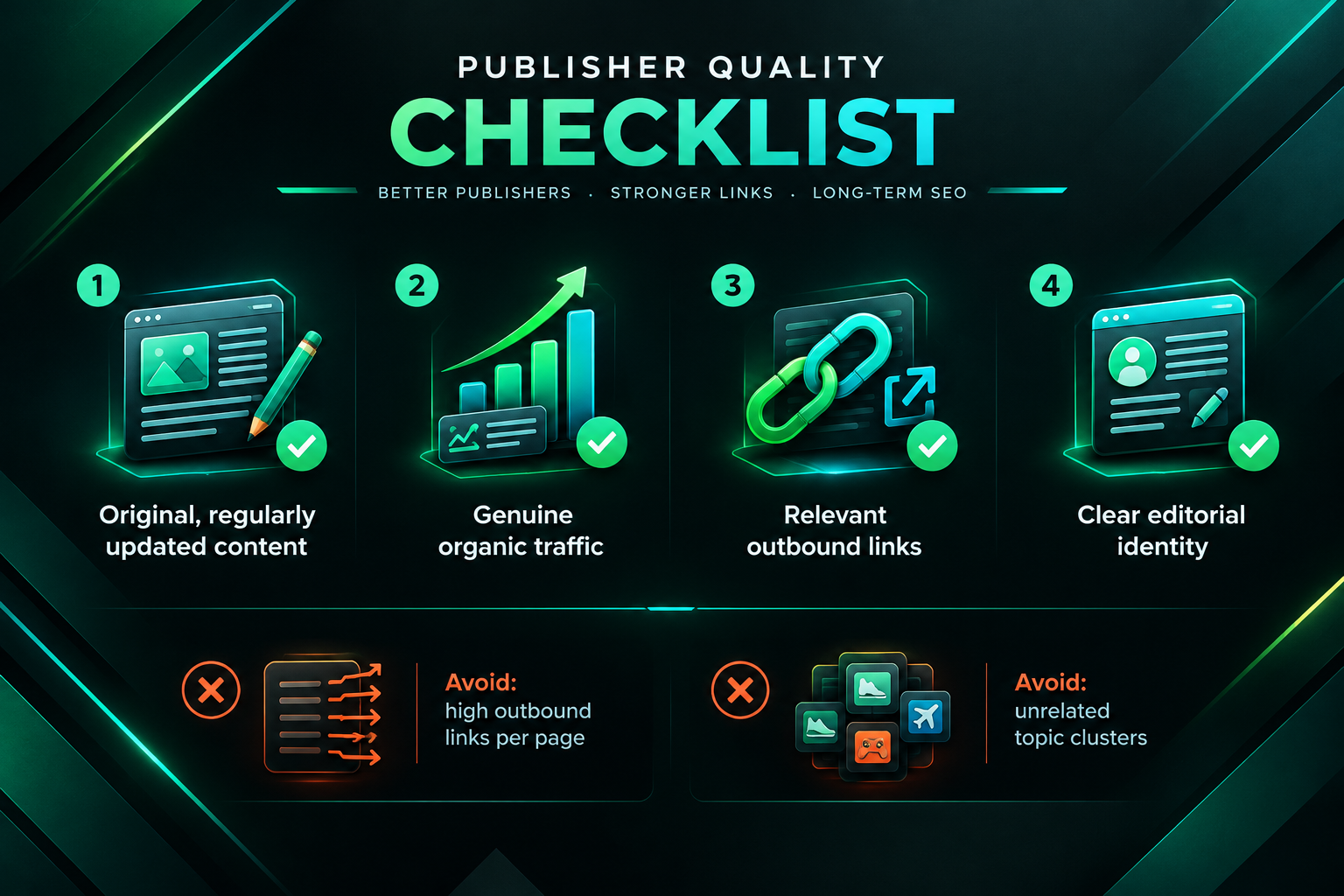
More useful indicators of publisher quality include: whether the site publishes original, regularly updated content; whether it attracts genuine organic traffic (which can be estimated using tools like Ahrefs or Semrush); whether its existing outbound links point to credible, relevant sources; and whether the site has a clear editorial identity rather than existing primarily to sell links. Sites that publish large volumes of low-quality content across unrelated topics, or that have unusually high numbers of outbound links per page, are generally lower-quality placements regardless of their domain-level metrics.
Anchor Text and Link Attribute Considerations
Anchor text — the visible, clickable text of a hyperlink — is one of the signals search engines use to understand what a linked page is about. For affiliate sites targeting specific commercial keywords, it can be tempting to use exact-match anchor text aggressively. However, a backlink profile dominated by exact-match commercial anchors can appear unnatural and may attract algorithmic scrutiny, particularly for sites in niches that have historically been associated with manipulative link building.
A more natural anchor text distribution typically includes a mix of branded anchors, partial-match phrases, generic terms, and some exact-match anchors where they occur naturally in editorial context. There is no universally correct ratio, and prescribing fixed percentages without reviewing the site’s existing profile and competitive landscape would be misleading. A qualified SEO professional reviewing the site’s current anchor distribution can provide more relevant guidance than any generic formula.
Link attributes are also worth understanding. A nofollow attribute signals to search engines that the linking site does not wish to pass ranking credit. A sponsored attribute is intended for paid or affiliate links. Google’s documented guidance recommends using the sponsored attribute for paid link placements. Editorial links acquired through genuine outreach and content contribution are typically followed links, though publisher policies vary. Understanding the attribute applied to a placement is relevant to assessing its likely SEO value.
Risks Specific to Affiliate Link Building
Affiliate websites face some link building risks that are worth understanding before committing to a campaign approach.
Google has historically applied algorithmic updates that target affiliate content perceived as low-quality or primarily designed to rank rather than to genuinely help users. Sites that combine thin content with an aggressive link building strategy may find that links provide limited benefit or that the site remains suppressed by content-quality filters regardless of backlink volume. Addressing content quality before or alongside link building is generally a more sustainable approach.
Private blog networks (PBNs) — networks of sites created or acquired specifically to pass links to target sites — carry documented policy risk. Google’s spam policies explicitly identify link schemes, including PBNs, as violations. Sites that rely on PBN links may see short-term ranking improvements, but the risk of algorithmic or manual action is real and the long-term value of the site can be significantly damaged if a penalty is applied. For affiliate sites where the business model depends on sustained organic traffic, this risk deserves careful consideration.
Paid link placements — where a fee is exchanged for a followed link without disclosure — are also against Google’s documented guidelines. This does not mean that all paid placements result in penalties, but the risk is not zero, and the risk profile may be higher for affiliate sites that are already under scrutiny. Using the sponsored attribute for paid placements is the documented compliant approach, though a sponsored link does not pass the same ranking signals as an editorial followed link.
Link velocity — the rate at which new backlinks are acquired — is another consideration. A sudden, large increase in backlinks from low-quality or irrelevant sources can appear unnatural. A gradual, consistent acquisition of relevant, quality links is generally considered a lower-risk approach, though there is no publicly documented threshold that definitively triggers a penalty.
Timelines and Realistic Expectations
Link building for affiliate websites is rarely a fast process, and the timeline from campaign start to measurable ranking or traffic change involves several stages. Initial outreach and content creation typically take several weeks. Publisher review, editorial approval, and article publication add further time. After a link is published, search engine crawlers need to discover and index it, which can take days to weeks depending on the publisher’s crawl frequency and the link’s prominence on the page.
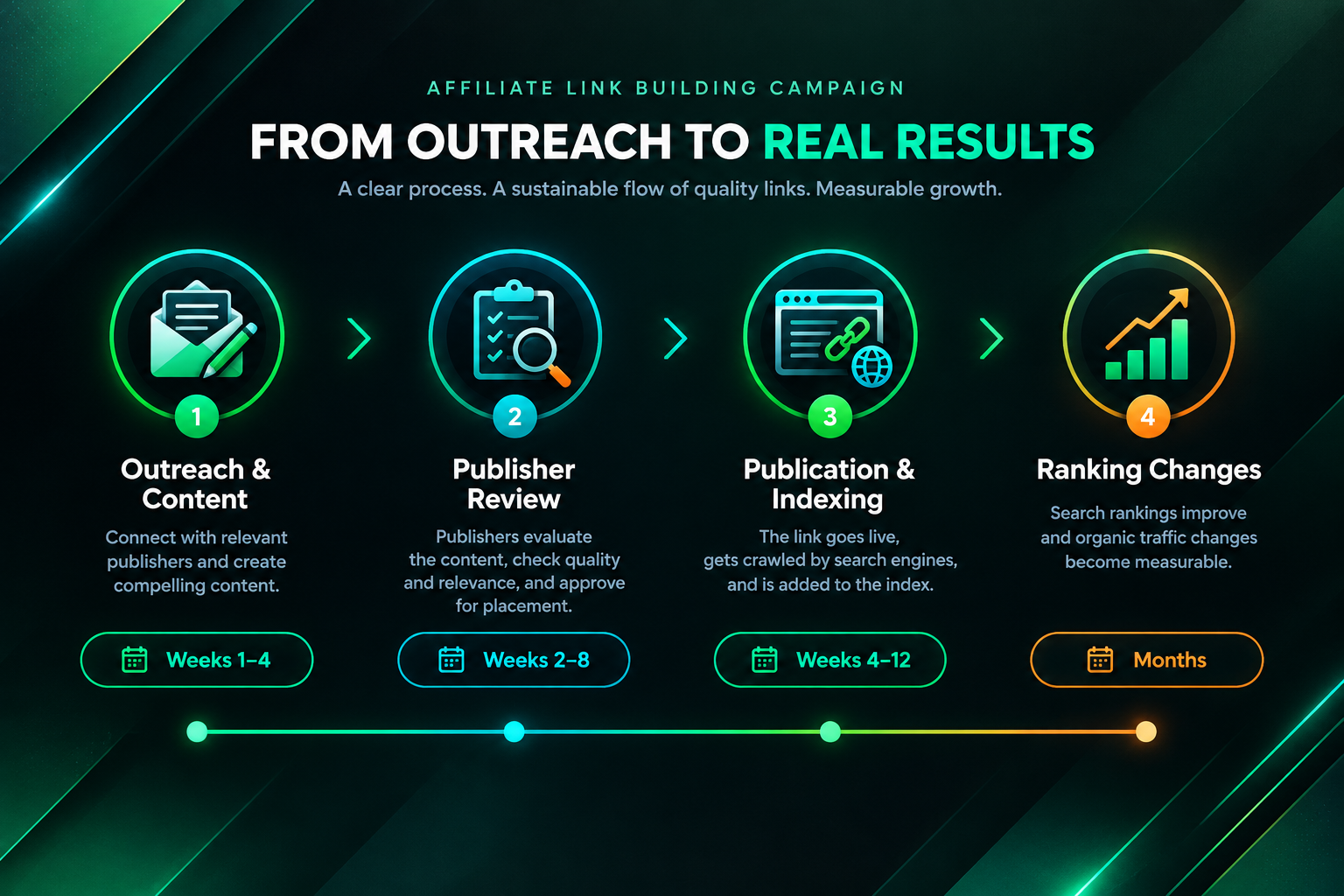
Even after a link is indexed, ranking changes are not immediate. Search engines reassess page authority and relevance over time, and the effect of new links on rankings may become more visible over weeks or months rather than days. For affiliate sites in competitive niches, a single campaign of five to ten links is unlikely to produce dramatic ranking shifts. Sustained, ongoing link acquisition over multiple months — combined with strong content — is more likely to contribute to meaningful organic growth than a one-time burst of activity.
Results also depend heavily on the starting point. A newer affiliate site with few existing backlinks may see more noticeable movement from early link acquisition than an established site competing against well-linked incumbents. Conversely, a site with a history of manipulative link building may need to address its existing profile before new links contribute positively.
Outsourcing Link Building for Affiliate Sites
Many affiliate site owners and SEO teams choose to outsource link acquisition rather than manage outreach, content creation, and publisher relationships in-house. Outsourcing can provide access to established publisher networks, experienced outreach teams, and scalable campaign management without the overhead of building those capabilities internally.
When evaluating an outsourced link building provider for an affiliate site, it is worth asking specific questions about their approach to publisher quality assessment, how they handle affiliate-specific publisher restrictions, what link attributes are used for placements, and how they report on campaign progress. A provider that can demonstrate a clear process for evaluating publisher relevance and editorial quality — rather than simply offering volume-based packages — is generally better suited to the requirements of affiliate link building.
White-label link building services, where an agency delivers link acquisition under another brand’s name, are also used by SEO agencies managing affiliate client campaigns. These arrangements can work well when the underlying delivery quality is strong, but the same quality assessment criteria apply regardless of how the service is branded.
It is also reasonable to ask a provider how they handle affiliate-specific challenges, such as publishers who decline to link to affiliate sites, or niches where outreach response rates are lower than average. A provider with experience in affiliate link building should be able to give a realistic picture of what is achievable in a given niche and timeframe.
Alternatives and Complementary Approaches
Link building is one component of affiliate SEO, and it is worth considering whether other investments might produce comparable or better returns depending on the site’s current situation.
Content improvement — updating thin or outdated reviews, expanding comparison pages, adding original data or expert commentary — can improve rankings without any new link acquisition, particularly for pages that are already ranking on page two or three and may be held back by content quality rather than authority. Internal linking improvements, which distribute authority from stronger pages to weaker ones within the same site, can also produce ranking improvements without external link acquisition.
For affiliate sites with some existing authority, targeting lower-competition long-tail keywords through new content can generate organic traffic growth without requiring the same level of link investment as competitive head terms. This approach can be combined with link building to build authority in a niche progressively rather than competing immediately for the most contested queries.
Social media, email newsletters, and community participation can generate referral traffic and brand awareness that indirectly supports link acquisition by increasing the site’s visibility among potential linking publishers. These channels do not replace backlinks as a ranking factor, but they can contribute to the conditions that make editorial link acquisition more achievable over time.
Frequently Asked Questions
Do affiliate websites have a harder time getting backlinks than other site types?
In many niches, yes. Some publishers are reluctant to link to sites whose primary purpose is commercial referral, particularly in competitive verticals like finance, health, and software. Affiliate sites with strong original content, genuine expertise, and a clear editorial identity tend to have better outreach success rates than thin sites built primarily around product listings.
How many backlinks does an affiliate site need to rank?
There is no universal answer. The number of referring domains needed to compete depends on the specific keyword, the authority of competing pages, the quality of the site’s content, and many other factors. Comparing the backlink profiles of pages currently ranking for target keywords using a tool like Ahrefs or Semrush can give a rough benchmark, but this should be treated as context rather than a fixed target.
Is it safe to buy links for an affiliate website?
Paid link placements that pass ranking signals without disclosure are against Google’s documented spam policies. This does not mean every paid placement results in a penalty, but the risk is real and may be higher for affiliate sites that already attract algorithmic scrutiny. Using the sponsored attribute for paid placements is the documented compliant approach, though sponsored links do not pass the same signals as editorial followed links.
How long does it take to see results from link building on an affiliate site?
Ranking changes from new backlinks typically become more visible over weeks to months rather than days. The timeline depends on how quickly links are crawled and indexed, the competitiveness of the target keywords, the authority of the linking domains, and the overall quality of the site’s content. A single campaign is unlikely to produce dramatic results in a short timeframe; sustained acquisition over multiple months is generally more effective.
Should I fix my content before building links?
If the site has thin, outdated, or poorly structured content, addressing those issues before or alongside link building is generally a more effective use of resources. Links pointing to pages that do not satisfy search intent or that Google considers low-quality are unlikely to produce meaningful ranking improvements. A content and technical audit before starting a link building campaign can help prioritise where effort is best directed.
Can I use the same link building approach for every page on my affiliate site?
Not necessarily. High-value commercial pages — primary review or comparison pages targeting competitive keywords — typically benefit most from direct link acquisition. Supporting informational content may be better served by internal linking from pages that already have external authority. A campaign strategy that identifies priority pages based on their current ranking position, traffic potential, and competitive gap is more likely to produce useful results than a uniform approach across the whole site.
Building Backlinks for Affiliate Sites: Choosing an Approach That Fits Your Situation
Affiliate websites can benefit from a well-planned link building campaign, but the approach needs to match the site’s content quality, niche, competitive landscape, and risk tolerance. Manual outreach, guest posting, niche edits, and digital PR each offer different trade-offs in terms of editorial requirements, timelines, and the quality of placements achievable. Higher-risk tactics carry documented policy risks that are worth weighing carefully against the long-term value of the site.
Before committing to a link acquisition strategy, it is worth assessing whether the site’s content and technical foundation are strong enough to benefit from new links, and whether the target pages are genuinely competitive candidates for the keywords being pursued. A site-specific assessment — rather than a generic package — is the most reliable starting point for understanding what a link building campaign can realistically achieve for a particular affiliate site.
If you are considering outsourcing link acquisition for an affiliate site, speaking with a provider who has experience in your niche and can explain their publisher quality assessment process is a reasonable first step. The right campaign approach will depend on factors specific to your site, your market, and your goals — and a qualified provider should be able to help you understand those factors before any campaign begins.