A link building contract is the document that defines what you are paying for, how quality is measured, what happens when things go wrong, and how either party can exit the arrangement. Without clear contractual terms, disputes over deliverables, link quality, and timelines are difficult to resolve, and the financial and reputational risks fall disproportionately on the client. This article explains the essential clauses a link building contract should include, why each one matters, and what to watch for before signing.
Key Takeaways
- A well-structured link building contract should define deliverables precisely, including link type, minimum quality thresholds, and target pages, rather than relying on vague promises about volume alone.
- Reporting, approval rights, and replacement or refund terms are among the most practically important clauses, yet they are frequently absent or poorly worded in standard agreements.
- Contracts should address search-engine policy compliance, link attribute requirements, and what happens if a placed link is removed or altered after delivery.
- Exit terms, intellectual property ownership, and confidentiality provisions protect both parties and are worth reviewing carefully before committing to a campaign.
- No contract can guarantee specific ranking improvements or traffic outcomes; any agreement that does should be treated with caution.
Why a Link Building Contract Matters
Link building campaigns involve ongoing financial commitments, third-party publishers, and SEO outcomes that take weeks or months to become measurable. A contract creates a shared understanding of what the provider will deliver, what the client is responsible for, and how disputes will be handled. Without one, clients may receive placements on low-quality websites, discover that links were removed shortly after delivery, or find that the provider’s definition of a “high-quality backlink” differs significantly from their own. Providers, equally, benefit from clear scope and approval processes that prevent scope creep and unrealistic expectations.
A contract does not need to be lengthy to be effective. What matters is that the key terms are specific, measurable where possible, and agreed upon before work begins. Vague language such as “quality links” or “relevant placements” without further definition creates ambiguity that is difficult to resolve later.
Scope of Work and Deliverable Definitions
The scope of work section is the foundation of any link building agreement. It should specify the type of link acquisition method being used, such as manual outreach, guest posting, niche edits, digital PR, or a combination. Each method has a different acquisition process, editorial involvement, and expected timeline, so the contract should not treat them interchangeably.
Deliverables should be defined in terms that go beyond a simple monthly link count. A well-drafted scope section typically includes:
- Link type: whether placements will be editorial links within existing content, new guest post articles, resource page inclusions, or another format.
- Target pages: which URLs on the client’s website will receive links, since linking to a homepage, a product page, and a blog post serve different SEO purposes.
- Anchor text approach: a general description of how anchor text will be selected, acknowledging that over-optimised or exact-match anchor text used at scale carries search-engine policy risk.
- Link attributes: whether links will be followed or nofollowed, and whether sponsored or UGC attributes are expected to apply. Google’s link spam policies distinguish between editorial links and paid placements, and the contract should reflect how the provider handles this distinction.
- Volume commitments: the number of placements per month or per campaign phase, expressed as a confirmed minimum rather than an aspiration.
If the provider uses white-label delivery, meaning they fulfil placements through a network of outreach specialists or sub-contractors, the contract should acknowledge this arrangement and confirm that quality standards apply regardless of who performs the outreach.
Publisher Quality Standards and Minimum Thresholds
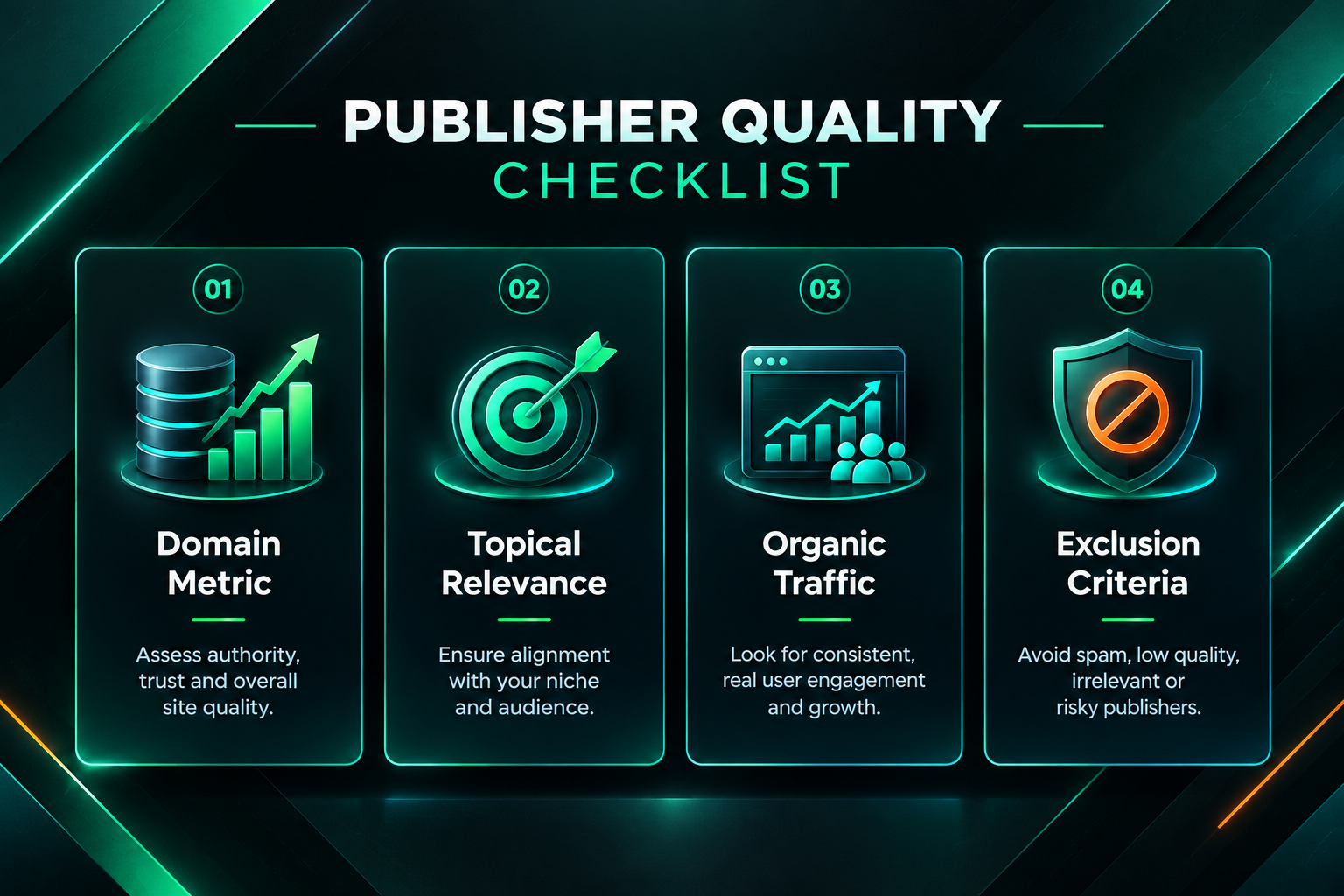
One of the most common sources of dissatisfaction in link building campaigns is a mismatch between the client’s expectations of publisher quality and what the provider actually delivers. A contract should define the minimum quality criteria that every placement must meet before it is counted as a delivered link.
Quality thresholds commonly referenced in link building agreements include third-party domain authority metrics from tools such as Ahrefs (Domain Rating), Moz (Domain Authority), or Majestic (Trust Flow and Citation Flow). It is important to understand that these are proprietary tool metrics, not Google-provided signals, and an improvement in any of them does not directly guarantee a ranking change. They are useful as relative quality indicators, but the contract should not treat them as proxies for SEO outcomes.
Beyond metric thresholds, a robust quality clause should address:
- Topical relevance: whether the publishing website’s content must be relevant to the client’s industry or niche, and how relevance is assessed.
- Organic traffic: some providers include a minimum organic traffic requirement for publisher sites, which can be verified using tools such as Ahrefs or Semrush. A site with a high domain authority metric but negligible organic traffic may indicate a low-quality or manipulated profile.
- Exclusion criteria: sites that will not be used, such as link farms, private blog networks (PBNs), sites with a history of manual actions, adult content sites, or sites in unrelated industries.
- Content quality: for guest post placements, whether the provider writes the content, whether the client approves it before publication, and what editorial standards apply.
Clients should be cautious of contracts that define quality solely by a single metric threshold without addressing topical relevance, organic visibility, or exclusion criteria. A site can score well on a domain authority metric while still being an unsuitable placement for a specific campaign.
Approval Rights and Client Involvement
The contract should clarify how much input the client has before a placement goes live. Approval rights vary significantly between providers. Some offer full pre-publication approval of both the publisher site and the content; others notify the client after placement. Neither model is inherently wrong, but the client should know which applies before signing.
A practical approval clause might specify:
- Whether the client receives a list of target publishers for review before outreach begins.
- Whether draft content is shared for approval before submission to the publisher.
- The turnaround time the client has to approve or reject a proposed placement.
- What happens if the client rejects a placement, including whether the provider will source an alternative at no additional cost.
For agencies managing campaigns on behalf of their own clients, white-label agreements may include additional confidentiality terms that prevent the end client from being identified to the publisher. The contract should confirm whether white-label delivery is available and what it covers.
Reporting, Transparency, and Verification
A link building contract should define how and when the provider will report on campaign progress. Reporting terms protect the client’s ability to verify that deliverables have been met and to monitor the ongoing health of placed links.
Reporting clauses should address:
- Frequency: monthly reporting is standard for most campaigns, though some providers offer more frequent updates during active outreach phases.
- Format: whether reports are delivered as spreadsheets, dashboard access, or written summaries, and what data they include.
- Verification data: live URLs for each placed link, the anchor text used, the target page linked to, and the publication date. Without live URLs, the client cannot independently verify placements using tools such as Google Search Console, Ahrefs, or Semrush.
- Metric data: the domain authority or equivalent metric of each publisher at the time of placement, so the client can confirm that minimum thresholds were met.
Transparency in reporting is also relevant to search-engine policy compliance. Google’s spam policies identify link schemes, including paid links that pass PageRank without appropriate disclosure. While the contract cannot guarantee that every placement will be treated as editorial by Google’s systems, clear reporting allows the client to monitor their backlink profile and identify any placements that may warrant review.
Link Retention, Replacement, and Refund Terms
Links placed through outreach campaigns can be removed by publishers after delivery. This may happen because the publisher updates their content, changes their editorial policy, or removes the page entirely. The contract should define what the provider’s obligations are when a placed link is lost.
Replacement and refund clauses vary considerably between providers. Common approaches include:
- Replacement guarantee: the provider will replace any link that is removed within a defined period, such as 30, 60, or 90 days after delivery, at no additional cost.
- Partial refund: if a link cannot be replaced within a reasonable timeframe, the client receives a credit or partial refund for that placement.
- No replacement obligation: some contracts treat delivery as complete once the link goes live, with no obligation to replace removed links. Clients should be aware of this before signing.
The contract should also specify what constitutes a delivered link. A link that is placed with a nofollow attribute when a followed link was agreed, or a link that points to the wrong target page, should not count as a completed deliverable. Defining delivery criteria precisely prevents disputes about whether the provider has met their obligations.
Search-Engine Policy Compliance and Risk Acknowledgement
No link building method is entirely free of search-engine policy risk. Google’s link spam policies cover a range of practices, including paid links that pass PageRank, large-scale guest posting primarily for link acquisition, and manipulative anchor text patterns. A responsible contract should acknowledge these risks rather than ignore them.
A compliance clause might include:
- A description of the methods the provider uses and does not use, such as confirming that PBNs or link farms will not be used.
- An acknowledgement that manual outreach and guest posting, while widely used, are subject to Google’s quality guidelines and that outcomes cannot be guaranteed.
- Confirmation of how link attributes will be handled for paid or sponsored placements, in line with Google’s guidance on sponsored link attributes.
- A risk acknowledgement clause confirming that the client understands link building carries inherent SEO risk and that the provider is not liable for ranking changes caused by algorithm updates or search-engine policy enforcement.
This clause protects both parties. It prevents the client from holding the provider responsible for ranking fluctuations caused by factors outside the campaign, while also ensuring the provider commits to methods that do not knowingly violate search-engine policies.
Timelines, Campaign Phases, and Realistic Expectations
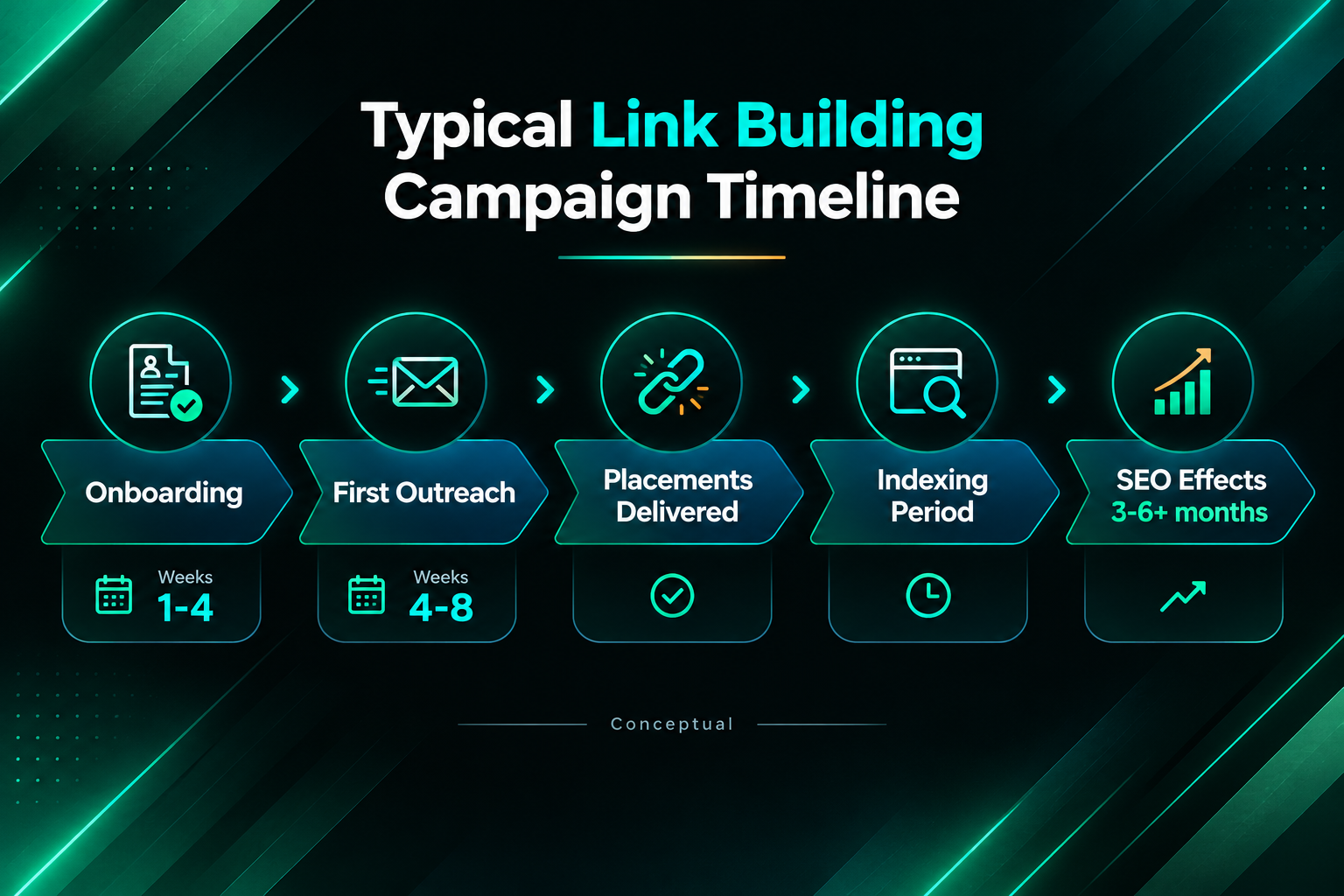
Link building campaigns do not produce immediate results. The contract should set realistic expectations for both the delivery timeline and the point at which SEO effects may become measurable.
A timeline clause should address:
- Onboarding period: the time required to complete a backlink profile audit, agree on target pages, and begin outreach. This is typically two to four weeks for a new campaign.
- First placement timeline: when the client can expect to see the first confirmed placements. Manual outreach campaigns typically require four to eight weeks before the first links are delivered, depending on publisher response rates and editorial schedules.
- Indexing and crawling delays: new backlinks must be discovered and indexed by search engines before they can influence rankings. This process can take additional weeks and is not controlled by the provider.
- When ranking or traffic changes may become measurable: observable changes in organic rankings or traffic may take three to six months or longer, depending on the website’s existing authority, the competitiveness of the target keywords, and other SEO factors. The contract should not promise ranking improvements within a fixed timeframe.
Contracts that promise first-page rankings within 30 or 60 days, or that guarantee a specific increase in organic traffic, should be treated with significant caution. Such promises are not consistent with how search engines work and may indicate the use of methods that carry higher policy risk.
Payment Terms, Pricing Structure, and Cancellation
The payment section should define the pricing model clearly. Link building services are typically priced on a per-link basis, a monthly retainer, or a project basis. Each model has different implications for budget predictability and campaign flexibility.
Payment clauses should specify:
- The total cost per link or monthly retainer amount.
- When invoices are issued and when payment is due.
- Whether payment is required in advance or on delivery of confirmed placements.
- What happens if the provider does not meet the agreed monthly volume, including whether credits or refunds apply.
Cancellation terms are equally important. The contract should state the notice period required to end the agreement, whether any fees apply to early termination, and what happens to work in progress at the point of cancellation. A minimum contract term of three to six months is common for ongoing campaigns, reflecting the time required to complete outreach cycles and begin seeing measurable results. Clients should understand this commitment before signing.
Intellectual Property, Confidentiality, and Data Ownership
For campaigns that include content creation, such as guest post articles written by the provider, the contract should clarify who owns the content once it is published. In most cases, the content becomes the property of the publishing website once it is live, but the client may wish to retain rights to the original draft or to republish it elsewhere.
Confidentiality clauses are particularly relevant for agency clients using white-label link building services. The contract should confirm that the provider will not disclose the agency’s client relationships, campaign details, or proprietary outreach lists to third parties. For agencies, this protection is essential to maintaining client trust and competitive positioning.
Data ownership clauses should address who retains access to campaign data, outreach records, and placement reports if the contract ends. Clients should ensure they can export or retain their placement history, as this data is useful for ongoing backlink profile monitoring regardless of which provider they work with in the future.
Dispute Resolution and Liability Limits
Even well-managed campaigns can produce disagreements about whether deliverables have been met or whether a placement meets the agreed quality standards. The contract should define a clear process for raising and resolving disputes, including:
- How the client should formally notify the provider of a concern.
- The timeframe within which the provider must respond.
- Whether disputes are resolved through negotiation, mediation, or a specific legal jurisdiction.
- The provider’s maximum liability, which is typically limited to the fees paid for the disputed deliverables rather than consequential losses such as lost revenue or ranking declines.
Liability limitation clauses are standard in professional service agreements and are not inherently unreasonable. However, clients should ensure that the limitation does not effectively remove all recourse in the event of a significant failure to deliver.
Questions to Ask Before Signing a Link Building Agreement
Before committing to a link building contract, it is worth asking the provider to clarify the following points if they are not already addressed in the agreement:
- How do you define a delivered link, and what verification data will I receive for each placement?
- What are the minimum quality thresholds for publisher sites, and how do you assess topical relevance?
- Will I have the opportunity to approve placements before they go live?
- What is your replacement policy if a link is removed within the first 90 days?
- Do you use any PBNs, link farms, or automated link building tools as part of this campaign?
- How do you handle link attributes for paid or sponsored placements?
- What notice period is required to cancel the agreement, and are there any early termination fees?
- Who owns the content created for guest post placements?
A provider who is unable or unwilling to answer these questions clearly before signing is unlikely to be more transparent once the campaign is underway.
Frequently Asked Questions
Is a link building contract legally binding?
A written link building agreement, signed by both parties, is generally treated as a legally binding contract in most jurisdictions, provided it meets the basic requirements of offer, acceptance, and consideration. The enforceability of specific clauses may depend on local contract law, so clients with significant budget commitments may wish to have the agreement reviewed by a legal professional before signing.
What is a reasonable minimum contract term for a link building campaign?
Many providers require a minimum term of three to six months. This reflects the time needed to complete outreach cycles, secure placements, and allow search engines to discover and index new links. Shorter commitments are sometimes available but may limit the provider’s ability to plan and execute a coherent campaign strategy.
Should a link building contract guarantee rankings?
No. A contract that guarantees specific ranking positions or traffic increases should be treated with caution. Search engine rankings are influenced by many factors beyond backlink acquisition, including content quality, technical SEO, user behaviour signals, and algorithm updates. Responsible providers commit to delivering agreed placements that meet defined quality standards, not to specific ranking outcomes.
What should happen if the provider misses the agreed monthly link volume?
The contract should specify a remedy, such as carrying the shortfall forward to the following month, issuing a credit, or providing a partial refund. The appropriate remedy depends on the pricing model. Clients on a per-link pricing model have a clearer basis for a refund than those on a flat monthly retainer, where the scope of work may be defined more broadly.
Can I use the same contract for different link building methods?
It is generally better to have method-specific scope definitions within the contract, since guest posting, niche edits, and digital PR have different acquisition processes, timelines, and quality criteria. A single generic contract that does not distinguish between methods may create ambiguity about what the provider is obligated to deliver.
What happens to my placed links if I cancel the contract?
Links placed on third-party publisher sites typically remain live after a contract ends, as they are part of the publisher’s content rather than the provider’s infrastructure. However, the provider’s replacement obligation for removed links usually ends when the contract terminates. Clients should confirm this in the agreement and ensure they retain access to their placement records after cancellation.
What to Review Before Committing to a Link Building Contract
A link building contract is most useful when it reflects the specific campaign being agreed upon rather than a generic template. Before signing, review the scope of work to confirm that deliverable definitions, quality thresholds, and target pages are specific enough to be verifiable. Check that reporting terms give you access to live placement URLs and sufficient data to monitor your backlink profile independently. Confirm that replacement or refund terms are clearly defined and that the cancellation process is straightforward.
It is also worth considering whether the campaign is appropriate for your website’s current SEO condition. Link building is one component of a broader SEO strategy, and its likely impact depends on factors including your existing backlink profile, content quality, technical SEO health, and the competitiveness of your target keywords. A provider who conducts a preliminary assessment of your website before proposing a campaign scope is better positioned to recommend a realistic approach than one who offers a standard package without reviewing your situation.
If you are evaluating link building providers and want to understand how a well-structured campaign might be scoped for your website, discussing your goals and current SEO position with a qualified provider before committing to a contract is a practical first step.