Annual research reports, industry surveys, and data-driven studies are among the most powerful assets a website can publish. They attract editorial backlinks, earn citations from journalists and bloggers, and build topical authority over time. The challenge arrives every year when the data needs refreshing: update the page carelessly and you risk breaking the backlink equity that took months to accumulate. This guide explains how to approach annual research updates in a way that preserves existing backlinks, maintains link equity, and gives the refreshed content the best chance of continuing to earn new links.
Key Takeaways
- The URL strategy you choose when updating annual research is the single most important factor in preserving backlink equity. Keeping a stable, evergreen URL is almost always preferable to creating a new dated URL each year.
- 301 redirects can transfer most link equity from an old URL to a new one, but they introduce friction and some equity loss, making them a secondary option rather than a first choice.
- Updating content in place, on the same URL, is the most reliable method for retaining the referring domains and backlinks a research page has earned.
- Outreach to existing linkers after a major update can help convert outdated citations into refreshed, accurate references and may generate additional coverage.
- Backlink monitoring before, during, and after an update is essential for catching link loss early and taking corrective action.
Why Annual Research Pages Attract Backlinks in the First Place
Data-driven research pages earn backlinks because they provide something other pages cannot easily replicate: original, citable statistics. When a journalist writes about industry trends, a blogger supports an argument with a figure, or a researcher references a benchmark, they link to the source. This makes annual reports, salary surveys, usage statistics, and benchmark studies some of the most link-attractive content formats available. The backlinks these pages earn tend to come from editorially motivated sources, meaning they reflect genuine third-party endorsement rather than paid or reciprocal arrangements.
The problem is that the value of this content is tied directly to its accuracy and recency. A 2022 statistic cited in 2025 may mislead readers, and publishers who discover outdated data sometimes remove or update their citations. This creates a tension between the need to refresh data and the need to protect the backlink profile that the original research built. Resolving that tension requires a deliberate URL and content strategy before any update begins.
The URL Decision: Evergreen vs. Dated URLs
The most consequential decision when managing annual research is whether to use an evergreen URL or a dated URL for each year’s edition. An evergreen URL remains constant across updates, for example /industry-salary-report/, while a dated URL creates a new page each year, such as /industry-salary-report-2025/. Each approach has meaningful implications for backlink preservation.
Evergreen URLs
An evergreen URL strategy means publishing the first edition of a research report at a stable address and updating that same page each year with new data. All backlinks pointing to the URL remain valid after the update because the address has not changed. Referring domains continue to pass link equity without any redirect chain, and search engines do not need to re-evaluate the page’s authority from scratch. This approach is widely considered the most reliable method for preserving accumulated backlink equity across annual updates. The main trade-off is that some readers or linkers may want to reference a specific year’s data, which requires thoughtful internal linking to archived versions.
Dated URLs
A dated URL strategy creates a new page for each year’s edition. This approach makes it easy to archive previous editions and allows readers to cite a specific year’s data with precision. However, every new URL starts with zero backlinks. The previous year’s page retains its backlinks, but those links now point to content that will become progressively outdated. If a 301 redirect is implemented from the old URL to the new one, some link equity transfers, but the redirect introduces an additional hop that can reduce the equity passed. Over multiple years, a chain of redirects can accumulate and further dilute the equity flow.
For most websites, an evergreen URL strategy is the more practical choice for backlink preservation. Dated URLs may be appropriate when the research is frequently cited in academic or legal contexts where year-specific attribution matters, or when the business model depends on selling access to archived editions separately.
Updating Content in Place: The Core Method
Updating research content in place means replacing outdated data, charts, and analysis on the existing URL without changing the page address. This is the most straightforward way to retain backlinks because no redirect is required and no referring domain needs to update its link. The page’s backlink profile, domain-level authority signals, and any accumulated ranking history remain associated with the same URL.
A successful in-place update involves more than swapping figures. The following elements typically need attention during a research refresh:
- Data and statistics: Replace all figures with the current year’s data. Clearly label the new publication date and methodology so readers and linkers can assess the source’s credibility.
- Charts and visualisations: Update embedded images, graphs, and infographics to reflect the new data. Outdated visuals can undermine trust even when the surrounding text has been refreshed.
- Methodology section: If the data collection method changed, document the change transparently. Readers who cite the research need to understand how the figures were produced.
- Internal links: Update any internal links that reference specific figures from the previous edition, particularly in blog posts or landing pages that quote the research.
- Structured data and metadata: Update the publication date in any schema markup, the meta description, and the page title if it references a year. A title such as Industry Salary Report 2024 should become Industry Salary Report 2025 while the URL remains unchanged.
One practical concern with in-place updates is that some backlinks may reference specific statistics in their anchor text or surrounding copy. For example, a referring page might say “according to the 2024 report, 67% of respondents…” If the new edition produces a different figure, the citing page’s text becomes inaccurate even though the link still resolves correctly. This is a normal consequence of updating research and is generally preferable to losing the backlink entirely. Proactive outreach to key referring domains, discussed later in this guide, can help address the most important cases.
When a New URL Is Unavoidable: Using 301 Redirects Correctly
Some situations make a new URL necessary. A website may have already published dated URLs for several years, a platform migration may require restructuring, or editorial policy may require separate pages for each edition. In these cases, a properly implemented 301 redirect is the standard method for transferring link equity from the old URL to the new one.
A 301 redirect signals to search engines that a page has moved permanently. Google’s documentation indicates that 301 redirects pass most, though not necessarily all, of the link signals from the original URL to the destination. The practical implication is that a redirect is a reasonable fallback when an evergreen URL is not possible, but it is not a lossless transfer of equity. The degree of equity passed can depend on factors including the age of the redirect, the number of hops in a redirect chain, and how quickly search engines crawl and process the change.
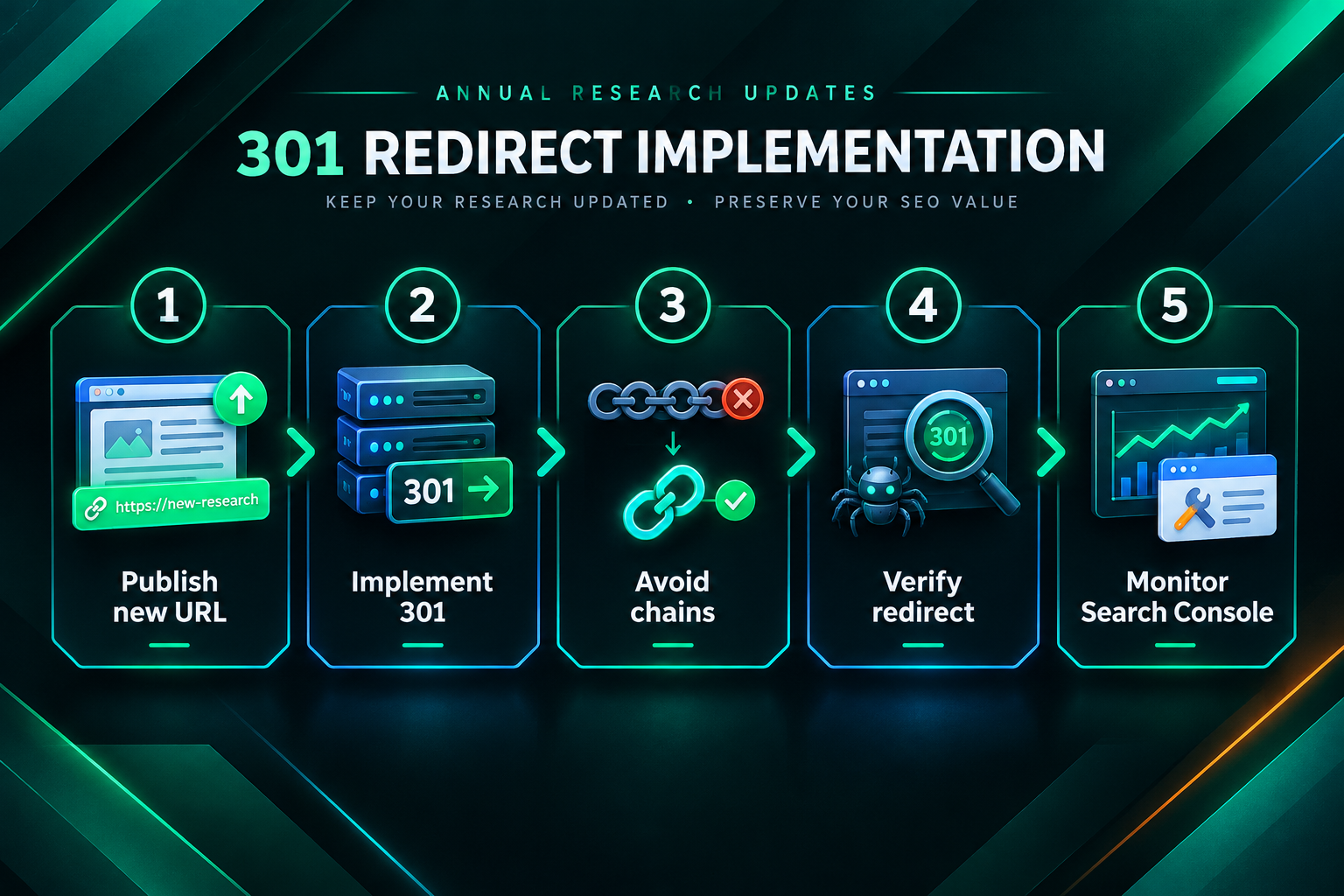
To implement a 301 redirect correctly when updating annual research:
- Publish the new year’s research at its intended URL before redirecting the old one.
- Implement the 301 redirect from the previous year’s URL to the new URL at the server or CMS level, not through JavaScript or meta refresh tags.
- Avoid creating redirect chains. If the 2023 page already redirects to the 2024 page, point the 2023 redirect directly to the 2025 page rather than chaining through 2024.
- Verify the redirect is functioning correctly using a crawl tool or HTTP header checker before announcing the update.
- Monitor Google Search Console for any crawl errors or coverage issues that emerge after the redirect is live.
Redirect chains are a common problem for websites that have published annual research for several years without consolidating their redirect structure. Each additional hop in a chain can reduce the equity passed and slow crawling. Auditing and flattening existing redirect chains before the next update is a worthwhile technical SEO task.
Backlink Monitoring Before, During, and After an Update
Backlink monitoring is essential at every stage of an annual research update. Without a clear picture of the existing backlink profile, it is impossible to assess whether the update preserved or damaged link equity. Tools such as Ahrefs, Semrush, and Majestic can provide referring domain counts, backlink totals, and link attribute data for a specific URL. Google Search Console provides a complementary view of links Google has discovered, though its data is not always complete.
Before an update, record a baseline: the number of referring domains, the total backlink count, and the most authoritative or editorially significant linking pages. This baseline makes it possible to identify link loss after the update and to prioritise outreach to the most valuable referring domains.
During the update, monitor for any unintended URL changes, redirect errors, or crawl issues that might cause search engines to treat the updated page as a new or inaccessible resource. A crawl error on a high-value research page can temporarily suppress rankings and reduce the page’s visibility to new potential linkers.
After the update, compare the referring domain count and backlink total against the pre-update baseline. Some fluctuation is normal as search engines re-crawl and re-index the updated content. Significant drops in referring domains, particularly from high-quality sources, may indicate that linkers have removed or updated their citations in response to the content change, or that a technical issue is preventing the page from being correctly indexed.
Outreach to Existing Linkers After a Major Update
Proactive outreach to websites that already link to a research page is one of the most underused tactics for backlink preservation and renewal. When a research report is updated with new data, the websites citing the previous edition may be linking to figures that are now outdated. Reaching out to inform those publishers about the updated edition serves two purposes: it helps them maintain accurate content for their own readers, and it gives them a reason to update their citation to reference the current data.
Effective outreach in this context is straightforward because the relationship already exists. The referring website has already chosen to cite the research, which means the editorial bar has already been cleared. A brief, personalised message explaining that the research has been updated with new data, and offering the updated URL or specific new figures, is often well received. This type of outreach is distinct from cold link building because it is grounded in an existing editorial relationship rather than a new pitch.
Prioritise outreach to referring domains with the highest editorial relevance and authority. A link from a respected industry publication or a widely read trade journal is worth more effort than a link from a low-traffic blog. Use the pre-update backlink baseline to identify the ten to twenty most valuable referring domains and contact them first.
Outreach after a research update can also generate new coverage. Publishers who covered the original research may be interested in reporting on year-over-year changes, particularly if the new data reveals a meaningful trend or shift. Framing the update as a news angle, rather than simply a content refresh, can increase the likelihood of earning additional editorial mentions and backlinks from the updated edition.
Archiving Previous Editions Without Diluting Link Equity
Many organisations want to preserve previous editions of their research for reference purposes, which raises the question of how to archive old content without creating competing pages or diluting the link equity concentrated on the main research URL.
The most common approach is to keep the evergreen URL as the canonical, actively updated version and to publish archived editions at separate dated URLs with a canonical tag pointing to the evergreen page, or with a noindex directive if the archived content is not intended to rank independently. This prevents search engines from treating the archived edition as a duplicate of the current page and avoids splitting the backlink profile across multiple URLs.
Internal linking from the evergreen page to archived editions, clearly labelled as previous years’ data, allows readers to access historical information without confusing search engines about which version is the primary, current resource. A simple archive section at the bottom of the main research page, with links to each previous edition, is a practical and reader-friendly solution.
If archived editions have already accumulated their own backlinks, consider whether those links are worth preserving independently or whether consolidating them through redirects to the evergreen URL would better serve the overall backlink strategy. This decision depends on the volume and quality of links pointing to each archived edition and the degree to which the archived content serves a distinct reader need.
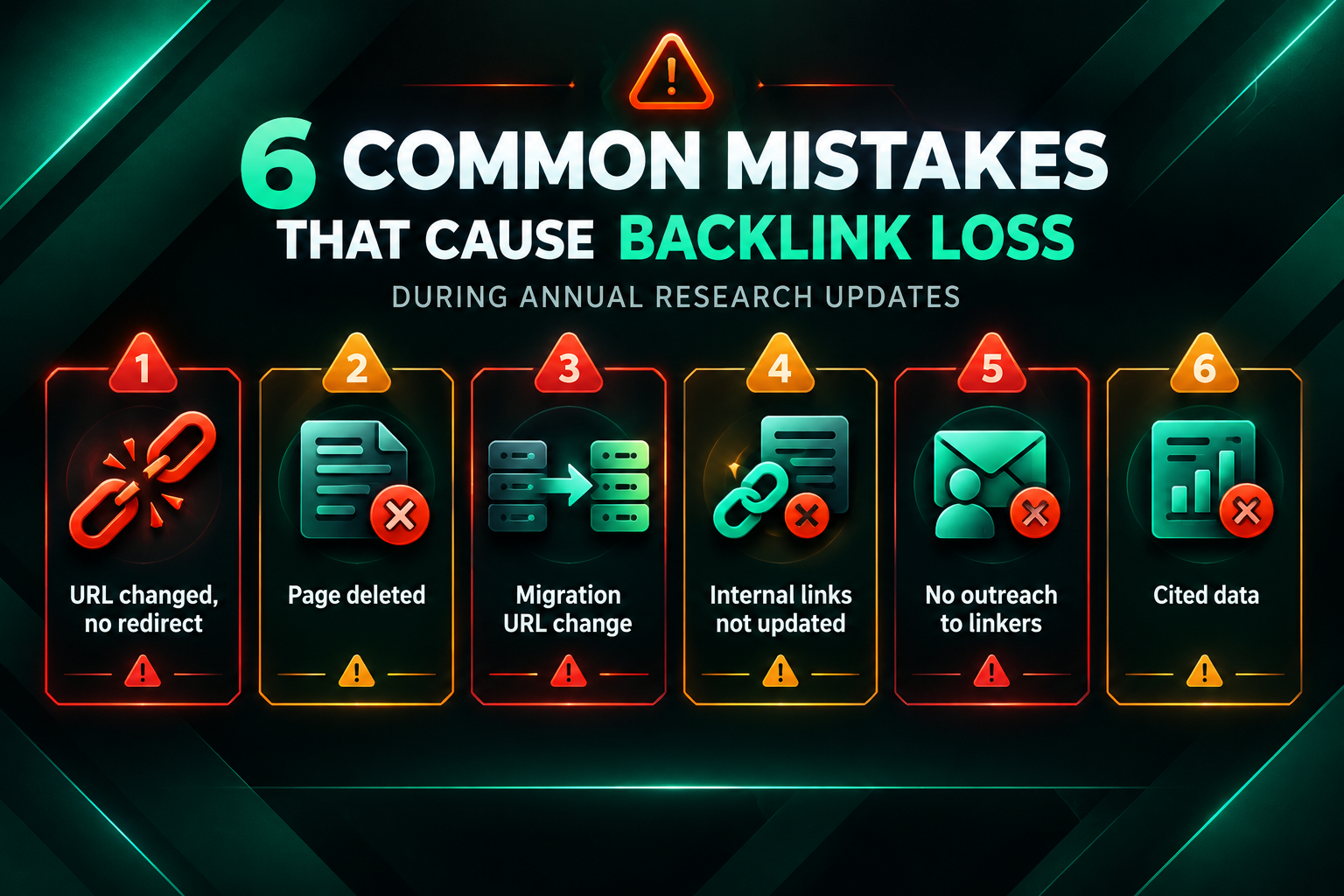
Common Mistakes That Cause Backlink Loss During Research Updates
Several avoidable errors account for the majority of backlink loss during annual research updates. Understanding these mistakes makes it easier to build a process that avoids them.
- Changing the URL without a redirect: Publishing updated research at a new URL without redirecting the old one leaves all existing backlinks pointing to a page that may return a 404 error or display outdated content. This is the most damaging mistake and the easiest to prevent.
- Deleting the old page: Removing the previous edition’s page without a redirect has the same effect as a URL change without a redirect. All backlinks to the deleted page lose their destination.
- Changing the URL structure during a CMS migration: Platform migrations often change URL structures. If a research page moves from one URL pattern to another during a migration, the redirect must be implemented as part of the migration plan, not as an afterthought.
- Failing to update internal links: Internal links that reference the old URL or outdated statistics can create a confusing experience for readers and may signal inconsistency to search engines.
- Publishing the update without notifying key linkers: Existing referring domains may not discover the updated content on their own. Without outreach, outdated citations may persist or be removed rather than updated.
- Removing data that linkers specifically cited: If a particular statistic or finding was widely cited and that data point is removed from the updated edition, some referring pages may remove their links because the specific claim they referenced no longer exists. Where possible, retain or clearly supersede widely cited figures.
The Role of Link Building in Supporting Research Content
Annual research pages benefit from ongoing link acquisition efforts, not just at the time of initial publication. A research page that earns backlinks continuously throughout the year is more resilient to the disruption of an annual update because its backlink profile is actively maintained rather than static.
Manual outreach campaigns targeting journalists, bloggers, and industry publications can help amplify a research report’s reach beyond its organic discovery. Digital PR approaches, which involve pitching research findings as news stories or data sources to relevant media contacts, are particularly well suited to data-driven content because journalists frequently seek citable statistics to support their reporting.
For organisations that lack the internal resources to run sustained outreach campaigns, outsourcing link building to a specialist provider can help maintain the momentum of a research page’s backlink growth between annual updates. A managed outreach campaign can identify relevant publishers, pitch the research as a citable resource, and secure editorial placements that strengthen the page’s authority before the next update cycle begins. This ongoing investment in link acquisition makes the annual update less disruptive because the page’s backlink profile is not dependent on a single burst of post-publication coverage.
The quality of backlinks matters as much as the quantity. Links from topically relevant, editorially independent publishers tend to carry more weight in search engine assessments than links from low-quality directories or unrelated websites. When evaluating a link building campaign for a research page, consider the editorial relevance of target publishers, the independence of the linking context, and whether the placement genuinely serves the referring site’s readers.
Frequently Asked Questions
Will updating my research page cause a temporary ranking drop?
A temporary fluctuation in rankings is possible after any significant content update, as search engines re-crawl and re-evaluate the page. The extent and duration of any fluctuation depends on factors including the scale of the content change, the page’s existing authority, and how quickly search engines process the update. Keeping the same URL and maintaining the page’s backlink profile minimises the risk of a sustained ranking decline.
How long does it take for a 301 redirect to pass link equity?
The time for a 301 redirect to be processed and for link equity to transfer depends on how frequently search engines crawl the redirected URL. High-authority pages with strong backlink profiles tend to be crawled more frequently, which can accelerate the process. In practice, it may take days to several weeks for the full effect of a redirect to be reflected in search engine assessments. Monitoring Google Search Console for crawl activity can provide an indication of progress.
Should I keep the old year’s research page live or redirect it?
If you are using an evergreen URL strategy, the old content is replaced in place and there is no separate old page to manage. If you are using dated URLs, redirecting the previous year’s page to the current edition is generally preferable to leaving it live as a competing page, unless the archived edition serves a distinct reader need and has been set up with appropriate canonical or noindex directives.
What should I do if I notice backlinks dropping after an update?
First, verify that the page is correctly indexed and that no redirect errors or crawl issues exist. Check Google Search Console for coverage problems. Then review the referring domains that have been lost to determine whether the links were removed, whether the referring pages themselves have changed, or whether a technical issue is preventing the links from being discovered. For high-value lost links, direct outreach to the referring domain may be appropriate.
Can I use canonical tags instead of redirects when archiving old research editions?
A canonical tag on an archived edition pointing to the evergreen URL signals to search engines that the evergreen page is the preferred version. This can help consolidate link equity and prevent duplicate content issues. However, canonical tags are treated as hints rather than directives by search engines, so they are not a guaranteed substitute for a well-implemented redirect structure. Using canonical tags alongside clear internal linking and, where appropriate, noindex directives provides a more robust archiving approach.
How do I handle research that changes methodology significantly from one year to the next?
A significant methodology change should be documented transparently on the updated page, ideally in a dedicated methodology section that explains what changed and why. This transparency helps readers and linkers assess the comparability of year-over-year data. If the methodology change is so substantial that the new research is effectively a different study, consider whether a new URL with a redirect from the old page, or a clearly labelled new section within the evergreen page, better serves readers and maintains editorial trust.
Protecting Backlink Equity Across Every Annual Update Cycle
The effort invested in earning backlinks to a research page is only worthwhile if those links are preserved through each annual update. The strategies outlined in this guide, centred on evergreen URLs, in-place content updates, correct redirect implementation, proactive outreach, and consistent backlink monitoring, provide a practical framework for maintaining link equity across update cycles.
No approach eliminates all risk of link loss. Some referring domains will update or remove their citations regardless of how carefully the update is managed. The goal is to minimise avoidable loss and to create conditions in which the updated research can continue to earn new backlinks as it reaches new audiences. A research page that is well maintained, accurately cited, and actively promoted through outreach is more likely to sustain and grow its backlink profile than one that is updated in isolation and left to be discovered organically.
If your organisation publishes annual research and wants to ensure that each update cycle strengthens rather than undermines your backlink profile, discussing your URL strategy, outreach approach, and link monitoring process with a qualified SEO or link building specialist before the next update is a practical first step. The decisions made before publishing an update are considerably easier to get right than the corrections required after backlinks have already been lost.