Affiliate links are a common feature of monetised websites, but their relationship with SEO is frequently misunderstood. Some site owners assume that earning affiliate placements automatically improves their search visibility, while others worry that hosting affiliate links will harm their rankings. The reality is more nuanced: affiliate links and SEO interact in specific ways that depend on link attributes, publisher quality, content relevance, and how a site manages its overall backlink profile. This article explains what affiliate links actually do—and do not do—for SEO, and how to think about them alongside a broader link acquisition strategy.
Key Takeaways
- Affiliate links are typically marked with
rel="nofollow"orrel="sponsored"attributes, which means they generally do not pass link equity (PageRank) to the linked destination in the way that editorial dofollow links do. - Hosting affiliate links on your site does not automatically improve your own search rankings, but the content built around those links can attract organic traffic and earn genuine editorial backlinks.
- Undisclosed or improperly attributed affiliate links may conflict with Google’s spam policies, creating a compliance risk that can affect a site’s standing in search results.
- For sites seeking to build domain authority and ranking strength, editorial link building through manual outreach, guest posting, or digital PR typically provides more direct SEO benefit than affiliate link participation alone.
- Affiliate marketing and SEO can complement each other when content quality is high, link attributes are correctly applied, and the site’s overall backlink profile is actively managed.
What Are Affiliate Links and How Do They Work?
An affiliate link is a tracked URL that connects a publisher’s content to a merchant’s website. When a reader clicks the link and completes a qualifying action—such as a purchase or sign-up—the publisher earns a commission. Affiliate programmes are used across e-commerce, SaaS, finance, travel, and many other sectors. From a technical standpoint, affiliate links usually contain tracking parameters or redirect through an affiliate network’s domain before reaching the merchant’s site.
The SEO-relevant question is not whether affiliate links generate revenue, but what signal—if any—they send to search engines. A link’s ability to pass ranking signals depends primarily on its link attribute: whether it carries a rel="dofollow" (the default), rel="nofollow", or rel="sponsored" designation. Google’s published guidance states that the rel="sponsored" attribute should be applied to links that are part of advertisements, sponsorships, or affiliate arrangements. The rel="nofollow" attribute is also widely used for this purpose. Both attributes instruct Google not to pass PageRank through the link, though Google has described them as hints rather than absolute directives since a 2019 policy update.
Do Affiliate Links Pass SEO Value to the Destination Site?
In most practical cases, affiliate links do not pass meaningful link equity to the merchant’s website. Because affiliate links are expected to carry rel="sponsored" or rel="nofollow" attributes, they are not treated as editorial endorsements in the same way that an unpaid, contextually relevant dofollow link would be. A merchant receiving thousands of affiliate links from publisher sites should not expect those links to function as a backlink-building campaign in the traditional SEO sense.
There is an additional technical consideration: many affiliate links redirect through a network domain or use URL parameters that search engine crawlers may not follow in the same way as a clean direct link. Even where a dofollow attribute is technically present, the redirect chain and tracking parameters can reduce or eliminate any link equity transfer. Merchants who want to build genuine domain authority and improve their organic search rankings typically need a separate, deliberate link acquisition strategy rather than relying on affiliate placements.
It is worth noting that some affiliate publishers do place dofollow links, either by oversight or by design. Google’s spam policies explicitly address paid links intended to manipulate PageRank, and affiliate links that pass equity without proper attribution may be treated as a policy violation. This applies to both the publisher and the merchant. Sites found to be participating in link schemes—including undisclosed paid or affiliate links—may face manual actions or algorithmic adjustments that reduce their search visibility.
How Affiliate Links Affect the Publisher’s Own SEO
For the publisher—the site hosting the affiliate links—the SEO picture is different. Affiliate content, such as product reviews, comparison pages, and buying guides, can rank well in organic search if it is genuinely useful, well-structured, and authoritative. High-quality affiliate content can attract organic traffic, earn editorial backlinks from other sites, and contribute to a site’s topical authority in its niche. In this sense, affiliate marketing and SEO can reinforce each other, but the SEO benefit comes from the content quality and the backlinks that content earns, not from the affiliate links themselves.
Publishers should be aware that Google has historically scrutinised thin affiliate content—pages that add little original value beyond reproducing a merchant’s product descriptions and embedding tracking links. Google’s helpful content guidance emphasises that pages should demonstrate first-hand expertise and provide a satisfying experience for the reader. Affiliate sites that invest in original research, genuine product testing, and detailed comparisons tend to perform better in organic search than those that rely on templated or low-effort content.
The volume of outgoing affiliate links on a page can also be a consideration. A page with a high ratio of affiliate links relative to useful editorial content may be assessed differently than a page where affiliate links appear naturally within a substantive, informative article. There is no publicly documented threshold, but the general principle from Google’s quality guidance is that the page’s primary purpose should be to serve the reader, not to generate clicks on monetised links.
Link Attributes, Disclosure, and Compliance
Correctly attributing affiliate links is both an SEO and a legal requirement in many markets. Google’s link spam policies state that any link that is part of an affiliate arrangement should carry the rel="sponsored" attribute. Failure to apply this attribute—whether intentional or accidental—means the link may be interpreted as an attempt to manipulate PageRank, which conflicts with Google’s spam policies. Sites that are found to be systematically passing link equity through undisclosed affiliate links risk a manual action, which can significantly reduce organic search visibility.
Beyond search engine compliance, many jurisdictions require clear disclosure of affiliate relationships to readers. In the United States, the Federal Trade Commission (FTC) requires that material connections between publishers and merchants be clearly disclosed. Similar requirements exist in the UK, the EU, and other markets. While these disclosure rules are primarily consumer protection measures rather than SEO rules, non-compliance can damage a site’s credibility and, if it attracts regulatory attention, its reputation.
From a practical standpoint, applying rel="sponsored" or rel="nofollow" to affiliate links and including a clear disclosure statement near the top of affiliate content pages is the approach most consistent with both search engine guidance and legal requirements. Many affiliate publishers use plugins or site-wide settings to automate this process, reducing the risk of accidental dofollow affiliate links appearing in published content.
Can Affiliate Content Earn Backlinks That Help SEO?
One of the more meaningful indirect SEO benefits of affiliate content is its potential to attract editorial backlinks. A well-researched buying guide, a detailed product comparison, or an original review that includes unique data or testing methodology can earn links from other publishers, journalists, and industry sites. These editorial backlinks—acquired because the content is genuinely useful—can contribute to a site’s backlink profile and may support improved rankings over time.
This is an important distinction: the affiliate link itself does not help SEO, but the content created to support affiliate monetisation can, if it is of sufficient quality and relevance. Sites that invest in producing genuinely authoritative affiliate content are effectively running a content-led link acquisition strategy alongside their monetisation activity. The two goals are compatible, but they require a deliberate approach to content quality, topical depth, and promotion.
For merchants, the same logic applies in reverse. If a publisher creates high-quality content about a merchant’s product category—content that earns editorial links from third-party sites—the merchant may benefit indirectly through increased brand visibility and referral traffic, even if the affiliate links themselves do not pass PageRank. However, this is a secondary effect and should not be confused with a direct SEO benefit from the affiliate link relationship.
Affiliate Links vs. Editorial Backlinks: Key Differences
| Characteristic | Affiliate Links | Editorial Backlinks |
|---|---|---|
| Primary purpose | Revenue generation through tracked referrals | Endorsement, citation, or resource reference |
| Typical link attribute | rel=”sponsored” or rel=”nofollow” | Dofollow (default, no attribute required) |
| Link equity transfer | Generally none (nofollow/sponsored) | Yes, when dofollow and editorially placed |
| Acquisition method | Affiliate programme enrolment | Manual outreach, content marketing, digital PR |
| Search engine policy | Must be disclosed; undisclosed may violate spam policy | Must be genuinely editorial; paid links require nofollow/sponsored |
| Direct ranking benefit | Limited to none from the link itself | May contribute to improved rankings over time |
| Indirect SEO benefit | Possible through high-quality affiliate content | Direct contribution to backlink profile strength |
| Referral traffic | Yes, from publisher to merchant | Possible, depending on publisher audience |
When Affiliate Links and SEO Strategy Overlap
Affiliate marketing and SEO strategy overlap most productively when a site treats its affiliate content as a genuine editorial asset rather than a monetisation shortcut. Sites that publish original, experience-based reviews, detailed comparison articles, and well-structured buying guides can rank for high-intent commercial keywords—terms that indicate a reader is close to making a purchase decision. Ranking for these terms can drive qualified organic traffic that converts through affiliate links, creating a sustainable revenue model that is supported by, rather than in conflict with, good SEO practice.
For this overlap to work effectively, the site needs a strong backlink profile to compete for competitive commercial keywords. This is where a deliberate link acquisition strategy becomes important. Affiliate content alone rarely earns enough editorial backlinks to compete in high-authority niches. Sites that combine quality affiliate content with proactive outreach—building links to their most important comparison and review pages through guest posting, digital PR, or niche edits—are better positioned to rank and sustain those rankings over time.
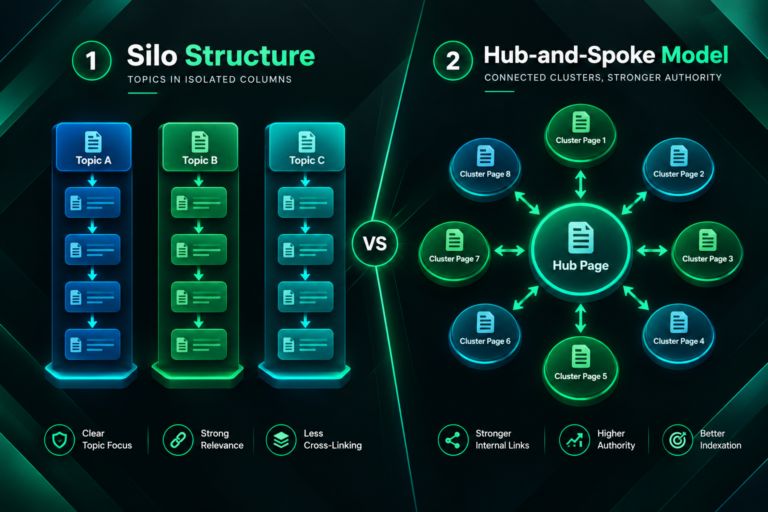
It is also worth considering the role of internal linking. A site with strong affiliate content can use internal links to distribute link equity from well-linked pages to newer or lower-authority affiliate pages. This is a straightforward on-site SEO technique that does not require external link acquisition but can improve the crawlability and ranking potential of a site’s affiliate content library.
Risks Associated with Affiliate Links and SEO
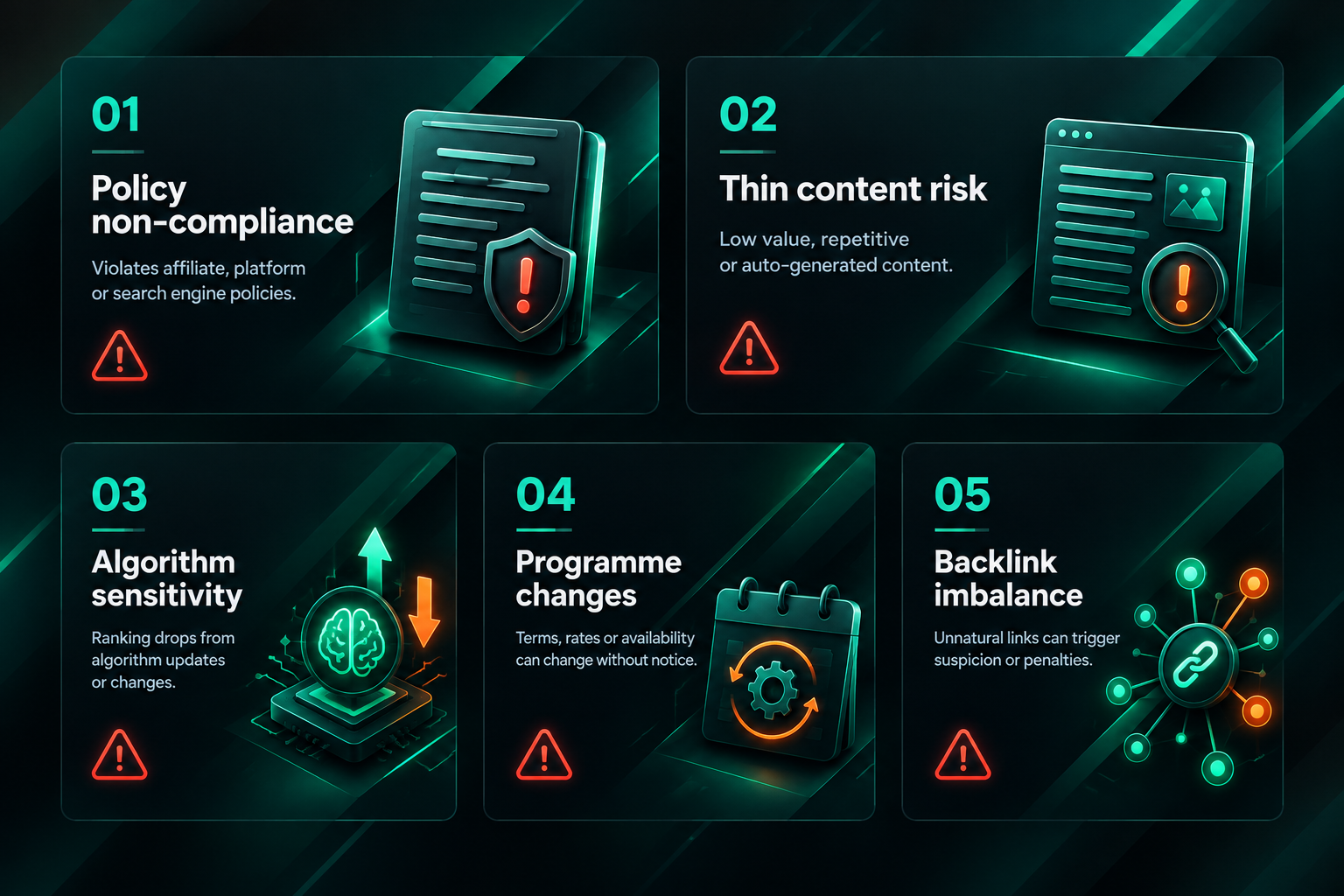
Several risks are worth understanding before building an SEO strategy that relies heavily on affiliate content or affiliate link placements.
- Policy non-compliance: Affiliate links that pass PageRank without proper attribution may be treated as link spam by Google. Both publishers and merchants can be affected if the link relationship is found to violate spam policies.
- Thin content penalties: Affiliate sites that prioritise link volume over content quality may be assessed negatively by Google’s helpful content systems, reducing organic visibility across the site.
- Algorithm sensitivity: Affiliate-heavy sites have historically been affected by Google algorithm updates targeting low-quality or manipulative content. Sites that rely on affiliate revenue without investing in genuine editorial quality face ongoing exposure to these updates.
- Merchant programme changes: Affiliate programmes can change commission structures, close to new publishers, or terminate without notice. A site whose SEO strategy is built around a single affiliate programme faces business continuity risk if that programme changes.
- Backlink profile imbalance: A site that earns most of its inbound links through affiliate relationships—rather than genuine editorial placements—may have a backlink profile that does not support strong organic rankings for competitive terms.
Building a Backlink Profile Alongside Affiliate Activity
For sites that use affiliate marketing as a revenue model, building a strong editorial backlink profile is one of the most effective ways to improve organic search performance. Affiliate links themselves do not contribute to this profile in a meaningful way, so the backlink-building effort needs to be separate and deliberate.
Manual outreach to relevant publishers—offering guest posts, data-driven content, or expert commentary—can earn dofollow editorial links to a site’s most important affiliate content pages. Digital PR campaigns that generate coverage in industry publications can build both backlinks and brand awareness. Niche edits, where a link is added to an existing relevant article on an authoritative site, can be an efficient way to build links to specific comparison or review pages that are already ranking but need additional authority to move up in search results.
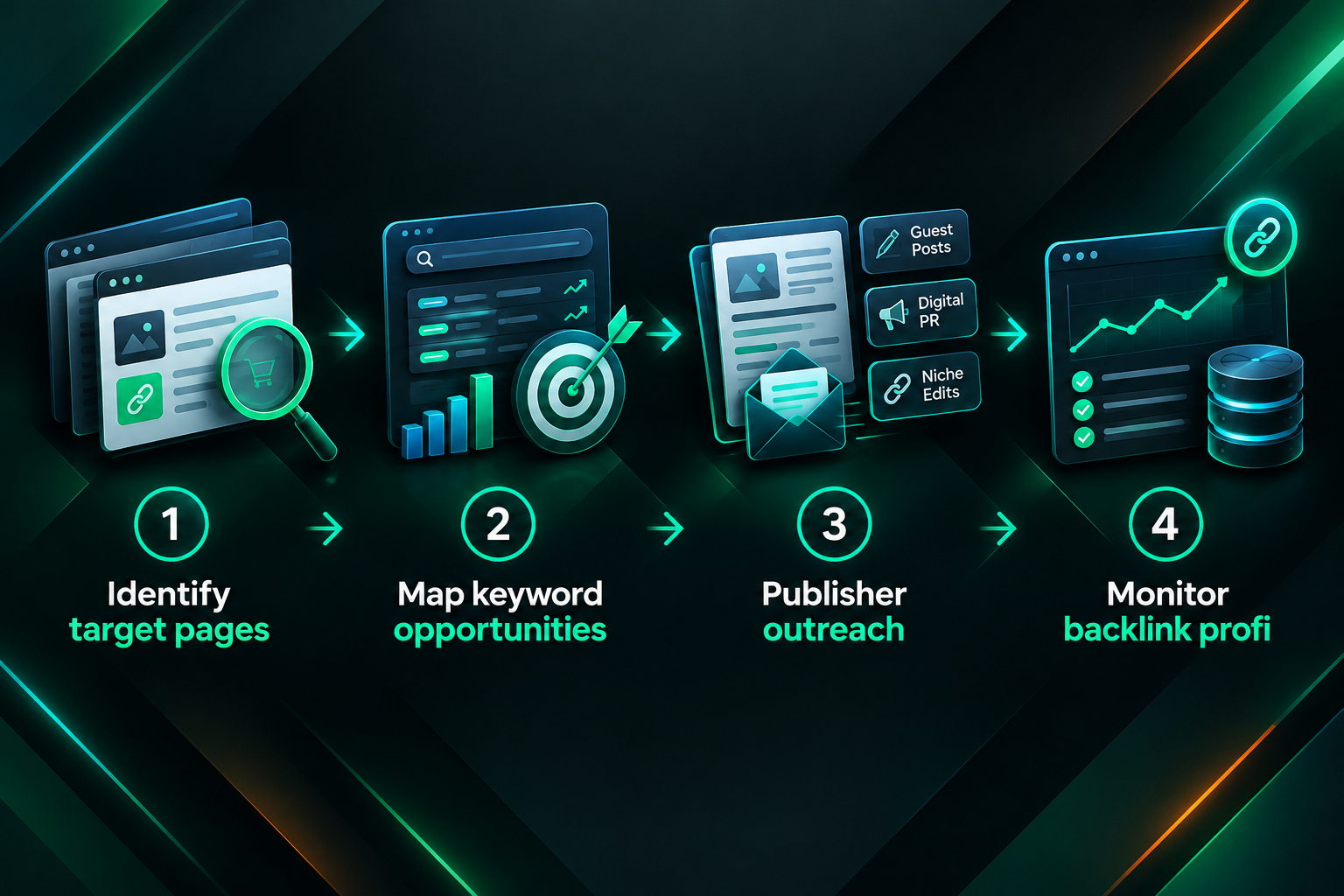
The choice of target pages matters. Linking directly to high-intent affiliate content pages—rather than only to a site’s homepage—can help those pages compete for the commercial keywords they are designed to rank for. A link acquisition campaign that maps target pages to specific keyword opportunities and publisher relevance criteria is more likely to produce measurable SEO outcomes than a generic approach to link building.
Outsourcing this link acquisition work to a specialist provider can be a practical option for affiliate site owners who lack the time or outreach infrastructure to run campaigns in-house. A qualified provider can assess the existing backlink profile, identify gaps, and manage publisher outreach on behalf of the site. The key is ensuring that the provider uses genuine editorial outreach rather than link networks or automated placements, which carry their own compliance risks.
Alternatives to Affiliate Links for SEO-Driven Revenue
Affiliate marketing is one of several content monetisation models, and it is not always the best fit for every site’s SEO goals. Some alternatives worth considering include:
- Display advertising: Ad networks do not require outgoing affiliate links, which simplifies link attribute management. However, display advertising typically generates lower revenue per visitor than affiliate commissions for high-intent commercial content.
- Sponsored content with proper disclosure: Publishers can work directly with brands on sponsored articles or reviews. These must carry appropriate disclosure and link attributes, but they can generate revenue without the tracking complexity of affiliate networks.
- Lead generation: Some sites generate revenue by capturing and selling qualified leads rather than driving affiliate clicks. This model can align well with SEO-driven traffic if the site ranks for high-intent informational or comparison queries.
- Digital products and services: Sites with strong organic traffic can monetise through their own products—courses, tools, or consulting services—without relying on affiliate relationships. This model avoids the compliance complexity of affiliate link management entirely.
None of these alternatives is universally superior to affiliate marketing. The right monetisation model depends on the site’s niche, audience, content type, and traffic volume. What matters from an SEO perspective is that the chosen model does not create incentives to publish low-quality content or manipulate link attributes in ways that conflict with search engine policies.
Frequently Asked Questions
Do affiliate links count as backlinks for SEO purposes?
Affiliate links placed on other sites do not typically function as SEO backlinks in the traditional sense. Because they are expected to carry rel="sponsored" or rel="nofollow" attributes, they generally do not pass link equity to the merchant’s site. For backlink-building purposes, editorial dofollow links acquired through outreach or content marketing are more directly relevant.
Will having lots of affiliate links on my site hurt my SEO?
A high volume of affiliate links does not automatically harm a site’s SEO, but it can be a contributing factor if the content is thin, the links are undisclosed, or the page appears to exist primarily to generate affiliate clicks rather than to serve the reader. Applying correct link attributes, disclosing affiliate relationships, and ensuring content quality are the most important steps for managing this risk.
Should affiliate links use nofollow or sponsored?
Google’s guidance recommends using rel="sponsored" for affiliate links, as this attribute is specifically designed for paid or commercial link arrangements. The rel="nofollow" attribute is also widely accepted for this purpose. Either attribute signals to Google that the link should not be treated as an editorial endorsement, which is consistent with Google’s spam policies for affiliate arrangements.
Can affiliate content rank well in Google search?
Yes, affiliate content can rank well if it is genuinely useful, demonstrates first-hand expertise, and is supported by a strong backlink profile. Google’s helpful content guidance does not prohibit affiliate monetisation, but it does assess whether the content provides real value to the reader. Sites that invest in original research, detailed comparisons, and authoritative writing tend to perform better than those relying on templated or thin affiliate content.
How can I build backlinks to my affiliate content pages?
Manual outreach to relevant publishers, guest posting on authoritative sites in your niche, digital PR campaigns, and niche edits to existing articles are all approaches that can build editorial backlinks to affiliate content pages. The target pages, anchor text strategy, and publisher relevance should be assessed based on the specific keywords and competition levels involved. A site-specific assessment is advisable before committing to a link acquisition approach.
Does Google penalise affiliate sites?
Google does not penalise sites simply for using affiliate marketing. However, sites that violate Google’s spam policies—through undisclosed paid links, thin content, or manipulative link schemes—may receive manual actions or be affected by algorithmic updates. The risk is not affiliate monetisation itself but the practices sometimes associated with it. Compliance with link attribute requirements and a genuine commitment to content quality are the most effective risk management measures.
Affiliate Links and SEO: Making an Informed Decision
Affiliate links are a legitimate monetisation tool, but they are not a substitute for a deliberate SEO and link acquisition strategy. The links themselves—when correctly attributed with rel="sponsored" or rel="nofollow"—do not pass link equity and do not directly improve a site’s search rankings. The SEO value associated with affiliate activity comes from the quality of the content built around those links and the editorial backlinks that content can earn over time.
For merchants, affiliate programmes can drive referral traffic and brand awareness, but building domain authority and ranking strength requires a separate investment in editorial link acquisition. For publishers, affiliate content can be a strong foundation for organic search performance, provided the content is genuinely useful, correctly attributed, and supported by a backlink profile that reflects the site’s topical authority.
Sites that want to improve their organic search performance alongside affiliate activity should consider a structured approach to link building—one that maps target pages to keyword opportunities, assesses publisher relevance and quality, and uses editorial outreach rather than link networks. If your site is at a stage where you are ready to invest in building a stronger backlink profile, discussing your goals with a qualified link building provider can help clarify which approach may be most appropriate for your niche, competition level, and existing SEO foundation.