Working with an external link building agency often requires sharing information you would not normally make public: website credentials, analytics access, target keyword lists, content strategies, or commercially sensitive business data. Knowing what to share, how to share it securely, and what protections to put in place before you begin can significantly reduce the risk of data exposure, misuse, or compliance problems without slowing down your campaign.
Key Takeaways
- Most link building campaigns require only a limited set of information; sharing the minimum necessary reduces your exposure without limiting campaign effectiveness.
- A signed non-disclosure agreement and clearly defined data handling terms should be in place before any sensitive information changes hands.
- Secure sharing methods such as encrypted file transfer, role-based access, and dedicated shared workspaces are preferable to email attachments or unprotected spreadsheets.
- Access to tools such as Google Search Console or Google Analytics can usually be granted at a read-only or restricted level, avoiding the need to share account passwords.
- Reviewing what data you have shared and revoking access at the end of a campaign is as important as the initial setup.
Why Confidential Data Sharing Matters in Link Building
Link building agencies need context to run effective campaigns. Without understanding your target pages, anchor text strategy, existing backlink profile, or competitive positioning, an agency cannot make informed decisions about outreach targets, publisher selection, or link placement. At the same time, the information required to run a campaign can overlap with data that is commercially sensitive, personally identifiable, or subject to regulatory requirements such as GDPR in the UK and EU or equivalent frameworks in other jurisdictions.
The risk is not hypothetical. Sharing login credentials over email, granting broad platform access without role restrictions, or sending unencrypted spreadsheets containing customer data creates genuine exposure. A data breach or misuse incident can damage your brand, create legal liability, and undermine the trust that a long-term agency relationship depends on. Establishing clear data sharing protocols at the outset protects both parties and makes the working relationship more efficient.
It is also worth noting that the type of data a link building agency legitimately needs is narrower than many clients assume. Understanding this distinction helps you share what is genuinely useful while keeping unrelated sensitive information out of the process entirely.
What Information a Link Building Agency Actually Needs
Before deciding how to share data, it is useful to identify what a link building agency typically requires and why. The specific information needed will vary depending on the campaign type, whether that is manual outreach, guest posting, digital PR, niche edits, or white-label delivery, but the categories below cover most standard campaigns.
Target URLs and Priority Pages
An agency needs to know which pages you want to build links to. This is usually a list of URLs with associated target keywords or topics. This information is not inherently sensitive, but it does reveal your SEO priorities and competitive strategy, which some businesses prefer to protect.
Existing Backlink Profile Data
Understanding your current backlink profile helps an agency avoid duplicating existing placements, identify gaps, and assess the relative authority of domains already linking to your site. This data is typically pulled from tools such as Ahrefs, Semrush, or Majestic and does not require sharing account credentials if you export a report directly.
Read-Only Analytics and Search Console Access
Access to Google Search Console and Google Analytics allows an agency to understand your current organic visibility, identify pages with ranking potential, and monitor the impact of link placements over time. Both platforms support read-only or restricted user roles, meaning you can grant access without sharing your primary account password or giving the agency the ability to modify settings.
Content and Anchor Text Guidelines
Agencies running outreach or guest posting campaigns need to understand your preferred anchor text approach, brand voice, and any content restrictions. This may include information about topics you want to avoid, competitor names you prefer not to mention, or regulatory constraints on how your products or services are described.
Competitor Intelligence
Some campaigns involve analysing competitor backlink profiles to identify outreach targets or content gaps. If you share proprietary competitive research, consider whether a summary or anonymised version would serve the same purpose as the full document.
What You Generally Do Not Need to Share
A link building agency does not typically need access to your CRM, customer data, payment systems, full website backend, or internal financial information. If an agency requests access to systems or data that seem unrelated to link acquisition, it is reasonable to ask why that access is necessary before granting it.
Legal and Contractual Protections to Put in Place First
Before sharing any confidential information with a link building agency, establish the legal framework that governs how that information can be used, stored, and eventually deleted or returned.
Non-Disclosure Agreement
A non-disclosure agreement, or NDA, is the most direct way to create a contractual obligation around confidentiality. A well-drafted NDA should define what constitutes confidential information in the context of your engagement, specify how the agency may use that information, prohibit disclosure to third parties without your consent, set a duration for the confidentiality obligation, and describe what happens to your data when the engagement ends. Many agencies will have a standard NDA they use with clients; it is reasonable to review this carefully and propose amendments if the terms do not adequately protect your interests.
Data Processing Agreement
If your campaign involves any personal data, for example if you are sharing contact lists for outreach purposes or if the agency will have access to analytics data that could be used to identify individuals, a data processing agreement may be required under GDPR or equivalent legislation. This document defines the agency’s role as a data processor, specifies the lawful basis for processing, and sets out security and retention requirements. If you are unsure whether a data processing agreement is necessary, seek legal advice before proceeding.
Service Agreement Clauses
Your main service agreement with the agency should also address data handling. Look for clauses covering data security standards the agency commits to, sub-contractor disclosure requirements if the agency uses third-party outreach teams or freelancers, breach notification timelines, and liability in the event of a data incident. If the agency’s standard contract is silent on these points, request that they be added before signing.
Secure Methods for Sharing Confidential Data
Once the legal framework is in place, the practical question is how to transfer information securely. The method you choose should match the sensitivity of the data involved.
Platform-Level Access Controls
For tools such as Google Search Console, Google Analytics, Ahrefs, or Semrush, the most secure approach is to add the agency as a user within the platform itself rather than sharing your account credentials. Most major SEO platforms support role-based access, allowing you to grant read-only or limited permissions. This means the agency can view the data they need without being able to modify account settings, add other users, or access billing information. When the engagement ends, you can revoke access from within the platform without needing to change your password.
Encrypted File Transfer
If you need to share documents, spreadsheets, or exported reports, avoid sending them as unprotected email attachments. Options include password-protected files sent with the password communicated through a separate channel, encrypted file transfer services, or secure cloud storage with access restricted to named individuals. Services that offer end-to-end encryption or zero-knowledge architecture provide stronger protection than standard cloud storage for particularly sensitive documents.
Shared Workspaces with Access Restrictions
Many agencies use project management platforms or shared workspaces such as Google Workspace, Notion, or similar tools to collaborate with clients. If you use a shared workspace, ensure that access is restricted to the specific individuals working on your account, that the workspace is not publicly accessible, and that you retain administrative control so you can revoke access when needed. Avoid placing sensitive documents in shared folders that are accessible to the agency’s entire team rather than the individuals assigned to your campaign.
Dedicated Campaign Email or Communication Channel
Using a dedicated email address or communication channel for your agency relationship, rather than your primary business email, can help contain the scope of information shared and make it easier to audit what has been communicated if a dispute arises later.
Avoiding Common Insecure Practices
Several common practices create unnecessary risk and are worth avoiding. Sharing passwords via email or messaging apps exposes credentials to interception and makes it difficult to revoke access selectively. Sending spreadsheets containing sensitive data as unencrypted attachments is similarly risky. Granting administrator-level access to platforms when read-only access would suffice gives the agency more capability than the campaign requires. Verbally agreeing to data handling terms without written confirmation creates ambiguity if a dispute arises.
Data Minimisation: Sharing Only What the Campaign Requires
Data minimisation is a principle embedded in GDPR and similar frameworks, but it is also practical advice for any business sharing information with a third party. The less sensitive data you share, the smaller your exposure if something goes wrong.
Before sharing any document or granting any access, ask whether the agency genuinely needs this specific information to run the campaign effectively. In many cases, a summary or anonymised version of a document serves the same purpose as the full original. An exported backlink report from Ahrefs, for example, gives an agency the information they need about your existing link profile without requiring them to log into your Ahrefs account directly. A list of target URLs and associated keywords is sufficient for most outreach campaigns without sharing your full keyword research database or content calendar.
Applying data minimisation at the start of a campaign also makes the offboarding process simpler. If you have shared only what was necessary, there is less to audit, revoke, or request the deletion of when the engagement concludes.
Questions to Ask a Link Building Agency About Data Security
Before sharing confidential information, it is reasonable to ask a prospective agency about their data handling practices. The answers will help you assess whether their security posture is appropriate for the sensitivity of the information involved.
- What data security standards does your organisation follow, and do you hold any relevant certifications such as ISO 27001 or Cyber Essentials?
- Who within your team will have access to our account data, and how is that access controlled?
- Do you use sub-contractors or freelancers for outreach or content work, and if so, are they subject to the same confidentiality obligations as your employees?
- How do you store client data, and what is your retention policy when an engagement ends?
- What is your process if a data breach or security incident occurs?
- Are you willing to sign a non-disclosure agreement and, if applicable, a data processing agreement before we begin?
- Can you provide read-only or restricted access options for the platforms and tools you need to use?
A reputable agency should be able to answer these questions clearly and without hesitation. Vague or evasive responses to straightforward data security questions are a meaningful signal about how the agency operates more broadly.
Managing Access During and After the Campaign
Data security is not a one-time setup task. It requires ongoing attention throughout the campaign and a deliberate offboarding process when the engagement ends.
During the Campaign
Periodically review what access the agency holds and whether it remains appropriate. If the campaign scope changes, for example if you add new target pages or expand into a new market, consider whether additional access is genuinely required or whether the existing setup is sufficient. If personnel change on either side, update access permissions accordingly rather than allowing credentials or platform access to persist under former employees’ accounts.
At the End of the Engagement
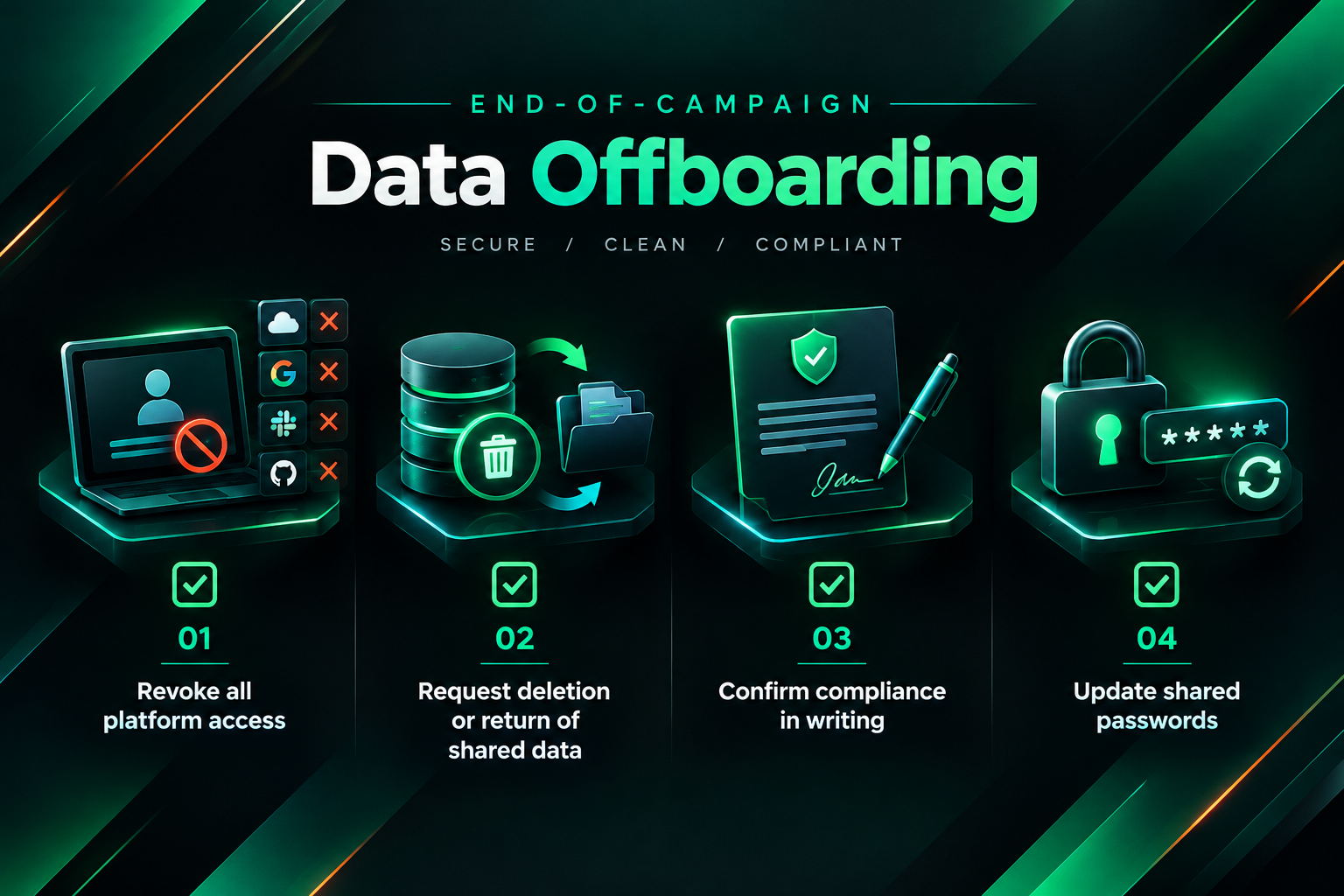
When a campaign concludes or a relationship ends, revoke all platform access granted to the agency, request the deletion or return of any documents or data shared outside of platforms, confirm in writing that the agency has complied with these requests, and update any shared passwords that were used during the engagement. This offboarding process is straightforward if access was managed carefully throughout the campaign but can become complicated if credentials were shared informally or access was granted without a clear record.
Keeping a simple log of what access was granted, to whom, and when makes the offboarding process significantly easier and provides a useful audit trail if any questions arise later.
Balancing Security with Campaign Effectiveness
It is worth acknowledging that overly restrictive data sharing can limit campaign effectiveness. An agency that cannot access your Google Search Console data may miss important signals about which pages have ranking potential or which queries are already generating impressions. An agency that does not understand your content strategy may produce outreach that conflicts with your brand positioning or targets publishers that are not relevant to your audience.
The goal is not to share as little as possible in absolute terms, but to share what is genuinely necessary through secure channels with appropriate contractual protections in place. A well-structured onboarding process, where the agency explains clearly what they need and why, makes it easier to make informed decisions about what to share rather than defaulting to either excessive openness or excessive restriction.
If you are uncertain about whether a particular piece of information is necessary, ask the agency to explain how they will use it and what the campaign impact would be if it were not available. This conversation often clarifies which information is genuinely important and which requests are simply habitual rather than essential.
Frequently Asked Questions
Do I need to share my website login credentials with a link building agency?
In most cases, no. Link building agencies typically need access to analytics and search data rather than your website backend. Where platform access is required, most tools support user-level permissions that allow read-only or restricted access without sharing your primary account password. If an agency requests your website admin credentials, ask specifically why that access is needed before granting it.
Is a non-disclosure agreement legally enforceable?
An NDA is a legally binding contract, and its enforceability depends on how it is drafted and the jurisdiction in which it applies. A well-drafted NDA signed by both parties provides meaningful legal protection, but it is not a substitute for secure data handling practices. If the information involved is particularly sensitive or commercially valuable, seek legal advice on the appropriate form of agreement.
What should I do if I suspect a data breach involving my agency?
Contact the agency immediately to understand the nature and scope of the incident. If personal data may have been affected, you may have a legal obligation to notify your data protection authority within a specified timeframe under GDPR or equivalent legislation. Document all communications and preserve any evidence relevant to the incident. Review your service agreement for breach notification and liability clauses.
Can I share competitor research with a link building agency without risk?
Sharing your own competitive research with an agency is generally permissible, but consider whether the full document is necessary or whether a summary would serve the same purpose. Ensure your NDA covers the treatment of competitive intelligence specifically, and be aware that agencies may work with multiple clients in the same industry, which makes clear confidentiality obligations particularly important.
How do I grant read-only access to Google Search Console?
In Google Search Console, navigate to Settings, then Users and permissions, and add the agency’s email address with the Restricted or Full user role. The Restricted role provides read-only access to most data without allowing the user to modify settings or add other users. You can remove this access at any time from the same settings panel.
Should I be concerned about agencies that use freelancers for outreach?
Many agencies use freelancers or sub-contractors for outreach, content writing, or publisher relationship management. This is common practice and does not automatically create a data security problem, but it does mean that your confidential information may be accessible to individuals outside the agency’s direct employment. Ask the agency whether freelancers are subject to the same NDA and data handling obligations as their employees, and ensure your service agreement addresses sub-contractor disclosure.
Making Confidential Data Sharing a Structured Part of Your Agency Onboarding
Sharing confidential data with a link building agency does not need to be a source of significant risk if it is approached systematically. The most effective approach combines a clear legal framework established before any information is shared, platform-level access controls that limit what the agency can see and do, data minimisation practices that keep the scope of shared information proportionate to campaign needs, and a deliberate offboarding process that revokes access and confirms data deletion when the engagement ends.
Agencies that take data security seriously will typically welcome these conversations rather than resist them. A provider that is reluctant to sign an NDA, cannot explain their data handling practices clearly, or requests broader access than the campaign requires may not be the right partner regardless of their link building capabilities. Treating data security as a standard part of agency selection and onboarding, rather than an afterthought, protects your business and creates a more professional foundation for the working relationship.
If you are evaluating link building agencies and want to understand how a prospective partner handles client data, raising these questions early in the conversation is a reasonable and appropriate step. A qualified agency should be able to walk you through their onboarding process, explain what access they need and why, and provide the contractual protections that responsible data sharing requires.