When a business pays for a guest post placement, or when a link within that post is part of a commercial arrangement, search engines and regulators expect that relationship to be transparent. Getting disclosure right protects your site from search engine penalties, reduces legal risk, and preserves the editorial credibility that makes guest posting valuable in the first place. This article explains what commercial relationship disclosures are, when they are required, how to apply them correctly, and what the practical consequences of getting them wrong can be.
Key Takeaways
- Google’s spam policies require that paid links pass no PageRank unless they carry a qualifying link attribute such as
rel="sponsored"orrel="nofollow"; failure to comply may result in a manual action or algorithmic demotion. - Regulatory bodies in many markets, including the FTC in the United States and the ASA in the United Kingdom, require clear disclosure of material commercial relationships in published content, including guest posts.
- A disclosure label alone does not make a paid placement compliant with Google’s link scheme policies; the link attribute on the hyperlink itself is what matters for search engine purposes.
- Editorial guest posts that are genuinely earned through outreach and accepted on merit occupy a different position from paid placements, though the line between the two can be blurred in practice.
- Transparency in commercial content is increasingly a quality signal that publishers, readers, and search engines use to assess the trustworthiness of a site.
What Counts as a Commercial Relationship in a Guest Post?
A commercial relationship exists whenever money, free products, services, reciprocal links, or any other form of compensation changes hands in connection with a guest post or a link within one. This covers a wide range of arrangements: a brand paying a publisher directly for a placement, an SEO agency securing a link as part of a managed campaign, a SaaS company offering a free subscription in exchange for a review post, or two websites agreeing to exchange guest posts primarily to build backlinks rather than to share genuinely useful content.
The key test is whether the placement would have happened without the commercial incentive. If the answer is no, or even probably not, a commercial relationship almost certainly exists. Publishers and link builders sometimes draw a distinction between a paid placement and an editorial link earned purely on the merit of the content, but regulators and search engines tend to look at the substance of the arrangement rather than the label applied to it.
It is also worth noting that the commercial relationship does not have to involve a direct cash payment to trigger disclosure obligations. Affiliate links embedded in a guest post, links to a site owned by the author, and links included as part of a content partnership arrangement can all constitute material connections that require disclosure depending on the applicable rules.
Why Disclosure Matters: Search Engine Policy and Regulatory Requirements
Disclosure obligations in guest posts come from two distinct directions: search engine webmaster guidelines and consumer protection or advertising regulations. Both matter, but they operate independently and require different responses.
Google’s Link Scheme and Spam Policies
Google’s spam policies identify paid links that pass PageRank as a violation of its guidelines. The relevant policy covers any link that is exchanged for money, goods, services, or other compensation and that is intended to manipulate search rankings. When Google identifies such links, it may apply a manual action to the linking or linked site, or its algorithms may discount the links algorithmically without issuing a formal notification.
The mechanism Google provides for handling paid or commercially influenced links is the link attribute. A link carrying rel="sponsored" signals to Google that the link is part of a paid or sponsored arrangement. A link carrying rel="nofollow" also instructs Google not to pass PageRank through it, though Google has described rel="nofollow" as a hint rather than a directive since a 2019 policy update. The rel="sponsored" attribute is the more specific and appropriate choice for paid placements. Using either attribute on a commercially influenced link is the publisher’s and the link builder’s primary obligation under Google’s guidelines.
It is important to understand that adding a visible disclosure label to the page, such as the words “Sponsored” or “Paid partnership”, does not by itself satisfy Google’s link policy. The attribute must be present on the hyperlink in the HTML. A page can carry a visible disclosure and still pass PageRank through a dofollow link, which would remain a policy violation regardless of the label.
Regulatory Requirements for Advertising Disclosure
Consumer protection and advertising regulations in many markets require that commercial content be clearly identified as such to readers. In the United States, the Federal Trade Commission requires that material connections between an endorser and a brand be disclosed clearly and conspicuously. In the United Kingdom, the Advertising Standards Authority and the Competition and Markets Authority apply similar requirements. The European Union’s Unfair Commercial Practices Directive also addresses undisclosed commercial content.
These regulations apply to guest posts when the content functions as an endorsement, review, or promotion of a product or service and when a material connection exists between the author or publisher and the brand being promoted. The disclosure must be placed where readers are likely to see it before engaging with the commercial content, not buried in a footer or hidden in small print. Phrases such as “Sponsored”, “Paid partnership”, “Advertisement”, or “This post contains paid links” are commonly used, though the exact wording requirements vary by jurisdiction.
Regulatory enforcement in this area has increased in recent years, and publishers who repeatedly fail to disclose commercial content risk formal investigations, fines, and reputational damage. For businesses running guest posting campaigns across multiple publishers, ensuring that each publisher applies the correct disclosure is a practical compliance challenge that should be addressed during campaign planning.
How to Apply Disclosures Correctly in Practice
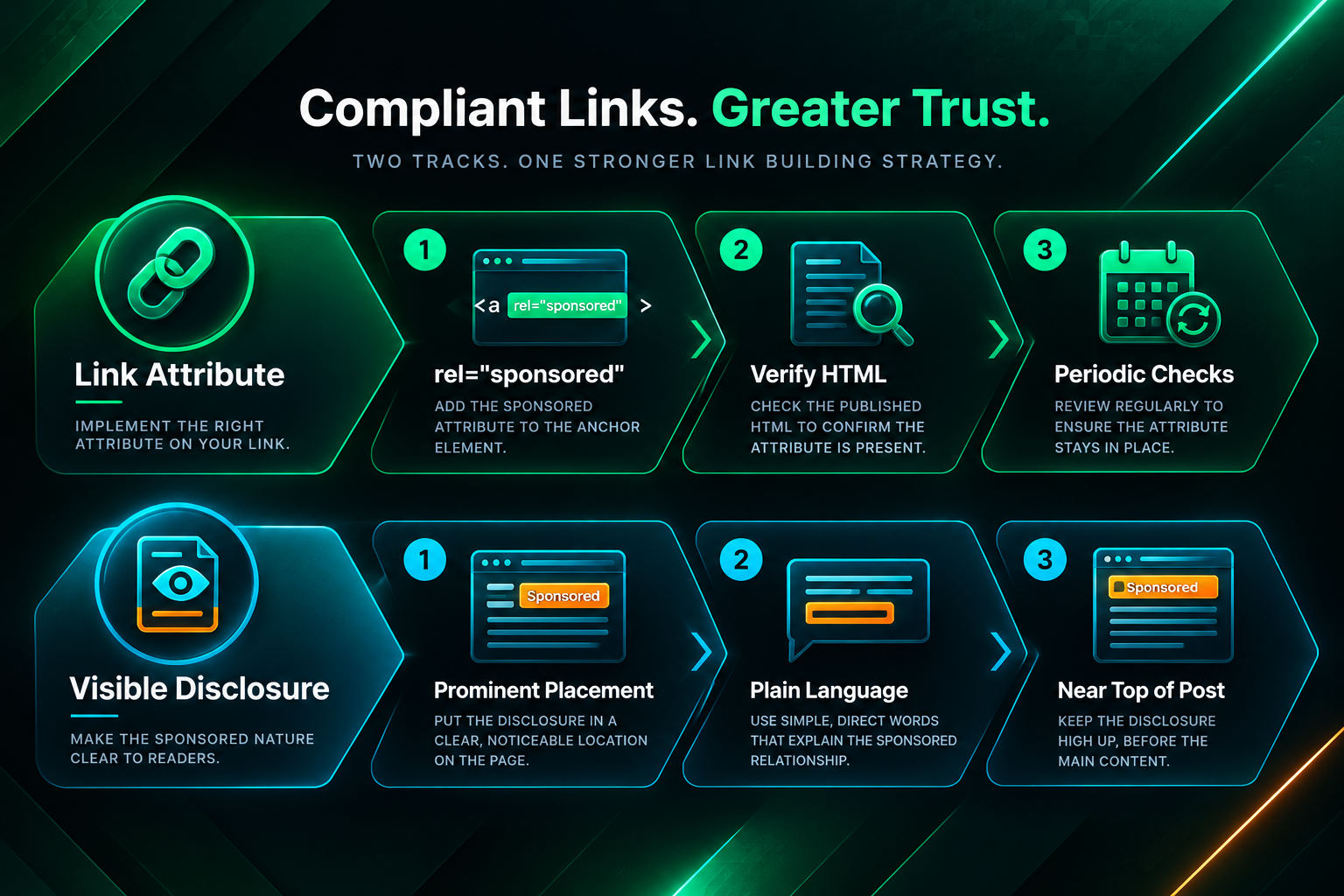
Applying disclosures correctly requires attention to both the technical implementation on the link and the visible labelling on the page. The two serve different purposes and neither substitutes for the other.
Link Attribute Implementation
For any link within a guest post that exists as part of a paid or commercially influenced arrangement, the publisher should apply rel="sponsored" to the anchor element. If the publisher’s content management system does not support custom link attributes easily, rel="nofollow" is an acceptable alternative under Google’s guidelines, though rel="sponsored" is the more precise signal. Both attributes should be confirmed in the published HTML, not assumed from the editorial brief.
When managing a guest posting campaign, the party responsible for quality assurance should check the live URL after publication to confirm that the link attribute is present and correctly formatted. A link that was submitted with the correct attribute can lose it if the publisher’s CMS strips custom attributes during editing or if the post is updated after publication. Periodic checks of published placements are a reasonable part of campaign maintenance.
Visible Page Disclosure
The visible disclosure should appear prominently on the page, ideally near the top of the post or immediately before the first commercial reference. Common placements include a short statement at the beginning of the article, a labelled banner or callout box, or a clearly visible tag in the post header. Disclosures placed only at the bottom of a long article, or written in a font size or colour that makes them difficult to read, are unlikely to satisfy regulatory standards in most markets.
The language used should be plain and unambiguous. Readers should be able to understand from the disclosure that the content or a link within it involves a commercial arrangement, without needing to interpret industry jargon. “This article contains sponsored links” or “This post was produced in partnership with [Brand]” are examples of clear, reader-facing disclosures. Vague phrases such as “This post may contain affiliate content” are less likely to meet the clarity standard required by regulators when the commercial relationship is definite rather than conditional.
Responsibility Between Publisher and Link Builder
In a guest posting arrangement, responsibility for disclosure is shared. The publisher controls the final published HTML and is ultimately responsible for what appears on their site. The link builder or brand commissioning the content is responsible for ensuring that the brief and the placement agreement include clear disclosure requirements, and for verifying compliance after publication.
When working with an outsourced link building provider, it is reasonable to ask how disclosure compliance is handled as part of the campaign workflow. A provider that does not address link attributes and visible disclosures in its quality assurance process introduces compliance risk that the client may ultimately bear. Clarifying this before a campaign begins is a straightforward due diligence step.
The Relationship Between Disclosure and Link Value
A common concern among businesses investing in guest posting is whether applying rel="sponsored" or rel="nofollow" to a link eliminates its SEO value. The honest answer is that these attributes instruct Google not to pass PageRank through the link in the traditional sense, which means a sponsored or nofollowed link is unlikely to contribute to ranking improvements in the same way that an editorially earned dofollow link might.
This creates a genuine tension in commercial guest posting. A paid placement that is correctly disclosed and attributed carries less direct link equity than an editorial placement earned on merit. However, a paid placement that is not disclosed and not attributed carries search engine policy risk that can outweigh any short-term ranking benefit. The practical implication is that businesses seeking link equity through guest posting should focus their investment on earning genuinely editorial placements through high-quality content and legitimate outreach, rather than on paid placements that require sponsored attribution.
Paid guest post placements can still serve legitimate marketing purposes: brand awareness, referral traffic from relevant audiences, and content distribution. These benefits do not depend on the link passing PageRank. Understanding the distinction between link equity and other forms of value helps businesses set realistic expectations for different types of guest post arrangements.
Editorial Guest Posts vs Paid Placements: Where the Line Falls
The distinction between an editorial guest post and a paid placement is not always as clear as it might appear. A guest post that is pitched to a publisher, accepted on the basis of content quality, and published without any payment is generally considered an editorial placement. The link within it is editorially given, and no disclosure is required under Google’s link policies, though the author’s affiliation with the linked brand should still be transparent to readers in most regulatory contexts.
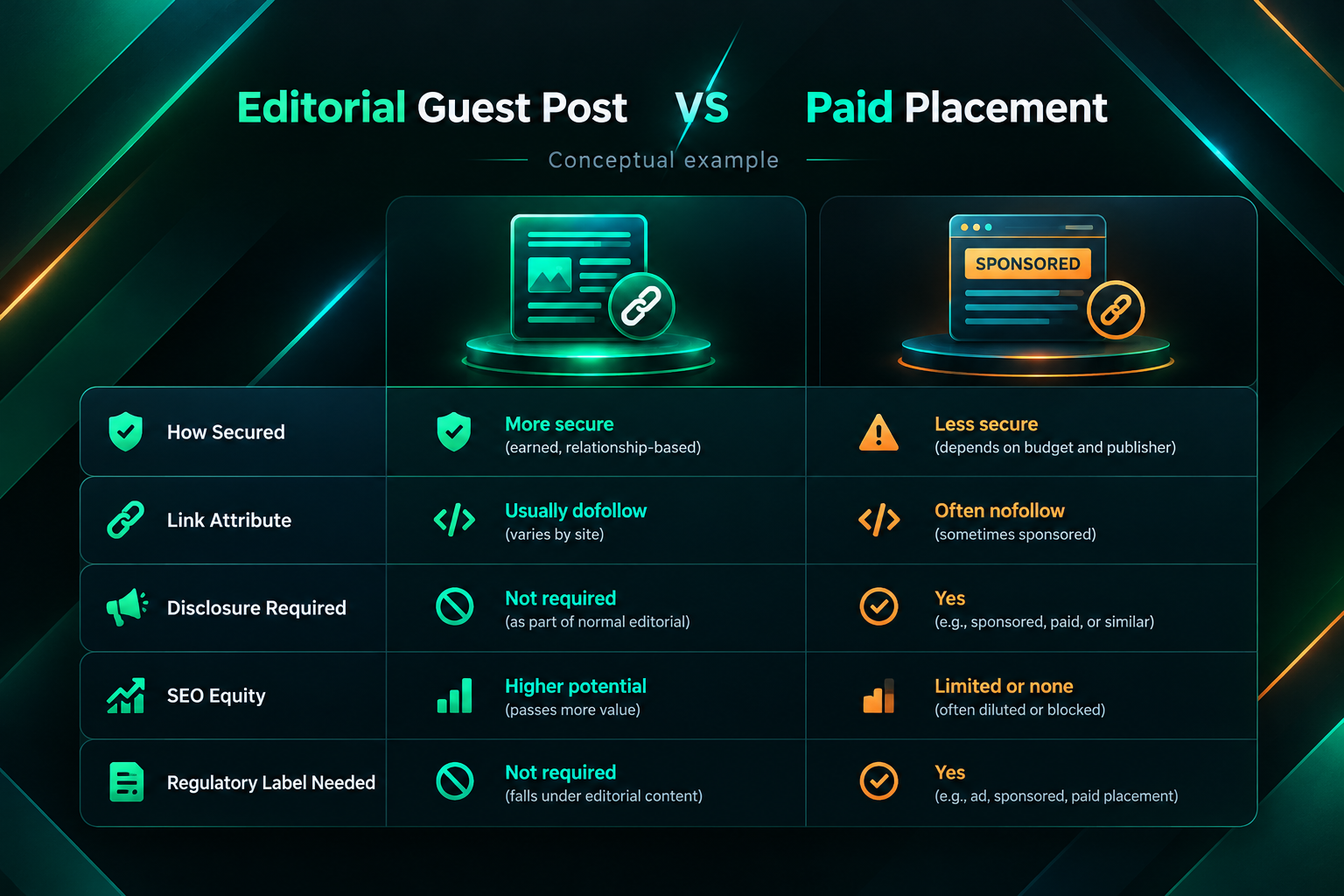
The line becomes blurred when a publisher charges a fee for reviewing or processing a guest post submission, when a placement is secured through a link marketplace that connects buyers and sellers, or when the outreach process involves an implicit understanding that a link will be included in exchange for the content. Google’s guidance has consistently treated these arrangements as paid links regardless of whether a formal invoice is issued, because the commercial incentive influences the editorial decision.
For businesses and agencies managing guest posting campaigns, the practical implication is that any placement secured through a process that involves payment, whether to the publisher, to a marketplace, or to an intermediary who guarantees placement, should be treated as a paid link for disclosure purposes. Assuming that a placement is editorial because the content itself is high quality does not change the nature of the commercial arrangement that secured it.
Risks of Inadequate Disclosure
Failing to disclose commercial relationships in guest posts carries risks across three areas: search engine penalties, regulatory action, and reputational damage.
- Manual actions from Google: Google’s spam team can issue manual actions against sites that participate in link schemes, including undisclosed paid guest post networks. A manual action targeting inbound links can significantly reduce a site’s organic visibility, and recovery typically requires identifying and addressing the problematic links before submitting a reconsideration request.
- Algorithmic discounting: Even without a formal manual action, Google’s algorithms may identify and discount links that appear to be commercially influenced, reducing or eliminating any ranking benefit from the placement.
- Regulatory investigation and fines: Regulatory bodies in the US, UK, and EU have the authority to investigate and fine publishers and brands that fail to disclose commercial content adequately. Enforcement actions have increased in frequency as regulators have become more attentive to digital advertising practices.
- Publisher risk: Publishers who repeatedly host undisclosed commercial content risk losing their own search visibility and editorial credibility, which reduces the value of any future placements on their site.
- Reputational damage: Readers who discover that content was commercially influenced without disclosure may lose trust in both the publisher and the brand involved. This is particularly relevant for brands in sectors where trust is a significant purchase factor.
Disclosure in White-Label and Outsourced Link Building Campaigns
When link building is outsourced to an agency or managed through a white-label provider, the disclosure obligations do not transfer away from the brand or the end client. The brand whose site receives the link, and the publisher who hosts the content, remain responsible for compliance with search engine policies and applicable regulations regardless of who managed the outreach.
This means that businesses working with outsourced link building providers should include disclosure compliance as an explicit requirement in their campaign brief. Questions worth asking a provider include: how link attributes are specified in placement briefs, whether compliance is verified after publication, how the provider distinguishes between editorial and paid placements in its reporting, and what happens if a publisher removes a disclosure or changes a link attribute after the placement goes live.
A provider that treats disclosure as an afterthought rather than a standard part of campaign quality assurance introduces compliance risk that can affect the client’s site long after the campaign ends. Transparency about how placements are secured and how compliance is maintained is a reasonable expectation when evaluating any outsourced link building service.
Frequently Asked Questions
Does adding “Sponsored” text to a guest post satisfy Google’s link policy?
No. A visible disclosure label on the page does not satisfy Google’s link scheme policy on its own. The link itself must carry a qualifying attribute, either rel="sponsored" or rel="nofollow", in the HTML. Both the visible disclosure and the link attribute are needed: the label addresses reader transparency and regulatory requirements, while the attribute addresses Google’s PageRank and spam policies.
Is a guest post link always considered paid if I used an outreach service to secure it?
Not necessarily, but it depends on how the placement was secured. If the outreach service pitched the content on merit and the publisher accepted it editorially without any payment or guaranteed placement arrangement, the link may be considered editorial. If the service paid the publisher, used a marketplace, or guaranteed placement as part of its offering, the link is more likely to be treated as paid under Google’s guidelines regardless of the content quality.
What link attribute should I use for a paid guest post?
Google recommends rel="sponsored" for links that are part of paid or sponsored arrangements. The rel="nofollow" attribute is also acceptable and instructs Google not to pass PageRank, though Google has described it as a hint since 2019. Using rel="sponsored" is the more specific and appropriate signal for commercially influenced placements.
Do disclosure requirements apply to all guest posts or only to paid ones?
Google’s link attribute requirements apply specifically to paid or commercially influenced links. Regulatory disclosure requirements apply whenever a material commercial connection exists between the author or publisher and the brand being promoted, which can include unpaid arrangements such as free products, reciprocal links, or affiliate relationships. An editorial guest post with no commercial connection generally does not require a disclosure label, though the author’s affiliation with the linked brand may still be relevant to readers.
Can a publisher remove a disclosure after publication without my knowledge?
Yes, and this is a practical risk in guest posting campaigns. Publishers can edit or remove disclosures, change link attributes, or update posts in ways that affect compliance after the initial placement. Periodic checks of published placements are a reasonable part of campaign maintenance, particularly for placements that are important to the campaign’s overall link profile.
Does disclosing a commercial relationship reduce the SEO value of the link?
Applying rel="sponsored" or rel="nofollow" to a link means it is unlikely to pass PageRank in the traditional sense, which reduces its direct contribution to ranking improvements compared to an editorially earned dofollow link. However, an undisclosed paid link that passes PageRank carries search engine policy risk that can result in penalties outweighing any short-term benefit. Paid placements can still deliver referral traffic and brand visibility without relying on link equity.
Making Disclosure a Standard Part of Your Guest Posting Process
Commercial relationship disclosure in guest posts is not a bureaucratic formality. It is a practical requirement that protects the long-term value of a link building campaign, reduces legal and regulatory exposure, and maintains the editorial credibility that makes guest posting a viable strategy. The businesses and agencies that treat disclosure as a standard workflow step, rather than an optional add-on, are better positioned to build a backlink profile that remains stable and compliant as search engine policies and regulatory standards continue to evolve.
For any business considering guest posting as part of its link acquisition strategy, the starting point is understanding which placements are genuinely editorial and which involve a commercial arrangement, and ensuring that the appropriate disclosures are applied to each. If you work with an outsourced provider, verifying that disclosure compliance is built into their process is a straightforward due diligence step that is worth taking before a campaign begins rather than after a problem arises.