Image links are a common feature of the web, appearing in logo placements, infographic embeds, banner advertisements, and image-based navigation menus. Whether these links pass PageRank — and therefore contribute to a page’s authority in Google’s eyes — is a question that matters for anyone planning a link acquisition strategy. The short answer is yes, image links can pass PageRank, but the practical SEO value they deliver depends on several factors that are worth understanding before you rely on them as a core part of your backlink profile.
Key Takeaways
- Google can follow image links and pass PageRank through them, provided the link is not blocked by a
nofollowattribute, a robots directive, or a JavaScript rendering issue. - The alt attribute of an image link functions similarly to anchor text in a text link, influencing how Google interprets the context and relevance of the link.
- Image links acquired through editorial placements — such as infographic embeds or logo links on relevant partner pages — can contribute meaningful SEO value, but their impact depends on the quality and relevance of the linking page.
- Image links alone are rarely sufficient for a competitive link building campaign; they work best as part of a broader, diversified backlink profile.
- Paid image link placements, like paid text links, are subject to Google’s link spam policies and should be disclosed with appropriate link attributes.
How Google Treats Image Links

Google’s crawlers follow hyperlinks regardless of whether the clickable element is text or an image. When a link wraps an image element, Googlebot treats the anchor in the same way it would treat a text link — it follows the href, evaluates the destination URL, and considers whether PageRank should flow through the link based on the link’s attributes. This has been confirmed in Google’s own documentation and through statements from Google Search Advocates over the years. The fundamental mechanism of PageRank transfer is not restricted to text-based anchors.
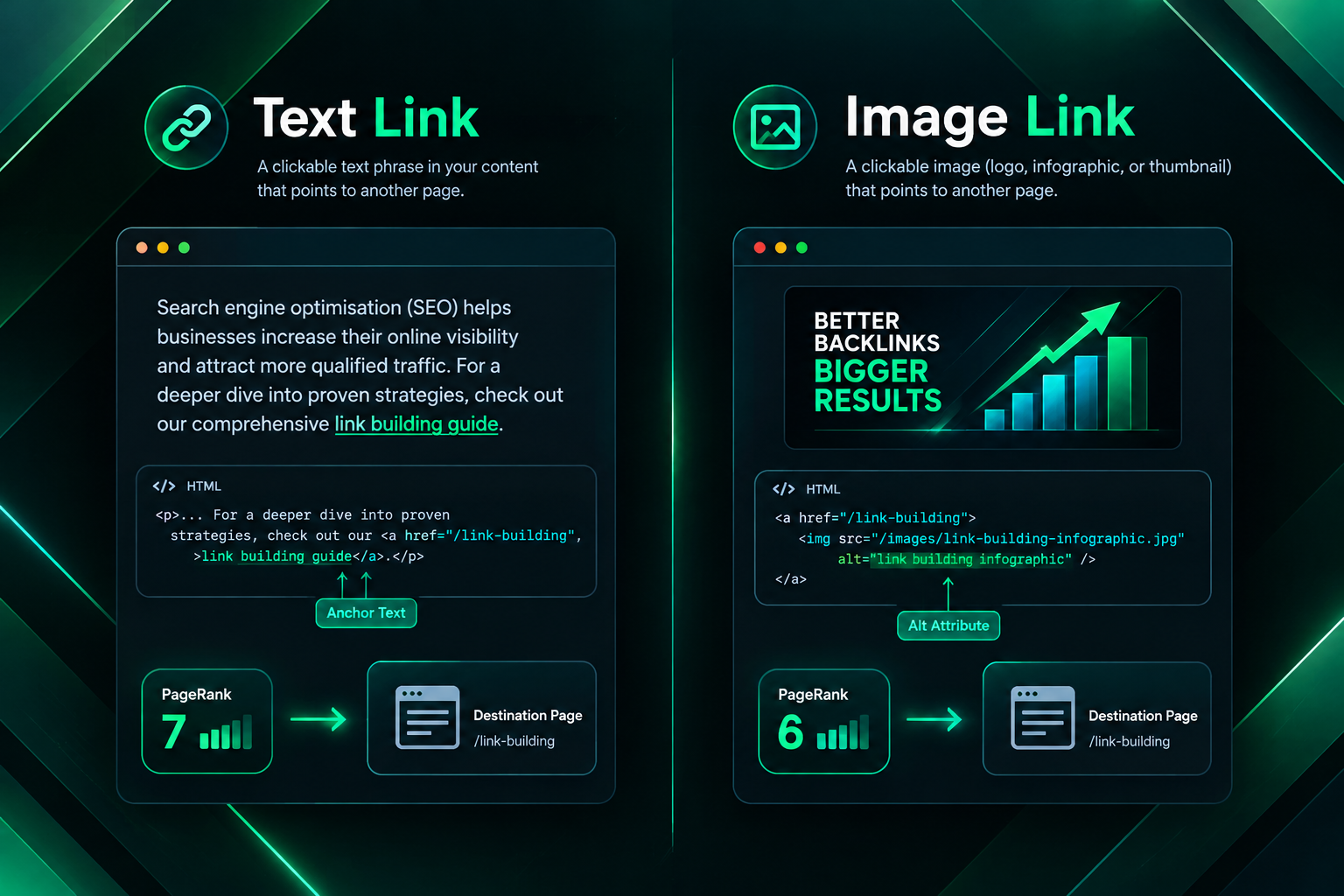
The key difference between an image link and a text link lies in how Google interprets the link’s context and relevance. With a text link, the anchor text provides a direct signal about the topic of the destination page. With an image link, Google uses the image’s alt attribute as a functional equivalent of anchor text. If the alt attribute is descriptive and relevant — for example, alt=”content marketing guide for SaaS companies” — Google can use that information to understand what the linked page is about. If the alt attribute is empty, generic, or missing entirely, Google has less contextual information to work with, which may reduce the link’s relevance signal even if PageRank still flows through it.
It is also worth noting that Google’s ability to process image links depends on the same technical conditions that apply to all links. A link wrapped in JavaScript that Googlebot cannot render, a page blocked by a robots.txt directive, or a link carrying a rel="nofollow", rel="sponsored", or rel="ugc" attribute will not pass PageRank in the conventional sense. These attributes signal to Google that the link should be treated as a hint rather than an editorial endorsement, and Google’s documentation indicates that nofollow links are treated as hints for crawling and indexing purposes rather than guaranteed PageRank conduits.
The Role of the Alt Attribute in Image Link SEO
The alt attribute is the most important on-page factor that distinguishes a well-optimised image link from one that provides minimal contextual value. When Google encounters an image link, it reads the alt text as the functional anchor text for that link. This means the alt attribute influences not only accessibility and image search visibility but also the topical signal the link sends to the destination page.
A descriptive, relevant alt attribute — one that accurately reflects the content of the destination page or the nature of the relationship between the linking site and the linked site — is more likely to contribute a meaningful relevance signal. A blank alt attribute or a generic placeholder such as “click here” or “logo” provides little topical context. In practice, many image links on the web, particularly logo links and banner placements, carry weak or missing alt text, which limits their ability to pass a strong relevance signal even when PageRank does flow through them.
For SEO practitioners managing link acquisition campaigns, this has a practical implication: when negotiating or reviewing image-based placements, it is worth confirming that the alt attribute is descriptive and relevant to the target page. This is a small detail that can meaningfully affect the quality of the link’s contextual signal.
Common Sources of Image Links and Their SEO Relevance
Image links appear in several distinct contexts on the web, and their SEO relevance varies considerably depending on how and where they are placed.
Infographic Embed Links
Infographic link building is one of the more established methods of earning image-based backlinks. When a publisher embeds an infographic created by another website, the embed code typically includes a link back to the original source. This link is often wrapped around the image itself, making it an image link. If the linking page is editorially relevant, has reasonable authority, and the alt attribute is appropriately set, an infographic embed link can pass PageRank and contribute a useful signal. The challenge with infographic link building is that it requires creating genuinely useful visual content and conducting outreach to relevant publishers — a process that demands time and editorial judgment.
Logo and Partner Links
Many websites display partner logos, client logos, or supplier logos with links back to the respective organisations. These logo links are image links by nature. Their SEO value depends heavily on the quality and relevance of the linking page. A logo link from a well-regarded industry association or a relevant partner website can carry meaningful PageRank. A logo link from a low-quality directory or an irrelevant website is unlikely to provide significant SEO benefit and may, in some cases, be part of a link scheme if acquired artificially.
Image-Based Navigation and Internal Links
Image links are also common in website navigation, particularly in older site designs that use image-based menus or icon-driven navigation. These are typically internal links rather than external backlinks, and while they are relevant to internal PageRank distribution, they are not the primary concern for external link building campaigns. It is worth ensuring that internal image links carry descriptive alt attributes for both accessibility and internal linking clarity.
Banner and Display Placements
Banner advertisements and sponsored image placements are a distinct category. These are paid placements and, under Google’s link spam policies, should carry a rel="sponsored" attribute. A paid image link without the appropriate attribute is treated as a violation of Google’s guidelines in the same way a paid text link would be. The presence of a rel="sponsored" attribute means the link is treated as a hint rather than an editorial endorsement, which limits its PageRank value. Businesses that acquire banner placements for brand visibility rather than SEO value may find them useful for referral traffic, but they should not be expected to function as PageRank-passing editorial links.
Image Links Compared to Text Links for SEO
Understanding how image links compare to text links helps clarify where they fit in a link building strategy and where their limitations become relevant.
| Characteristic | Text Link | Image Link |
|---|---|---|
| PageRank transfer | Yes, when followed | Yes, when followed |
| Anchor text signal | Anchor text of the link | Alt attribute of the image |
| Contextual relevance signal | Anchor text plus surrounding content | Alt text plus surrounding content |
| Common placement types | Editorial content, guest posts, niche edits | Infographic embeds, logo links, banners |
| Risk of weak contextual signal | Lower, if anchor text is descriptive | Higher, if alt attribute is missing or generic |
| Suitability for link building campaigns | Primary method for most campaigns | Supplementary; useful in specific contexts |
| Policy considerations | Paid links require rel=”sponsored” | Paid image links require rel=”sponsored” |
Text links remain the dominant format in most professional link building campaigns because they offer clearer anchor text signals and are more naturally integrated into editorial content. Image links can complement a backlink profile, particularly when they come from editorially relevant sources such as infographic placements or genuine partner pages, but they are rarely the primary vehicle for building topical authority at scale.
Technical Factors That Affect Whether an Image Link Passes PageRank
Several technical conditions determine whether an image link actually passes PageRank, regardless of the quality of the linking page.
Link Attributes
The rel attribute on a link element controls how Google treats the link for PageRank purposes. A rel="nofollow" attribute tells Google not to pass PageRank through the link. A rel="sponsored" attribute indicates a paid or commercial relationship. A rel="ugc" attribute indicates user-generated content. Google’s documentation describes these as hints rather than absolute directives, but in practice, links carrying these attributes are not treated as standard editorial endorsements. An image link without any of these attributes, on a page that is crawlable and indexable, is treated as a standard followed link.
JavaScript Rendering
If an image link is rendered through JavaScript rather than present in the raw HTML, Googlebot may not discover or process it during the initial crawl. Google does crawl and render JavaScript, but this process can be delayed, and some JavaScript implementations may prevent Googlebot from following the link at all. For link building purposes, links that appear in static HTML are generally more reliable than those dependent on JavaScript rendering.
Page Crawlability and Indexability
A link on a page that is blocked by robots.txt will not be crawled, and therefore no PageRank will flow through it. Similarly, a page with a noindex directive may still be crawled, but its ability to pass PageRank is less predictable. When assessing the value of a potential image link placement, confirming that the linking page is crawlable and indexed is a basic quality check that applies equally to text links and image links.
Redirect Chains
If the image link points to a URL that redirects to the target page, PageRank may be diluted depending on the type and length of the redirect chain. A clean 301 redirect generally passes most PageRank, but multiple redirects or redirect chains involving non-standard status codes can reduce the amount of PageRank that reaches the final destination.
Image Links in a Broader Link Building Strategy
For most link building campaigns, image links function best as a supplementary element rather than the primary acquisition method. A backlink profile that consists predominantly of image links — particularly logo links or banner placements with generic alt attributes — is unlikely to build the same degree of topical authority as a profile that includes editorially placed text links within relevant content.
That said, image links from high-quality, editorially relevant sources do contribute to a natural and diverse backlink profile. A website that earns infographic embeds from authoritative industry publications, or that receives logo links from genuine partner organisations, is building a profile that reflects real-world relationships and content value. This kind of diversity is generally considered a positive signal, and it is consistent with the types of backlink profiles that tend to appear on well-regarded websites in competitive niches.
When planning a link acquisition campaign, it is worth distinguishing between image links that arise naturally from content creation and outreach — such as infographic campaigns or digital PR efforts — and image links that are purchased or placed artificially. The former can contribute genuine SEO value; the latter carry the same policy risks as any other form of paid link placement and should be treated accordingly.
Assessing the Quality of an Image Link Placement
Evaluating the potential value of an image link placement involves the same quality criteria that apply to any backlink opportunity, with a few additional considerations specific to the image format.
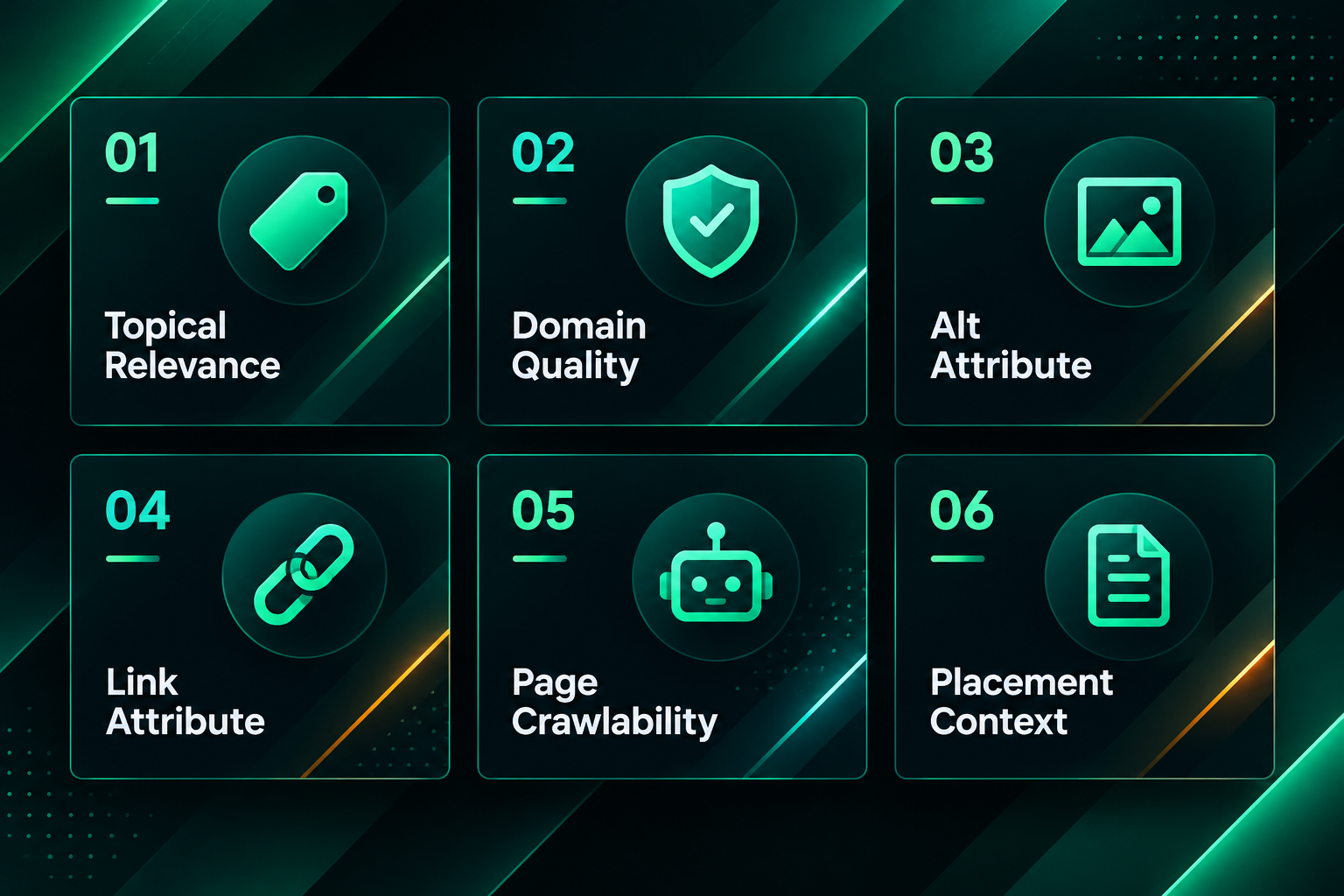
- Topical relevance: Is the linking page relevant to the topic of the destination page? A link from a relevant industry resource carries more contextual weight than a link from an unrelated website, regardless of whether it is a text link or an image link.
- Page authority and referring domain quality: Third-party metrics such as Ahrefs’ Domain Rating, Moz’s Domain Authority, or Majestic’s Trust Flow can provide a rough indication of a linking domain’s authority, but these are proprietary estimates rather than Google metrics. They should be used as one input among several, not as a definitive measure of link value.
- Alt attribute quality: Is the alt attribute descriptive and relevant? A missing or generic alt attribute weakens the contextual signal of the image link.
- Link attribute: Is the link followed, or does it carry a nofollow or sponsored attribute? This determines whether PageRank flows through the link.
- Page crawlability: Is the linking page crawlable and indexed? A link on a blocked or deindexed page provides no PageRank benefit.
- Placement context: Is the image link embedded within relevant editorial content, or is it isolated in a sidebar, footer, or widget area? Links within the main body of relevant content tend to carry more weight than those in peripheral page areas.
Risks and Limitations of Image Link Building
Image link building carries some specific limitations that are worth acknowledging before incorporating it into a campaign strategy.
The most significant limitation is the contextual signal gap that arises when alt attributes are absent or generic. Unlike text links, where the anchor text is visible and editable by the linking publisher, the alt attribute of an image link may be set by the publisher in ways that are difficult to control or verify after placement. This means the relevance signal of an image link can be weaker or less predictable than that of a well-placed text link with a descriptive anchor.
Infographic link building, while a legitimate content-driven strategy, has become less effective in some niches as the format has become more common and publishers have become more selective about what they embed. The effort required to create a genuinely useful, well-designed infographic and conduct effective outreach can be substantial, and the resulting links may not always justify the investment compared to other content-driven link acquisition methods.
Paid image placements — banner links, sponsored logo placements, and similar arrangements — carry the same policy risks as paid text links. Google’s link spam policies apply to all link types, and a pattern of paid image links without appropriate attributes could attract scrutiny in the same way that a pattern of paid text links would. The risk level depends on the scale, the visibility of the pattern, and the overall link profile context, but it is not negligible.
Finally, image links from low-quality or irrelevant sources provide little SEO benefit and may contribute to a backlink profile that appears unnatural. As with all link acquisition, quality and relevance matter more than volume.
Frequently Asked Questions
Does Google follow image links the same way it follows text links?
Yes. Google’s crawlers follow image links in the same way they follow text links, provided the link does not carry a nofollow or sponsored attribute and the page is crawlable. The main difference is that Google uses the image’s alt attribute as the functional equivalent of anchor text, rather than visible link text.
What happens if an image link has no alt attribute?
If an image link has an empty or missing alt attribute, Google has less contextual information about the destination page. PageRank may still flow through the link if it is followed and the page is crawlable, but the relevance signal will be weaker than it would be with a descriptive alt attribute. This is one reason why image links with missing alt text are generally considered lower quality than well-optimised text links.
Are infographic embed links a reliable link building strategy?
Infographic embed links can be a legitimate part of a content-driven link acquisition strategy, particularly when the infographic provides genuine value and is placed on editorially relevant pages. However, the effectiveness of infographic campaigns varies by niche, and the effort required to create and promote high-quality infographics is significant. Results depend on content quality, outreach effectiveness, and the relevance of the publishers who embed the content.
Do logo links from partner websites pass PageRank?
Logo links from genuine partner websites can pass PageRank if they are followed links on crawlable, indexed pages. Their SEO value depends on the quality and relevance of the linking domain and the descriptiveness of the alt attribute. Logo links from low-quality or irrelevant websites are unlikely to provide meaningful SEO benefit.
Should paid image link placements carry a rel attribute?
Yes. Google’s link spam policies apply to paid image links in the same way they apply to paid text links. A paid image link placement — such as a sponsored banner or a logo link acquired through a commercial arrangement — should carry a rel="sponsored" attribute. Failing to disclose paid links appropriately is a policy violation regardless of whether the link is text-based or image-based.
Can image links help build topical authority for a website?
Image links can contribute to topical authority when they come from editorially relevant sources and carry descriptive alt attributes. However, they are generally less effective at building topical authority than well-placed text links within relevant editorial content, because the contextual signal from alt text is typically less rich than the signal from anchor text embedded in a paragraph of relevant content.
Deciding Whether Image Links Belong in Your Link Building Strategy
Image links can pass PageRank and contribute to a backlink profile, but their practical value depends on the quality of the linking page, the descriptiveness of the alt attribute, and the technical conditions of the link itself. They are not a separate category of link that Google ignores, nor are they a shortcut to building authority — they are simply one format among several through which PageRank can flow.
For most websites, image links work best as a natural byproduct of content-driven strategies such as infographic campaigns or genuine partnership relationships, rather than as a primary acquisition method. A backlink profile that includes a reasonable proportion of high-quality image links alongside well-placed editorial text links is likely to appear more natural and diverse than one that relies exclusively on either format.
If you are planning a link acquisition campaign and want to understand how image links, text links, and other placement types might fit your specific situation, a site-specific assessment is the most reliable starting point. The right mix of link types, anchor signals, and placement contexts depends on your existing backlink profile, your target pages, your industry, and the competitive landscape you are operating in. A qualified link building provider can help you evaluate these factors and design a campaign that reflects both your goals and the realities of your market.