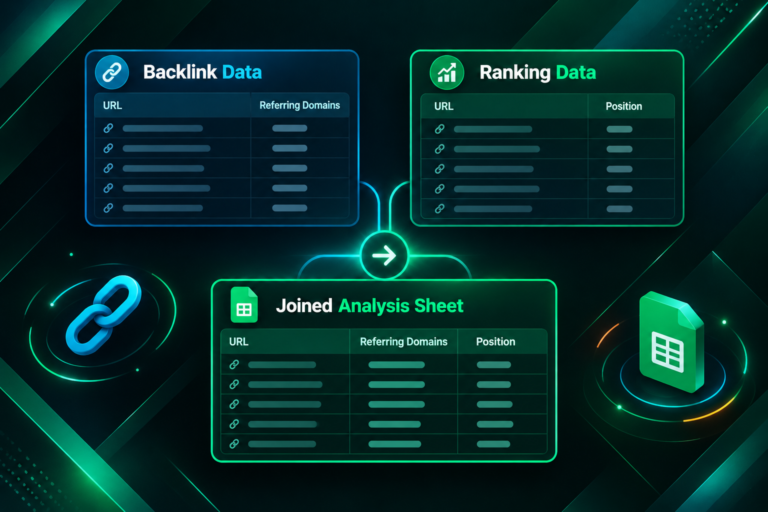
PageRank is the foundational algorithm Google uses to evaluate the relative importance of web pages based on the links pointing to them. Understanding how it works helps explain why link building remains a meaningful part of SEO strategy, what makes one backlink more valuable than another, and why simply accumulating large numbers of links does not reliably produce ranking improvements. This article explains the core mechanics of PageRank, how link equity flows through a website, what factors influence that flow, and what the practical implications are for anyone managing or commissioning a link building campaign.
Key Takeaways
- PageRank treats each link as a vote of confidence, but the weight of that vote depends on the linking page’s own authority and how many other links it distributes.
- Link equity passes through internal and external links, meaning site architecture and anchor text choices both influence how PageRank flows across a domain.
- Google has confirmed that PageRank remains a ranking signal, though the publicly visible PageRank toolbar was discontinued in 2016 and the algorithm has evolved considerably since its original publication.
- Third-party metrics such as Domain Rating, Domain Authority, and Trust Flow are proprietary approximations, not direct measures of Google’s internal PageRank scores.
- Acquiring links from pages with genuine topical relevance and editorial context may contribute more meaningfully to ranking potential than volume alone.
The Original PageRank Concept
PageRank was introduced by Larry Page and Sergey Brin in their 1998 research paper describing the architecture of a large-scale web search engine. The core idea was straightforward: a page that receives many links from other pages is likely to be more important than one that receives few, and a link from an already-important page carries more weight than a link from an obscure one. This recursive logic allowed the algorithm to assign a numerical score to every page on the web based on the structure of links connecting them.
In its original formulation, PageRank was expressed as a probability. Imagine a hypothetical user who clicks links at random, moving from page to page indefinitely. The PageRank of any given page represents the probability that this random user would land on it at any moment. Pages that attract many links from well-connected sources accumulate a higher probability of being visited, and therefore a higher PageRank score. This probabilistic framing is important because it explains why PageRank is not simply additive — it is distributed and recursive across the entire web graph.
The original algorithm included a damping factor, typically set at around 0.85, which accounts for the likelihood that a random user will stop clicking and start fresh from a new page rather than following links indefinitely. This damping factor prevents PageRank from concentrating entirely in a small number of highly linked pages and ensures that every page on the web retains at least a small baseline score.
How Link Equity Is Distributed
When a page links to another page, it passes a portion of its PageRank to the destination. The amount passed depends on two things: the PageRank of the linking page itself, and the total number of outbound links on that page. A page with a high PageRank that links to only two other pages passes a substantial share of its equity to each. The same page linking to fifty destinations passes a much smaller share to each individual recipient. This is sometimes described informally as link juice, though that term does not appear in Google’s documentation.
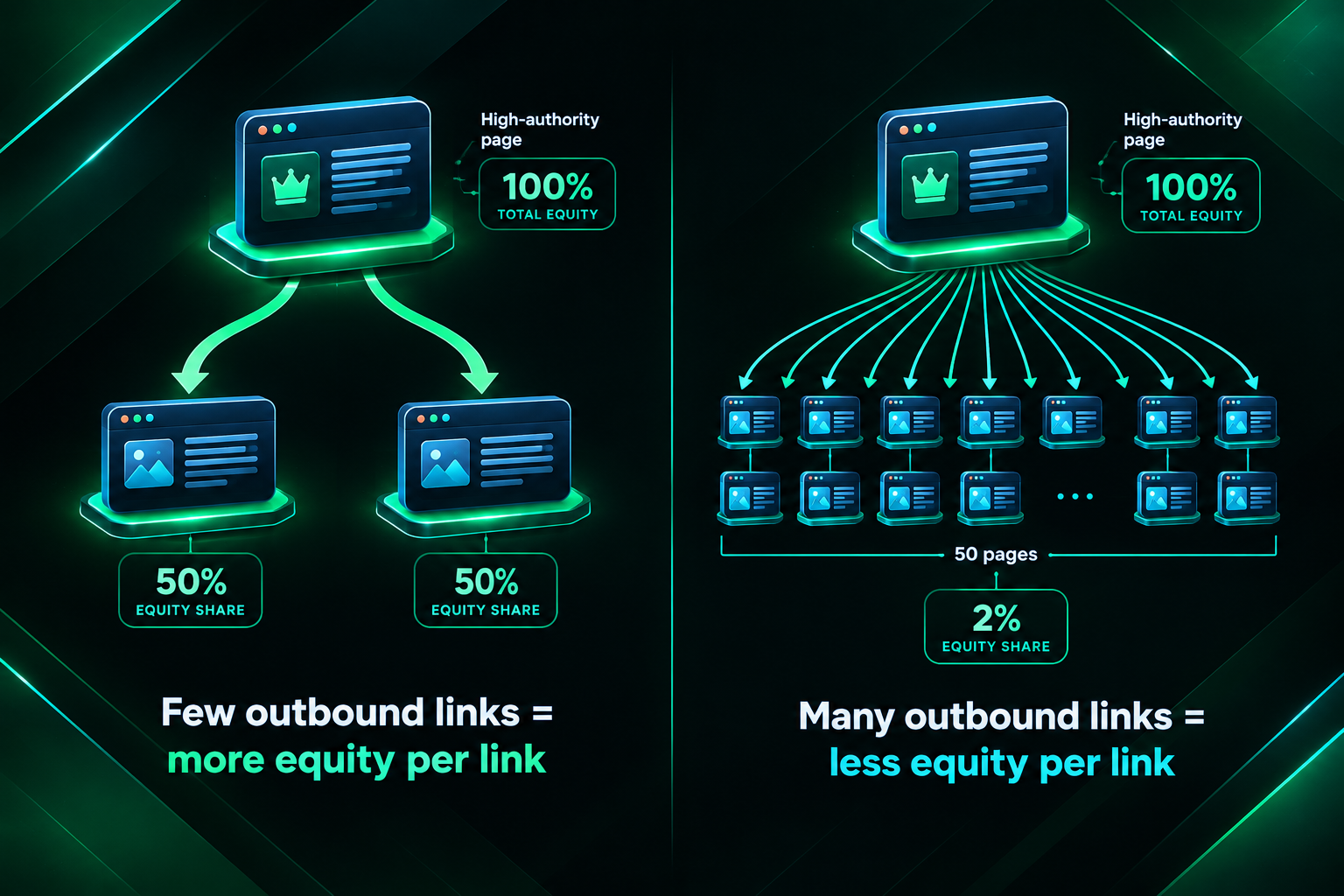
This distribution mechanic has several practical implications. A link from a page that links to hundreds of other sites in a directory-style format may pass considerably less equity than a link from an editorial article that links to only a handful of relevant sources. It also means that the position of a link on a page — whether it appears in the main body content, a sidebar, a footer, or a navigation menu — may influence how Google weights it, though Google has not published precise details about how placement affects equity distribution in its current implementation.
Internal links follow the same distribution logic. When a website’s homepage links to a category page, and that category page links to individual product or article pages, PageRank flows through the internal link structure. This is why internal linking strategy is considered an important part of technical SEO: pages that receive more internal links from authoritative sections of a site may accumulate more PageRank and, in turn, may be better positioned to rank for competitive queries.
The Role of the Damping Factor and Dangling Nodes
The damping factor in the PageRank formula serves as a mathematical representation of user behaviour. At a damping factor of 0.85, roughly 85 percent of a page’s PageRank is distributed through its outbound links, while the remaining 15 percent is redistributed evenly across all pages in the web graph. This redistribution prevents so-called dangling nodes — pages with no outbound links — from acting as black holes that absorb PageRank without passing any forward.
In practice, the damping factor means that PageRank decays as it travels through chains of links. A link from a highly authoritative page passes significant equity to its direct destination, but if that destination then links onward, the equity passed to the next page in the chain is reduced by the damping factor again. Very long link chains therefore deliver diminishing returns in terms of equity transfer, which is one reason why links from pages that are themselves well-linked tend to be more valuable than links buried deep in a site’s architecture.
How Google Has Evolved PageRank
Google discontinued the publicly visible PageRank toolbar score in 2016, meaning website owners and SEO practitioners can no longer see a page’s official PageRank value. However, Google has confirmed in various public statements and documentation that PageRank continues to function as a core component of its ranking systems. The algorithm has been refined substantially since 1998 and now operates alongside hundreds of other signals, including content quality assessments, user experience factors, and spam detection systems.
One significant evolution is the introduction of link quality evaluation. Early PageRank treated all links as genuine votes, but Google’s systems now attempt to identify and discount links that appear to have been acquired artificially, placed in low-quality contexts, or generated through manipulative schemes. Google’s spam policies explicitly address link schemes, including paid links that pass PageRank without appropriate disclosure, large-scale guest posting campaigns designed primarily to manipulate rankings, and links from sites created specifically to distribute equity rather than serve readers.
Google also introduced the nofollow link attribute, which instructs crawlers not to pass PageRank through a link. In 2019, Google announced two additional attributes — sponsored for paid or affiliate links, and ugc for user-generated content — and updated its treatment of nofollow from a directive to a hint, meaning Google may choose to crawl and index nofollow links but does not guarantee that PageRank will flow through them. These attribute distinctions matter for link building because they affect whether a placement is likely to contribute to a site’s link equity or serve primarily as a referral traffic source.
What Third-Party Metrics Actually Measure
Because Google’s internal PageRank scores are not publicly accessible, SEO tools have developed their own proprietary metrics to approximate link authority. Ahrefs uses Domain Rating and URL Rating, Moz uses Domain Authority and Page Authority, Semrush uses Authority Score, and Majestic uses Trust Flow and Citation Flow. Each of these metrics is calculated using the tool’s own crawl data and its own interpretation of link graph relationships. They are useful for comparing sites and identifying broadly authoritative linking opportunities, but they are not direct measures of Google’s PageRank and should not be treated as such.
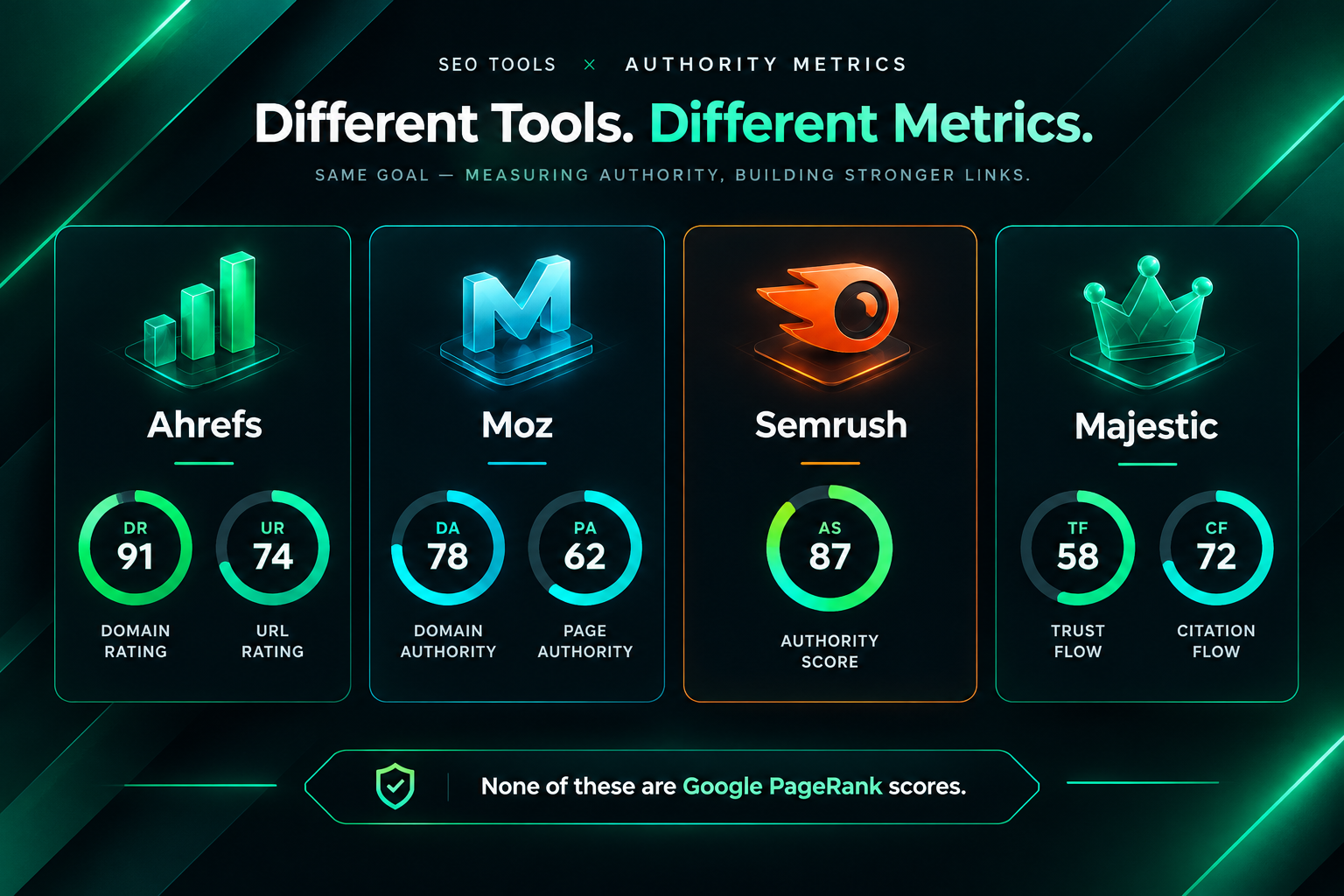
A high Domain Rating does not guarantee that a link from a given page will improve rankings. A page may have accumulated strong third-party metrics through historical link acquisition while producing content that Google’s quality systems now evaluate less favourably. Conversely, a page with a modest Domain Rating on a highly relevant, well-maintained site may pass meaningful equity if Google’s systems treat it as a trustworthy source within its topic area. When assessing potential link placements, topical relevance, editorial quality, and the organic traffic profile of the linking page are worth considering alongside any single authority metric.
PageRank, Anchor Text, and Topical Relevance
PageRank describes the quantity of link equity a page accumulates, but it does not fully explain how Google interprets what a link means. Anchor text — the visible, clickable words in a hyperlink — provides a signal about the topic or entity being linked to. Google’s systems use anchor text as one input when determining what a destination page is about and for which queries it may be relevant. A link with descriptive anchor text pointing to a page about a specific topic may help Google associate that page with the relevant subject matter.
This is why anchor text diversity and relevance are discussed in link building strategy. An unnatural pattern — for example, a large proportion of links using identical exact-match commercial anchor text — may be interpreted as a signal of manipulation rather than organic editorial linking behaviour. Google’s spam systems are designed to detect such patterns, and a backlink profile that appears artificially constructed may be discounted or, in more severe cases, may attract a manual review. Responsible link building approaches aim to acquire links with anchor text that reflects how a genuine editorial source would naturally reference the destination page.
Topical relevance of the linking page also matters beyond anchor text. A link from a page whose content is closely related to the destination page’s subject may carry more interpretive weight than a link from an unrelated context, even if both pages have similar authority metrics. This is consistent with how Google’s systems attempt to understand the web as a network of topically connected documents rather than a flat collection of pages with numerical scores.
PageRank Flow Through a Website’s Architecture
Understanding PageRank mechanics has direct implications for how a website should be structured internally. When external links point to a domain, they typically land on specific pages — often the homepage, key landing pages, or content that has attracted editorial attention. The PageRank accumulated by those pages then flows through internal links to other pages on the site. Pages that are difficult to reach through internal navigation — sometimes called orphan pages — may accumulate little internal PageRank regardless of how strong the domain’s overall link profile is.
For businesses running link building campaigns, this means that acquiring links to a specific target page is generally more direct than relying on homepage links to distribute equity to deeper pages. If the goal is to improve the ranking potential of a product category page, a service landing page, or a specific piece of content, links pointing directly to that page may be more efficient than links that point to the homepage and depend on internal link flow to reach the target. Campaign planning that accounts for both external link acquisition and internal linking structure tends to be more coherent than treating the two as separate concerns.
Practical Implications for Link Building Strategy
PageRank mechanics help explain several principles that inform responsible link building practice. First, the quality and authority of the linking page matters more than the raw number of links acquired. A smaller number of links from pages that have themselves accumulated genuine PageRank through editorial linking may contribute more to a site’s ranking potential than a large volume of links from pages with little authority or organic traffic.
Second, the context in which a link appears affects its likely value. Links embedded in relevant editorial content, surrounded by topically related text, and placed on pages that attract genuine readership are more consistent with the kind of linking behaviour that PageRank was designed to reward. Links placed in footers, sidebars, or low-quality directories may pass less equity and, depending on their origin, may be evaluated sceptically by Google’s spam detection systems.
Third, link building is not a one-time activity. PageRank is calculated dynamically across the web graph, and a site’s relative position within that graph changes as other sites acquire or lose links, as new content is published, and as Google’s crawl and indexing cycles update its understanding of the link structure. Maintaining a healthy, growing backlink profile over time is generally more sustainable than attempting to acquire a large number of links in a short period and then stopping.
Fourth, PageRank is one signal among many. Even a page with strong link equity may not rank well if its content does not satisfy search intent, if it has technical issues that prevent effective crawling or indexing, or if it faces competition from pages that combine strong link profiles with superior content quality. Link building strategy is most effective when it operates alongside, rather than as a substitute for, sound technical SEO and content development.
Risks and Limitations Worth Understanding
Several risks are worth understanding before designing a link acquisition strategy around PageRank mechanics. Google’s spam policies explicitly prohibit link schemes intended to manipulate PageRank, and the consequences of a manual action for unnatural links can include significant ranking losses that may take considerable time and effort to recover from. The fact that a link was acquired through outreach rather than purchased from a marketplace does not automatically make it compliant with Google’s policies; the intent and context of the placement matter.
PageRank is also not the only factor determining whether a link contributes positively to a site’s performance. A link from a site that Google’s quality systems evaluate negatively — for example, a site with a history of thin content, spam, or policy violations — may be discounted or may attract scrutiny even if the linking page has accumulated third-party authority metrics. Assessing the quality of a potential linking site requires looking beyond a single metric to consider content quality, organic traffic trends, editorial standards, and the overall character of the site’s backlink profile.
Finally, the relationship between PageRank, rankings, and business outcomes is not linear or guaranteed. An improvement in a site’s link profile may contribute to improved rankings for target queries, but rankings also depend on content relevance, user experience, competition, and many other factors. An increase in a third-party authority metric following a link building campaign is not the same as an improvement in organic traffic, and an improvement in organic traffic is not the same as an improvement in qualified leads or revenue. Realistic expectations require distinguishing between these different outcomes.
Frequently Asked Questions
Is PageRank still used by Google?
Yes. Google has confirmed in public statements and documentation that PageRank remains part of its ranking systems. The publicly visible toolbar score was discontinued in 2016, but the underlying algorithm continues to operate as one of many signals Google uses to evaluate pages. The current implementation is considerably more sophisticated than the original 1998 version and operates alongside content quality, spam detection, and user experience signals.
What is the difference between PageRank and Domain Authority?
PageRank is Google’s internal measure of a page’s importance based on its link graph position. Domain Authority is a proprietary metric created by Moz that attempts to predict how well a domain may rank in search results. Domain Authority is calculated using Moz’s own crawl data and methodology and is not a Google metric. Similar distinctions apply to Ahrefs’ Domain Rating, Semrush’s Authority Score, and Majestic’s Trust Flow — all are third-party approximations, not direct measures of Google’s internal scores.
Does a nofollow link pass PageRank?
Since Google updated its treatment of the nofollow attribute in 2019, nofollow is treated as a hint rather than a directive. Google may choose to crawl and index pages reached through nofollow links, but it does not guarantee that PageRank will flow through them. In practice, nofollow links are generally not expected to contribute meaningfully to link equity, though they may still provide referral traffic and brand visibility.
Does the number of outbound links on a page affect how much PageRank it passes?
Yes. In the original PageRank formula, a page’s equity is divided among all the pages it links to. A page with two outbound links passes more equity to each destination than a page with fifty outbound links, assuming the same PageRank score. This is one reason why links from pages with focused, selective outbound linking are generally considered more valuable than links from pages that link to large numbers of destinations.
Can internal links improve a page’s PageRank?
Internal links distribute PageRank within a website in the same way that external links distribute it across the web. Pages that receive more internal links from authoritative sections of a site may accumulate more PageRank than pages that are difficult to reach through internal navigation. Improving internal linking to priority pages is a legitimate and often underused way to help those pages benefit more fully from the domain’s existing link equity.
How long does it take for a new backlink to affect rankings?
The timeline varies considerably. Google must first crawl and index the linking page, then process the link as part of its ranking calculations. This can take anywhere from a few days to several weeks depending on how frequently Google crawls the linking site. Even after a link is processed, ranking changes may not be immediately visible, and the contribution of any single link to a measurable ranking improvement depends on the competitiveness of the target query, the existing strength of the site’s backlink profile, and many other factors.
What PageRank Mechanics Mean for Your Link Building Decisions
PageRank mechanics provide a useful framework for understanding why link quality, topical relevance, editorial context, and site architecture all matter in link building — but they do not provide a formula that guarantees ranking outcomes. The algorithm has evolved substantially since its original publication, operates alongside many other signals, and is applied by systems designed to detect and discount manipulative link acquisition. This means that link building strategies built around acquiring the largest possible number of links, or around gaming specific metrics, are less likely to produce durable results than approaches focused on earning links from genuinely relevant, editorially credible sources.
For businesses and SEO teams considering a link building campaign, the practical takeaway is that PageRank mechanics reward patience and quality over volume and speed. Campaigns that identify relevant, authoritative linking opportunities, acquire placements through genuine editorial outreach, and align external link acquisition with sound internal linking and content strategy are more consistent with how PageRank is designed to work. Whether that campaign is managed in-house or through an experienced external provider, understanding the underlying mechanics helps set realistic expectations and supports better decisions about where to invest link building resources.
If you are assessing a link building strategy or evaluating a provider’s approach, it is worth asking how they assess the quality of linking pages beyond a single authority metric, how they approach anchor text and topical relevance, and how they align link acquisition with your specific target pages and business goals. A provider who can answer those questions with clarity and nuance is more likely to deliver campaigns that reflect how PageRank actually works.