

Article syndication is the practice of republishing content that originally appeared on one website across one or more additional websites or platforms. It has been used in publishing for decades, but its role in SEO and link building is frequently misunderstood. Done carefully, syndication can extend the reach of quality content and contribute to a broader visibility strategy. Done carelessly, it can create duplicate content problems, dilute link equity, and produce backlinks with limited SEO value. This article explains how article syndication works, what it means for search engine optimisation, and how to assess whether it belongs in your content or link acquisition strategy.
Key Takeaways
- Article syndication republishes existing content on third-party websites, which differs from guest posting, where original content is created specifically for a publisher.
- Search engines, including Google, have documented guidance on handling syndicated content, and canonical tags or clear attribution are important for managing duplicate content risk.
- Syndication can support brand visibility and referral traffic, but the SEO link building value of syndicated placements depends heavily on how the receiving site handles attribution and linking.
- Syndication is generally more useful as a content distribution tactic than as a primary link acquisition method, and it works best alongside a broader SEO strategy.
- The quality of the syndication partner, the link attributes used, and the canonical setup all affect whether a syndicated placement helps or hinders organic performance.
What Is Article Syndication?
Article syndication means distributing a piece of content — typically an article, blog post, or news item — to one or more third-party websites after it has been published on the original source. The republished version may appear in full, as a partial excerpt, or in a lightly adapted form. The original publisher retains authorship, and the syndicated copy is usually attributed to the source with a link back to the original URL.
Traditional media syndication, where wire services distribute news stories to newspapers and broadcasters, follows the same basic principle. In digital marketing, article syndication has been adapted as a way to reach larger or more targeted audiences by placing content on established platforms, industry publications, news aggregators, or content networks that already have an existing readership.
Common syndication destinations include large editorial platforms, industry-specific media sites, content aggregators, and partner websites within the same niche. Some syndication arrangements are informal agreements between publishers. Others involve structured content networks or paid distribution services that place articles across multiple websites simultaneously.
It is important to distinguish article syndication from content scraping. Scraping involves copying content without permission, whereas syndication is an authorised republication with the original publisher’s knowledge and usually with attribution. It is also distinct from guest posting, where a writer creates original content specifically for a third-party website rather than republishing something that already exists.
How Article Syndication Works in Practice
A typical article syndication arrangement begins when a publisher agrees to republish content from another source. The original article is published on the source website first, establishing it as the canonical version. The syndicated copy is then published on the partner site, ideally with a link back to the original and, where appropriate, a canonical tag pointing to the source URL.

The canonical tag is an HTML element that tells search engines which version of a page should be treated as the authoritative source. When a syndicated partner includes a canonical tag pointing to the original article, search engines are more likely to index and rank the original rather than the copy. Without this signal, search engines must determine on their own which version to treat as primary, which can lead to the syndicated copy outranking the original or to both versions competing for the same search queries.
Some syndication arrangements use a different approach: the republished version includes a clear editorial note stating that the content originally appeared elsewhere, along with a link to the source. This is less technically precise than a canonical tag but can still provide attribution and a backlink. The SEO value of that backlink depends on whether it carries a followed or nofollowed link attribute, the authority and relevance of the syndication partner, and how the link is placed within the content.
Paid content distribution networks operate differently. These services distribute articles to a large number of websites automatically, often with little editorial oversight. The resulting placements may appear on low-quality or topically irrelevant sites, and the backlinks generated may carry little SEO weight or could potentially attract scrutiny under search engine spam policies.
Article Syndication and Duplicate Content
Duplicate content is one of the most discussed risks associated with article syndication. When the same article appears on multiple URLs, search engines must decide which version to show in results. Google has stated publicly that duplicate content is not automatically penalised, but it can affect which version ranks and may dilute the link equity that would otherwise consolidate around a single URL.
The practical risk depends on several factors. If a high-authority platform syndicates your article without a canonical tag pointing back to your site, that platform’s version may rank instead of yours. Readers who find the syndicated version may not visit your original site, reducing the referral traffic benefit. If multiple low-quality sites republish the same article, the overall backlink profile associated with that content may appear manipulative to search engine algorithms.
Managing duplicate content in a syndication strategy typically involves one or more of the following approaches: requesting that syndication partners include a canonical tag pointing to the original URL; ensuring the original article is indexed before the syndicated version is published; using partial syndication, where only an excerpt is republished with a link to the full article on the source site; and monitoring which version search engines are indexing using tools such as Google Search Console.
None of these approaches eliminates duplicate content risk entirely, but they reduce the likelihood that syndication will harm the original article’s organic visibility. A site-specific assessment is advisable before committing to a syndication arrangement, particularly if the website already has indexing or crawl-related issues.
The SEO Value of Backlinks from Syndicated Content
One reason article syndication is discussed in link building contexts is that syndicated placements often include a backlink to the original source. Whether that backlink contributes meaningfully to SEO depends on several factors that vary by placement.
Link attribute matters significantly. A followed backlink from a relevant, editorially credible website can contribute to the referring domain count and may support domain-level authority metrics such as Domain Rating in Ahrefs or Domain Authority in Moz. A nofollowed link does not pass PageRank in the same way, though it may still generate referral traffic and brand visibility. Many large content platforms and news aggregators apply nofollow attributes to syndicated content links by default.
Topical relevance also affects the likely SEO contribution of a syndicated backlink. A link from a website that covers the same subject area as the original content is generally considered more contextually relevant than a link from a general-purpose aggregator. Search engines assess the relationship between linking and linked pages as part of evaluating link quality, though the precise weighting of topical relevance in ranking algorithms is not publicly documented in detail.
The placement context within the syndicated article matters too. A link embedded naturally within the body of a republished article, attributed as the original source, is contextually different from a link placed only in a byline or author bio. Body links in relevant content are generally considered more valuable in link building practice, though this is based on practitioner observation rather than confirmed algorithmic documentation.
It is worth noting that backlinks from syndicated content are not equivalent to editorially earned links or links acquired through manual outreach and guest posting. Syndication links are often predictable in their placement and may be recognised as such by search engine algorithms. Relying on syndication as a primary link acquisition method is unlikely to produce the same results as a diversified strategy that includes original content placements on relevant, high-quality publishers.
Article Syndication vs Guest Posting
Article syndication and guest posting are sometimes grouped together as content-based link building methods, but they differ in important ways that affect their SEO value and practical application.
Guest posting involves creating original content written specifically for a third-party publisher. The content has not appeared elsewhere, which means there is no duplicate content concern. The backlink in a guest post is typically a followed editorial link placed within original content on a relevant website. Guest posting requires more effort per placement — research, pitching, writing, and editorial approval — but the resulting link is generally considered higher quality and more likely to contribute to organic ranking improvements.
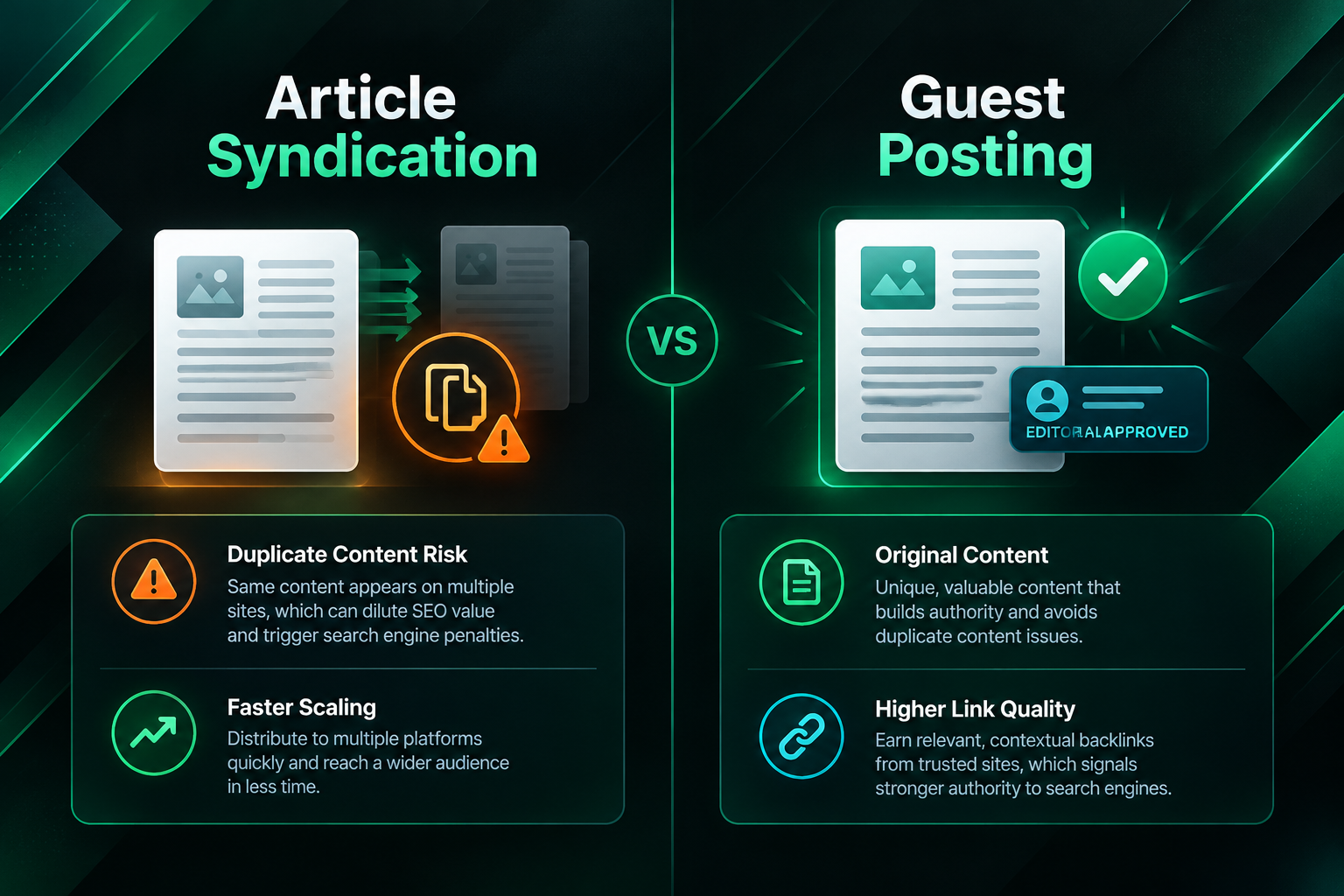
Article syndication republishes existing content, which reduces the content creation workload per placement but introduces duplicate content considerations. The backlink value depends on how the syndication partner handles attribution and link attributes. Syndication can reach a wider audience more quickly, but the SEO contribution per placement is often lower than a well-placed guest post on a relevant, editorially selective website.
For businesses focused primarily on link acquisition to support organic rankings, guest posting and manual outreach to relevant publishers tend to offer more predictable SEO value. Article syndication may be more useful as a content distribution and brand awareness tactic, particularly when the goal is to reach an established audience on a trusted platform rather than to acquire a specific type of backlink.
When Article Syndication May Be Useful
Article syndication is not universally suitable or unsuitable. Its usefulness depends on the goals of the campaign, the quality of the syndication partners, and the technical setup of the arrangement.
Syndication may be worth considering in the following situations. A business has produced high-quality, evergreen content that would benefit from wider distribution to audiences it cannot reach through its own channels. A relevant industry publication or media platform is willing to republish content with proper attribution and a canonical tag or clear source link. The primary goal is brand visibility, thought leadership, or referral traffic rather than direct link equity accumulation. The content is time-sensitive, such as research findings or industry commentary, and rapid distribution to multiple platforms is more valuable than the incremental SEO benefit of a single original placement.
Syndication is less likely to be the right approach when the primary objective is to build a strong referring domain profile for a specific target page. In that case, original content placements through manual outreach, guest posting, or digital PR are generally better suited to the goal. Syndication is also less appropriate when the website already has duplicate content issues, indexing problems, or a thin content profile, as adding more copies of existing content is unlikely to address those underlying issues.
Risks and Quality Considerations
Several risks are worth understanding before incorporating article syndication into a content or link building strategy.
Duplicate content and indexing competition. Without proper canonical signals, syndicated copies can compete with the original for search visibility. In some cases, a higher-authority syndication partner’s version may outrank the original, reducing the traffic benefit to the source site.
Low-quality distribution networks. Paid syndication services that distribute content to large numbers of websites with little editorial oversight can result in placements on irrelevant, low-quality, or spammy sites. Backlinks from such sites are unlikely to contribute positively to SEO and may attract scrutiny under Google’s spam policies, which address manipulative link schemes regardless of whether the links were acquired through paid or organic means.
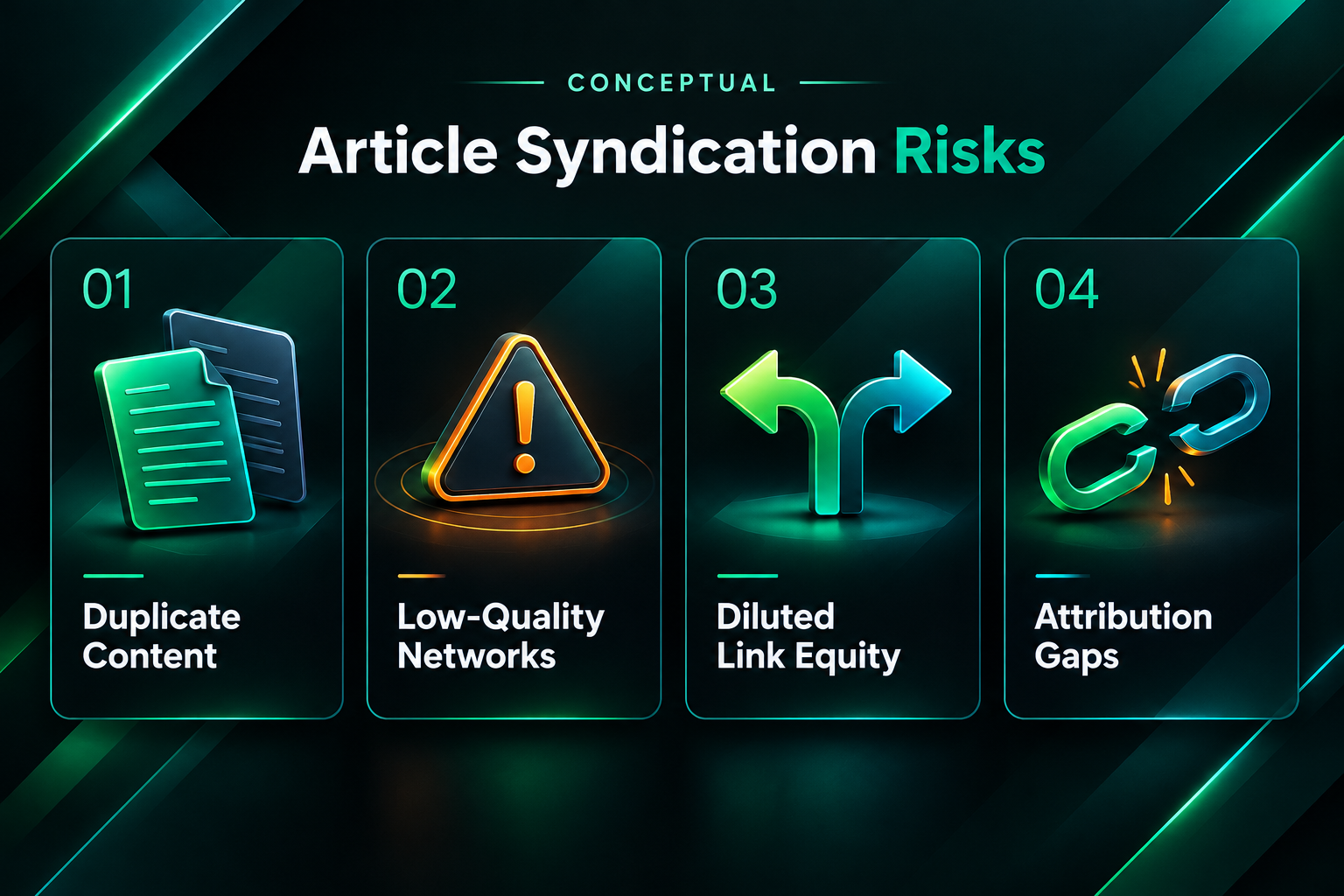
Diluted link equity. When the same content appears across many URLs, the backlinks pointing to each version are spread across multiple pages rather than consolidating around the original. This can reduce the cumulative link equity benefit compared to a strategy focused on building links to a single authoritative source page.
Attribution inconsistency. Not all syndication partners follow through on agreed attribution or canonical implementation. Monitoring syndicated placements after publication is important to confirm that links and canonical tags are in place as agreed.
Brand and editorial control. Once content is syndicated, the publisher controls how it appears on their platform. Edits, formatting changes, or contextual placement alongside unrelated content can affect how the brand is perceived by readers on that platform.
How to Assess a Syndication Partner
Not all syndication opportunities carry the same value or risk. Evaluating a potential syndication partner before agreeing to a placement can help avoid arrangements that offer little benefit or introduce unnecessary risk.
- Topical relevance: Does the partner website cover subjects closely related to the content being syndicated? A relevant audience is more likely to engage with the content and follow through to the source site.
- Editorial standards: Does the platform publish content selectively, or does it accept all submissions? Editorially selective platforms are generally more credible and their links carry more weight.
- Link attributes: Will the syndicated placement include a followed link to the original source, or will links be nofollowed? Understanding this in advance helps set realistic expectations for SEO contribution.
- Canonical tag policy: Is the partner willing and technically able to implement a canonical tag pointing to the original URL? This is the most reliable way to manage duplicate content risk.
- Audience size and engagement: Does the platform have a genuine, engaged readership? Referral traffic and brand exposure are meaningful benefits of syndication, and they depend on the partner having real visitors.
- Third-party metrics: Tools such as Ahrefs, Semrush, or Majestic can provide domain-level metrics such as Domain Rating, Authority Score, or Trust Flow. These are proprietary estimates, not Google metrics, and should be used as one input among several rather than as definitive quality indicators.
Article Syndication Within a Broader Link Building Strategy
Article syndication works best when it is one component of a broader content and link acquisition strategy rather than the primary method for building backlinks. A well-rounded approach typically combines several tactics suited to the website’s goals, competitive landscape, and existing backlink profile.
Manual outreach and guest posting on relevant, editorially selective websites tend to produce higher-quality backlinks with clearer SEO value. Digital PR, which involves creating original research, data, or commentary that earns coverage from journalists and publishers, can generate editorial links from high-authority domains. Niche edits, where links are placed within existing published content on relevant sites, offer another route to contextual backlinks without requiring new content creation.
Syndication can complement these methods by extending the reach of content that has already been created, reinforcing brand presence across multiple platforms, and occasionally generating referral traffic from audiences that would not otherwise encounter the original content. However, it is unlikely to replace the link equity contribution of original placements on high-quality, relevant publishers.
For businesses assessing their link building options, the starting point should be a clear understanding of the target pages, the competitive backlink landscape for those pages, and the existing technical and content condition of the website. Link building of any kind is more likely to contribute to organic visibility when the target pages are technically sound, well-optimised for search intent, and supported by quality content. Syndication, like other link acquisition methods, cannot compensate for fundamental on-page or technical SEO weaknesses.
Frequently Asked Questions
Does Google penalise syndicated content?
Google has stated that duplicate content is not automatically penalised, but it can affect which version of a page ranks in search results. The main risk with syndication is that the original article may not rank if search engines index the syndicated version instead. Using canonical tags and ensuring the original is indexed first reduces this risk, but does not eliminate it entirely.
Should I use a canonical tag when syndicating content?
Requesting that syndication partners implement a canonical tag pointing to the original URL is generally the most reliable way to signal to search engines which version should be treated as authoritative. Not all partners will be willing or technically able to do this, so it is worth confirming before agreeing to a syndication arrangement.
Are backlinks from syndicated articles valuable for SEO?
The value varies depending on the link attribute (followed or nofollowed), the topical relevance and authority of the syndication partner, and how the link is placed within the content. Syndication links are generally considered less valuable than editorially earned links from original content placements, but a followed link from a relevant, high-quality platform can still contribute to a referring domain profile.
What is the difference between article syndication and guest posting?
Guest posting involves creating original content written specifically for a third-party publisher, with no duplicate content concern. Article syndication republishes existing content on additional platforms. Guest posting typically produces higher-quality backlinks and avoids duplicate content risk, but requires more effort per placement. Syndication is faster to scale but introduces duplicate content considerations and often produces lower SEO link value per placement.
Can article syndication help with brand awareness even if the SEO value is limited?
Yes. Reaching an established audience on a trusted platform can generate referral traffic, increase brand recognition, and support thought leadership goals regardless of the direct SEO link contribution. For businesses where audience reach is a priority alongside or above link acquisition, syndication on relevant, high-traffic platforms can be a useful distribution tactic.
How do I know if a syndication partner is worth working with?
Assess topical relevance, editorial standards, audience engagement, link attribute policy, and willingness to implement canonical tags. Third-party domain metrics from tools such as Ahrefs or Semrush can provide a rough quality signal, but they are proprietary estimates rather than direct measures of SEO value. A site-specific review is advisable before committing to a syndication arrangement.
Is Article Syndication the Right Approach for Your Content Strategy?
Article syndication can serve a legitimate role in content distribution and brand visibility, but it is not a straightforward substitute for original link acquisition methods. Its SEO contribution depends on the quality of the syndication partner, the technical setup of the arrangement, and how it fits within a broader strategy that addresses the website’s actual ranking and traffic goals.
For businesses primarily focused on building a strong backlink profile to support organic rankings, manual outreach, guest posting, and digital PR are likely to offer more reliable and measurable SEO value. Syndication may complement those efforts by extending content reach, but it is unlikely to drive meaningful ranking improvements on its own, particularly without careful management of duplicate content and link attribution.
If you are evaluating content distribution and link building options for your website, the most useful starting point is a clear assessment of your target pages, competitive landscape, and existing SEO foundation. A qualified link building provider can help identify which combination of tactics is most likely to support your specific goals, rather than applying a one-size-fits-all approach. Syndication may be part of that mix, but its role should be defined by your objectives rather than assumed to be universally beneficial.


