

There is no universal number of backlinks that guarantees a ranking improvement. The quantity of backlinks a page or domain needs depends on the competition in your target market, the quality and relevance of the links you already have, the strength of your content, and a range of other on-site and off-site factors. This article explains how to think about backlink quantity realistically, what signals actually matter, and how to assess your own situation before committing to a link acquisition strategy.
Key Takeaways
- Backlink quantity alone does not determine rankings. Link quality, topical relevance, and the competitive landscape in your niche all play a significant role.
- The most useful starting point is a gap analysis comparing your backlink profile to the pages currently ranking for your target keywords.
- A smaller number of editorially placed, contextually relevant links from authoritative referring domains will generally carry more weight than a large volume of low-quality links.
- Low organic visibility may have causes unrelated to backlinks, including weak content, technical issues, or search-intent mismatches, so link building is not always the first priority.
- Backlink requirements vary significantly by industry, geography, page type, and the age and history of your domain.
Why There Is No Single Answer to Backlink Quantity
Search engines evaluate backlinks as one signal among many. Google’s publicly available documentation describes links as a way of understanding the relative importance and trustworthiness of pages, but the weight given to any individual link depends on factors such as the linking page’s own authority, the topical relevance of the linking site, the placement context within the content, and the link attributes used. Because these variables differ across every website and every competitive landscape, a fixed number of backlinks cannot be prescribed as a threshold for ranking success.
Consider two scenarios. A local service business targeting a low-competition keyword in a regional market may see measurable organic visibility improvements with a modest number of well-placed, locally relevant links. A SaaS company competing for a high-volume commercial keyword against established domain-level authority will likely need a sustained, multi-phase link acquisition campaign before any ranking movement becomes measurable. The quantity requirement in the second scenario could be ten or twenty times higher than in the first, and even then, results are not guaranteed.
This variability is why experienced SEO practitioners focus on competitive benchmarking rather than fixed link counts. The question is not how many backlinks exist in the abstract, but how many high-quality referring domains your target pages need relative to the pages currently outranking them.
How to Estimate Your Backlink Requirements
A competitive gap analysis is the most practical method for estimating how many backlinks a page may need. The process involves identifying the pages currently ranking in positions one through ten for your target keyword, then examining their backlink profiles using a tool such as Ahrefs, Semrush, or Moz. Key data points to collect include the number of unique referring domains pointing to each ranking page, the distribution of those domains by authority metric, the topical relevance of the linking sites, and the anchor text patterns used.
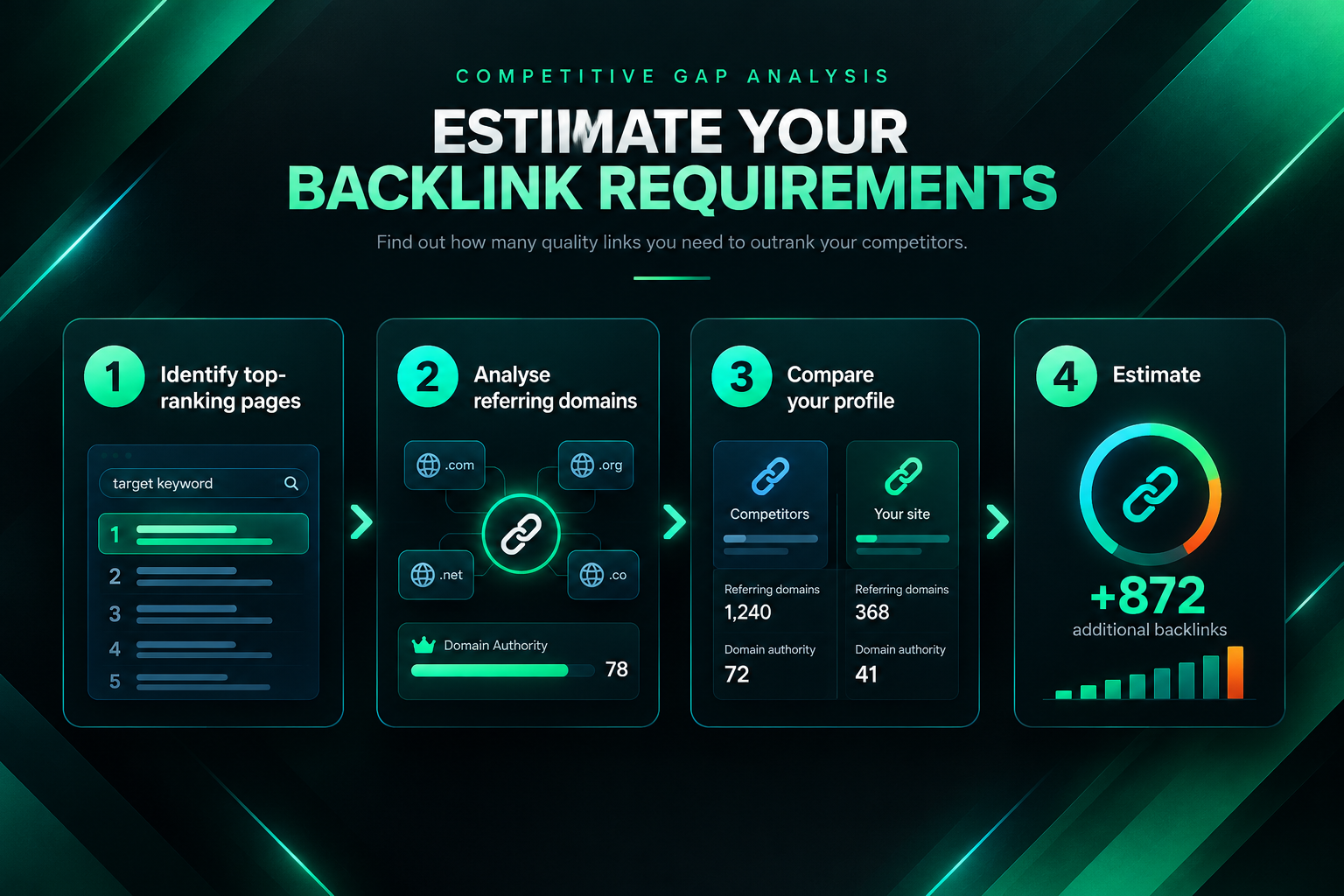
Once you have this data, compare it to your own target page’s backlink profile. The gap between where your page currently sits and the median profile of the top-ranking pages gives you a rough directional estimate of the link acquisition effort required. This is not a precise formula. A page with significantly stronger content, better internal linking, or a more established domain may need fewer external links than a weaker competitor with more referring domains. Conversely, a page on a newer domain may need more links to overcome the trust deficit that comes with limited domain history.
Tools like Ahrefs and Semrush provide proprietary metrics such as Domain Rating, Domain Authority, and Authority Score. These metrics can be useful for relative comparisons within a competitive set, but they are not Google ranking signals and should not be treated as guarantees of ranking performance. Use them as directional indicators rather than definitive benchmarks.
What to Look for Beyond Raw Link Counts
When reviewing competitor backlink profiles, pay attention to the diversity of referring domains rather than the total number of individual backlinks. A single domain linking to a page multiple times typically contributes less incremental value than the same number of links coming from distinct, independent referring domains. A page with 200 backlinks from 20 referring domains is generally in a weaker position than a page with 200 backlinks from 180 referring domains, assuming comparable link quality.
Topical relevance is equally important. Links from websites that cover closely related subject matter tend to carry stronger contextual signals than links from unrelated domains, even if the unrelated domains have higher authority metrics. For a B2B software company, a link from an established technology publication is likely to be more meaningful than a link from a general lifestyle blog with a similar authority score.
Anchor text distribution also matters. A natural backlink profile includes a mix of branded anchors, partial-match phrases, generic terms, and bare URLs. Profiles that are heavily weighted toward exact-match commercial anchors can attract scrutiny, particularly if the links were acquired through paid placements or manipulative schemes. This is a quality and risk consideration as much as a quantity one.
Link Quality vs Link Quantity: What the Evidence Suggests
The SEO industry has broadly shifted toward prioritising link quality over raw volume, and this reflects the direction of search engine development over the past decade. Google’s documented spam policies explicitly identify link schemes, including the purchase of links intended to manipulate PageRank, as a violation of its guidelines. While the enforcement of these policies is imperfect and varies by market, the general principle that a smaller number of high-quality, editorially placed links outperforms a large volume of low-quality links is well-supported by observational data from practitioners and tool-based research.
High-quality links share several characteristics. They come from websites with genuine editorial standards, real organic traffic, and content relevant to the linked page’s topic. They are placed within the body of relevant content rather than in footers, sidebars, or link directories. They use natural anchor text. And they are acquired through methods that reflect genuine editorial endorsement, such as manual outreach, guest posting on relevant publications, digital PR campaigns, or the creation of genuinely linkable assets.
Low-quality links, by contrast, may come from private blog networks, link farms, irrelevant directories, or sites with no real audience. Accumulating large numbers of these links may provide short-term ranking movement in some markets, but the risk of a manual action or algorithmic demotion is real and the long-term value is limited. For most businesses, a strategy focused on acquiring fewer, better links is both more sustainable and more defensible.
Factors That Affect How Many Links You May Need
Several variables influence the number of referring domains a page may need before ranking improvements become measurable. Understanding these factors helps set realistic expectations before committing to a link building campaign.
- Keyword competition: High-volume commercial keywords in competitive niches typically require more referring domains and stronger domain-level authority than informational or long-tail queries with lower competition.
- Domain age and history: Newer domains generally need more time and more links to establish trust signals than established domains with a clean history and existing backlink equity.
- Existing backlink profile: A domain with a strong existing profile of relevant, high-quality referring domains may see ranking improvements from a smaller incremental link acquisition effort than a domain starting from a weak baseline.
- Content quality and search intent alignment: Pages with thin, outdated, or intent-mismatched content may not rank even with a strong backlink profile. Content quality is a prerequisite, not an afterthought.
- Technical SEO condition: Crawling and indexing problems, slow page speed, poor mobile usability, or broken internal linking can suppress rankings regardless of backlink quantity. These issues should be addressed before or alongside a link building campaign.
- Industry and niche: Some industries, such as finance, health, and legal services, operate in what Google has described as YMYL (Your Money or Your Life) categories, where content quality and authority signals are evaluated more stringently.
- Target geography: Local and regional campaigns often require fewer links than national or international campaigns, but the links need to be geographically and topically relevant to carry meaningful weight.
- Page type: A homepage, a product category page, a blog post, and a landing page each have different competitive contexts and may require different link acquisition approaches and volumes.
When Backlinks Are Not the Primary Problem
Before investing in link acquisition, it is worth confirming that backlinks are actually the limiting factor for your organic visibility. Low rankings or stagnant traffic can have several causes that link building will not resolve on its own.
Crawling and indexing issues prevent pages from appearing in search results regardless of their backlink profile. If a page is blocked by a robots.txt directive, marked noindex, or not being discovered by search engine crawlers, acquiring links to it will have no measurable effect until the technical issue is corrected. Google Search Console is a useful starting point for identifying these problems.
Weak or outdated content is another common cause of poor organic performance. If a page does not adequately address the search intent behind a target keyword, or if the content is significantly thinner or less comprehensive than competing pages, additional backlinks are unlikely to produce sustained ranking improvements. Content quality and topical depth need to be competitive before link acquisition becomes the primary lever.
Internal linking structure can also limit a page’s ability to rank. If a target page receives little internal link equity from the rest of the site, improving internal linking may produce ranking improvements without any external link acquisition. This is often an underutilised opportunity, particularly for larger websites with deep content archives.
Strong competition from well-established domains with years of accumulated authority may mean that link building alone is insufficient in the short term. In these cases, a longer-term strategy combining content development, internal linking improvements, and sustained link acquisition is typically more realistic than expecting rapid results from a single campaign.
Realistic Timelines for Backlink Impact
Even when backlinks are the right priority, the timeline from link acquisition to measurable ranking or traffic change is rarely immediate. Several stages introduce delay between a link being placed and its effect becoming visible in search performance data.
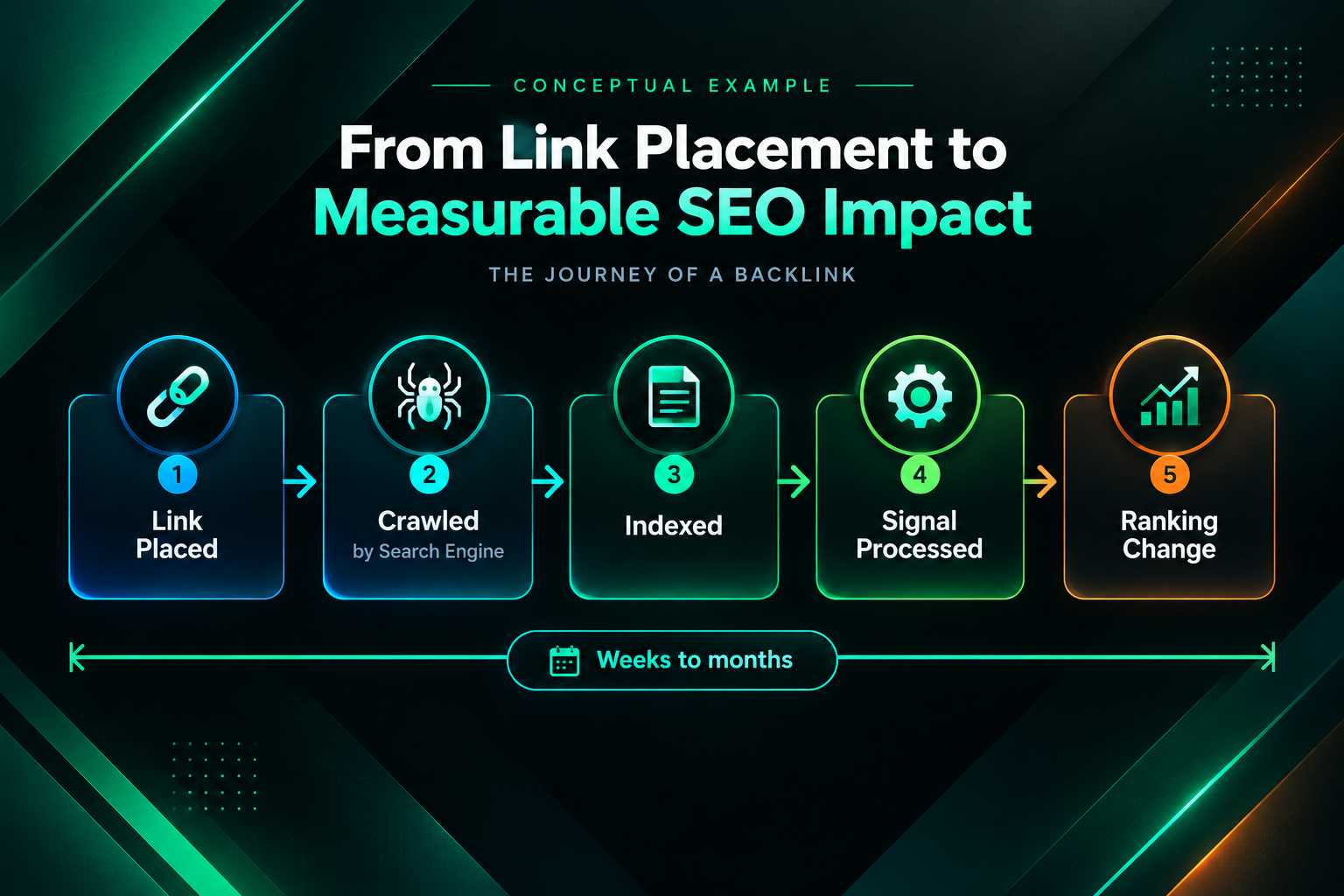
First, a newly placed link needs to be crawled and indexed by search engines. This can take anywhere from a few days to several weeks depending on the crawl frequency of the linking domain and the overall crawl budget allocated to the site. Links on high-traffic, frequently crawled domains tend to be discovered more quickly than links on lower-traffic sites.
Once indexed, the link’s influence on rankings may take additional weeks or months to become measurable, particularly in competitive markets. Google’s ranking systems process many signals simultaneously, and the effect of a single new referring domain is rarely visible in isolation. Practitioners commonly observe that meaningful ranking movement from a link building campaign becomes detectable after three to six months of consistent effort, though this varies considerably by market, domain strength, and the quality of links acquired.
It is also worth noting that link building is rarely a one-time activity. Competitors continue acquiring links, content landscapes evolve, and some links are lost over time as pages are updated, removed, or restructured. Maintaining and improving rankings typically requires ongoing link acquisition rather than a single campaign with a fixed endpoint.
Approaches to Link Acquisition and Their Relevance to Quantity
Different link acquisition methods produce different types of links, at different volumes, with different quality profiles. Understanding these differences helps in planning a campaign that balances quantity, quality, and risk appropriately.
Manual outreach and guest posting involve identifying relevant publications, pitching content ideas, and securing editorially placed links within original articles. This approach tends to produce high-quality, contextually relevant links, but it is resource-intensive and typically yields a lower volume of placements per month than automated or marketplace-based methods. For most businesses, a realistic expectation from a managed outreach campaign is a modest number of high-quality placements per month rather than dozens of links in a short period.
Niche edits, sometimes called link insertions, involve placing a link within existing published content on a relevant website. This method can be faster than guest posting because it does not require creating new content, but the quality of placements varies significantly depending on how the outreach is conducted and whether the linking pages have genuine editorial value.
Digital PR involves creating newsworthy content, data studies, or resources that attract links organically from journalists, bloggers, and industry publications. This approach can produce a higher volume of links from authoritative sources when a campaign resonates, but outcomes are less predictable and the upfront investment in content creation is typically higher.
Linkable asset creation, such as original research, tools, calculators, or comprehensive guides, can generate passive link acquisition over time as other sites reference the resource. This approach requires significant content investment but can produce compounding returns if the asset gains traction in its niche.
Each method has a different risk profile, cost structure, and typical output volume. A well-planned campaign often combines methods to balance quality, quantity, and sustainability over time.
How to Prioritise Which Pages to Build Links To
Not every page on a website benefits equally from external link acquisition. Prioritising the right target pages is as important as determining how many links to acquire overall.
Pages that are close to ranking on the first page for commercially valuable keywords are often the highest-priority targets for link acquisition. A page ranking in positions eight through fifteen may need only a modest number of additional high-quality referring domains to move into the top five, where click-through rates increase substantially. Pages ranking on the second or third page typically require more sustained effort.
Revenue-generating pages, such as product pages, service pages, and conversion-focused landing pages, are natural priorities for link building investment. However, these pages are often harder to acquire links to directly because publishers are less willing to link to overtly commercial content. A common approach is to build links to supporting content, such as informational blog posts or resource pages, and use strong internal linking to pass equity to the commercial target pages.
For websites with limited link building budgets, concentrating effort on a small number of high-priority pages is generally more effective than spreading links thinly across many pages simultaneously. A focused campaign that meaningfully improves the backlink profile of two or three target pages is more likely to produce measurable results than a diffuse effort that adds one or two links to dozens of pages.
Frequently Asked Questions
Is there a minimum number of backlinks needed to rank on Google?
There is no documented minimum. Some pages rank with very few external links because competition for the target keyword is low or the content is exceptionally strong. Others require hundreds of referring domains because they compete against well-established pages in high-competition markets. The relevant benchmark is always the competitive landscape for your specific target keywords, not an absolute number.
Do more backlinks always mean better rankings?
Not necessarily. A large volume of low-quality or irrelevant links can be neutral or harmful, particularly if the links come from sources that violate search engine spam policies. Quality, relevance, and diversity of referring domains matter more than raw link count. Acquiring a smaller number of editorially placed, contextually relevant links from authoritative sites is generally more effective than accumulating a high volume of low-quality placements.
How many new backlinks should I aim to acquire each month?
This depends on your competitive gap, your budget, and the link acquisition methods you use. There is no universally correct monthly target. A useful approach is to estimate the referring domain gap between your target pages and the top-ranking competitors, then plan a campaign that closes that gap over a realistic timeframe, typically six to twelve months for competitive keywords. Acquiring links at a pace that looks natural relative to your domain’s history is also worth considering.
Can I rank without any backlinks?
In some low-competition niches or for very specific long-tail queries, pages can rank with few or no external links if the content is strong and the domain has existing authority. However, for most commercially valuable keywords, some level of external link acquisition is likely to be necessary to compete effectively. The degree to which backlinks are required depends on the specific competitive context.
Should I focus on the number of backlinks or the number of referring domains?
Referring domains is generally the more meaningful metric. Multiple links from the same domain typically contribute diminishing incremental value compared to links from new, independent referring domains. When assessing your backlink profile or comparing it to competitors, the count of unique referring domains is usually a more useful indicator of link equity than the total number of individual backlinks.
How long does it take for new backlinks to affect rankings?
The timeline varies. A newly placed link needs to be crawled and indexed before it can influence rankings, which may take days to weeks. After indexing, ranking changes may take additional weeks or months to become measurable, particularly in competitive markets. Most practitioners observe that the effects of a sustained link building campaign become more clearly visible after three to six months, though this is not a guarantee and depends on many factors.
What should I do if my rankings are not improving despite acquiring backlinks?
If link acquisition is not producing expected results, it is worth reviewing whether other factors may be limiting performance. Common issues include technical problems preventing proper crawling or indexing, content that does not adequately match search intent, weak internal linking, or a competitive gap that is larger than initially estimated. A site-specific SEO audit is the most reliable way to identify the actual limiting factors before investing further in link acquisition.
Deciding How Many Backlinks to Prioritise for Your Situation
The most honest answer to the question of how many backlinks you need is: enough high-quality, relevant referring domains to be competitive for your specific target keywords, given your domain’s current authority, content quality, and technical condition. That number could be five or five hundred depending on your market, and it will change as competitors continue building links and as search engine algorithms evolve.
Starting with a competitive gap analysis gives you a directional estimate grounded in real data rather than arbitrary targets. Addressing technical SEO and content quality issues before or alongside link acquisition ensures that the links you do acquire have the best possible chance of contributing to measurable improvements. And focusing on link quality, topical relevance, and referring domain diversity rather than raw volume gives your campaign a more sustainable foundation.
If you are unsure where your backlink profile stands relative to your competitors, or which pages to prioritise for link acquisition, working with an experienced link building specialist can help you develop a strategy based on your actual competitive situation rather than generic benchmarks. A well-scoped campaign assessment is a useful starting point before committing to a specific volume or timeline.


