Google’s E-E-A-T framework — Experience, Expertise, Authoritativeness, and Trustworthiness — shapes how quality raters and, indirectly, ranking systems evaluate web content. Backlinks are not a direct E-E-A-T signal in the way that author credentials or on-page content are, but the relationship between link acquisition and perceived authority is meaningful enough that understanding it can inform smarter link building decisions. This article explains what E-E-A-T actually covers, where backlinks fit within that framework, and what that means for businesses and SEO teams planning a link acquisition strategy.
Key Takeaways
- E-E-A-T is a quality evaluation framework used in Google’s Search Quality Rater Guidelines; it is not a direct ranking algorithm, but it influences how Google’s systems are designed and refined.
- Backlinks from editorially relevant, authoritative sources can contribute to a site’s perceived authoritativeness and trustworthiness, but they are one signal among many.
- Link quality, topical relevance, and editorial context matter more than raw link volume when considering how backlinks may support E-E-A-T signals.
- E-E-A-T is especially important for YMYL (Your Money or Your Life) topics such as health, finance, and legal content, where trust signals carry greater weight.
- Backlinks alone cannot compensate for weak content, missing author credentials, or poor on-page trust signals — a holistic approach is required.
What Is E-E-A-T and Why Does It Matter for SEO?
E-E-A-T stands for Experience, Expertise, Authoritativeness, and Trustworthiness. Google introduced the concept through its Search Quality Rater Guidelines, a document used to train human evaluators who assess search result quality. The guidelines were updated in December 2022 to add the first “E” for Experience, reflecting Google’s interest in content created by people with genuine first-hand knowledge of a topic. While quality raters do not directly change rankings, their assessments inform how Google’s automated systems are calibrated over time.
Trust is described in the guidelines as the most important element of E-E-A-T. A page can demonstrate experience and expertise, but if it lacks trustworthiness — through poor sourcing, misleading claims, or an unverifiable publisher — it is unlikely to be rated highly. For businesses, this means that E-E-A-T is not a single checkbox but a layered set of quality signals that span content, author credentials, site reputation, and external references to the brand or domain.
YMYL topics — those that could significantly affect a person’s health, financial stability, safety, or wellbeing — are held to a higher E-E-A-T standard. A financial advice website or a medical information resource will face more scrutiny than a hobbyist blog, which means the role of authoritative external signals, including backlinks from credible sources, becomes proportionally more important in competitive YMYL niches.
Where Backlinks Fit Within the E-E-A-T Framework
Backlinks are not listed as a direct E-E-A-T signal in Google’s Search Quality Rater Guidelines. However, Google has consistently described PageRank and link-based signals as part of how it assesses the reputation and authority of a page or domain. In practical terms, backlinks from editorially placed, topically relevant sources can function as third-party endorsements that reinforce a site’s authoritativeness — one of the four E-E-A-T dimensions.
Google’s own documentation distinguishes between the quality of a site’s content and its external reputation. The guidelines instruct raters to look at what other reputable sources say about a website, including mentions, citations, and links from credible publications. A backlink from a well-regarded industry publication, a university, a government body, or a respected news outlet carries a different reputational signal than a link from a low-quality directory or a content farm. This distinction is central to understanding how link building strategy intersects with E-E-A-T.
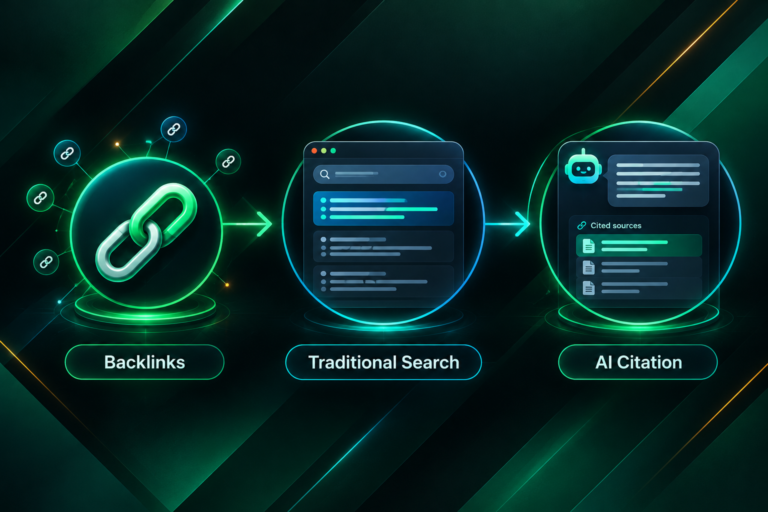
It is also worth separating two related but distinct concepts: PageRank, which is Google’s algorithmic measure of link-based authority, and E-E-A-T, which is a qualitative framework used by human raters. Backlinks influence PageRank directly. They influence E-E-A-T indirectly, by contributing to the external reputation signals that raters are asked to consider. The two systems interact, but they are not the same thing, and conflating them leads to oversimplified link building strategies.
How Backlink Quality Relates to Authoritativeness and Trust
Within the E-E-A-T framework, authoritativeness refers to how well-regarded a page or site is within its subject area. A cybersecurity company cited by major technology publications, or a nutrition brand referenced in peer-reviewed health journalism, is demonstrating authoritativeness through external recognition. Backlinks from those sources are one measurable proxy for that recognition, though they are not the only one — brand mentions without links, press coverage, and industry awards can also contribute.
Trustworthiness, the most weighted E-E-A-T dimension, is supported by signals such as accurate information, transparent authorship, clear contact details, secure site infrastructure, and a clean backlink profile. A site with a large number of low-quality, irrelevant, or manipulative backlinks may face the opposite effect: a backlink profile that raises questions about the site’s credibility rather than reinforcing it. Google’s spam policies specifically address link schemes, and a history of manipulative link acquisition can result in manual actions or algorithmic suppression that undermines trust signals across the board.
For link building campaigns, this means that the editorial context of a placement matters as much as the domain-level metrics of the linking site. A guest post on a respected industry publication, where the content is genuinely useful and the link is contextually relevant, contributes differently to perceived authoritativeness than a paid placement on a site that exists primarily to sell links. Third-party metrics such as Domain Rating (Ahrefs), Domain Authority (Moz), or Trust Flow (Majestic) can help screen publishers during outreach, but they are proprietary estimates and should not be treated as direct measures of E-E-A-T or as guarantees of ranking improvement.
Experience and Expertise: Can Backlinks Help Signal These?
Experience and expertise are primarily demonstrated through on-page signals: the depth and accuracy of content, author bylines with verifiable credentials, first-hand accounts, original research, and clear sourcing. Backlinks do not directly signal that a content creator has personal experience with a topic. However, they can reinforce expertise indirectly when the linking context is relevant.
For example, if a financial planning firm publishes a detailed guide on retirement strategies and that guide is cited by a respected personal finance publication, the citation suggests that subject-matter experts in the field found the content credible enough to reference. This kind of earned editorial link — where the backlink is a byproduct of genuinely useful, expert-level content — aligns well with what E-E-A-T is designed to reward. It is a different outcome from a link acquired through outreach to a general lifestyle blog with no topical connection to finance.
This distinction has practical implications for content strategy. Pages that are designed to attract editorially earned links — original research, detailed how-to guides, expert commentary, data-driven analysis — tend to be the same pages that demonstrate expertise and experience to quality raters. Building links to thin or generic content may improve a page’s link count without meaningfully contributing to its E-E-A-T profile.
Topical Relevance and Editorial Context in Link Acquisition
Topical relevance is one of the most important factors connecting backlink quality to E-E-A-T. A link from a source that covers the same subject area as the target page carries a stronger relevance signal than a link from an unrelated domain, even if both domains have similar authority metrics. Google’s systems are designed to understand the semantic relationship between linking and linked content, and quality raters are instructed to consider whether a site is recognised as an authority within its specific field — not just online in general.
Manual outreach campaigns that prioritise topically relevant publishers — industry blogs, trade publications, niche news sites, professional associations — are more likely to produce backlinks that reinforce E-E-A-T signals than broad outreach to any site with a high domain metric. This does not mean that every link must come from a direct competitor’s niche, but the editorial context of the placement should make logical sense to a reader and to a quality rater assessing the site’s reputation.
Guest posting on relevant publications, securing niche edits within contextually appropriate existing articles, and earning digital PR coverage in industry media are all acquisition methods that can produce topically relevant, editorially placed backlinks. Each method has different timelines, editorial requirements, and suitability depending on the target site’s content, industry, and existing backlink profile. None of them guarantee E-E-A-T improvement on their own, but they are more likely to contribute positively than link placements with no topical connection to the target domain.
What Backlinks Cannot Do for E-E-A-T
Understanding the limits of backlinks within the E-E-A-T framework is as important as understanding their potential contribution. Backlinks cannot substitute for the on-page signals that quality raters assess directly. A site with strong inbound links but anonymous authorship, unverifiable claims, and thin content is unlikely to score well on expertise or trust dimensions, regardless of its link profile.
Backlinks also cannot correct underlying technical SEO problems, content quality issues, or search-intent mismatches that may be suppressing organic visibility. If a page is not ranking because it fails to satisfy the user’s query, or because it has crawling and indexing problems, or because the content is outdated, additional backlinks are unlikely to resolve those issues. A site-specific assessment is needed before concluding that link acquisition is the appropriate next step for any underperforming page.
It is also worth noting that E-E-A-T is not a score that can be directly measured in Google Search Console or any third-party SEO tool. Improvements in domain authority metrics, referring domain counts, or even organic rankings do not confirm that a site’s E-E-A-T has improved in the way Google’s quality raters would assess it. These metrics can be useful proxies for campaign progress, but they should not be presented as proof of E-E-A-T gains.
Practical Link Building Approaches That May Support E-E-A-T
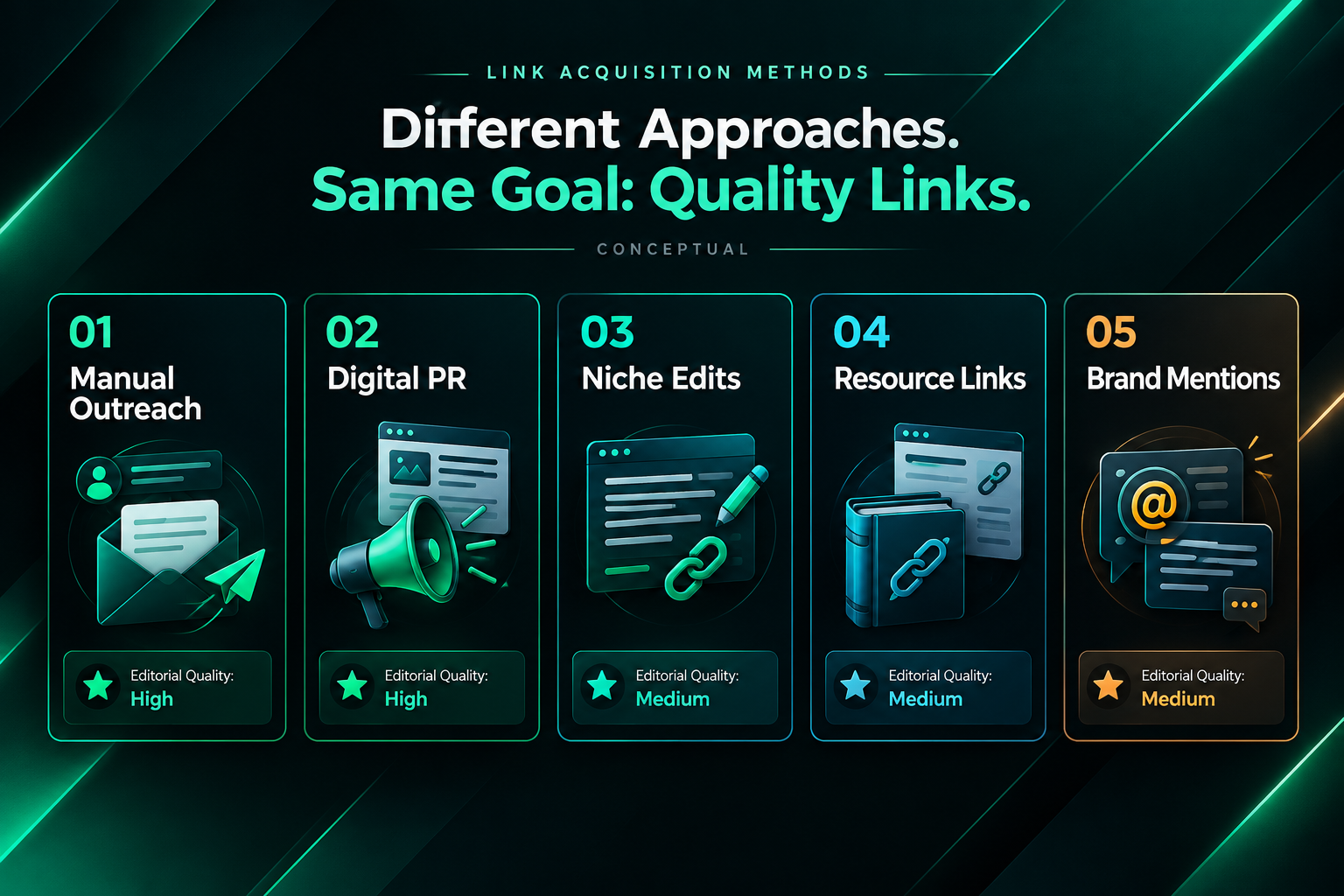
Several link acquisition methods are more likely to produce backlinks that align with E-E-A-T principles, though outcomes depend on the quality of execution, the target site’s existing profile, and the competitive landscape of the niche.
- Manual editorial outreach: Reaching out to relevant publishers with a genuine content contribution — a guest article, expert commentary, or original data — can produce editorially placed links from topically relevant sources. The editorial involvement of the publisher is a meaningful quality signal.
- Digital PR and original research: Publishing original studies, surveys, or data-driven reports that journalists and bloggers want to cite can generate earned backlinks from high-authority news and industry sources. These placements often carry strong trust signals because they result from genuine editorial interest rather than a commercial arrangement.
- Niche edits in contextually relevant content: Securing a link insertion within an existing, well-performing article on a relevant publisher’s site can provide contextual relevance and topical alignment, provided the placement is editorially appropriate and the host site meets quality standards.
- Resource and citation link building: Creating genuinely useful resources — tools, glossaries, research summaries, industry guides — that other sites in the niche naturally want to reference can produce editorially earned links over time.
- Brand mention reclamation: Identifying existing unlinked brand mentions and requesting that publishers convert them to linked citations is a lower-friction method that can add trust signals without requiring new content creation.
Each of these methods requires careful publisher assessment, including evaluation of the site’s topical relevance, content quality, traffic profile, and existing link neighbourhood. Campaigns that skip this assessment in favour of volume-based outreach are more likely to produce placements that do not meaningfully contribute to E-E-A-T signals and may carry policy risks if the publishers involved do not meet editorial standards.
Risks and Quality Considerations
Not all link building activity supports E-E-A-T, and some approaches carry meaningful risks. Google’s spam policies explicitly prohibit link schemes, including the purchase of links that pass PageRank, large-scale guest posting with keyword-rich anchor text, and link exchanges intended to manipulate rankings. Sites that engage in these practices may face algorithmic suppression or manual actions, both of which can damage trust signals and organic visibility.
A backlink profile that includes a high proportion of low-quality, irrelevant, or clearly commercial placements can raise red flags during a quality review, even if individual links were acquired through outreach rather than a link marketplace. The distinction between a genuinely editorial placement and a paid placement is not always visible in the link itself, but the pattern of a site’s backlink profile — anchor text distribution, publisher quality, topical diversity — can indicate whether link acquisition has been conducted with editorial standards in mind.
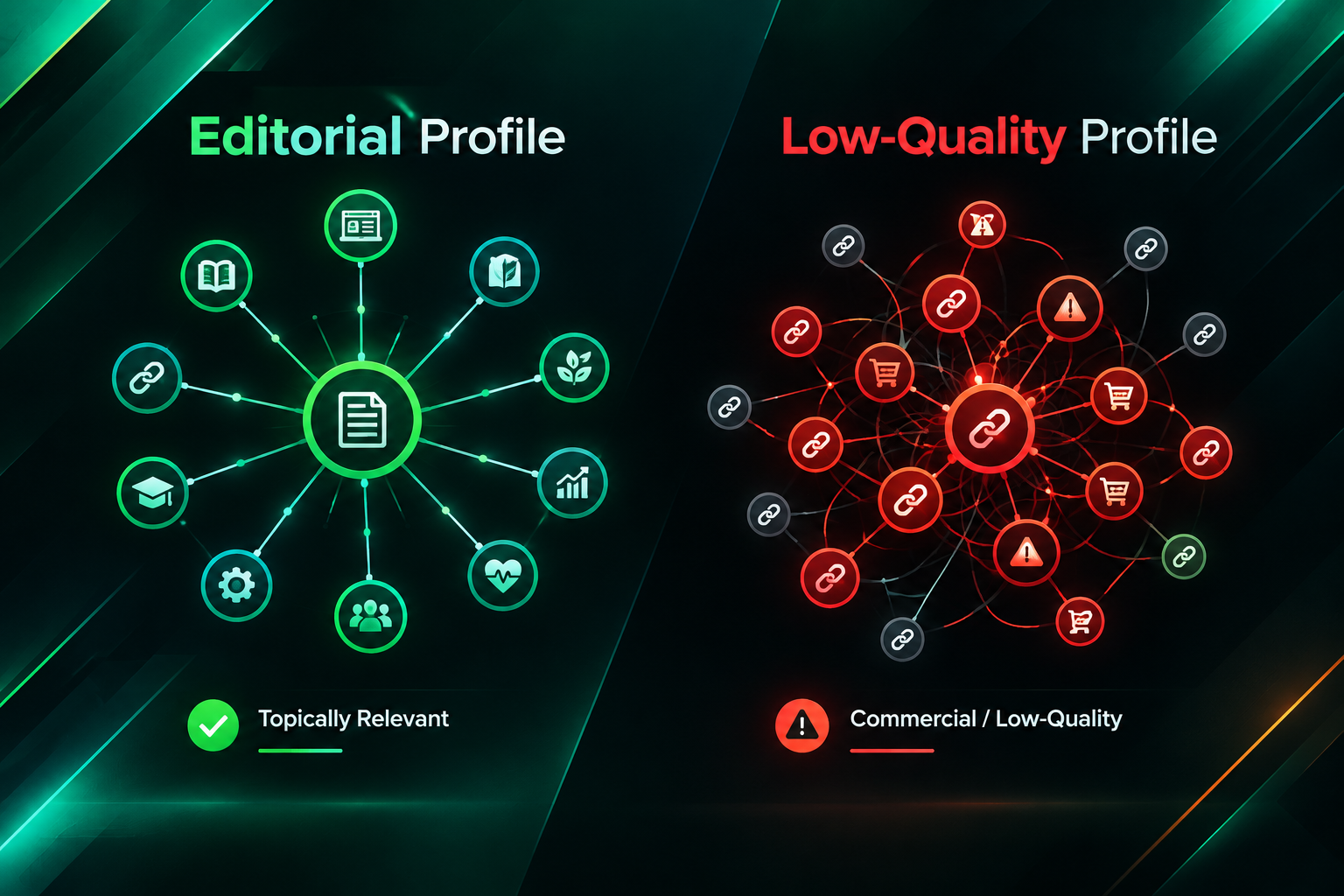
For businesses considering outsourced link building, it is worth asking prospective providers how they assess publisher quality, what editorial standards they apply, how they handle link attributes such as rel=”sponsored” for paid placements, and what their approach is to topical relevance. Providers who prioritise volume over quality, or who cannot explain their publisher vetting process, are more likely to produce placements that carry policy risk without meaningfully contributing to E-E-A-T signals.
E-E-A-T, Backlinks, and YMYL Websites
For websites operating in YMYL categories — health, medical advice, financial products, legal services, news, and similar areas — the relationship between backlinks and E-E-A-T is particularly consequential. Google’s quality raters apply a higher standard of scrutiny to these sites, and the external reputation signals that backlinks can provide carry greater relative weight in competitive YMYL niches.
A health information site cited by medical journals, hospital networks, or established health journalism outlets is demonstrating a form of external validation that aligns with what quality raters look for when assessing authoritativeness and trust. Conversely, a YMYL site with a backlink profile dominated by low-quality or irrelevant sources may struggle to establish the external reputation signals that E-E-A-T requires, regardless of how well-written its content is.
This does not mean that YMYL sites should pursue links from any high-authority source indiscriminately. Topical relevance and editorial credibility remain important. A financial services firm linked from a respected personal finance publication is in a stronger position than the same firm linked from an unrelated technology blog, even if both domains have comparable authority metrics. Campaign planning for YMYL sites should account for the higher editorial bar and the longer timelines typically required to secure placements from credible, relevant publishers.
Frequently Asked Questions
Does Google use E-E-A-T as a direct ranking factor?
E-E-A-T is not a single algorithmic ranking factor with a measurable score. It is a qualitative framework used in Google’s Search Quality Rater Guidelines to help human evaluators assess content quality. The assessments inform how Google’s ranking systems are developed and refined, but there is no E-E-A-T score that can be directly measured or optimised in isolation.
Can backlinks improve my site’s E-E-A-T?
Backlinks from editorially relevant, authoritative sources can contribute to the external reputation signals that quality raters consider when assessing authoritativeness and trustworthiness. However, backlinks are one signal among many. On-page content quality, author credentials, accurate sourcing, and site transparency are equally important E-E-A-T dimensions that backlinks cannot replace.
How many backlinks do I need to improve E-E-A-T?
There is no documented link count that guarantees E-E-A-T improvement. The quality, topical relevance, and editorial context of backlinks matter more than volume. A small number of editorially placed links from credible, relevant publishers is likely to contribute more meaningfully than a large number of low-quality placements. A site-specific assessment is needed to determine what an appropriate link acquisition strategy looks like for a given domain and competitive landscape.
Are paid links compatible with E-E-A-T?
Paid links that pass PageRank without appropriate disclosure violate Google’s spam policies. Links acquired through commercial arrangements should carry a rel=”sponsored” or rel=”nofollow” attribute, which signals to Google that the link should not be treated as an editorial endorsement. Paid placements with proper attribution do not carry the same reputational signal as genuinely earned editorial links, and a backlink profile dominated by commercial placements is unlikely to strongly reinforce authoritativeness or trust signals.
Does digital PR contribute to E-E-A-T more than guest posting?
Digital PR campaigns that generate coverage in established news outlets or industry publications can produce backlinks with strong trust and authority signals, often from sources that are difficult to access through standard outreach. Guest posting on relevant, editorially rigorous publications can also contribute positively. The key variable is the editorial credibility and topical relevance of the publisher, not the acquisition method itself. Both approaches can support E-E-A-T signals when executed with quality standards in mind.
How long does it take for backlinks to influence E-E-A-T signals?
There is no fixed timeline. Backlinks need to be crawled and indexed before they can influence any ranking signals, which can take days to weeks depending on the publisher’s crawl frequency. Measurable changes in organic visibility, if they occur, typically become apparent over months rather than weeks, and depend on many factors beyond the backlink profile, including content quality, competition, and technical SEO condition. E-E-A-T-related reputation signals may take longer to accumulate than individual ranking changes.
Deciding Whether Backlink Strategy Should Be Part of Your E-E-A-T Approach
Backlinks and E-E-A-T are connected, but the relationship is more nuanced than a simple cause-and-effect. Editorially placed, topically relevant backlinks from credible publishers can reinforce the authoritativeness and trustworthiness dimensions of E-E-A-T, particularly for competitive niches and YMYL topics where external reputation signals carry greater weight. They are not a shortcut to E-E-A-T improvement, and they cannot substitute for strong content, transparent authorship, or accurate information.
For businesses and SEO teams evaluating their link acquisition strategy, the most useful question is not how many links to build, but whether the links being acquired are the kind that a quality rater would recognise as genuine external validation. That means prioritising editorial relevance, publisher credibility, and placement context over volume and domain metric targets alone.
If your site operates in a competitive or YMYL niche, or if your existing backlink profile lacks topically relevant, high-quality placements, a structured link acquisition campaign — built around editorial outreach, digital PR, or relevant guest contributions — may be worth discussing with a qualified SEO provider. A site-specific assessment of your current backlink profile, content quality, and competitive landscape is the appropriate starting point before committing to any link building strategy.