Forum link building involves acquiring backlinks from online discussion communities, Q&A platforms, and niche forums by participating in threads, answering questions, or contributing to community discussions. It is one of the older link acquisition methods in SEO, and its value, risks, and appropriate use have changed considerably as search engines have become more sophisticated. This article explains how forum link building works, what it can and cannot realistically achieve, the risks you should understand before using it, and the alternatives worth considering.
Key Takeaways
- Most forum links carry the nofollow or UGC link attribute, which means they do not pass PageRank in the traditional sense, though they may still contribute to a natural-looking backlink profile.
- Forum link building carries meaningful spam risks if links are placed without genuine participation or topical relevance, and low-quality forum links can attract manual review.
- Selective, high-quality forum participation on authoritative, niche-relevant communities may provide referral traffic and brand visibility alongside limited SEO value.
- Forum links are rarely sufficient as a standalone link acquisition strategy for competitive keywords; they work best as a supplementary tactic within a broader campaign.
- Suitability depends on your niche, existing backlink profile, content quality, and business goals — a site-specific assessment is advisable before committing resources.
What Is Forum Link Building?
Forum link building is the practice of placing links to a website within online forums, community boards, Q&A sites, and discussion platforms. These links typically appear in user profiles, forum signatures, or within the body of a post or reply. The underlying idea is that a link from a relevant, active community signals topical authority and drives both referral traffic and, potentially, some degree of search engine recognition.
The practice spans a wide range of platforms. Traditional phpBB or vBulletin-style forums, Reddit communities (subreddits), Quora answers, Stack Exchange threads, and niche industry communities all fall within this category. The quality, moderation standards, and link policies vary enormously between these platforms, which is one reason why forum link building produces highly variable results.
It is important to distinguish between two broad approaches. Genuine community participation — where a contributor adds real value to a discussion and includes a link only when it is directly relevant — differs substantially from mass forum posting, where accounts are created solely to drop links with little or no meaningful contribution. Search engines, particularly Google, have introduced link attributes specifically to address the latter: the nofollow attribute has been standard on most forum platforms for many years, and Google introduced the UGC (user-generated content) attribute in 2019 to further distinguish editorially placed links from those added by users in open community spaces.
How Forum Links Are Acquired
Forum link acquisition generally follows one of several approaches, each with different implications for quality and risk.
Profile Links
Many forums allow registered users to include a website URL in their profile. These profile links are almost universally nofollowed and offer minimal direct SEO value. They are easy to acquire at scale, which is precisely why they became associated with low-quality link building practices. A large volume of profile links from unrelated or low-authority forums is unlikely to improve rankings and may attract negative attention during a manual review.
Signature Links
Forum signatures — short blocks of text or HTML that appear below every post a user makes — were once a popular way to build links at scale. Most active forums have either disabled signature links, nofollowed them, or restricted them to users who have reached a minimum post count. Where signature links remain available, their value depends entirely on the authority and topical relevance of the forum itself.
In-Thread Contextual Links
Placing a link within the body of a forum post or reply, in direct response to a relevant question or discussion, is the highest-quality form of forum link building. When the link genuinely answers a question or adds useful context, it is more likely to be accepted by moderators, less likely to be removed, and more likely to generate actual referral traffic. These links are still typically nofollowed or tagged with the UGC attribute, but they contribute to a diverse, natural-looking backlink profile and can drive qualified visitors if the forum has an engaged audience.
Q&A Platform Contributions
Platforms such as Quora and Reddit occupy a distinct position. Both carry significant organic traffic and domain authority by conventional third-party metrics. A well-placed, genuinely helpful answer on Quora that includes a relevant link can drive meaningful referral traffic, particularly if the answer gains upvotes and visibility. Reddit links are nofollowed, but threads frequently rank in Google search results, meaning a link in a highly visible Reddit thread may still generate traffic even without passing PageRank directly.
Link Attributes and SEO Value
Understanding link attributes is essential before assessing the SEO value of forum links. Google recognises several link attributes that signal how a link should be treated:

- Dofollow (no attribute): passes PageRank and is treated as an editorial endorsement by default.
- nofollow: historically told Google not to pass PageRank; since 2019, Google treats nofollow as a hint rather than a directive, meaning it may still consider these links in some contexts.
- UGC: introduced in 2019, specifically for user-generated content such as forum posts and comments. Google uses this as a hint when assessing the link.
- sponsored: for paid or affiliate links.
The practical implication is that the vast majority of forum links will carry the nofollow or UGC attribute. Google’s 2019 update changed nofollow from a strict directive to a hint, which means forum links are not entirely ignored, but they should not be expected to carry the same weight as an editorially placed dofollow link from a high-authority, topically relevant website. Treating forum links as equivalent to editorial backlinks from quality publishers would be a significant overestimation of their likely impact.
Potential Benefits of Forum Link Building
Despite the limitations around link attributes, forum link building can offer some genuine benefits when executed carefully and selectively.
Referral Traffic from Engaged Communities
Active niche forums and Q&A platforms can send targeted referral traffic to a website. A well-written answer on a relevant Quora thread or a helpful contribution to an industry-specific forum may reach an audience that is already interested in the topic, product, or service being discussed. This referral traffic can be more qualified than general organic traffic in some cases, depending on the specificity of the community.
Brand Visibility and Topical Authority
Consistent, genuine participation in relevant communities can build brand recognition within a niche. When a business or individual contributor is seen as a helpful, knowledgeable presence in a forum, this can support brand awareness and trust over time. While this is a marketing benefit rather than a direct SEO signal, it may contribute to branded search volume and direct traffic, both of which are associated with stronger organic performance.
Backlink Profile Diversity
A backlink profile that consists entirely of guest posts or niche edits from similar types of websites can appear unnatural. Forum links, Q&A contributions, and community mentions add diversity to a link profile, which may make it look more organically acquired. This is a supplementary benefit rather than a primary reason to pursue forum links, but it is a legitimate consideration within a broader link building strategy.
Indexation Support for New Content
Sharing a link to new content in a relevant forum thread or community can help search engine crawlers discover the page more quickly. This is not a ranking benefit in itself, but faster indexation means the page can begin accumulating ranking signals sooner. This use case is most relevant for new websites or newly published content that has not yet been discovered through other means.
Risks and Limitations
Forum link building carries risks that are worth understanding clearly before deciding whether to use it.

Spam Risk and Manual Actions
Google’s spam policies explicitly address link schemes, including the acquisition of links through forum posts, comments, and user-generated content at scale. A pattern of low-quality forum links — particularly from unrelated communities, newly created accounts, or posts with no genuine contribution — can attract a manual action or algorithmic demotion. The risk is higher when forum link building is used aggressively or as a primary strategy rather than as a supplementary tactic.
Link Removal and Impermanence
Forum links are among the least stable backlinks available. Moderators regularly remove links that appear promotional or off-topic. Threads can be deleted, forums can close, and platforms can change their link policies. The impermanence of forum links means that any benefit they provide may be short-lived, and maintaining a forum link profile requires ongoing monitoring.
Low Direct SEO Impact
Because most forum links carry the nofollow or UGC attribute, their direct contribution to PageRank and rankings is limited and uncertain. Businesses that invest significant time or budget in forum link building as a primary ranking strategy are likely to see disappointing results compared with editorial link acquisition through guest posting, digital PR, or niche edits on authoritative, topically relevant websites.
Reputation Risk
Poorly executed forum link building — where posts are clearly promotional, off-topic, or add no value — can damage a brand’s reputation within the communities where it is attempting to participate. Forum communities are often tight-knit and experienced at identifying self-promotional behaviour. A negative reputation in a relevant niche community can be difficult to reverse.
When Forum Link Building May Be Worth Considering
Forum link building is not universally appropriate or inappropriate. Its suitability depends on several factors specific to the website, niche, and campaign goals.
It may be worth considering as a supplementary tactic when a website operates in a niche with active, high-quality online communities where genuine participation is possible. Industries such as software development, digital marketing, finance, health, and specialist hobbies often have established forums and Q&A communities with significant organic traffic and engaged audiences. In these contexts, a contributor who genuinely adds value can earn links and referral traffic that would be difficult to acquire through other means.
Forum link building may also be appropriate for new websites that need to build initial link diversity and brand awareness before they have the content assets or domain authority to attract editorial links at scale. In this context, it functions as an early-stage tactic rather than a long-term strategy.
It is generally less suitable for websites in highly competitive niches where rankings are determined primarily by the quality and quantity of editorial backlinks from authoritative publishers. In these cases, the resources spent on forum participation would typically generate better returns if directed toward guest posting, digital PR, or link-worthy content creation.
Quality Assessment: What Makes a Forum Link Worth Pursuing
Not all forum links carry equal value or risk. Assessing the quality of a potential forum placement before investing time in it can help avoid wasted effort and unnecessary risk.
- Topical relevance: The forum or thread should be directly relevant to the website’s niche or the specific page being linked to. A link from a marketing forum to a marketing software page is more defensible than a link from an unrelated community.
- Community activity and moderation: Active, well-moderated forums with genuine user engagement are preferable to dormant or spam-heavy communities. Third-party metrics such as Ahrefs Domain Rating, Semrush Authority Score, or Majestic Trust Flow can provide a rough indication of a forum’s link profile quality, though these are proprietary estimates rather than Google metrics and should not be treated as guarantees of SEO value.
- Contribution quality: The post or reply containing the link should add genuine value to the discussion. Links embedded in substantive, helpful contributions are less likely to be removed and more likely to generate referral traffic.
- Link attribute: Understanding whether the forum uses nofollow, UGC, or dofollow links helps set realistic expectations about the direct SEO impact of the placement.
- Existing link profile context: A website with a very thin or unnatural backlink profile may benefit from the diversity that forum links add, while a website with a strong editorial link profile may see little incremental benefit.
Forum Link Building Within a Broader Campaign
Forum link building is most effective when it forms part of a diversified link acquisition strategy rather than operating in isolation. A well-structured link building campaign typically combines several complementary methods, each serving a different purpose.
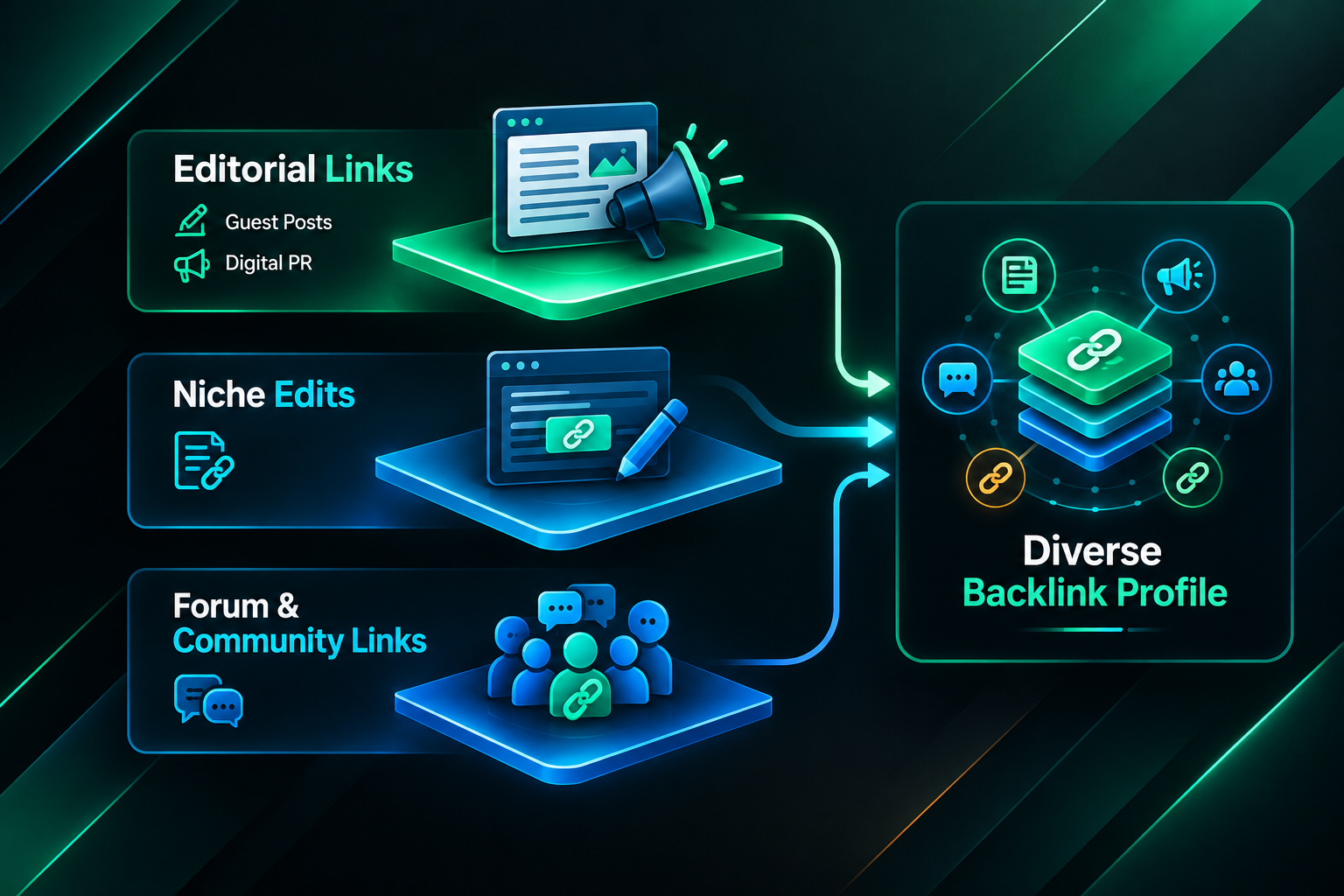
Editorial backlinks acquired through manual outreach, guest posting on authoritative and topically relevant websites, or digital PR campaigns tend to carry the greatest direct SEO value because they are placed editorially and often carry dofollow attributes. These links signal genuine third-party endorsement and are the primary driver of domain authority growth in competitive markets.
Niche edits — where a link is inserted into an existing, indexed piece of content on a relevant website — can complement guest posting by targeting pages that already have established authority and traffic. These placements are typically more efficient to acquire than new guest posts and can deliver faster indexation of the linked page.
Forum links, Q&A contributions, and community mentions then serve as a supplementary layer that adds profile diversity, supports brand visibility, and can generate referral traffic from engaged audiences. When these three layers work together, the overall backlink profile is more natural, more diverse, and more resilient than one built on a single acquisition method.
The appropriate balance between these methods depends on the website’s existing authority, the competitiveness of the target keywords, the available budget, and the specific pages being targeted. A site-specific assessment is the most reliable way to determine the right mix.
Alternatives to Forum Link Building
If forum link building does not appear to be the right fit for a website’s goals or risk tolerance, several alternatives may be worth considering.
Guest posting on editorially controlled, topically relevant websites remains one of the most widely used and defensible link acquisition methods. It involves creating original content for a third-party publisher in exchange for an editorial backlink. The quality of the placement depends heavily on the publisher’s authority, audience relevance, and editorial standards.
Digital PR involves creating genuinely newsworthy content — such as original research, data studies, or expert commentary — and distributing it to journalists and publishers who may cover it and link back to the source. This approach can generate high-authority editorial links from major publications, though it requires significant content investment and is not guaranteed to produce coverage.
Niche edits (also called link insertions) involve identifying existing content on relevant websites and negotiating the addition of a contextual link. This can be an efficient way to acquire links on pages that already have established authority and organic traffic.
Resource page link building targets websites that maintain curated lists of useful tools, guides, or services in a specific niche. If a website has genuinely useful content, outreach to resource page owners can result in editorial inclusions.
Broken link building involves identifying broken outbound links on relevant websites and suggesting the website owner replace them with a link to equivalent live content. This approach provides a clear value proposition for the publisher and can result in editorial placements.
Each of these alternatives carries its own requirements, timelines, and risk considerations. The most appropriate choice depends on the website’s niche, content assets, existing authority, and campaign goals.
Frequently Asked Questions
Do forum links help SEO?
Forum links may contribute to a natural-looking backlink profile and can drive referral traffic from engaged communities, but most carry the nofollow or UGC attribute, which limits their direct PageRank impact. Their SEO value is generally lower than editorial dofollow links from authoritative, topically relevant websites. Results vary depending on the forum’s quality, the relevance of the placement, and the website’s existing backlink profile.
Are forum links safe to use?
Selective, genuine participation in relevant forums is generally lower risk than mass forum posting or profile link building at scale. However, no link acquisition method is entirely without risk. A pattern of low-quality, irrelevant, or clearly promotional forum links can attract algorithmic or manual scrutiny. The risk level depends on the volume, quality, and context of the links being acquired.
How many forum links should I build?
There is no universal answer. The appropriate volume depends on the website’s existing backlink profile, the quality of the forums being targeted, and the overall link building strategy. Forum links are best treated as a supplementary tactic rather than a primary acquisition method, and quality should take priority over quantity. A site-specific assessment is advisable before setting targets.
What is the difference between nofollow and UGC link attributes?
Both nofollow and UGC are link attributes that signal to Google how a link should be treated. The nofollow attribute has been in use since 2005 and was originally a strict directive not to pass PageRank. The UGC attribute was introduced in 2019 specifically for user-generated content such as forum posts and comments. Since 2019, Google treats both as hints rather than strict directives, meaning it may still consider these links in some contexts, though they are not expected to carry the same weight as editorially placed dofollow links.
Can forum link building cause a Google penalty?
Aggressive or manipulative forum link building — such as creating accounts solely to drop links, posting irrelevant or low-quality content, or building links at scale from unrelated communities — is inconsistent with Google’s spam policies and could contribute to a manual action or algorithmic demotion. Genuine, selective participation in relevant communities carries lower risk, but no link building method is entirely free from policy considerations.
Is Quora or Reddit better for forum link building?
Both platforms carry significant organic traffic and can drive referral visitors to a website. Quora answers can rank in Google search results and may generate sustained referral traffic over time. Reddit links are nofollowed, but Reddit threads frequently appear in search results, providing indirect visibility. The better choice depends on where the target audience is most active and whether the content being promoted is genuinely useful to that community.
Should I outsource forum link building?
Outsourcing forum link building can save time, but the quality of execution matters significantly. A provider that uses automated tools, creates low-quality posts, or targets irrelevant communities may create more risk than benefit. If outsourcing, it is worth asking how the provider selects forums, what contribution quality standards they apply, how they handle link removal, and what reporting they provide. Understanding the provider’s approach before committing is advisable.
Is Forum Link Building the Right Approach for Your Website?
Forum link building occupies a specific and limited role in modern SEO. It is not a shortcut to rankings, and it is not a substitute for editorial link acquisition from authoritative publishers. However, when used selectively and genuinely — as part of a broader, diversified link building strategy — it can contribute to backlink profile diversity, brand visibility in relevant communities, and referral traffic from engaged audiences.
The decision to include forum link building in a campaign should be based on a clear-eyed assessment of the website’s niche, existing backlink profile, content quality, and business goals. Websites in niches with active, high-quality online communities may find genuine value in thoughtful forum participation. Websites in highly competitive markets where rankings are driven primarily by editorial authority are likely to see better returns from guest posting, digital PR, or niche edits.
If you are considering forum link building as part of a wider campaign and want to understand how it might fit alongside other acquisition methods, speaking with a qualified link building specialist who can assess your specific situation is a practical next step. A well-structured campaign that matches the right tactics to the right goals is more likely to produce measurable, sustainable results than any single method applied in isolation.