When an SEO agency takes on two or more clients competing for the same search rankings, the potential for conflict is real and often underestimated. Link building campaigns involve confidential outreach strategies, publisher relationships, and target-page priorities that can directly affect how well a client ranks against a direct competitor. Without a clear framework for managing these situations, agencies risk damaging client trust, compromising campaign integrity, and creating legal or ethical exposure. This article explains the core conflict types agencies face, practical approaches for managing them, and the structural decisions that can prevent problems before they arise.
Key Takeaways
- Competing clients in the same niche or geography create genuine conflicts of interest that require proactive management, not just disclosure.
- Confidentiality, campaign separation, and clear contractual terms are the foundation of ethical conflict management in link building.
- Some agencies adopt exclusivity policies by niche or geography; others use structural separation such as dedicated account teams to manage competing relationships.
- Transparency with clients about agency policies before signing is more effective than managing disputes after a conflict surfaces.
- Outsourcing link building to a specialist provider can help agencies avoid internal conflicts while maintaining service quality for all clients.
What Counts as a Competing Client in Link Building?
Two clients are generally considered competing when they target overlapping keywords, serve the same geographic market, and operate in the same or closely adjacent industry. In link building terms, competition becomes particularly sensitive when both clients are pursuing placements on the same pool of publishers, targeting similar anchor text profiles, or building links to pages that rank for the same search queries. A local law firm and a national legal directory might not be direct competitors in a business sense, but if both are pursuing backlinks from the same regional legal blogs, their campaigns can interfere with each other in practice.
The conflict is not always obvious at the point of onboarding. A client acquired in one quarter may later expand into a vertical already served by an existing client. Agencies that work across broad niches such as finance, health, or e-commerce are particularly exposed to this kind of gradual overlap. Recognising the conditions that create a competing relationship early is the first step toward managing it responsibly.
Why Competing Clients Create Real Risks for Agencies
The risks associated with managing competing link building clients fall into three broad categories: confidentiality risk, campaign quality risk, and reputational risk.
Confidentiality risk arises because effective link building campaigns involve proprietary information. Target page priorities, outreach templates, publisher relationships, content angles, and anchor text strategies are all developed through research and testing. If the same account team manages two competing clients, there is a structural risk that insights developed for one client inform decisions made for the other, even unintentionally. This is not a hypothetical concern; it is a documented source of client disputes in professional services generally.
Campaign quality risk is more specific to link building. When two clients compete for placements on the same set of high-quality publishers, the agency faces a practical allocation problem. A strong editorial placement on a relevant industry publication can only go to one client. If the agency controls which client receives that placement, it is making a decision that directly affects both clients’ competitive positions. Without a transparent policy for how such decisions are made, the agency is exposed to accusations of favouritism regardless of its actual intentions.
Reputational risk compounds both of the above. Clients who discover that a competitor is being served by the same agency, and who feel that their campaign was disadvantaged as a result, are unlikely to remain quiet. In a professional services market where referrals and reviews carry significant weight, a single high-profile dispute over competing clients can affect an agency’s ability to win new business for years.
Structural Approaches to Managing Competing Clients
Agencies that handle competing clients successfully tend to use one or more of the following structural approaches. None of these is universally appropriate; the right choice depends on agency size, niche focus, and the nature of the client relationships involved.
Niche or Geography Exclusivity
The most straightforward approach is to offer exclusivity by niche or geography as a contractual commitment. Under this model, the agency agrees not to take on a direct competitor of an existing client for the duration of the engagement. This is common among boutique agencies that position themselves as specialists in a particular vertical, and it is a genuine differentiator in competitive pitches.
The practical limitation is that exclusivity reduces the agency’s addressable market and can create revenue pressure, particularly if a client in an exclusive niche reduces their budget or churns. Agencies considering this model need to price exclusivity appropriately and define the scope of the exclusivity clause precisely. A clause that is too broad can prevent the agency from serving clients in adjacent verticals that do not genuinely compete; a clause that is too narrow may not provide the protection the client expects.
Dedicated Account Teams with Information Barriers
Larger agencies sometimes manage competing clients by assigning entirely separate account teams, with explicit information barriers between them. This approach, borrowed from professional services firms such as law firms and investment banks, prevents the cross-contamination of confidential information by ensuring that the people working on one client’s campaign have no access to the other’s strategy, publisher lists, or performance data.
Information barriers are only effective if they are enforced operationally, not just stated in policy. This means separate project management systems, separate communication channels, and clear escalation procedures for situations where a team member becomes aware of a potential conflict. For most small and mid-sized agencies, maintaining genuine information barriers is operationally demanding and may not be realistic without dedicated infrastructure.
Transparent Disclosure and Client Consent
Some agencies take a disclosure-based approach: they inform both clients that they serve competitors, explain the safeguards in place, and obtain written consent to proceed. This approach is more common in markets where exclusivity is not standard practice, or where the agency’s scale makes exclusivity impractical.
Disclosure without meaningful safeguards is not sufficient. Telling a client that a competitor is also a client does not resolve the underlying conflict; it simply makes the client aware of it. For disclosure to be ethically adequate, it needs to be accompanied by a clear explanation of how campaign separation is maintained, how publisher allocation decisions are made, and what the client’s options are if they are not comfortable with the arrangement.
Confidentiality in Link Building Campaigns: What Needs Protecting
Understanding what information is genuinely sensitive in a link building context helps agencies design appropriate protections. Not all campaign information carries the same risk if it crosses between competing clients.
Information that typically warrants strong protection includes: the specific publisher relationships an agency has developed through outreach, particularly where those relationships are exclusive or semi-exclusive; the content strategies and angles used to secure editorial placements; the target pages and keyword priorities that reflect a client’s broader SEO strategy; and the performance data that reveals which link types and publishers are producing measurable results for a given niche.
Information that is generally less sensitive includes: generic outreach processes, standard link quality assessment criteria, and publicly available data about a client’s backlink profile. The distinction matters because agencies sometimes over-restrict information sharing internally in ways that reduce operational efficiency without providing meaningful protection, while under-protecting the information that actually creates competitive advantage.
Contractual Foundations for Conflict Management
Clear contractual terms are the most reliable foundation for managing competing client relationships. Agencies that rely on informal understandings or verbal assurances are exposed when disputes arise, because the terms of the relationship are then subject to competing recollections rather than documented agreement.
A well-drafted client agreement for link building services should address several specific points relevant to competing clients. It should define what constitutes a competing client clearly enough to be applied in practice. It should state whether the agency offers exclusivity, and if so, the scope, duration, and any conditions under which exclusivity may be waived. It should describe the information handling practices that apply to the client’s campaign data. And it should specify the process the agency will follow if a conflict of interest arises during the engagement, including whether the client has the right to terminate without penalty in that circumstance.
Agencies that outsource link building delivery to specialist providers should also consider how their supplier agreements address confidentiality. If a white-label link building partner is delivering campaigns for multiple agency clients in the same niche, the same conflict risks apply at the supplier level, and the agency remains responsible to its own clients for how those risks are managed.
Publisher Allocation: A Practical Decision Framework
One of the most operationally challenging aspects of managing competing link building clients is deciding which client receives a placement opportunity when both could benefit from it. This situation arises regularly in agencies that have developed strong publisher relationships in a specific niche, because the pool of genuinely high-quality, topically relevant publishers is finite.
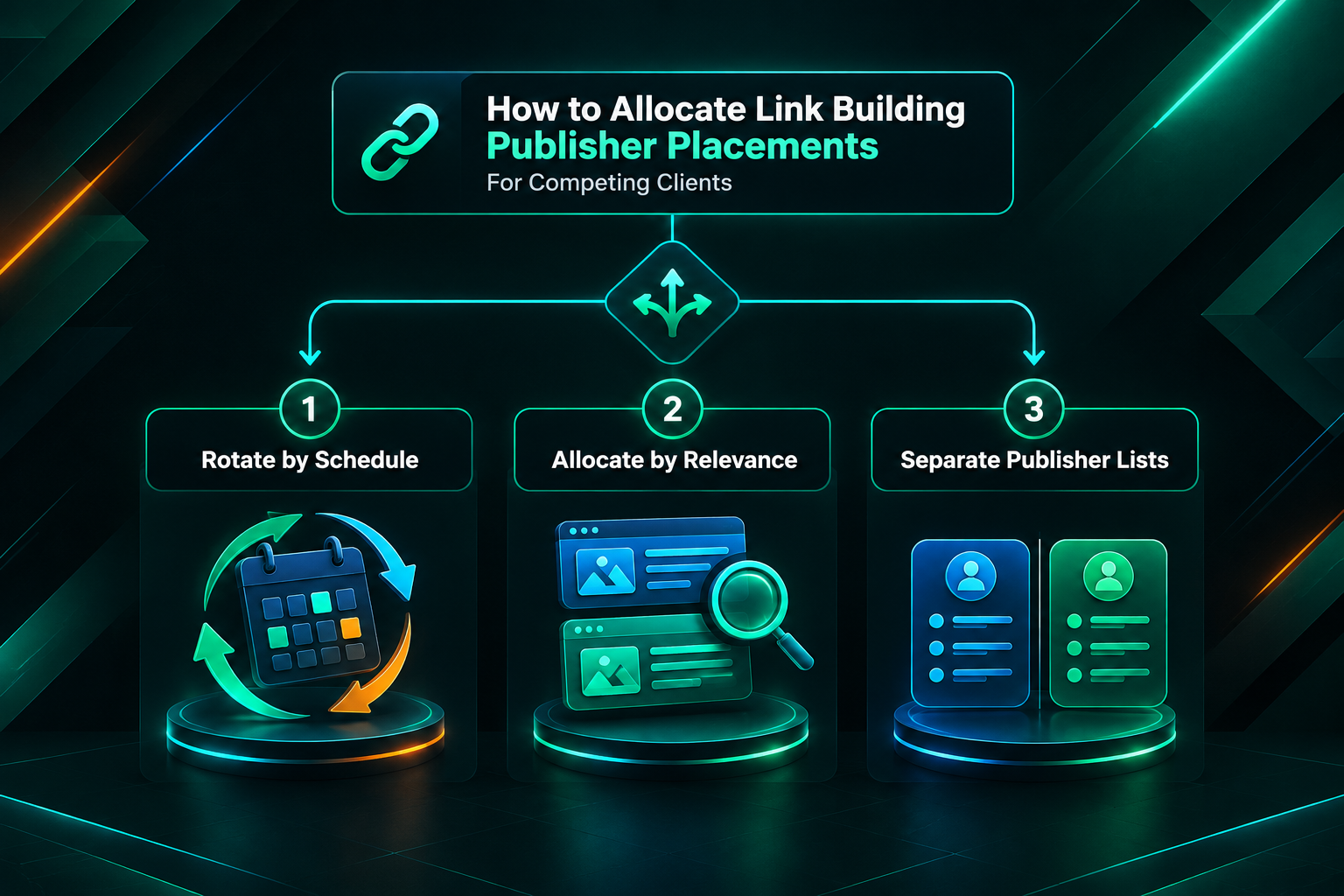
A transparent allocation framework reduces the risk of perceived or actual favouritism. Practical approaches include: rotating priority between clients on a defined schedule; allocating placements based on which client’s target page has the greater relevance to the specific publisher’s audience; or maintaining separate publisher lists for each competing client so that outreach efforts do not overlap at all. The last approach is the most protective but also the most resource-intensive, since it effectively requires the agency to develop and maintain parallel publisher networks.
Whatever framework is used, the agency should be able to explain it to a client if asked. An allocation process that cannot be articulated clearly is unlikely to withstand scrutiny if a client raises a concern about how their campaign was managed relative to a competitor’s.
When to Decline a Competing Client
There are circumstances in which the most appropriate response to a potential competing client relationship is to decline the engagement. Agencies that are reluctant to turn away revenue sometimes underestimate the cost of managing a conflict that cannot be adequately resolved through structural or contractual means.
Declining is most clearly appropriate when: the agency cannot offer genuine campaign separation due to team size or operational constraints; the existing client has a contractual exclusivity right that covers the prospective client’s niche; the prospective client’s campaign would require access to publisher relationships or content strategies developed specifically for the existing client; or the nature of the competition between the two clients is so direct that any allocation of agency resources to one will materially disadvantage the other.
Declining a prospective client is a business decision with short-term revenue implications, but it is often less costly than the reputational and legal exposure that can follow from a poorly managed conflict. Agencies that are transparent about their exclusivity policies in their marketing and sales process tend to attract clients who value that commitment, which can offset the revenue impact of turning away competing engagements.
Outsourcing as a Conflict Management Tool
For agencies that want to serve clients across a broad range of niches without the operational complexity of managing competing relationships internally, outsourcing link building delivery to a specialist provider is a practical option worth considering. A specialist link building provider that operates at scale can often maintain genuine separation between competing campaigns more effectively than a small in-house team, because the provider has the infrastructure, staffing, and publisher network to support parallel campaigns without cross-contamination.
This approach does not eliminate the agency’s responsibility to its clients. The agency remains the primary relationship holder and is accountable for the quality and integrity of the campaigns delivered on its behalf. Agencies considering this model should evaluate prospective providers on their conflict management policies, not just their link acquisition capabilities. Key questions include: how does the provider handle situations where two agency clients are competing in the same niche; what information barriers exist between campaigns; and how are publisher allocation decisions made when multiple clients could benefit from the same placement opportunity.
White-label link building arrangements, where the provider delivers campaigns under the agency’s brand, add an additional layer of complexity because the end client is typically unaware of the provider’s involvement. In these arrangements, the agency’s contractual and ethical obligations to its clients extend to the provider’s conduct, making supplier due diligence on conflict management particularly important.
Communicating Conflict Policies to Clients
How an agency communicates its conflict management policies is as important as the policies themselves. Clients who learn about an agency’s approach to competing relationships for the first time after a conflict has surfaced are likely to feel that the agency was not transparent, even if the agency’s actual practices were sound.
Best practice is to address conflict management proactively during the sales and onboarding process. This means explaining the agency’s exclusivity policy or lack of one, describing the safeguards that apply to campaign confidentiality, and giving the prospective client an opportunity to ask questions before signing. Agencies that treat this conversation as a selling point rather than a compliance exercise tend to build stronger client relationships, because they demonstrate that they have thought carefully about the client’s interests rather than simply their own revenue.
Ongoing communication matters too. If a conflict situation arises during an engagement, the agency should notify the affected client promptly, explain the nature of the conflict, describe the steps being taken to manage it, and give the client a clear understanding of their options. Delayed or incomplete disclosure of a conflict that the agency was aware of is significantly more damaging to the client relationship than the conflict itself.
Frequently Asked Questions
Should agencies always offer exclusivity to link building clients?
Not necessarily. Exclusivity is a meaningful commitment that has real operational and revenue implications for an agency. It is most appropriate when the agency specialises in a specific niche, when the client’s competitive position is particularly sensitive, or when the client is willing to pay a premium that reflects the value of the exclusivity. Agencies that offer exclusivity as a standard term without pricing it appropriately may find it difficult to sustain the commitment over time.
What should a client do if they discover their agency also works with a competitor?
The first step is to review the client agreement to understand what the agency committed to regarding competing clients. If the agency made an exclusivity commitment that it has not honoured, the client has a contractual basis for raising a formal complaint or seeking to exit the agreement. If no exclusivity was promised, the client should ask the agency to explain its conflict management practices in detail and assess whether those practices are adequate. If the explanation is unsatisfactory, the client may reasonably consider moving to an agency with a clearer exclusivity policy.
Can a link building agency serve two competing clients ethically without exclusivity?
It is possible, but it requires genuine structural safeguards rather than informal assurances. Dedicated account teams, information barriers, transparent publisher allocation policies, and clear contractual terms are the minimum requirements for an ethical non-exclusive arrangement. Agencies that serve competing clients without these safeguards in place are taking on significant ethical and reputational risk, even if they believe their intentions are sound.
How does outsourcing link building affect conflict management responsibilities?
Outsourcing delivery does not transfer the agency’s conflict management responsibilities to the provider. The agency remains accountable to its clients for the integrity of the campaigns delivered on its behalf. Agencies that outsource should conduct due diligence on their provider’s conflict management policies and include appropriate terms in their supplier agreements to ensure that the provider’s practices meet the standard the agency has committed to its clients.
What information from a link building campaign is most sensitive in a competing client context?
Publisher relationships developed through outreach, content strategies used to secure editorial placements, target page priorities, and performance data showing which link types and publishers are producing results in a specific niche are generally the most sensitive. Generic process information and publicly available backlink data are typically less sensitive, though agencies should assess this on a case-by-case basis depending on the nature of the competition between clients.
How should agencies handle a conflict that arises mid-campaign?
The agency should notify the affected client promptly, explain the nature of the conflict clearly, describe the steps being taken to manage it, and give the client a clear understanding of their options including the right to exit if the conflict cannot be adequately resolved. Delayed disclosure is significantly more damaging to the client relationship than the conflict itself, and agencies that attempt to manage conflicts quietly without informing affected clients risk compounding the original problem.
Building a Conflict Management Policy That Protects Everyone
Managing competing link building clients is ultimately a question of professional standards, not just operational logistics. Agencies that approach this challenge with clear policies, honest communication, and genuine structural safeguards are better positioned to retain client trust, avoid disputes, and build a sustainable practice than those that treat conflict management as an afterthought.
The right approach will vary depending on agency size, niche focus, and the nature of the client relationships involved. Boutique specialists may find that niche exclusivity is both practical and commercially valuable. Larger agencies may need to invest in dedicated team structures and information barriers. Agencies that outsource delivery should extend their conflict management standards to their supplier relationships. In all cases, the foundation is the same: clear contractual terms, proactive disclosure, and a transparent process for handling situations where client interests could conflict.
If your agency is reviewing its approach to competing client relationships, or if you are considering outsourcing link building delivery as part of a broader conflict management strategy, a conversation with a specialist provider about how they handle these situations can be a useful starting point. The questions you ask during that conversation will tell you a great deal about whether the provider’s standards align with the commitments you have made to your own clients.