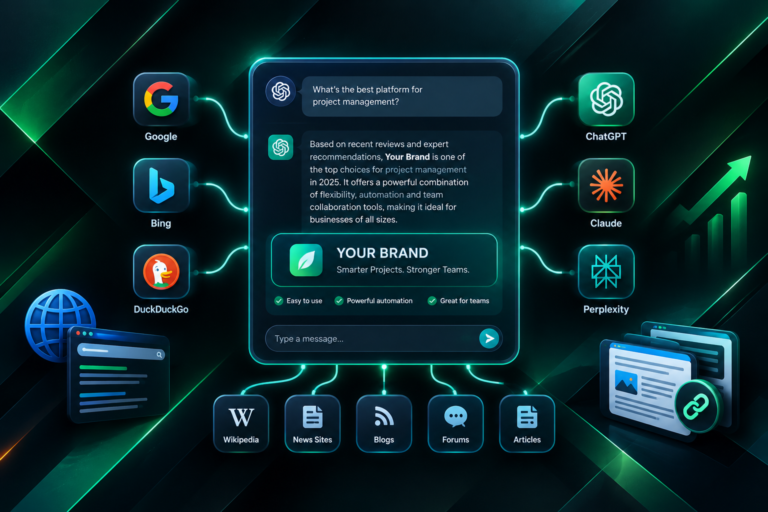
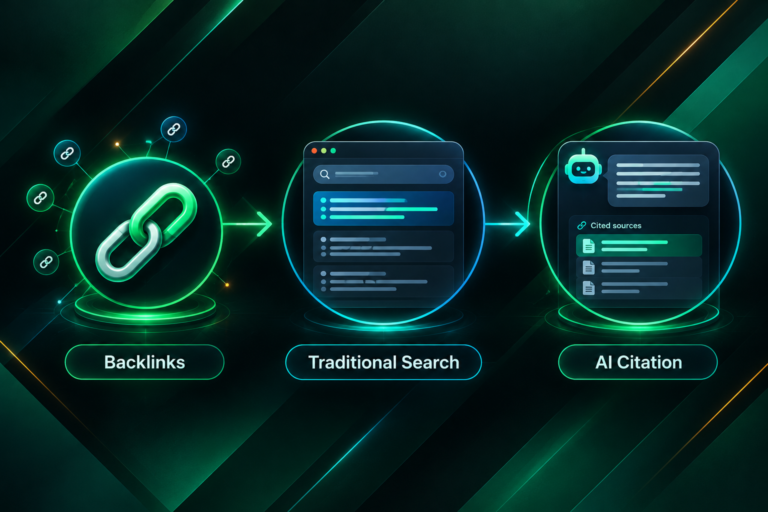
Brand mentions and backlinks are both discussed as signals that can influence how search engines evaluate a website’s authority and relevance, but they work in meaningfully different ways. Understanding the distinction matters for anyone planning a link acquisition strategy, managing an SEO campaign, or deciding where to focus outreach efforts. This article explains what each signal is, what the current evidence suggests about how search engines may use them, and the practical factors that should inform your approach.
Quick Comparison
| Characteristic | Backlinks | Brand Mentions |
|---|---|---|
| Definition | A hyperlink from an external page pointing to your website | A reference to your brand name on an external page, with or without a link |
| Passes PageRank | Yes (when followed) | No direct PageRank transfer confirmed |
| Crawlable by search engines | Yes | Yes, as text; indexable as a co-citation signal |
| Referral traffic potential | Yes | Minimal unless linked |
| Acquisition method | Manual outreach, guest posting, digital PR, niche edits | PR, brand awareness campaigns, content marketing, social media |
| Measurability | Directly measurable via tools such as Ahrefs, Semrush, Majestic | Partially measurable via mention monitoring tools |
| Search engine policy risk | Higher if links are paid or manipulative | Lower, though context and quality still matter |
| Impact on rankings | Well-documented as a ranking factor | Possible indirect influence; evidence is limited and debated |
| Conversion to the other | Already a backlink | Can sometimes be converted to a backlink through outreach |
| Typical campaign goal | Domain authority growth, ranking improvement, referral traffic | Brand awareness, reputation, potential co-citation signals |
What Is a Backlink and Why Does It Matter for SEO?
A backlink is a hyperlink placed on an external website that points to a page on your domain. When another site links to yours, search engines such as Google can follow that link, attribute it to your page, and use it as one of many signals when evaluating how authoritative or relevant your content may be for a given query. Google’s original PageRank algorithm was built on the premise that links function like votes of confidence, and while the algorithm has evolved considerably, links remain one of the most consistently documented ranking factors in SEO research and in Google’s own public guidance.
Not all backlinks carry equal weight. A link’s potential value depends on several characteristics: whether it carries a followed or nofollowed attribute, the topical relevance of the linking page, the overall quality and trustworthiness of the linking domain, the placement context within the content, and the anchor text used. Third-party tools such as Ahrefs, Semrush, and Majestic assign proprietary metrics — Domain Rating, Authority Score, and Trust Flow respectively — to help estimate a domain’s link profile strength. These metrics are useful proxies for comparison and prospecting, but they are not Google metrics and should not be treated as direct predictors of ranking outcomes.
Backlinks also carry policy considerations. Google’s spam policies explicitly address manipulative link schemes, including paid links that pass PageRank without appropriate disclosure, large-scale guest posting primarily for link acquisition, and links from low-quality or irrelevant sources. A backlink acquired through genuine editorial outreach, where a publisher independently chooses to link because the content is useful, carries a different risk profile than a link purchased from a link marketplace. This distinction matters when planning any link acquisition campaign.
What Is a Brand Mention and How Might Search Engines Use It?
A brand mention — sometimes called an unlinked mention or a co-citation — is any reference to your brand name, product, or website on an external page that does not include a hyperlink. For example, a journalist writing about your industry might name your company in an article without linking to your site. The mention is visible to readers and crawlable by search engines, but it does not pass PageRank in the way a followed backlink does.
The question of whether unlinked brand mentions influence search rankings is genuinely debated among SEO practitioners and researchers. Google has filed patents that describe the concept of implied links — references to a brand or URL that could be interpreted as a signal of authority even without a hyperlink. However, a patent filing describes a technical possibility, not a confirmed ranking mechanism. Google’s public statements have not definitively confirmed that unlinked mentions are treated as a direct ranking factor in the same way that followed backlinks are.
What the evidence does suggest more clearly is that brand mentions may contribute to a broader concept sometimes called entity authority or brand entity recognition. When a brand is consistently mentioned across credible, topically relevant sources, search engines may develop a stronger understanding of what that brand represents, the topics it is associated with, and the context in which it appears. This kind of entity-level understanding could plausibly influence how a site is evaluated for certain queries, though the mechanism and magnitude remain uncertain. Treating brand mentions as a confirmed ranking signal equivalent to backlinks would overstate the current evidence.
How Backlinks and Brand Mentions Differ in Practice
The most important practical difference between backlinks and brand mentions is that backlinks directly transfer link equity — the accumulated authority signal that flows through a hyperlink — while brand mentions do not. This means that a campaign focused exclusively on generating brand mentions, without securing followed links, is unlikely to produce the same measurable improvements in domain-level authority metrics or ranking positions that a well-executed backlink campaign might achieve over time.
Brand mentions do offer distinct advantages in other areas. They can contribute to brand awareness, help establish topical associations in search engine knowledge graphs, and create opportunities for conversion. When a credible publication mentions your brand without linking, that mention can often be converted into a backlink through targeted outreach — a tactic sometimes called unlinked mention reclamation. This approach can be an efficient way to build links because the publisher has already demonstrated familiarity with your brand and a willingness to reference it.
From a measurement perspective, backlinks are considerably easier to track. Tools such as Ahrefs and Semrush provide detailed data on referring domains, anchor text distribution, link attributes, and historical link acquisition. Brand mentions can be monitored using tools such as Google Alerts, Mention, or Brand24, but the data is less structured and the connection between a mention and any SEO outcome is harder to isolate. This makes it more difficult to evaluate the return on investment of a brand mention campaign compared to a link building campaign.
The Role of Co-Citations and Topical Relevance
Co-citation is a concept borrowed from academic research: two entities that are frequently mentioned together in the same context may be understood as related, even if they are not directly linked to each other. In SEO, co-citation theory suggests that if your brand is consistently mentioned alongside established, authoritative brands in your industry, search engines may infer a degree of topical relevance or authority by association. This is a plausible hypothesis and has been discussed in SEO research, but it remains difficult to isolate as a standalone ranking factor because it typically occurs alongside other signals.
Topical relevance is a factor that applies to both backlinks and brand mentions. A backlink from a page that is closely related to your industry or subject matter is generally considered more valuable than a link from an unrelated source. Similarly, a brand mention in a topically relevant article — for example, a mention of a SaaS analytics tool in a data science publication — is likely to carry more contextual weight than a mention in an unrelated context. When planning either a link acquisition campaign or a broader brand visibility effort, the relevance of the source should be a primary consideration.
Acquiring Backlinks: Methods and Quality Considerations
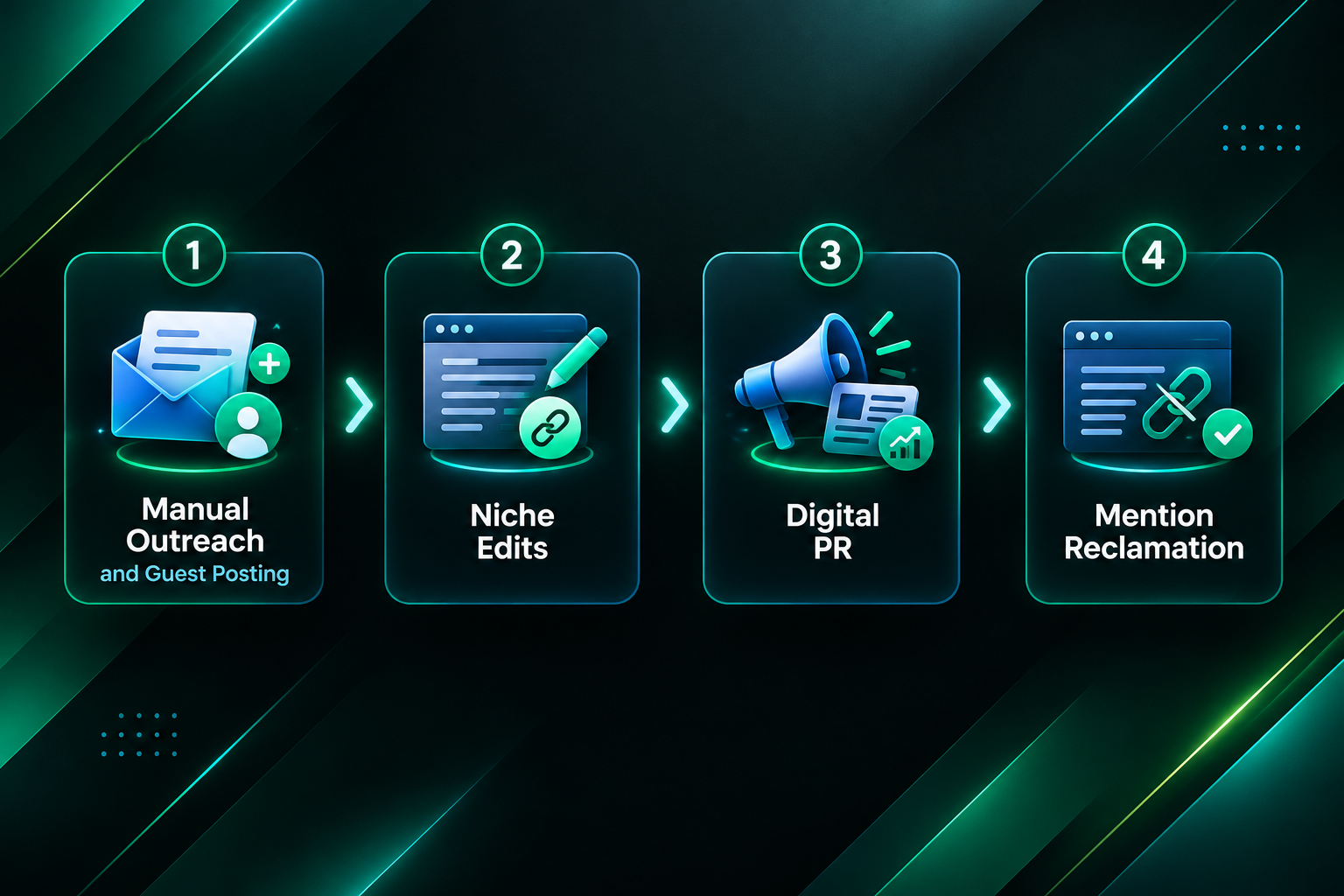
Backlink acquisition typically involves one or more of the following approaches, each with different characteristics in terms of editorial involvement, placement quality, and campaign timelines.
- Manual outreach and guest posting: A content piece is pitched to a relevant publisher, written to meet their editorial standards, and published with a contextual link back to the target page. This approach involves genuine editorial involvement and, when executed well, tends to produce placements on topically relevant, editorially controlled sites. Timelines vary depending on publisher responsiveness and editorial queues, but placements typically take several weeks to secure.
- Niche edits (link insertions): An existing published article on a relevant site is identified, and a link to your page is inserted into the existing content. This can be faster than guest posting and places the link in established content that may already have accumulated some authority, though the editorial standards and publisher quality vary considerably.
- Digital PR: Newsworthy content — such as original research, data studies, or expert commentary — is distributed to journalists and publishers with the goal of earning editorial coverage and links. Digital PR tends to produce links from high-authority news and media sites, but it requires significant content investment and results are less predictable than outreach-based methods.
- Unlinked mention reclamation: Existing brand mentions that do not include a hyperlink are identified and converted into backlinks through targeted outreach to the publisher. This is often one of the more efficient link acquisition tactics because the relationship and brand recognition already exist.
Assessing publisher quality before securing a placement is an important step in any link acquisition campaign. Relevant factors include the site’s organic visibility, the topical relevance of its content, the quality of its existing outbound links, whether it publishes content primarily for link selling rather than genuine editorial purposes, and whether it has a history of search engine penalties. Relying solely on a third-party domain authority metric without reviewing these factors can result in placements that provide little practical value.
When Brand Mentions May Be Worth Pursuing
Brand mentions are not a substitute for a well-structured backlink profile, but they can be a worthwhile component of a broader SEO and marketing strategy in specific circumstances.
- Early-stage brand building: For newer businesses or brands entering a competitive market, generating consistent mentions across credible industry publications can help establish entity recognition and topical associations before a full link acquisition campaign is underway.
- Reputation and trust signals: Being mentioned in respected industry publications, news outlets, or expert roundups can contribute to perceived authority among potential customers and partners, even when those mentions do not include a link.
- Mention-to-link conversion pipeline: A systematic approach to monitoring brand mentions and converting unlinked references into backlinks can be an efficient ongoing tactic, particularly for brands that generate regular press coverage or industry commentary.
- Supporting content marketing: When a brand’s content is referenced or cited by other writers without a link, those mentions can indicate that the content is genuinely useful and may be worth promoting more actively to secure editorial links.
It is worth noting that the SEO value of brand mentions alone — without conversion to backlinks — is difficult to measure and may vary considerably depending on the industry, the authority of the mentioning source, and how consistently the brand is referenced. Businesses with limited SEO budgets should generally prioritize securing followed backlinks from relevant, quality sources before investing heavily in brand mention campaigns that do not include a link acquisition component.
Risks, Limitations, and Realistic Expectations
Both backlinks and brand mentions carry limitations that are worth understanding before committing to a strategy.
For backlinks, the primary risks relate to link quality and search engine policy compliance. Links acquired from low-quality, irrelevant, or manipulative sources can attract algorithmic filtering or, in more serious cases, manual actions from Google. Paid links that pass PageRank without appropriate disclosure — such as a sponsored attribute — are explicitly against Google’s spam policies. Even links acquired through outreach can vary considerably in quality depending on the publisher, the placement context, and the anchor text used. A link acquisition campaign that prioritizes volume over quality may produce a backlink profile that provides little measurable benefit or, in worse cases, creates compliance risks.
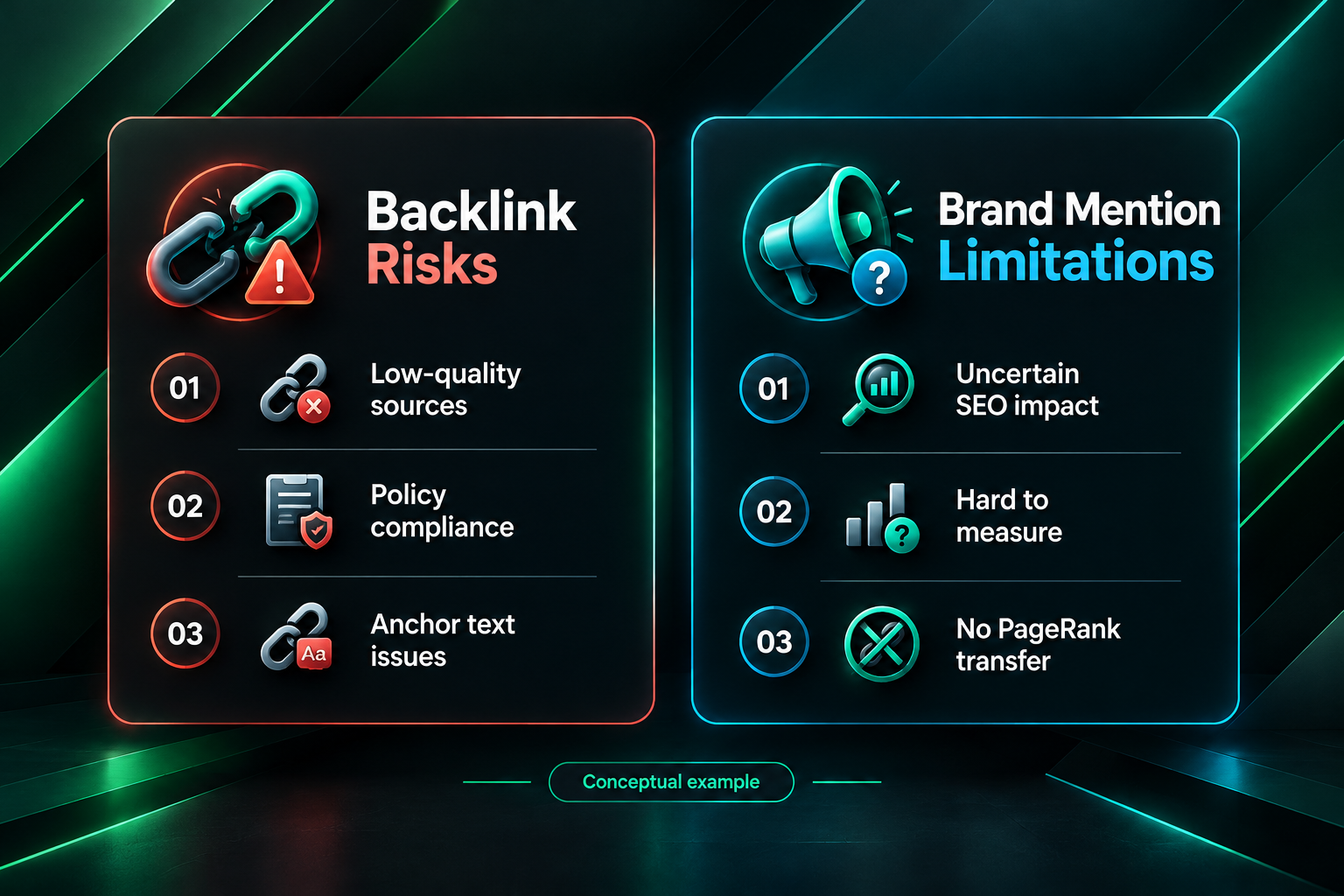
For brand mentions, the primary limitation is the uncertainty around their direct SEO impact. Investing significant resources in generating mentions that do not include links, without a clear conversion strategy, may produce brand awareness benefits but is unlikely to move the needle on domain authority metrics or ranking positions in the way that a comparable investment in quality backlink acquisition might. The evidence for unlinked mentions as a standalone ranking factor remains limited and should not be overstated when setting campaign expectations.
Both strategies also require ongoing investment. Backlinks can be lost if a publisher removes content, changes their site structure, or goes offline. Brand mentions require consistent content and PR activity to maintain visibility. Neither approach produces permanent, guaranteed results, and the impact of any link building or brand visibility campaign depends on many other factors including the technical condition of the website, the quality of its content, the competitiveness of the target market, and the existing backlink profile.
Integrating Both Signals into an SEO Strategy
The most practical approach for most businesses is not to choose exclusively between backlinks and brand mentions, but to understand how each fits into a broader SEO and content strategy. A well-structured link acquisition campaign focused on securing followed backlinks from topically relevant, editorially controlled publishers addresses the most directly documented ranking factor. Alongside this, a brand monitoring process that identifies unlinked mentions and converts them into backlinks can improve efficiency and extend the reach of outreach efforts.
Digital PR campaigns that generate both editorial coverage and backlinks represent a natural integration of both signals. When a data-driven piece of content earns coverage in a respected industry publication, it may produce a followed backlink, a brand mention in the article text, and broader awareness among the publication’s audience. This kind of placement addresses multiple goals simultaneously, though it requires more content investment and carries less predictable outcomes than targeted outreach campaigns.
For businesses working with an outsourced link building provider or SEO agency, it is worth discussing how brand mention monitoring and unlinked mention reclamation fit into the campaign scope. These tactics can complement a core link acquisition strategy without requiring a separate, parallel campaign, and they can be particularly useful for brands that already generate regular press coverage or industry commentary.
Frequently Asked Questions
Do unlinked brand mentions directly improve search rankings?
The evidence for unlinked brand mentions as a direct ranking factor is limited and debated. Google has filed patents describing implied links, but has not confirmed that unlinked mentions are treated equivalently to followed backlinks. They may contribute to entity recognition and topical associations, but businesses should not rely on unlinked mentions as a substitute for a quality backlink profile.
Is it worth converting unlinked brand mentions into backlinks?
Unlinked mention reclamation can be an efficient link acquisition tactic because the publisher has already demonstrated familiarity with your brand. Converting these mentions into followed backlinks through targeted outreach is generally considered a worthwhile activity when the mentioning site is topically relevant and of reasonable quality.
How do I find unlinked brand mentions?
Tools such as Google Alerts, Ahrefs Content Explorer, Semrush Brand Monitoring, and dedicated mention tracking platforms such as Mention or Brand24 can help identify references to your brand name across the web. Filtering results by domain quality and topical relevance helps prioritize which mentions are worth pursuing for conversion.
Are nofollow backlinks better than unlinked mentions?
Nofollow backlinks do not pass PageRank in the same way as followed links, but they may still contribute to a natural-looking link profile, drive referral traffic, and provide some degree of brand visibility. Google has stated that nofollow links are treated as hints rather than directives in some contexts. Whether a nofollow link or an unlinked mention provides more SEO value is difficult to determine definitively and likely depends on the specific context and source.
Can brand mentions help with local SEO?
For local businesses, consistent mentions of the business name, address, and phone number — often called NAP citations — across local directories and relevant publications are considered a meaningful signal for local search rankings. These structured citations function differently from general brand mentions and are a distinct component of local SEO strategy.
How long does it take to see results from a backlink campaign?
The timeline for measurable ranking or traffic changes following a backlink campaign varies considerably depending on the website’s existing authority, the competitiveness of the target market, the quality and relevance of the links acquired, and how quickly search engines crawl and index the new placements. Meaningful changes are often observed over a period of several months rather than weeks, and results are not guaranteed.
Backlinks or Brand Mentions: Choosing the Right Focus for Your SEO Goals
For most businesses and SEO campaigns, followed backlinks from topically relevant, editorially controlled sources remain the more directly documented and measurable signal for improving search rankings and domain authority. The evidence for backlinks as a ranking factor is well-established in both Google’s public guidance and independent SEO research, whereas the evidence for unlinked brand mentions as a standalone ranking signal is more limited and uncertain.
This does not mean brand mentions are without value. They can support entity recognition, contribute to brand awareness, and — when converted into backlinks through systematic outreach — become a practical and efficient component of a link acquisition strategy. The most effective approach for many businesses is to prioritize quality backlink acquisition while maintaining a process for monitoring and converting unlinked mentions, rather than treating the two as competing alternatives.
The right balance depends on your website’s current backlink profile, the competitiveness of your target market, your content and PR capabilities, and your broader business goals. A site-specific assessment is the most reliable way to determine where link acquisition efforts are likely to have the greatest impact. If you are considering outsourcing link building or integrating brand mention reclamation into an existing campaign, discussing your goals and current profile with an experienced provider can help clarify which approach may be most appropriate for your situation.