Content pruning — the process of removing, consolidating, or improving underperforming pages — can help a website become more focused and easier for search engines to evaluate. But deleting or redirecting pages without first checking their backlink profiles carries a real risk: you may discard link equity that took months or years to accumulate. Understanding how to use backlink data when pruning content helps you make decisions that protect existing authority rather than accidentally dismantling it.
Key Takeaways
- Backlink data should be reviewed before any page is deleted, redirected, or merged during a content audit, because some low-traffic pages carry meaningful external link equity.
- The number of referring domains, the topical relevance of linking pages, and the link attributes (followed versus nofollowed) all affect how much equity is at risk.
- A 301 redirect to a relevant destination page can preserve a portion of the link equity from a pruned page, but redirects are not a perfect substitute for a live, well-linked page.
- Backlink data alone does not determine whether a page should be kept; content quality, search intent alignment, crawl efficiency, and organic traffic trends all contribute to the decision.
- Pages with strong backlink profiles but weak content may be better candidates for improvement than for removal.
Why Backlink Data Matters in a Content Audit
A content audit typically begins with organic traffic and engagement data: pages with declining sessions, low time-on-page, or thin content are flagged for review. Traffic data is a reasonable starting point, but it captures only part of the picture. A page may receive little organic traffic because it targets a low-volume keyword, because it has been outranked by stronger competitors, or because it was never properly promoted — yet it may still hold a cluster of external backlinks that contribute to the domain’s overall authority signals. Removing that page without accounting for its backlinks can reduce the number of referring domains pointing to your site and may weaken the authority passed to related pages through internal linking.
Search engines such as Google use links as one of many signals when evaluating the relevance and trustworthiness of pages and domains. While the precise weight of any individual link is not publicly documented, the general principle — that links from relevant, credible external sources carry value — is well established in Google’s own documentation and in the broader body of SEO research. When a page is deleted and no redirect is in place, any link equity previously flowing through that URL is effectively lost. A well-planned content pruning process treats backlink data as a protective filter, not an afterthought.
What Backlink Data to Collect Before Pruning
Before making any pruning decisions, export a complete backlink report for the pages under review. Tools such as Ahrefs, Semrush, Moz, and Majestic each provide referring domain counts, individual backlink lists, link attributes, and domain-level authority metrics. No single tool captures every backlink on the web, so cross-referencing two tools and supplementing with Google Search Console’s Links report can give a more complete view of which pages are receiving external links.
For each page flagged for pruning, collect the following data points:
- Number of referring domains: The count of unique external domains linking to the page. A page with links from ten or more distinct domains generally warrants more caution than one with a single low-quality link.
- Domain-level authority metrics: Metrics such as Ahrefs’ Domain Rating (DR), Semrush’s Authority Score, or Moz’s Domain Authority (DA) provide a rough indication of the relative strength of linking domains. These are proprietary third-party metrics, not Google signals, and should be used as directional indicators rather than definitive quality scores.
- Link attributes: Determine whether the links are followed (passing equity) or nofollowed (typically not passing equity in the same way). A page with ten followed links from relevant domains is more valuable to preserve than one with ten nofollowed links from unrelated directories.
- Topical relevance of linking pages: A backlink from a page that is topically related to your content is generally considered more valuable than one from an unrelated source. Review the context in which your page is linked to understand whether the link is genuinely editorial or incidental.
- Anchor text distribution: The anchor text used by external sites to link to a page can indicate how that page is perceived externally and may affect how search engines interpret its relevance.
- Link age and stability: Links that have been in place for an extended period and appear on stable, active domains are generally more reliable than recently acquired links on sites with uncertain longevity.
Google Search Console’s Links report is particularly useful because it reflects links that Google has actually discovered and processed, rather than a third-party tool’s crawl. However, Search Console does not provide the same level of granular filtering as dedicated SEO tools, so both sources are worth consulting.
How to Categorise Pages Using Backlink and Traffic Data Together
Once you have collected backlink data alongside traffic and engagement metrics, you can place each candidate page into one of several categories. This framework helps prioritise decisions and reduces the risk of unintended equity loss.
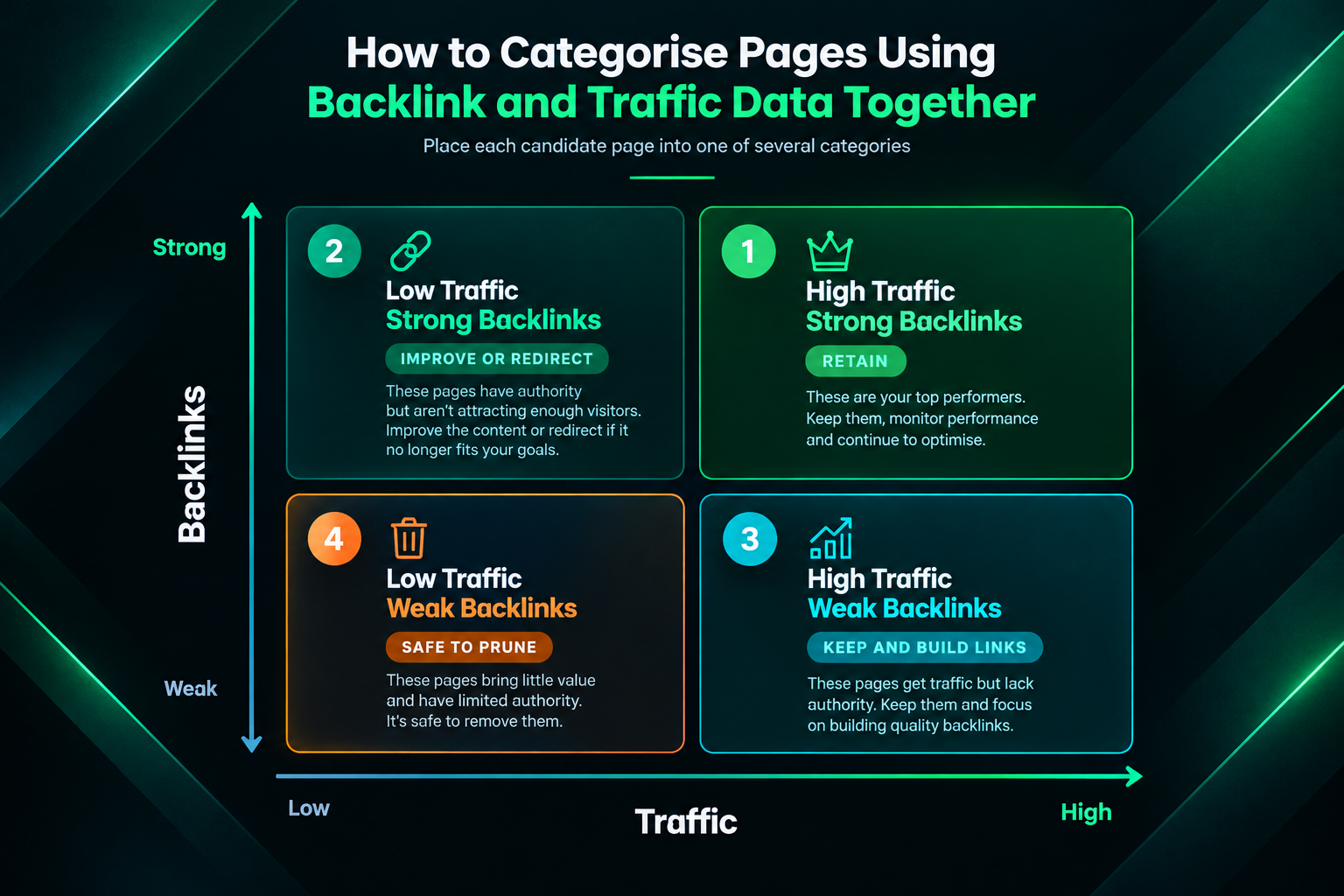
High Traffic, Strong Backlinks
Pages in this category are performing well on both dimensions and should generally be retained and maintained. If content quality has declined, an update is more appropriate than removal. These pages are often the strongest contributors to domain authority and should be considered anchor points in your internal linking structure.
Low Traffic, Strong Backlinks
This is the category where backlink data most frequently prevents a costly mistake. A page with minimal organic traffic but a meaningful number of referring domains from relevant, credible sources may be underperforming for reasons unrelated to its link value — for example, a content quality issue, a search intent mismatch, or a technical problem such as slow page speed or poor mobile experience. Before pruning, investigate whether the page can be improved to better match current search intent. If the page is genuinely beyond saving, a 301 redirect to the most relevant live page on your site is preferable to outright deletion.
High Traffic, Weak Backlinks
Pages that attract organic traffic but have few or no external backlinks may be ranking due to strong internal linking, low competition, or topical authority built across the domain. These pages are generally worth keeping, though they represent an opportunity to build external links and strengthen their position further.
Low Traffic, Weak Backlinks
Pages with neither meaningful traffic nor external backlinks are the safest candidates for pruning. Even here, consider whether the page serves a navigational or conversion purpose that traffic data alone would not capture. If the page has no strategic value, deletion or consolidation is reasonable — but ensure a redirect is in place if the URL has any historical crawl activity, to avoid creating unnecessary 404 errors.
Redirect Strategy: Preserving Link Equity After Pruning
When a page with external backlinks is removed, implementing a 301 redirect to a relevant destination is the standard approach for preserving as much link equity as possible. A 301 redirect signals to search engines that the content has permanently moved, and Google has stated that 301 redirects pass the majority of link signals to the destination URL. However, some equity loss during a redirect is generally accepted in the SEO community as a realistic expectation, and the degree of loss is not publicly quantified by Google.
The destination page matters significantly. Redirecting a pruned page to a topically relevant page — one that covers similar subject matter or serves a related audience — is more likely to preserve the contextual value of the original links than redirecting to a generic category page or the homepage. If no closely relevant destination exists, creating a new consolidated page that absorbs the content and backlinks from multiple pruned pages may be a more effective approach than scattering redirects across unrelated URLs.
Avoid redirect chains, where a pruned page redirects to another redirected URL, which then redirects again. Each hop in a redirect chain can reduce the equity passed and slow crawling. Audit existing redirects as part of the pruning process and resolve any chains to direct 301s where possible.
When Backlink Data Should Delay or Prevent Pruning
Backlink data does not automatically override a pruning decision, but certain patterns should prompt a pause before proceeding. Consider delaying or reconsidering pruning when:
- A page has referring domains from ten or more distinct external sites, particularly if those domains have strong authority metrics and are topically relevant.
- The linking pages include editorial mentions in industry publications, news sites, or authoritative resource pages — link types that are difficult to replicate through outreach.
- The page is linked to from other pages on your own site that rank well, meaning it may be contributing to internal link equity flow even if its own traffic is low.
- The page targets a keyword with commercial or informational intent that aligns with your current content strategy, suggesting it could be improved rather than removed.
- The backlinks pointing to the page use anchor text that is relevant to a priority topic or product category, indicating that external sites associate your domain with that subject.
In these situations, the more productive question is not whether to delete the page but whether to invest in improving it. A page that has earned genuine editorial links from credible sources has demonstrated some level of external recognition. Rebuilding that recognition after deletion is rarely straightforward, and outreach campaigns to replace lost links take time and resources.
Integrating Backlink Review Into a Repeatable Content Audit Process
A content audit that incorporates backlink data is more complex than a simple traffic-based review, but the additional step is manageable when built into a structured workflow. A practical sequence might look like this:
- Export your full page inventory from Google Search Console, your CMS, or a crawl tool such as Screaming Frog. Include all indexable URLs.
- Pull organic traffic and engagement data for each URL, covering at least twelve months to account for seasonal variation.
- Export backlink data for each URL from at least one dedicated SEO tool, supplemented by Google Search Console’s Links report.
- Flag pages with meaningful backlink profiles — for example, those with five or more referring domains — and separate them from pages with no external links before making any pruning decisions.
- Categorise each page using the traffic and backlink matrix described above, and assign a recommended action: retain, improve, consolidate, redirect, or remove.
- Plan redirects for all pages to be removed that have any external backlinks or historical crawl activity, identifying the most relevant destination for each.
- Implement changes in stages rather than all at once, so that any unexpected ranking or traffic changes can be attributed to specific decisions and addressed before they compound.
- Monitor performance after implementation using Google Search Console and your analytics platform, watching for changes in crawl errors, indexed page counts, organic sessions, and referring domain counts.
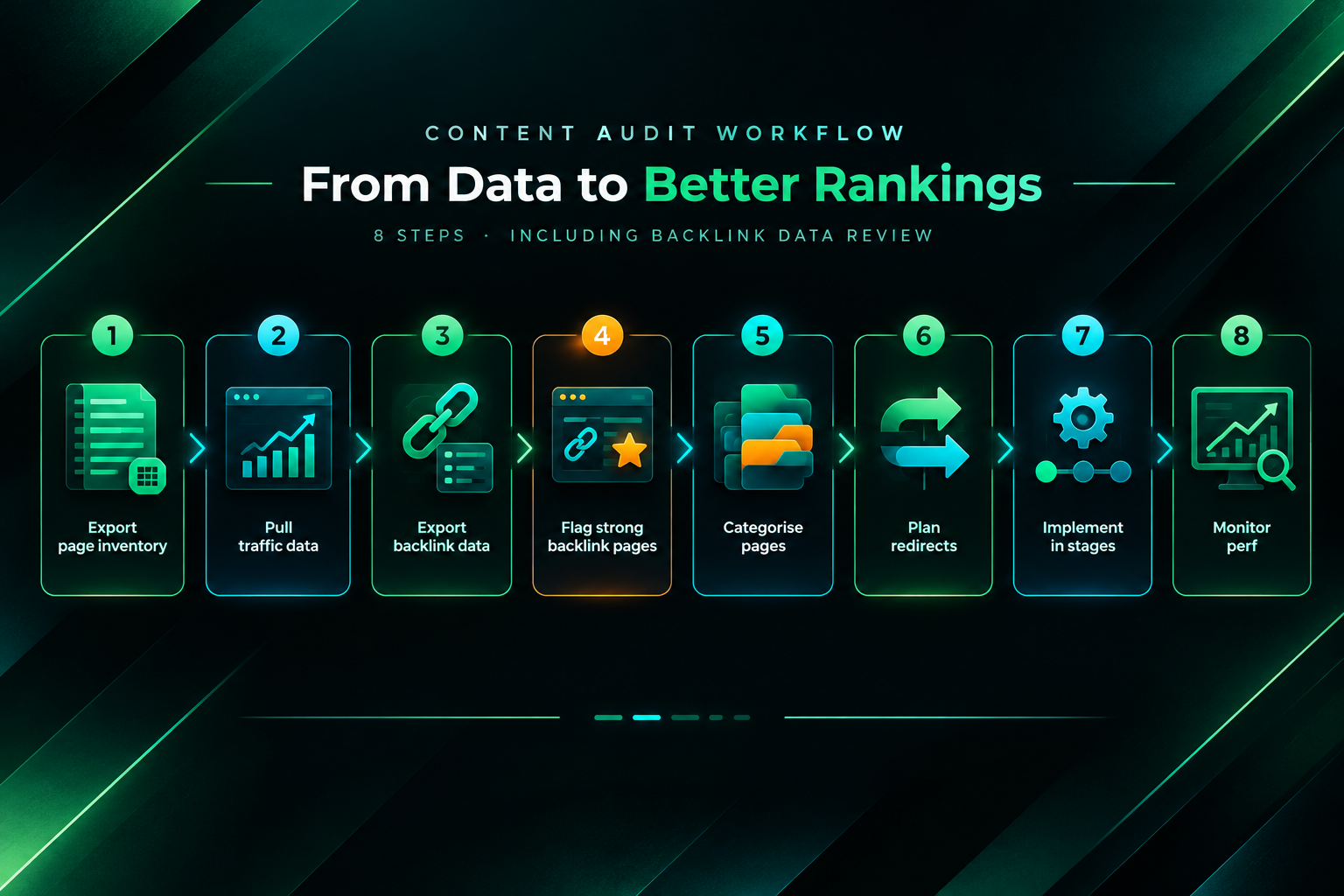
Running this process annually, or after significant site changes such as a redesign or CMS migration, helps maintain a clean and well-linked content architecture without allowing underperforming pages to accumulate unchecked.
Common Mistakes When Pruning Without Backlink Data
Several recurring errors appear when content pruning decisions are made on traffic data alone. Understanding these mistakes can help teams avoid them during future audits.
Deleting pages without checking for referring domains is the most direct way to lose link equity. Even a page with a few hundred monthly sessions may have accumulated links from industry directories, partner sites, or editorial mentions that would be difficult to recover through new outreach.
Redirecting to irrelevant destinations reduces the contextual value of the original links. A redirect from a detailed technical guide to a generic product category page, for example, may not preserve the topical relevance that made the original links valuable.
Treating all backlinks as equal leads to over-caution about pages with many low-quality or spammy links and under-caution about pages with fewer but more authoritative links. Quality and relevance matter more than raw link count.
Ignoring internal links when pruning can disrupt the flow of equity through your site’s architecture. When a page is removed, any internal links pointing to it should be updated to point directly to the redirect destination or to another relevant page, rather than passing through an unnecessary redirect.
Failing to monitor after implementation means that unexpected drops in rankings or referring domain counts may go unnoticed until the damage is significant. A brief monitoring period of four to eight weeks after a pruning exercise allows for early detection and correction.
The Relationship Between Content Pruning and Link Building
Content pruning and link building are often treated as separate activities, but they interact in ways that affect long-term SEO performance. A pruning exercise that consolidates multiple thin pages into a single authoritative resource can concentrate external backlinks onto one URL, potentially strengthening that page’s authority signals. Conversely, a poorly executed pruning exercise that removes well-linked pages without appropriate redirects can reduce the domain’s overall referring domain count and weaken the authority available to support new content.
For websites running active link building campaigns, it is worth coordinating pruning decisions with whoever manages outreach. If a page is scheduled to receive new backlinks through a guest posting or digital PR campaign, removing or redirecting that page mid-campaign wastes outreach effort and may confuse linking partners. Similarly, if a content consolidation is planned, the target URL for the consolidated page should be established before outreach begins, so that new links point to the correct destination from the start.
Websites that outsource link building to an agency or specialist provider should communicate any planned content changes before they are implemented. A provider building links to specific target pages needs to know if those pages are being restructured, redirected, or removed, so that outreach can be paused or redirected accordingly. This coordination prevents wasted placements and ensures that the link equity being built flows to the intended pages.
Frequently Asked Questions
Should I keep a page just because it has backlinks?
Not necessarily. Backlinks are one factor in the decision, not the only one. A page with a strong backlink profile but content that is factually outdated, duplicative, or misaligned with current search intent may be better served by a thorough update than by preservation in its current state. The goal is to retain the link equity while improving the page’s ability to satisfy user intent.
How many referring domains make a page worth keeping?
There is no universal threshold. A page with links from three highly relevant, editorially credible domains may be more valuable to retain than one with twenty links from low-quality directories. Evaluate the quality and relevance of the linking domains alongside the count, and weigh that against the cost of improving the page versus the risk of losing the links.
Do 301 redirects fully preserve link equity?
Google has indicated that 301 redirects pass the majority of link signals to the destination URL, but the SEO community generally accepts that some equity loss is likely. The destination page’s relevance to the original content affects how much contextual value is preserved. Redirects are preferable to deletion for pages with external backlinks, but they are not a perfect substitute for a live, well-optimised page.
Can I use Google Search Console alone for backlink data during a content audit?
Google Search Console’s Links report shows links that Google has discovered and processed, which makes it a useful and reliable source. However, it offers less filtering and segmentation than dedicated tools such as Ahrefs or Semrush. For a thorough audit, using Search Console alongside at least one third-party tool gives a more complete picture of which pages have meaningful external link profiles.
What should I do if a pruned page had backlinks but I already deleted it without a redirect?
Implement a 301 redirect from the deleted URL to the most relevant live page as soon as possible. Search engines may continue to crawl the old URL for some time after deletion, and a redirect in place will capture any remaining link equity. If the page has been down for an extended period, some equity may already have been lost, but a redirect is still worthwhile for any links that remain active.
How does content pruning affect a link building campaign in progress?
If pages targeted by an active outreach campaign are pruned or redirected during the campaign, placements secured to those URLs may deliver equity to an unintended destination or, in the case of deletion without a redirect, may deliver no equity at all. Coordinate pruning decisions with your link building team or provider before implementing changes to avoid wasted placements.
Making Content Pruning Decisions That Protect Your Link Equity
Content pruning is a legitimate and often beneficial SEO practice, but its value depends on the quality of the decisions made during the audit. Traffic data identifies underperforming pages; backlink data determines how much is at stake if those pages are removed. Using both together produces a more accurate picture of each page’s contribution to the site’s overall authority and organic performance.
The practical steps — collecting referring domain data, assessing link quality and relevance, categorising pages by traffic and backlink profile, planning appropriate redirects, and monitoring after implementation — are not technically complex, but they do require time and access to reliable data sources. For websites with large content inventories or active link building campaigns, the coordination involved in a thorough audit may benefit from specialist input, whether from an in-house SEO team or an external provider familiar with both content strategy and link acquisition.
If you are planning a content audit and want to ensure that your existing backlink profile is protected throughout the process, discussing the audit scope with an experienced SEO or link building specialist before making changes is a reasonable precaution. The cost of losing well-earned editorial links is often higher than the cost of a careful, data-informed review.