Localizing a guest post for a different language market involves considerably more than running the original text through a translation tool. To earn a placement on a reputable publisher in another country or language, the content must read naturally for that audience, meet the editorial standards of the target publication, and carry the right topical signals for the local search environment. This article explains the practical steps involved, the quality factors that matter most, the SEO considerations specific to multilingual link building, and the realistic limitations you should plan around before starting a campaign.
Key Takeaways
- Effective guest post localization requires cultural adaptation and editorial quality, not just word-for-word translation.
- Local keyword research for the target language should be completed before writing or translating the content, not after.
- Publisher standards, link attributes, and editorial requirements vary significantly across language markets.
- Machine translation alone is rarely sufficient for guest posts intended to earn editorial placements on quality sites.
- Multilingual link building campaigns benefit from native-speaker review at every stage, from topic selection through final copy approval.
What Guest Post Localization Actually Means

Guest post localization is the process of adapting an article written in one language so that it is appropriate, credible, and useful for readers and publishers in a different language market. The term is sometimes used interchangeably with translation, but the two are not the same. Translation converts words from one language to another. Localization adjusts meaning, tone, examples, references, formatting conventions, and cultural context so that the content feels native to the target audience rather than imported.
For link building purposes, this distinction matters because publishers in any language market apply editorial judgment. A guest post that reads like a translated document — with awkward phrasing, unfamiliar idioms, or examples that do not resonate locally — is more likely to be rejected or accepted only on lower-quality sites. The goal of localization is to produce content that a native-speaking editor would consider genuinely useful and well-written, regardless of where the original draft originated.
Localization also affects the SEO value of the placement. A guest post that targets the wrong keyword variant for the local market, uses search terms that native speakers do not actually use, or links to a page that has no relevance to the local audience will deliver limited benefit even if the placement itself is secured. Effective localization therefore combines linguistic quality with market-specific keyword research and audience relevance.
Why Language Markets Differ Beyond Vocabulary
Each language market has its own search behavior, content conventions, and publisher expectations. Spanish-language audiences in Spain and Latin America share a language but differ in vocabulary, spelling conventions, and cultural references. French content published in France may not resonate with readers in Quebec or West Africa without further adaptation. German-language publishers often expect a more formal register than English-language equivalents. These differences affect both the editorial acceptance rate and the relevance signals the content sends to search engines operating in that market.
Beyond language, local publishers may have different expectations about article length, heading structure, the use of statistics, citation practices, and the types of sources considered credible. A guest post that cites English-language research without local equivalents may appear less authoritative to a German or French editor than one that references locally recognized studies or institutions. Where local data or sources exist, incorporating them strengthens both editorial credibility and topical relevance for the target market.
Search engines also index and rank content differently across language and regional settings. Google’s local search algorithms consider language signals, regional domain extensions, hreflang attributes, and the geographic relevance of linking domains. A backlink from a locally relevant, editorially credible publisher in the target language market generally carries stronger relevance signals for that market than a link from a generic English-language site, though the actual ranking impact depends on many other factors including the target page’s existing authority, content quality, and competitive landscape.
Step-by-Step: How to Localize a Guest Post Effectively
Step 1: Conduct Local Keyword Research First
Before writing or translating any content, identify the keyword variants that native speakers in the target market actually use. Direct translation of an English keyword phrase often produces a term that is grammatically correct but not how local users search. Tools such as Google Keyword Planner, Ahrefs, and Semrush allow you to filter keyword data by country and language, which helps identify search volume and competition for local variants. This research should inform the article’s topic angle, primary term, and supporting terminology before a single word of the guest post is drafted.
Local keyword research also reveals whether the topic itself has meaningful search demand in the target market. A subject that performs well in English-language search may have low volume or different competitive dynamics in French, German, or Portuguese. Identifying this early prevents investment in content that is unlikely to generate referral or organic traffic benefit for the linked page.
Step 2: Choose the Right Translation and Localization Approach
There are three main approaches to producing localized guest post content, each with different quality and cost implications.
- Native-speaker original writing: A writer who is a native speaker of the target language creates the article from a brief, incorporating the local keyword research and topic angle. This typically produces the highest editorial quality and the most natural-sounding content, but requires a qualified writer with subject-matter knowledge.
- Professional human translation with localization: A qualified translator who is a native speaker of the target language translates the original article and adapts cultural references, examples, and phrasing for the local audience. This approach works well when the original content is strong and the translator has relevant subject expertise.
- Machine translation with native-speaker editing: An automated tool such as DeepL or Google Translate produces a draft, which a native-speaking editor then reviews, corrects, and adapts. This can reduce cost but requires a thorough editing pass; light proofreading of machine output is rarely sufficient for editorial-quality guest posts.
Machine translation alone, without meaningful human review, is generally not appropriate for guest posts targeting reputable publishers. Editors at quality sites can identify machine-translated content by its unnatural phrasing, inconsistent register, and literal rendering of idioms. Submitting such content risks rejection and may damage the outreach relationship with that publisher.
Step 3: Adapt Cultural References, Examples, and Data
Effective localization replaces or supplements examples, statistics, and cultural references that are specific to the original market with equivalents that are meaningful in the target market. An article about e-commerce trends that cites US retail data should incorporate equivalent figures from the target country where available. An article using a sports analogy drawn from American football may need to substitute a locally recognized sport. Brand references, regulatory examples, and consumer behavior statistics should all be reviewed for local relevance.
This step is often skipped when teams treat localization as a translation task rather than an editorial one. The result is content that is technically readable but feels foreign to local readers and editors, reducing both acceptance rates and reader engagement after publication.
Step 4: Match the Publisher’s Editorial Standards and Format
Research the target publisher’s existing content before submitting a localized guest post. Review the typical article length, heading structure, use of bullet points or numbered lists, citation style, and tone. Some language markets favor longer, more detailed articles; others prefer concise, practical formats. Some publishers expect formal academic-style references; others use informal inline links. Matching these conventions signals that the submission was prepared specifically for that publication rather than repurposed from another market.
Pay attention to how the publisher handles external links within guest content. Some publishers in certain language markets are more restrictive about followed links in contributed articles, or may require that links are disclosed as sponsored. Understanding these norms before outreach avoids misaligned expectations and helps you plan the link attribute and placement context appropriately.
Step 5: Optimize On-Page Elements for the Local Language
The localized article should include the target-language keyword in the title, at least one subheading, and naturally within the body text. Meta descriptions, image alt text, and any anchor text suggestions provided to the publisher should also use the local keyword variant rather than a translated version of the English term. If the publisher allows author bio links or contextual links, ensure the anchor text reflects how native speakers would naturally describe the linked page’s topic.
Avoid over-optimizing anchor text in localized guest posts. Exact-match anchor text in any language can appear unnatural and may attract editorial scrutiny from publishers or algorithmic scrutiny from search engines. Descriptive, contextually appropriate anchor text that reads naturally in the target language is generally preferable.
Step 6: Have a Native Speaker Review the Final Draft
Before submission, have a native speaker of the target language who was not involved in the translation or writing review the complete article. This reviewer should assess whether the content reads naturally, whether the examples and references feel locally relevant, and whether the tone matches the publisher’s style. This step catches errors that non-native reviewers and automated tools consistently miss, including subtle register mismatches, regional vocabulary differences, and culturally inappropriate phrasing.
Publisher Quality Assessment in Multilingual Markets
Assessing the quality of a potential guest post publisher in a non-English language market requires the same general criteria as in English, with some additional considerations. Domain-level metrics such as Domain Rating in Ahrefs or Domain Authority in Moz can provide a starting point, but these proprietary scores are not provided by Google and do not directly measure ranking potential. They should be treated as one signal among several rather than a definitive quality indicator.
For multilingual markets, also consider whether the publisher’s content is genuinely written for and read by the local audience, or whether it is a low-quality site that accepts paid placements indiscriminately. Signs of a credible local publisher include consistent publication in the target language, an identifiable editorial team, engagement from local readers, and content that references local events, regulations, or market conditions. A site that publishes in multiple languages simultaneously with no clear local editorial focus may offer weaker relevance signals for the target market.
Check the publisher’s existing backlink profile and organic visibility using tools such as Ahrefs or Semrush to assess whether the site has genuine search presence in the target country and language. A publisher with strong local organic traffic and a clean backlink profile is generally a more valuable placement than one with inflated domain metrics but limited real-world visibility in the target market.
Technical SEO Considerations for Multilingual Guest Posts
When building links through guest posts in another language, the technical relationship between the linking page and the target page matters. A guest post published on a locally relevant domain in the target language, linking to a page on your site that is also in that language and targets that market, creates a coherent relevance signal. If your target page is in English but you are building links from non-English publishers, the relevance signal may be weaker, though this depends on the specific market and competitive context.
If your website serves multiple language markets, ensure that hreflang tags are correctly implemented on your target pages. Hreflang tells search engines which language and regional version of a page to serve to users in different markets. Guest post links pointing to the correct language version of a page, combined with properly implemented hreflang, help search engines understand the intended audience for both the linking content and the target page.
Consider also whether the target page itself is sufficiently optimized for the local market before investing in localized guest post placements. A page with weak content, poor local keyword targeting, or technical issues such as slow load times or crawling problems is unlikely to benefit significantly from additional backlinks regardless of their quality. Addressing on-page and technical factors before or alongside a link building campaign generally produces better outcomes than relying on links alone to improve local rankings.
Common Mistakes in Guest Post Localization
-
- Translating keywords literally: Search terms that work in English often have different natural equivalents in other languages. Translating an English keyword phrase word-for-word frequently produces a term with low or no local search volume.
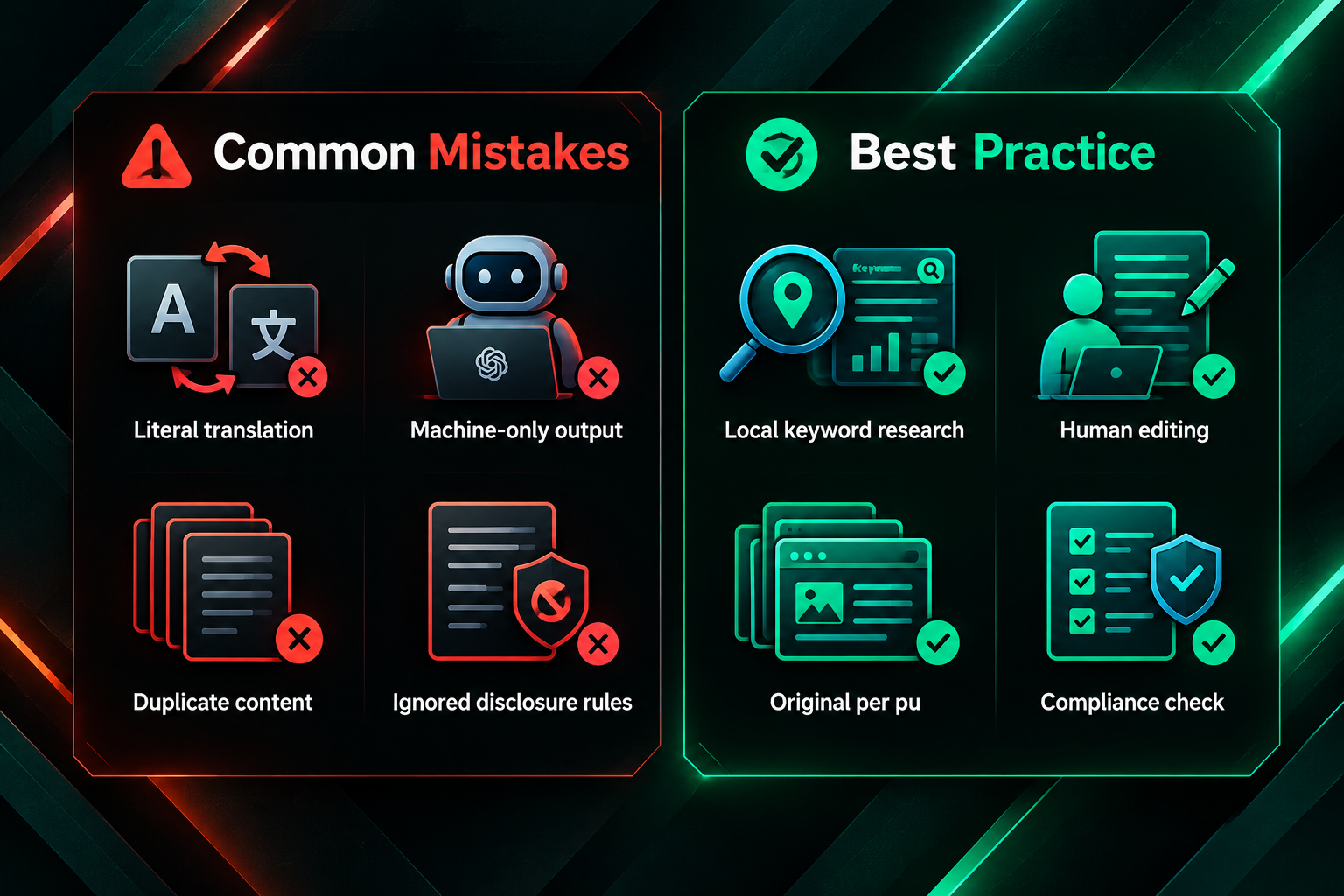
- Using machine translation without thorough human editing: Automated translation tools have improved significantly but still produce unnatural phrasing, incorrect register, and literal idiom translations that native speakers and editors notice immediately.
- Ignoring regional variation within a language: Spanish, French, Portuguese, and Arabic each have significant regional variants. Content optimized for one region may not resonate with readers or publishers in another.
- Submitting the same article to multiple publishers in the same language market: Duplicate content across multiple publishers in the same language reduces the editorial value of each placement and may create indexing issues. Each localized guest post should be original for its target publisher.
- Neglecting the link context: A link embedded in a paragraph that is clearly about a different topic, or that uses anchor text that does not match the surrounding content, provides weaker relevance signals and may be edited or removed by the publisher.
- Overlooking publisher disclosure requirements: Some markets have stricter requirements around disclosure of paid or sponsored content. Failing to comply with local regulations or publisher policies creates both legal and reputational risk.
Realistic Timelines and Expectations
Localized guest post campaigns typically take longer to execute than equivalent English-language campaigns. Finding qualified native-speaking writers or translators with relevant subject expertise, identifying suitable publishers in the target language market, conducting outreach in the target language, and managing editorial review cycles all add time to the process. A realistic timeline from campaign planning to published placement in a non-English market is often eight to sixteen weeks, depending on the language, niche, and publisher responsiveness.
The SEO impact of localized guest post placements, like all link building activity, is not immediate. Search engines need to crawl and index the published article, follow the link to the target page, and incorporate the new signal into their ranking calculations. Measurable changes in local organic rankings or traffic may take several months to become apparent, and the degree of improvement depends on many factors beyond the links themselves, including the target page’s content quality, the competitiveness of the local market, and the overall health of the website’s backlink profile.
Campaigns targeting highly competitive local markets or languages with fewer high-quality publishers may require a sustained effort over multiple months rather than a single batch of placements. Setting realistic expectations at the outset, and monitoring local organic visibility through tools such as Google Search Console filtered by country, helps assess whether the campaign is producing measurable results over time.
When to Consider Outsourcing Multilingual Guest Post Campaigns
Managing guest post localization in-house requires access to native-speaking writers or translators with subject expertise, relationships with publishers in the target language market, and the capacity to conduct outreach in the target language. For many businesses and SEO agencies, assembling these resources for multiple language markets simultaneously is not practical.
Outsourcing multilingual guest post campaigns to a provider with established publisher relationships and native-language content capabilities can reduce the operational burden and improve placement quality, provided the provider applies genuine editorial standards rather than placing content on low-quality sites that accept any submission. When evaluating a provider, ask specifically how they assess publisher quality in the target language market, whether content is written or reviewed by native speakers, how they handle link attributes and disclosure requirements in different markets, and what their process is for replacing placements that are removed after publication.
White-label link building services that include multilingual capabilities can also be useful for agencies managing campaigns across multiple client markets without the internal resources to handle each language independently. In this context, the quality of the provider’s publisher network and content standards in each language market is the most important factor to assess before committing to a campaign.
Frequently Asked Questions
Can I use the same guest post in multiple languages by translating it?
You can use a translated version of an article as the basis for a localized guest post, but each version submitted to a publisher should be original and adapted for that specific publication and market. Submitting identical translated content to multiple publishers in the same language creates duplicate content issues and reduces the editorial value of each placement. Each localized article should be treated as a distinct piece of content.
Does the language of the linking page affect the SEO value of the backlink?
The language and geographic relevance of the linking page can influence how search engines interpret the relevance of a backlink for a specific market. A link from a locally relevant publisher in the target language generally sends stronger market-specific relevance signals than a link from an English-language site, though the actual impact depends on many other factors including the authority of the linking domain, the topical relevance of the content, and the competitive landscape of the target market.
How do I find guest post publishers in non-English language markets?
Identifying publishers in non-English markets requires searching in the target language using local search engines and relevant industry terms. Tools such as Ahrefs and Semrush can help identify sites with strong local organic visibility and relevant topical coverage. Reviewing the backlink profiles of competitors who rank well in the target market can also reveal publishers that have accepted guest contributions in that language. Outreach should be conducted in the target language to maximize response rates.
Is machine translation ever acceptable for guest posts?
Machine translation can be a useful starting point for producing a draft, particularly for languages where qualified human translators are harder to source quickly. However, machine-translated content requires thorough editing by a native speaker before submission to any quality publisher. Light proofreading of machine output is not sufficient; the editor needs to rewrite unnatural phrasing, correct register, adapt cultural references, and ensure the content meets the publisher’s editorial standards.
How should anchor text be handled in localized guest posts?
Anchor text in localized guest posts should use natural, descriptive phrasing in the target language that fits the surrounding content. The anchor text should reflect how native speakers would naturally describe the linked page’s topic rather than being a direct translation of an English keyword phrase. Avoid over-optimized exact-match anchor text, which can appear unnatural in any language and may attract editorial or algorithmic scrutiny.
What disclosure requirements apply to guest posts in non-English markets?
Disclosure requirements for paid or sponsored content vary by country and are governed by local advertising standards, consumer protection regulations, and individual publisher policies. Some markets have stricter requirements than others. Before placing localized guest posts, review the relevant regulations for the target country and confirm the publisher’s own disclosure policy. Non-compliance creates legal and reputational risk that outweighs any short-term link building benefit.
Making Localized Guest Posts Worth the Investment
Localizing guest post content for another language market is a meaningful investment of time, expertise, and budget. The process works best when it is treated as a genuine editorial exercise rather than a translation task — starting with local keyword research, producing content that reads naturally for the target audience, selecting publishers with real local credibility, and maintaining quality standards at every stage from brief to final review.
The businesses and agencies most likely to see measurable benefit from multilingual guest post campaigns are those that have already addressed the technical and content foundations of their target pages, have realistic timelines in mind, and are prepared to sustain the effort across multiple placements rather than expecting significant results from a single article. Where internal resources for native-language content and publisher outreach are limited, working with a provider that has established multilingual capabilities and applies genuine editorial standards can make the difference between placements that contribute to local search visibility and those that do not. A qualified SEO professional or link building specialist familiar with the target market can help assess whether a localized guest post campaign is the right approach for your specific goals and competitive situation.