When you outsource link building, you are trusting a provider to acquire placements on your behalf. What is not always clear is whether that provider is doing the work directly or passing it to a subcontractor, a reseller, or a link marketplace. Subcontracting is common in the link building industry and is not inherently problematic, but a lack of transparency about it can affect placement quality, editorial standards, reporting accuracy, and your ability to manage risk. This article explains how to assess subcontracting transparency before and during a link building engagement, what questions to ask, and what the answers reveal about a provider’s actual delivery model.
Key Takeaways
- Subcontracting in link building is widespread and not automatically a quality problem, but undisclosed subcontracting removes your ability to evaluate the real delivery chain.
- The most reliable way to assess transparency is to ask direct questions about who performs outreach, who selects publishers, and how placements are reviewed before delivery.
- Hidden subcontracting often surfaces through inconsistent reporting, vague publisher criteria, and an inability to explain the outreach process in specific terms.
- Transparent providers can describe their delivery model clearly, share publisher assessment criteria, and explain what happens when a placement does not meet agreed standards.
- Understanding the subcontracting structure helps you compare providers accurately, set realistic expectations, and make informed decisions about campaign risk.
Why Subcontracting Transparency Matters in Link Building
Link building campaigns frequently involve multiple parties. An agency may handle strategy and client communication while a specialist outreach team manages publisher relationships. A white-label provider may deliver placements that a reseller packages under their own brand. A freelancer may use a link marketplace to fulfil orders they cannot complete through direct outreach. None of these arrangements is automatically harmful, but each introduces a layer between the client and the actual placement decision. When that layer is undisclosed, the client cannot evaluate whether the publisher selection criteria, editorial standards, or link attributes they were promised are actually being applied.
The practical consequence of hidden subcontracting is that quality control becomes difficult to verify. If a provider claims to assess publisher relevance, domain authority metrics, and organic traffic before accepting a placement, but the actual placement decision is made by a third party using different criteria, the client has no reliable way to confirm that the promised standards were met. This matters because link quality varies significantly across the industry. Placements on sites with thin content, low organic visibility, or a history of selling links carry different risk profiles than placements on editorially active, topically relevant publications. Without knowing who made the placement decision and on what basis, the client cannot assess that risk accurately.
Transparency also affects accountability. When a placement underperforms or a publisher removes a link, a transparent provider can explain what happened and what the resolution process involves. A provider who cannot explain their delivery chain in specific terms is also unlikely to be able to explain why a problem occurred or how it will be prevented in future campaigns.
Common Subcontracting Models in Link Building
Understanding the most common delivery structures makes it easier to ask the right questions. Link building providers typically operate through one of several models, and many use a combination depending on the campaign type or niche.
Direct outreach teams employ or contract outreach specialists who contact publishers directly, negotiate placements, and manage the editorial relationship. This model gives the provider the most control over publisher selection and content standards, but it is also the most resource-intensive. Providers using this model should be able to describe their outreach process, explain how they identify target publishers, and confirm who reviews placements before delivery.
White-label fulfilment involves one provider delivering placements under another provider’s brand. This is common in agency relationships where the client-facing agency does not have its own outreach infrastructure. White-label arrangements can work well when the fulfilment provider applies consistent quality standards, but the client-facing agency needs to understand and be able to communicate those standards accurately. If the agency cannot describe the fulfilment provider’s publisher criteria, that is a transparency gap worth investigating.
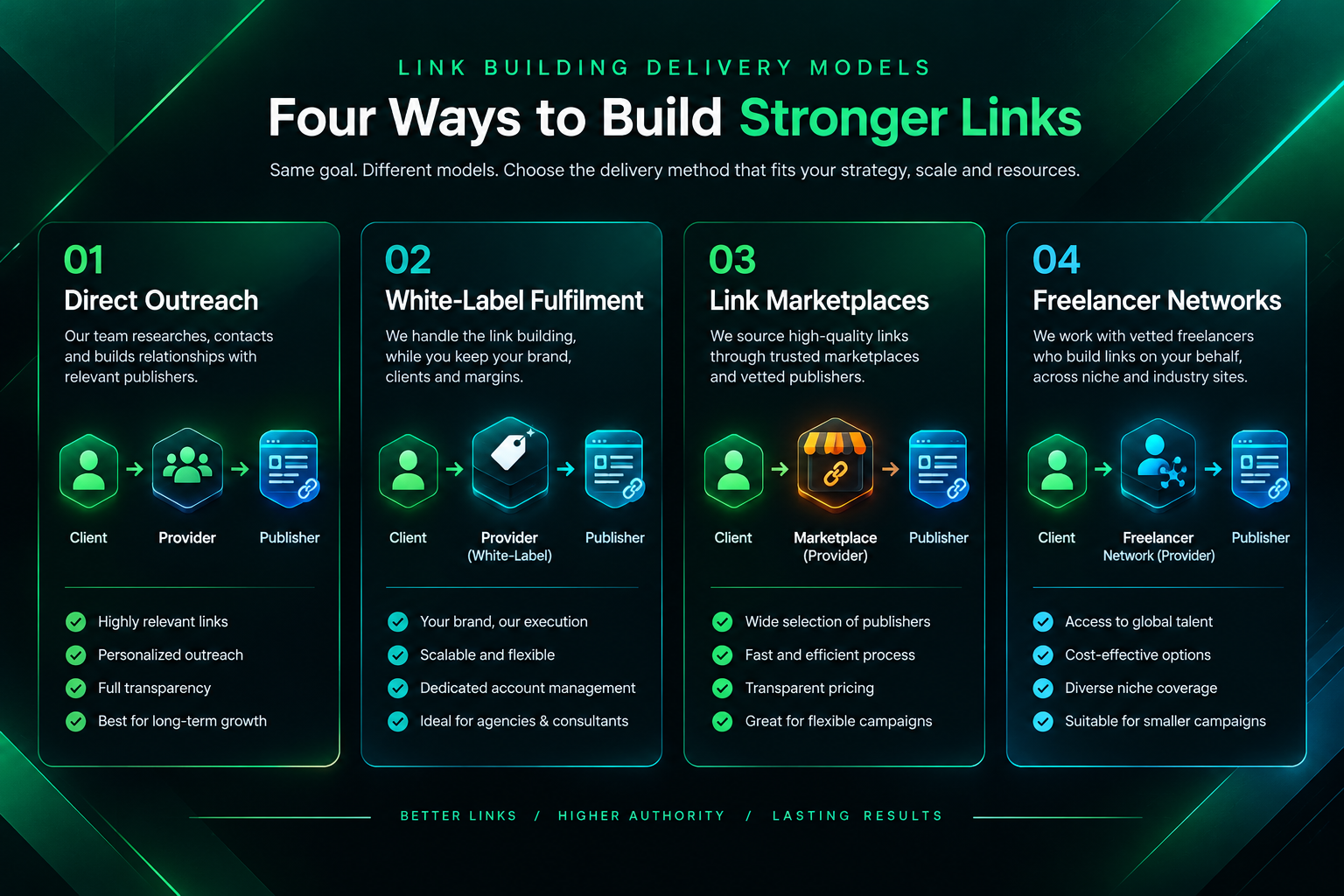
Link marketplaces and publisher networks are platforms where publishers list available placements and buyers select them based on metrics such as domain rating, traffic estimates, or niche category. Placements sourced through these networks may or may not involve genuine editorial review. Some networks apply publisher vetting; others do not. A provider using a marketplace should be able to confirm which network they use, what vetting criteria the network applies, and whether they conduct additional review before accepting a placement for a client campaign.
Freelancer networks involve outsourcing outreach or content tasks to individual contractors. This model can produce high-quality results when contractors are experienced and supervised, but it can also introduce inconsistency if different contractors apply different standards. Providers using freelancer networks should be able to explain how contractor work is reviewed and how quality is maintained across campaigns.
Questions That Reveal the Real Delivery Model
Asking the right questions before signing a contract is the most direct way to assess subcontracting transparency. The goal is not to catch a provider in a deception but to understand the actual delivery chain so you can evaluate whether it matches your quality requirements and risk tolerance.
Who performs the outreach?
A transparent provider will describe whether outreach is handled by in-house staff, dedicated contractors, a white-label partner, or a combination. Vague answers such as “our team” without further detail are worth following up. Ask whether the people performing outreach are employed directly, contracted on a per-campaign basis, or sourced through a third-party platform. The answer tells you how much direct control the provider has over the outreach process and how consistently their stated standards are likely to be applied.
How are publishers identified and assessed?
A provider with a genuine publisher assessment process should be able to describe the criteria they use. Relevant factors typically include topical relevance to the client’s niche, the publisher’s organic traffic and indexing status, the quality and recency of existing content, the site’s existing backlink profile, and whether the site has a history of selling links at scale. If a provider can only describe publisher quality in terms of a single metric such as domain rating or domain authority, that suggests a limited assessment process. Third-party metrics from tools such as Ahrefs, Semrush, or Moz can be useful reference points, but they are proprietary estimates rather than direct signals from search engines, and no single metric reliably predicts the SEO value of a placement.
Is any part of the campaign fulfilled by a third party?
Asking this question directly is the clearest way to surface undisclosed subcontracting. A transparent provider will confirm whether they use a white-label fulfilment partner, a publisher network, or freelance contractors, and will be able to explain how those parties are selected and supervised. A provider who deflects this question or gives an answer that contradicts other information they have provided is signalling a transparency problem.
What happens if a placement does not meet the agreed criteria?
The answer to this question reveals whether the provider has a genuine quality control process or whether placements are delivered without post-delivery review. A transparent provider will describe a specific process: who reviews placements before delivery, what criteria are checked, and what the resolution process is if a placement is found to be non-compliant after delivery. Providers who cannot describe this process in specific terms are unlikely to have a reliable quality control mechanism in place.
Warning Signs of Undisclosed Subcontracting
Even when a provider does not volunteer information about their delivery model, certain patterns in their communication and reporting can indicate that subcontracting is occurring without disclosure.
Inconsistent publisher quality is one of the most common indicators. If placements vary significantly in topical relevance, content quality, or traffic levels without a clear explanation, it may suggest that different parties with different standards are making placement decisions. A provider with a consistent internal process tends to produce more uniform results across a campaign.
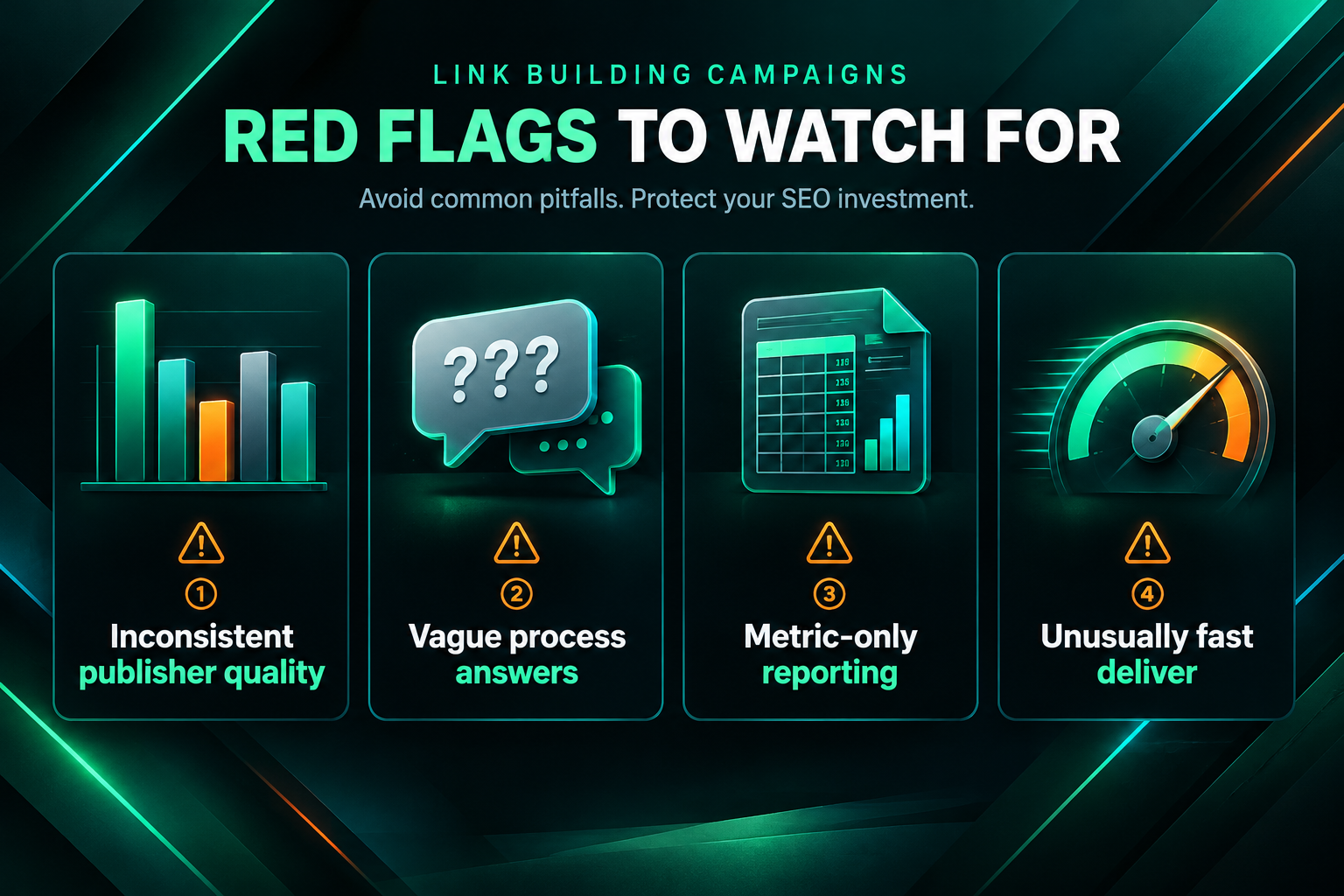
Inability to explain the outreach process in specific terms is another signal. A provider who manages their own outreach should be able to describe how they identify target publishers, what their initial contact looks like, how they handle editorial requirements, and how long the process typically takes. If a provider gives only generic answers to these questions, it may indicate that they are not directly involved in the outreach process.
Reporting that focuses exclusively on metrics rather than process can also indicate a lack of direct involvement. Transparent providers typically report on both the placements delivered and the process used to acquire them. If reports contain only domain rating figures and live URLs without any description of how the placements were acquired or reviewed, the provider may be reselling placements from a network without adding meaningful quality control.
Unusually fast delivery relative to the campaign scope can suggest marketplace sourcing rather than manual outreach. Genuine manual outreach campaigns require time for publisher identification, contact, negotiation, content creation, and editorial review. Campaigns that deliver a large volume of placements very quickly may be drawing from a pre-existing inventory of available placements rather than conducting fresh outreach.
How Transparent Providers Structure Their Reporting
Reporting quality is one of the clearest indicators of subcontracting transparency. A provider who is directly involved in the delivery process can report on both outcomes and process. A provider who is reselling placements from a third party typically can only report on outcomes, because they do not have access to the process information.
Useful campaign reports from a transparent provider typically include the live URL of each placement, the target page the link points to, the anchor text used, the topical relevance of the publisher to the client’s niche, the key metrics used to assess the publisher, and a brief description of how the placement was acquired. Some providers also include information about the content published, the editorial relationship with the publisher, and any conditions attached to the placement.
Reports that contain only a list of URLs and domain rating figures are not necessarily evidence of poor quality, but they do not give the client enough information to independently assess whether the placements meet their requirements. Asking for a sample report before committing to a campaign is a practical way to evaluate reporting depth before you are relying on it.
Evaluating Publisher Quality Independently
Regardless of what a provider tells you about their delivery model, you can conduct your own assessment of delivered placements. Independent evaluation is not a substitute for provider transparency, but it is a useful check on whether the placements you receive match the standards you were promised.
When reviewing a delivered placement, consider whether the publisher’s content is topically relevant to your niche, whether the site has genuine organic traffic according to tools such as Ahrefs or Semrush, whether the existing content on the site is original and substantive, whether the site’s backlink profile contains a reasonable proportion of editorial links, and whether the placement itself reads as a natural editorial inclusion rather than an obvious paid insertion. No single factor is definitive, but a pattern of weak results across multiple placements is worth raising with your provider and investigating further.
It is also worth checking whether the publisher discloses sponsored or paid content. Search engine guidelines distinguish between editorial links and paid links, and the appropriate link attribute for a paid placement differs from that for an editorially earned link. A provider who does not address link attribute requirements in their reporting may not be applying consistent standards in this area.
Subcontracting Transparency and Campaign Risk
The connection between subcontracting transparency and campaign risk is direct. When you do not know who is making placement decisions or on what basis, you cannot accurately assess the risk profile of your backlink profile. Placements that appear acceptable based on surface metrics may have been sourced from networks with a history of link selling, may be on sites that have received manual actions from search engines in the past, or may use link attributes that do not reflect the nature of the placement. These factors are difficult to identify without access to the provider’s publisher assessment process.
It is important to note that no link building method is entirely without risk, and manual outreach does not automatically produce placements that are compliant with search engine guidelines. The relevant question is not whether a provider uses subcontractors but whether the provider can demonstrate that meaningful quality control is applied at every stage of the delivery chain, regardless of who performs each task. A provider who uses a white-label fulfilment partner but can describe that partner’s publisher criteria, review process, and replacement policy in specific terms is more transparent than a provider who claims to do everything in-house but cannot explain their process in any detail.
Questions to Ask Before Signing a Link Building Contract
The following questions are designed to help you assess subcontracting transparency before committing to a campaign. They are not a checklist that guarantees quality, but they are a practical starting point for evaluating whether a provider’s delivery model matches their stated standards.
- Who performs the outreach for this campaign, and are they employed directly or contracted through a third party?
- Do you use any publisher networks, link marketplaces, or white-label fulfilment partners? If so, which ones, and how do you assess their quality standards?
- What criteria do you use to assess publisher suitability before accepting a placement?
- How do you review placements before delivering them to the client?
- What happens if a delivered placement does not meet the agreed criteria?
- Can you provide a sample report that shows how you document the acquisition process, not just the live URL and metrics?
- How do you handle link attribute requirements for paid or sponsored placements?
- What is your process if a publisher removes a link after delivery?
Frequently Asked Questions
Is subcontracting in link building always a problem?
Subcontracting is not inherently problematic. Many high-quality link building campaigns involve specialist outreach teams, white-label fulfilment partners, or freelance contractors. The issue is not subcontracting itself but the absence of transparency about it. When a provider discloses their delivery model and can demonstrate that quality control is applied consistently throughout the chain, subcontracting does not automatically reduce campaign quality or increase risk.
How can I tell if a provider is using a link marketplace without disclosing it?
Common indicators include unusually fast delivery relative to the campaign scope, placements that vary significantly in quality without explanation, reports that contain only URLs and metrics without process information, and an inability to describe the outreach process in specific terms. These patterns do not confirm marketplace sourcing, but they are worth investigating through direct questions to the provider.
Does it matter whether a provider uses in-house staff or contractors for outreach?
The employment model matters less than the quality control process applied to the work. A provider with a well-supervised contractor network and a clear review process can produce consistent results. A provider with in-house staff but no meaningful quality control may not. The relevant question is how placements are assessed and reviewed before delivery, not whether the person performing the outreach is an employee or a contractor.
What should a transparent link building report include?
A useful report typically includes the live URL of each placement, the target page and anchor text, the topical relevance of the publisher, the key metrics used to assess the publisher, and a description of how the placement was acquired. Reports that contain only URLs and domain rating figures give you outcome information but not enough process information to independently assess whether the placements meet your quality requirements.
Can I assess publisher quality myself after receiving a placement?
Yes. You can use tools such as Ahrefs or Semrush to review a publisher’s organic traffic, backlink profile, and content quality. Checking whether the site’s content is topically relevant, substantive, and regularly updated is also useful. Independent assessment does not replace provider transparency, but it is a practical check on whether delivered placements match the standards you were promised.
What is the difference between white-label link building and undisclosed subcontracting?
White-label link building is a disclosed arrangement in which one provider delivers placements under another provider’s brand, typically with the client-facing agency’s knowledge. Undisclosed subcontracting occurs when a provider passes work to a third party without informing the client. The distinction is transparency: a white-label arrangement that is disclosed and supported by clear quality standards is a legitimate delivery model; subcontracting that is concealed from the client removes the client’s ability to evaluate the real delivery chain.
Making an Informed Decision About Link Building Transparency
Assessing subcontracting transparency is not about finding a provider who does everything in-house. It is about finding a provider who can describe their delivery model clearly, explain how quality control is applied at every stage, and give you enough information to evaluate whether their process matches your requirements. A provider who is transparent about using a white-label partner or a publisher network, and who can describe the standards applied within that arrangement, is in a stronger position than a provider who makes vague claims about an in-house process they cannot explain in specific terms.
Before committing to a campaign, ask the questions outlined in this article, request a sample report, and evaluate whether the answers you receive are specific enough to be verifiable. If a provider cannot describe their publisher assessment criteria, their review process, or their resolution policy in concrete terms, that is a meaningful signal about the level of transparency you can expect throughout the campaign. Link building campaigns involve ongoing decisions about publisher selection, content standards, and link attributes, and those decisions are easier to evaluate and manage when the delivery model is clearly understood from the start.
If you are reviewing providers and want to understand how a specific campaign would be structured and delivered, discussing the delivery model and quality control process in detail before signing a contract is a reasonable and practical step. Providers who welcome that conversation are generally better positioned to deliver campaigns that meet your stated requirements.