Factual errors in published guest posts can damage your credibility, mislead readers, and in some cases create legal or reputational risk. Whether the mistake was introduced during editing, slipped through your own review, or reflects information that has since changed, knowing how to approach the correction process professionally can make the difference between a swift fix and a prolonged dispute. This guide explains the practical steps involved, what to include in a correction request, how publishers typically respond, and what options remain if the standard process stalls.
Key Takeaways
- Most publishers will correct genuine factual errors when approached professionally and with clear supporting evidence.
- A well-structured correction request that identifies the specific error, explains why it is incorrect, and provides a verified replacement is far more likely to succeed than a vague complaint.
- Response timelines vary widely by publication size and editorial workflow; following up once after a reasonable interval is appropriate.
- If a correction is refused or ignored, several escalation options exist, including editorial escalation, public clarification, or in serious cases, legal or regulatory routes.
- For link building campaigns, factual accuracy in guest posts protects both the placement’s long-term value and the referring site’s editorial reputation.
Why Factual Accuracy in Guest Posts Matters Beyond the Obvious
A factual error in a guest post is not simply an embarrassment. For businesses and SEO professionals who use guest posting as part of a link acquisition strategy, inaccurate content can undermine the editorial credibility that makes a placement valuable in the first place. Publishers who accept guest contributions stake their own reputation on the accuracy of what they publish. When an error is identified, most reputable editors want it corrected as much as the author does, because their site’s trustworthiness depends on it.
From an SEO perspective, a guest post that contains demonstrably false claims may attract negative attention, social corrections, or even editorial notes that reduce the perceived quality of the page. While search engines do not directly penalise individual factual errors in the way they penalise manipulative link schemes, content quality signals and editorial reputation are factors that influence how a site is perceived over time. Maintaining accuracy in published content is therefore both an ethical obligation and a practical interest for anyone involved in content-based link building.
It is also worth distinguishing between different types of errors. A typographical mistake, a broken statistic, an outdated figure, a misattributed quote, and a substantively false claim each carry different levels of urgency and require slightly different approaches. Understanding which type of error you are dealing with helps you frame the correction request appropriately and set realistic expectations about how quickly a publisher is likely to act.
Preparing Your Correction Request
Before contacting the publisher, gather everything you need to make the request as straightforward as possible for the editorial team. A correction request that requires the editor to do additional research is less likely to be acted on quickly. Your goal is to make the correction easy to implement.
Identify the Exact Error
Locate the specific sentence or passage that contains the error. Copy it exactly as it appears in the published article. This removes any ambiguity about what you are asking to be changed and demonstrates that you have reviewed the content carefully rather than raising a general concern.
Explain Why It Is Incorrect
State clearly and concisely why the information is wrong. Avoid vague language such as “this doesn’t seem right” or “I think this may be inaccurate.” Instead, explain the specific factual problem: for example, that a statistic has been misquoted, that a date is wrong, that a named source did not make the attributed statement, or that a regulatory position has changed since publication.
Provide Verified Replacement Information
Wherever possible, supply the correct information along with a credible source that the editor can verify independently. Acceptable sources typically include official government or regulatory publications, peer-reviewed research, well-documented industry reports, or the original primary source that was misquoted. Avoid citing your own website or a competitor’s content as the sole evidence for a correction, as this may raise questions about your motivation.
Draft the Corrected Text
Offer a suggested replacement sentence or passage. This is not mandatory, but it significantly reduces the editorial workload and increases the likelihood of a prompt response. Keep the suggested replacement consistent with the surrounding content’s tone and style so that the editor can implement it with minimal additional effort.
How to Contact the Publisher
The method of contact matters. A professional, clearly structured message sent through the appropriate channel is more effective than an informal social media message or a complaint sent to a general enquiries address.
Find the Right Contact
Look for an editorial contact, a corrections policy page, or a named editor associated with the section where your article was published. Many publications list a managing editor, content editor, or specific section editor. If the publication has a formal corrections process, follow it exactly. Using the correct channel signals that you are familiar with editorial standards and are approaching the matter professionally.
If no specific corrections contact is listed, use the email address you originally communicated with during the guest post submission process. This is usually the most direct route to the person with authority to make changes to published content.
Structure Your Message Clearly
Your correction request email should be concise and easy to act on. A useful structure includes the following elements in order:
- Subject line: State clearly that you are requesting a factual correction and include the article title or URL. For example: “Factual Correction Request – [Article Title] – [Publication Name].”
- Brief introduction: Identify yourself as the author and provide the article URL.
- The error: Quote the specific incorrect passage exactly as published.
- The explanation: State concisely why it is incorrect, with a reference to your supporting source.
- The suggested correction: Provide the replacement text you are proposing.
- A polite closing: Thank the editor for their time and offer to provide additional documentation if needed.
Keep the tone professional and collaborative throughout. Editors are more likely to act quickly when they perceive the request as a genuine effort to improve the accuracy of their publication rather than a complaint or a demand.
What Publishers Typically Do With Correction Requests
Response behaviour varies considerably depending on the size of the publication, the seriousness of the error, and the editorial team’s current workload. Smaller niche publications with a single editor may respond within a day or two. Larger publications with formal editorial processes may take one to three weeks to review, verify, and implement a correction.
Most reputable publishers will acknowledge the request, verify the information independently, and then either implement the correction, add an editorial note, or explain why they have decided not to make a change. Some publications add a visible correction notice at the bottom of the article noting what was changed and when, which is considered good editorial practice. Others make the change silently without a public note, particularly for minor errors such as incorrect dates or misquoted figures.
In some cases, an editor may disagree with your assessment of the error. This can happen when the original information was accurate at the time of publication but has since become outdated, or when the editor interprets a source differently. If this occurs, it is worth providing additional documentation rather than escalating immediately, as a second round of evidence often resolves the disagreement.
Following Up When There Is No Response
If you have not received any acknowledgement after seven to ten business days, a single polite follow-up is appropriate. Reference your original message, restate the core request briefly, and ask whether the editorial team needs any additional information to proceed. Avoid sending multiple follow-ups in quick succession, as this can create friction and make the editor less inclined to cooperate.
If a second follow-up after a further week also receives no response, consider whether the publication has a general contact form, a social media presence, or a listed editorial director you could contact. Frame any escalation as a genuine concern about accuracy rather than a complaint about the lack of response.
When a Publisher Refuses to Make a Correction
A refusal to correct a genuine factual error is relatively uncommon among reputable publications, but it does occur. Understanding your options in this situation helps you respond proportionately.
Request an Editorial Note or Author’s Note
If the publisher will not change the text itself, ask whether they would be willing to add an editorial note or an author’s note at the end of the article clarifying the correct information. This is a common compromise that allows the publication to maintain its original editorial decision while still providing readers with accurate information. Many editors find this approach acceptable when they are uncertain about making a direct change to published content.
Publish a Clarification Elsewhere
If the error is significant and the publisher will not act, you may choose to publish a clarification on your own website or through another credible channel. This approach is most appropriate when the error could genuinely mislead readers or damage your professional reputation. If you take this route, keep the clarification factual and avoid language that could be interpreted as an attack on the publication.
Consider Escalation for Serious Errors
For errors that are defamatory, that misrepresent regulated information such as financial or medical advice, or that could cause material harm, more formal escalation may be warranted. This could include contacting a press regulator if the publication is subject to one, seeking legal advice, or in the case of regulated industries, notifying the relevant regulatory body. These routes are appropriate only for serious cases and should not be used as a first response to a minor factual disagreement.
Factual Corrections and Their Effect on Backlinks
For SEO professionals and link building practitioners, a factual correction request raises a practical concern: will the correction process affect the backlink that the guest post provides? In most cases, a factual correction that changes a sentence or updates a statistic does not affect the link itself. The URL of the published article typically remains the same, the link attributes are unchanged, and the referring domain continues to pass whatever link equity it was passing before the correction.
However, there are scenarios where a correction request could have broader implications for a placement. If the error is serious enough that the publisher decides to unpublish the article entirely rather than correct it, the backlink is lost. If the correction reveals that the article was based on fabricated or significantly misleading information, the publisher may choose to add a nofollow attribute to links within the article or remove them altogether. These outcomes are uncommon when the error is a genuine mistake rather than deliberate misinformation, but they are worth considering before initiating a correction request for a placement that is part of an active link building campaign.
The practical implication is that maintaining factual accuracy during the content creation and review stage is far preferable to managing corrections after publication. For agencies and businesses running guest posting campaigns at scale, building a robust editorial review process before submission reduces the likelihood of errors reaching publication and avoids the time and relationship cost of post-publication correction requests.
Preventing Errors Before They Reach Publication
The most effective way to manage factual errors in guest posts is to prevent them from being published in the first place. This is particularly relevant for link building campaigns where multiple pieces of content are being produced and placed across different publications simultaneously.
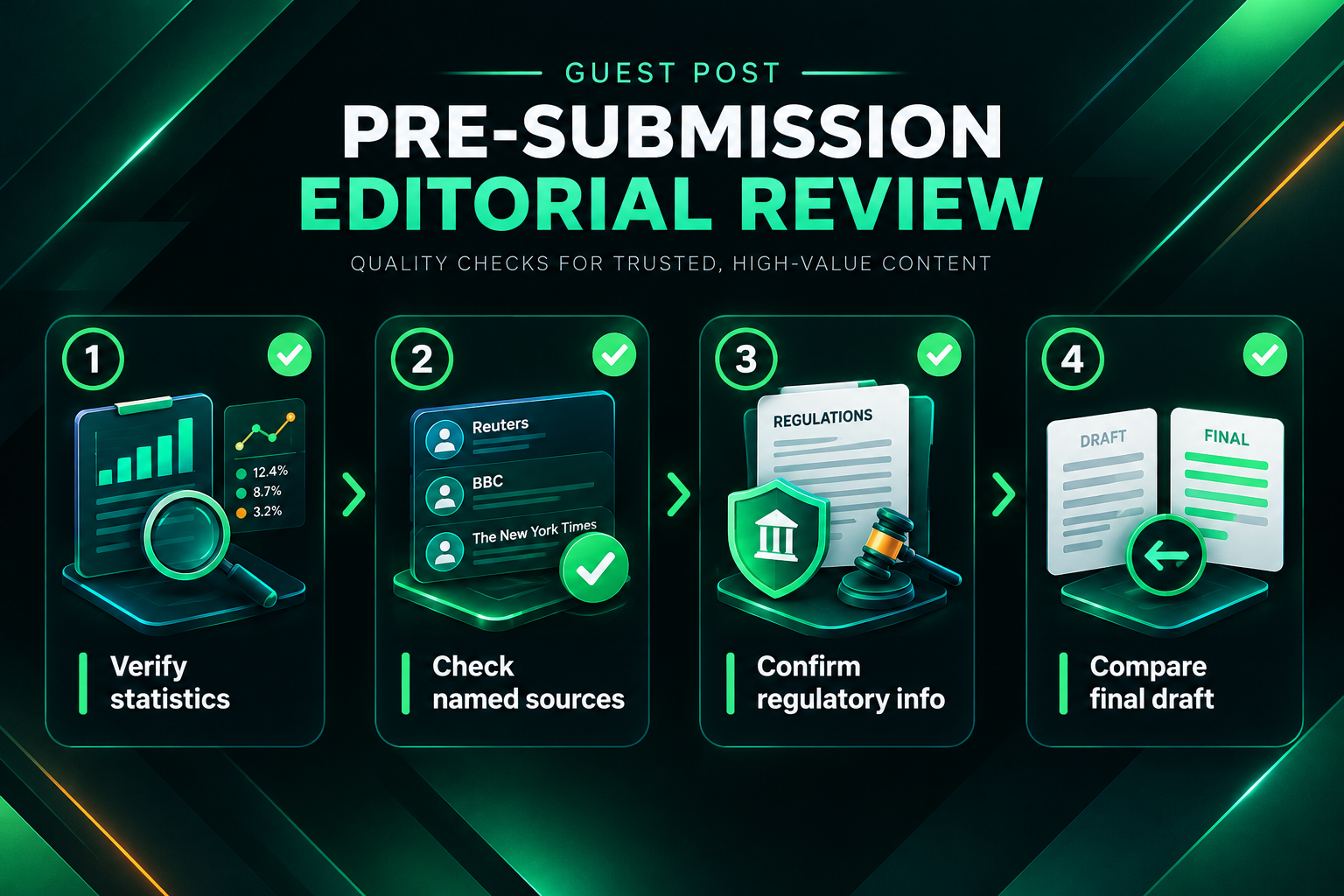
A practical pre-submission review process typically includes verifying all statistics against their original primary sources rather than secondary summaries, checking that any named individuals, organisations, or studies are correctly identified, confirming that regulatory or legal information reflects the current position rather than an outdated one, and reviewing the final published version against the submitted draft to catch any errors introduced during editorial formatting.
When working with a link building service or content team, it is worth clarifying who is responsible for factual verification at each stage of the production process. Clear accountability reduces the risk of errors being introduced between the research, writing, and submission stages, and makes it easier to identify where a mistake originated if a correction is later needed.
Frequently Asked Questions
How long does it typically take for a publisher to correct a factual error?
Timelines vary significantly. Smaller publications may respond and implement a correction within a few days. Larger publications with formal editorial workflows may take two to four weeks. If you have not received a response after ten business days, a single polite follow-up is appropriate.
Should I mention the backlink when requesting a correction?
Generally, no. The correction request should focus entirely on the factual accuracy of the content. Mentioning the backlink could create the impression that your primary concern is the link rather than the accuracy of the information, which may make the editor less inclined to cooperate.
What if the error was introduced by the editor during the publication process, not in my original submission?
This is a common situation and does not change the correction process significantly. Explain politely that the error does not appear in your original submission and provide the submitted draft as evidence if you have it. Most editors will treat this as a straightforward correction rather than a dispute.
Can I request a correction for information that was accurate when published but is now outdated?
Yes, though publishers may handle this differently from a clear factual error. Some will update the content and add a note indicating when it was revised. Others may decline to update older articles. Frame the request as an update rather than a correction, and explain why the change is relevant to readers.
Will requesting a correction damage my relationship with the publisher?
A professionally handled correction request rarely damages an editorial relationship. Most editors appreciate authors who take accuracy seriously. The relationship is more likely to be affected by an aggressive or accusatory tone than by the correction request itself.
What should I do if the publisher corrects the error but introduces a new one in the process?
Contact the editor again using the same approach, referencing the previous correction and identifying the new error clearly. Keep the tone collaborative and acknowledge that the editor has already made an effort to address your concern.
Is there a standard format for a correction request email?
There is no universal standard, but a clear subject line identifying the article and the nature of the request, followed by the specific error, the explanation, the supporting source, and the suggested replacement text, covers the essential elements that most editors need to act on a request efficiently.
Making Correction Requests Work in Practice
Requesting a factual correction in a published guest post is a manageable process when approached with preparation, clear evidence, and a professional tone. The majority of reputable publishers will respond constructively to a well-structured request that makes the correction easy to verify and implement. The key variables are the quality of your supporting evidence, the clarity of your proposed replacement, and the channel through which you make contact.
For businesses and SEO teams managing guest posting as part of a broader link acquisition strategy, the correction process is also a reminder that content quality and factual rigour are not separate from link building effectiveness. Placements on editorially credible sites derive much of their value from the trust those sites have built with their audiences. Protecting that trust through accurate, well-sourced content is in the interest of both the publisher and the contributor.
If you are managing guest posting campaigns at scale and want to reduce the risk of factual errors reaching publication, discussing editorial review processes with your link building provider is a practical starting point. A provider with a structured content production workflow can help ensure that accuracy checks are built into the process before submission rather than addressed after the fact.