University research repositories hold some of the most credible, original content on the web, yet many remain significantly underlinked relative to their academic value. Attracting backlinks to these repositories requires a deliberate combination of open-access publishing, targeted outreach, digital PR, and relationship-building with the communities most likely to cite and share academic work. This article explains the most practical methods, the realistic limitations of each, and how institutions and their SEO or communications teams can approach repository link acquisition in a way that is sustainable and aligned with search-engine quality expectations.
Key Takeaways
- Research repositories earn the strongest backlinks when their content is genuinely accessible, clearly structured, and easy for journalists, bloggers, and practitioners to discover and cite.
- Open-access publishing, proactive outreach to relevant communities, and digital PR around research findings are among the most effective methods for attracting editorially earned links.
- Link acquisition for repositories is a long-term effort; meaningful results typically require consistent promotion over months rather than a single campaign.
- Quality matters more than volume: a small number of contextually relevant, editorially placed links from authoritative domains tends to carry more SEO value than a large number of low-quality citations.
- Institutions should assess technical accessibility, metadata quality, and content discoverability before investing heavily in outreach, since these factors directly affect whether external sites choose to link.
Why Research Repositories Struggle to Attract Backlinks
Research repositories often contain peer-reviewed studies, datasets, theses, and working papers that practitioners, journalists, and other academics would genuinely benefit from citing. Despite this, many repositories accumulate relatively few external backlinks compared to the depth of their content. Several structural factors contribute to this gap. Repository landing pages are frequently behind login walls or paywalls, making it difficult for non-institutional visitors to access the full content. Metadata is sometimes incomplete or formatted in ways that are not easily readable by non-specialists. URLs can be long, unstable, or generated dynamically, which discourages linking. And crucially, the researchers who produce the work rarely have a systematic process for promoting it beyond their immediate academic networks.
From an SEO perspective, backlinks to repository pages signal to search engines that the content is trusted and referenced by other credible sources. When a repository page earns links from relevant, authoritative domains — whether a science journalism outlet, a government agency, a professional association, or a well-regarded industry blog — those signals can contribute to improved organic visibility for the repository’s content. However, the relationship between backlinks and rankings is not mechanical; technical SEO factors, content quality, crawlability, and the competitive landscape all influence how much any individual link contributes to visibility.
Open Access as a Foundation for Link Acquisition
The single most impactful structural change a university can make to improve its repository’s link acquisition potential is to maximise open-access availability. When research is freely readable without registration or institutional login, external websites — including news outlets, industry blogs, policy organisations, and other universities — can link to it with confidence that their audience will be able to access the content. Paywalled or login-restricted pages are rarely linked to by non-academic sources because the link provides little value to a general reader.
Open-access repositories such as those operating under Creative Commons licensing or institutional open-access mandates tend to attract more organic, editorially earned links over time. This is partly because search engines can crawl and index the full content, making it discoverable for relevant queries, and partly because content creators across the web are more willing to cite sources their readers can actually visit. Universities that have not yet implemented open-access policies for their repositories may find that this structural barrier limits the effectiveness of any outreach or promotion effort they undertake.
Stable, persistent URLs — often implemented through DOI (Digital Object Identifier) systems or handle-based persistent identifiers — also matter for link retention. If a repository URL changes after external sites have linked to it, those links lose their value and the citing site may remove or update the reference. Ensuring URL stability is a technical prerequisite for sustainable link acquisition.
Outreach to Journalists, Science Communicators, and Industry Publications
Proactive outreach is one of the most reliable methods for attracting backlinks to specific repository pages. The approach involves identifying journalists, science writers, bloggers, and industry publications that cover topics related to the research, then contacting them with a clear, accessible summary of the findings and a direct link to the repository page. This is sometimes called research promotion outreach or academic digital PR, and it draws on the same principles used in broader link building campaigns: finding the right audience, communicating value clearly, and making it easy for the recipient to act.
Effective outreach for research repositories typically requires a non-technical summary of the research findings — often called a plain-language summary or lay abstract — that a journalist or blogger can understand without specialist knowledge. Many universities already produce press releases for significant research outputs, but these are often distributed only through wire services rather than targeted directly at the specific publications most likely to cover the topic. A more targeted approach, identifying ten to thirty relevant publications or writers who have previously covered similar research and reaching out personally, tends to generate better results than broad press release distribution.

Science journalism outlets, policy think tanks, professional associations, and industry trade publications are particularly valuable targets because they tend to have established domain authority, relevant topical audiences, and editorial standards that make their links more meaningful from an SEO perspective. Links from these sources are typically editorially placed — meaning the linking site chose to include the reference based on its relevance and credibility — which aligns with the type of link acquisition that search engines consider most valuable.
Digital PR Around Research Findings
Digital PR for research repositories involves creating shareable, newsworthy content around research findings and distributing it in ways that encourage external coverage and linking. This can include data visualisations, interactive tools built on research datasets, infographics summarising key findings, or short video explainers. When these assets are hosted on or linked back to the repository page, they create additional entry points for backlinks from sites that prefer to link to visual or interactive content rather than academic papers.
Research that contains original data, surprising findings, or clear practical implications tends to attract more unsolicited coverage and linking than incremental academic work. Universities can improve their digital PR outcomes by identifying which research outputs have the strongest news value — novelty, relevance to current public debates, clear societal implications — and concentrating promotion resources on those outputs rather than attempting to promote every publication equally.
Timing also matters. Research that connects to a current news cycle, a policy debate, or a seasonal topic is more likely to be picked up by journalists working to tight deadlines. Universities with communications teams that monitor relevant news cycles and proactively match research outputs to emerging stories can generate more timely coverage and the backlinks that accompany it. This approach requires coordination between researchers, communications staff, and whoever manages the repository’s SEO or digital presence.
Building Relationships with Academic and Professional Communities
Backlinks from other universities, research institutions, professional associations, and government bodies carry particular credibility for research repositories because they come from topically relevant, institutionally authoritative sources. Building these relationships requires sustained engagement rather than one-off outreach. Researchers who participate actively in their professional communities — presenting at conferences, contributing to working groups, collaborating on cross-institutional projects — naturally create opportunities for their institution’s repository to be cited and linked by partner organisations.
University libraries and repository managers can support this process by making it easy for researchers to share persistent links to their repository records, by providing embeddable citation widgets, and by maintaining up-to-date researcher profile pages that link to repository content. When a researcher’s profile on a professional association website, a conference proceedings page, or a collaborative project site links back to their institutional repository record, this creates a network of contextually relevant backlinks that builds gradually over time.
Reciprocal linking arrangements between institutions should be approached carefully. Search engines distinguish between editorially motivated links — where one site links to another because the content is genuinely useful — and links that exist primarily for SEO purposes. Formal link exchange agreements between universities are unlikely to carry the same weight as organic citations that arise from genuine academic collaboration, and in some cases may be treated as manipulative by search-engine quality assessments.
Optimising Repository Pages for Discoverability
Outreach and digital PR are more effective when the repository pages themselves are well-optimised for both search engines and human visitors. Several technical and content factors influence whether a repository page is likely to be discovered organically and whether external sites will choose to link to it once they find it.
- Descriptive, keyword-relevant titles and abstracts: Repository records should use clear, descriptive titles that reflect how practitioners and journalists search for the topic, not just how academics describe it internally.
- Structured metadata: Schema markup for academic articles, datasets, and research outputs helps search engines understand and display repository content in relevant search results, including rich snippets and knowledge panels.
- Mobile accessibility and page speed: Repository pages that load slowly or display poorly on mobile devices create a poor user experience that may discourage linking and sharing.
- Clear citation information: Making it easy for visitors to copy a correctly formatted citation — including the repository URL — reduces friction for academics and journalists who want to reference the work.
- Canonical URLs: Where the same research output appears in multiple locations (the repository, a publisher’s site, a preprint server), canonical tags help search engines identify the preferred version and consolidate link equity appropriately.
These technical factors do not directly generate backlinks, but they improve the probability that outreach efforts will result in links and that organically discovered content will be cited. A repository that is difficult to navigate, slow to load, or poorly indexed by search engines will underperform regardless of how much promotion effort is invested.
Leveraging Existing Institutional Assets
Universities typically have a range of existing digital assets that can be used to support repository link acquisition without requiring significant additional investment. Alumni networks, student and faculty blogs, university news sites, and departmental websites all represent opportunities to create internal and external links to repository content. While internal links do not carry the same SEO weight as external backlinks from independent domains, they improve crawlability and help search engines understand the relationship between repository pages and the broader institutional website.
University social media channels, email newsletters, and researcher profile pages on platforms such as ResearchGate, Academia.edu, and ORCID can amplify the reach of repository content and increase the likelihood that it will be discovered and cited by external sites. These platforms are not substitutes for editorially earned backlinks from independent websites, but they extend the distribution of research outputs to audiences that may subsequently link to them from their own websites or publications.
Partnerships with industry bodies, government agencies, and non-governmental organisations that use university research to inform their work represent another underutilised asset. When a policy document, industry report, or government consultation cites university research, requesting that the citation include a direct link to the repository record — rather than just a bibliographic reference — can convert an existing relationship into a valuable backlink.
Realistic Timelines and Expectations
Attracting backlinks to research repositories is a gradual process. Unlike some commercial link building campaigns where placements can be arranged within weeks, repository link acquisition depends heavily on organic discovery, editorial decisions by third parties, and the natural pace of academic and journalistic publishing cycles. A well-executed outreach campaign targeting relevant journalists and publications might generate a handful of high-quality backlinks over several months; a sustained digital PR programme built around multiple research outputs over a year or more is more likely to produce a meaningful cumulative effect on the repository’s backlink profile and organic visibility.
Institutions should also recognise that not every backlink will produce a measurable change in search rankings or referral traffic. The SEO impact of any individual link depends on the authority and relevance of the linking domain, the anchor text used, the context of the placement, and many other factors that vary by repository, topic, and competitive landscape. Third-party metrics such as Domain Rating (Ahrefs), Domain Authority (Moz), or Trust Flow (Majestic) can provide a rough indication of a linking domain’s relative authority, but these are proprietary estimates rather than Google-provided signals, and they should not be treated as guarantees of ranking improvement.
Monitoring the repository’s backlink profile using tools such as Ahrefs, Semrush, or Google Search Console can help institutions track which outreach efforts are generating links, identify which research outputs are attracting organic citations, and spot any low-quality or potentially harmful links that may warrant disavowal. Regular reporting against baseline metrics — referring domains, organic impressions, and click-through rates for repository pages — provides a more grounded basis for evaluating progress than relying on any single metric.
Risks and Quality Considerations
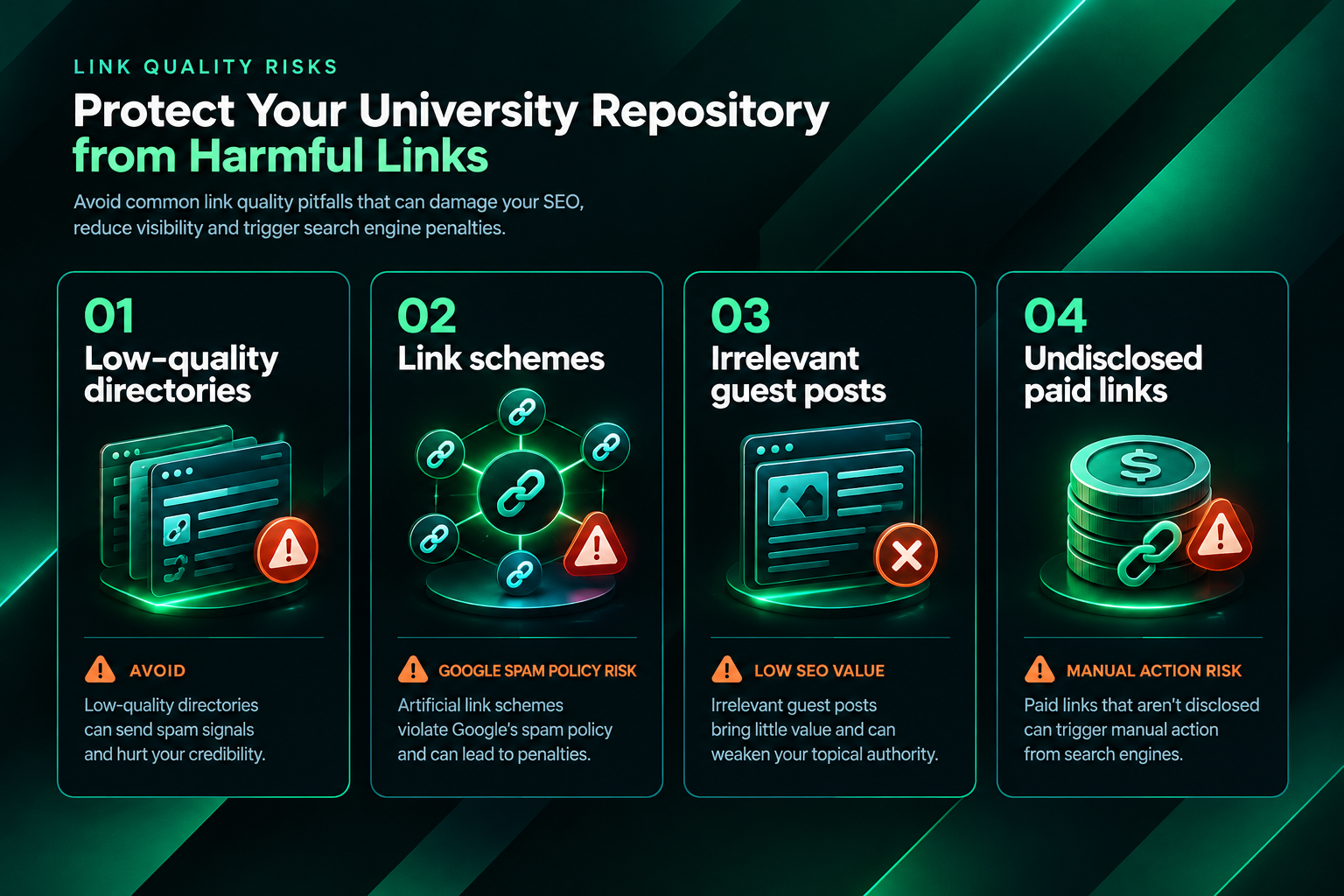
Universities should be cautious about approaches that prioritise link volume over link quality. Submitting repository URLs to low-quality directories, participating in link schemes, or purchasing links from link marketplaces are tactics that carry meaningful risk of search-engine penalties and are inconsistent with the editorial standards that give academic institutions their credibility. Google’s spam policies explicitly identify manipulative link acquisition as a violation, and the reputational consequences of a manual action against a university domain could extend well beyond the repository itself.
Guest posting on low-quality or topically irrelevant websites in exchange for links to repository pages is similarly unlikely to produce lasting SEO value and may attract negative attention from search-engine quality reviewers. Where guest posting or contributed content is used as part of a repository promotion strategy, it should be limited to genuinely relevant, editorially rigorous publications where the content provides real value to the audience.
Institutions working with external SEO agencies or link building service providers should ensure that any outreach conducted on their behalf adheres to white-hat principles and focuses on editorially earned placements. Asking a provider to explain their outreach methodology, publisher vetting process, and link quality standards before engaging is a reasonable due-diligence step. Campaigns that promise large numbers of links in short timeframes without clear explanation of how those links will be acquired warrant careful scrutiny.
Frequently Asked Questions
Do backlinks to a research repository actually improve its search rankings?
Backlinks from relevant, authoritative domains are one of many factors that may contribute to improved organic visibility for repository pages. However, rankings also depend on content quality, technical SEO, crawlability, search intent alignment, and competition. A backlink alone does not guarantee a ranking improvement, and results vary significantly by topic, repository, and competitive landscape.
Is it acceptable for universities to pay for backlinks to their repositories?
Paying for links that are not disclosed as sponsored or paid placements is against Google’s spam policies and carries a risk of manual action. Universities are generally better served by investing in open-access publishing, digital PR, and outreach that generates editorially earned links, which are more durable and carry fewer risks than paid placements.
How long does it take to see results from a repository link building campaign?
Meaningful results from a sustained outreach and digital PR programme typically take several months to become measurable, and cumulative effects on organic visibility may take longer. Individual high-quality placements can sometimes produce faster referral traffic, but SEO impact depends on many variables beyond the link itself.
Which types of websites provide the most valuable backlinks for research repositories?
Science journalism outlets, government agencies, professional associations, policy organisations, and other universities tend to provide the most contextually relevant and editorially credible backlinks for research repositories. Industry trade publications and well-regarded practitioner blogs in the relevant field can also be valuable, particularly for applied research.
Should universities focus on building links to the repository homepage or to individual record pages?
Links to individual research record pages — the specific landing page for a paper, dataset, or thesis — are generally more valuable for SEO purposes than links to the repository homepage, because they direct link equity to the pages that are most likely to rank for relevant queries. Homepage links can still contribute to overall domain authority, but record-level links are more targeted and more likely to drive relevant referral traffic.
Can social media shares substitute for backlinks in improving repository visibility?
Social media shares can increase the reach of repository content and may indirectly lead to backlinks if the content is discovered by journalists, bloggers, or other website owners. However, social media shares are not equivalent to backlinks for SEO purposes; they do not pass link equity in the same way that an editorially placed link on an independent website does.
Deciding Whether to Invest in Repository Link Acquisition
Research repositories that are technically sound, openly accessible, and populated with genuinely valuable content are well-positioned to benefit from a sustained link acquisition programme. The most effective approach combines structural improvements — open access, stable URLs, well-structured metadata — with proactive outreach to journalists, industry publications, and professional communities, supported by digital PR around the research outputs most likely to attract external interest.
Institutions that are considering working with an external link building or digital PR provider should look for partners with demonstrable experience in academic or institutional outreach, a transparent methodology for identifying and vetting linking opportunities, and a clear commitment to editorially earned placements rather than volume-based tactics. A provider that takes time to understand the repository’s content, target audiences, and existing backlink profile before proposing a strategy is more likely to deliver durable results than one offering generic link packages.
If your institution is exploring how to improve the organic visibility and external citation profile of its research repository, a conversation with an experienced link building team can help clarify which methods are most appropriate for your specific situation, content, and goals.