Guest content that draws on genuine expertise tends to earn more editorial placements, attract stronger links, and hold up better under scrutiny than content written purely for SEO purposes. Knowing how to involve subject matter experts in guest content is a practical skill for any team running outreach campaigns, whether in-house or through an outsourced link building partner. This article explains the process, the realistic benefits, the common friction points, and how to structure expert involvement so it adds value without slowing your campaign down.
Key Takeaways
- Subject matter expert (SME) input can improve the credibility, originality, and editorial acceptance rate of guest content, but it requires a structured workflow to avoid delays.
- Expert involvement does not need to mean full article authorship; targeted contributions such as quotes, data commentary, or technical review are often more practical and equally effective.
- Publishers at higher-authority sites increasingly expect content that reflects genuine first-hand knowledge, making SME involvement more relevant for competitive link building campaigns.
- The depth of expert involvement should match the complexity of the topic, the authority of the target publication, and the resources available to your team.
- Outsourced link building teams can accommodate SME-contributed content, but clear briefing, realistic timelines, and defined approval processes are essential for smooth delivery.
Why Expert Input Matters for Guest Content
Guest posting has long been a core method for acquiring editorial backlinks. A writer produces an article, a publisher reviews it, and if accepted, the piece earns a contextual link back to the target site. The challenge is that publishers at established, high-traffic websites have become more selective. Generic, surface-level content is easier to identify and easier to reject. Content that reflects real-world experience, proprietary insight, or professional expertise is harder to replicate and more likely to pass editorial review.
Google’s quality guidance has consistently emphasised experience, expertise, authoritativeness, and trustworthiness as signals it uses to assess content quality. While these signals do not translate directly into a single ranking factor, they reflect the kind of content that tends to earn genuine editorial links rather than transactional placements. When a guest article includes a practitioner’s perspective, a data point drawn from internal research, or a nuanced opinion that only someone with hands-on experience could offer, it becomes more distinctive and more defensible as editorial content.
For link building campaigns specifically, SME-backed content may improve placement rates on sites that would otherwise decline generic submissions. It can also support topical authority building, where a website accumulates links from relevant, credible sources over time rather than acquiring a broad mix of loosely related placements.
What Counts as Subject Matter Expert Involvement
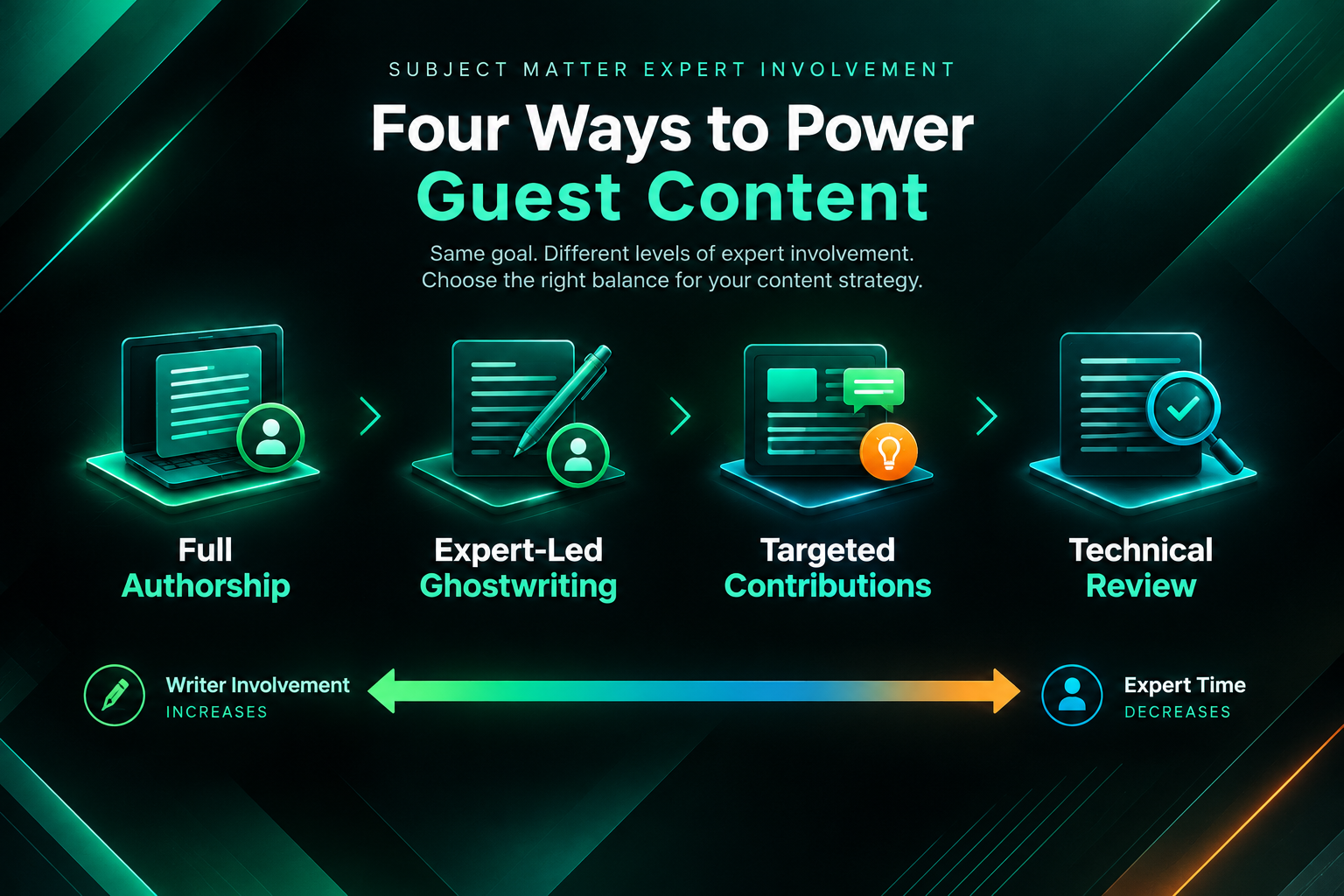
Subject matter expert involvement in guest content exists on a spectrum. At one end, an expert writes the entire article from scratch. At the other, a writer produces a complete draft and an expert reviews it for factual accuracy before submission. Most practical workflows fall somewhere between these two points, and the right level of involvement depends on the topic, the target publication, and the time available.
Full Authorship
In full authorship, the subject matter expert writes the article themselves. This produces the most authentic voice and the deepest level of expertise, but it is also the most demanding on the expert’s time. Full authorship works well when the expert is an experienced writer, when the target publication specifically requests bylined content from practitioners, or when the topic is sufficiently specialised that a ghostwritten version would lack credibility. It is less practical for high-volume campaigns where multiple placements are needed each month.
Expert-Led Ghostwriting
Expert-led ghostwriting is the most common practical model. A writer conducts a structured interview or receives a detailed brief from the expert, then drafts the article in the expert’s voice. The expert reviews the draft, suggests corrections or additions, and approves the final version before submission. This approach preserves the expert’s knowledge and perspective while reducing the time burden on them. It is well-suited to outsourced link building workflows where a content team handles production and the client’s internal expert provides the substance.
Targeted Contributions
Targeted contributions involve the expert providing specific elements rather than reviewing or writing the whole piece. Common formats include a quoted opinion on an industry trend, a short explanation of a technical concept, a commentary on a data set, or a brief case example drawn from their experience. The writer builds the article around these contributions. This model works particularly well when the expert has limited availability, when the article covers a broad topic where only one section requires deep expertise, or when the campaign involves multiple publications with different editorial angles.
Technical Review
Technical review places the expert at the end of the process rather than the beginning. A writer produces a complete draft, and the expert checks it for accuracy, flags anything misleading, and confirms that the content reflects current practice in the field. This is the lightest form of involvement and is most appropriate for topics where the writer has a solid working knowledge but the expert’s sign-off adds credibility and reduces the risk of factual errors reaching the publisher.
How to Structure the Expert Contribution Process
Unstructured expert involvement is one of the most common causes of delays in guest content campaigns. When the process is unclear, experts are unsure what is expected of them, writers wait for input that arrives in an unusable format, and deadlines slip. A defined workflow prevents most of these problems.
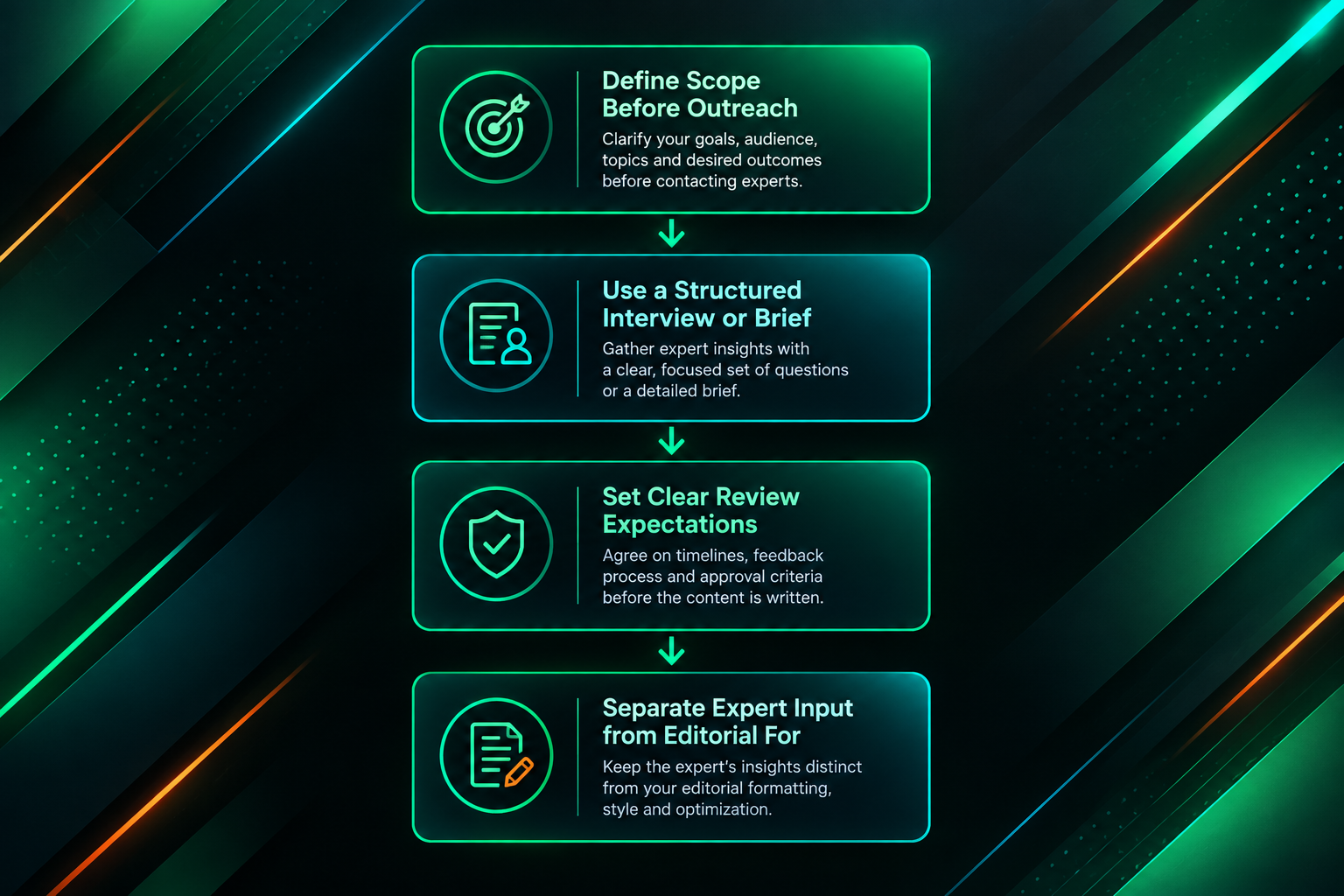
Define the Scope Before Outreach Begins
Before approaching a publisher or briefing a writer, clarify what the expert will contribute and when. Decide whether the expert will be interviewed, will review a draft, or will provide specific quotes or data. Set a realistic time commitment so the expert can plan accordingly. If the expert is a client-side employee rather than a dedicated content contributor, their availability may be limited and should be factored into campaign timelines from the start.
Use a Structured Interview or Brief
When the expert-led ghostwriting model is used, a structured interview or written brief is more efficient than an open-ended conversation. Prepare specific questions aligned with the article’s angle and the target publication’s audience. Ask for concrete examples, opinions on current debates in the field, and any data or research the expert can reference. A 20-to-30-minute recorded interview typically provides enough material for a 700-to-1,200-word guest article, which is a common length range for editorial placements.
Set Clear Review Expectations
When the expert is reviewing a draft rather than producing content, give them a clear brief on what to look for. Ask them to flag factual inaccuracies, suggest missing context, and confirm that the tone reflects their professional perspective. Avoid asking for a full rewrite at the review stage; if the draft requires substantial changes, the briefing process earlier in the workflow needs adjustment. A 48-to-72-hour review window is reasonable for most experts, provided the request is made with sufficient notice.
Separate Expert Input from Editorial Formatting
Experts should focus on substance, not on formatting the article for a specific publication. The writer or content team should handle structure, word count, internal linking suggestions, and compliance with the publisher’s style guide. Asking an expert to also manage formatting adds unnecessary friction and rarely improves the quality of the content itself.
Matching Expert Involvement to Campaign Goals
The appropriate level of SME involvement varies depending on what the campaign is trying to achieve and which publications are being targeted.
For campaigns targeting high-authority publications in competitive niches such as finance, healthcare, legal services, or enterprise software, deeper expert involvement is generally worth the additional time investment. These publishers apply stricter editorial standards, and content that lacks genuine expertise is more likely to be declined or to receive a lower-quality placement within the site. A rejected pitch costs time and outreach effort, so investing in stronger content upfront can improve overall campaign efficiency.
For campaigns targeting mid-tier publications in less regulated industries, targeted contributions or technical review may be sufficient. The goal in these cases is often to build topical relevance and referral traffic potential rather than to establish the expert as a recognised authority in a specific field.
E-commerce and SaaS link building campaigns sometimes use a hybrid approach, where product or technical experts contribute to content targeting industry publications, while more general brand-awareness content is produced without deep SME involvement. The key is matching the level of expertise in the content to the expectations of the target audience and the editorial standards of the target publication.
Practical Challenges and How to Address Them
Involving subject matter experts in guest content introduces coordination challenges that purely writer-led campaigns do not face. Understanding these challenges in advance makes them easier to manage.
Expert Availability
Subject matter experts are usually busy professionals with primary responsibilities outside content production. Campaigns that depend on expert input need to build buffer time into their schedules. A placement that would take three weeks with a writer-only workflow may take five or six weeks when expert review and approval are included. This is not a reason to avoid SME involvement, but it is a reason to plan campaigns with realistic lead times and to communicate timelines clearly to publishers during the pitch stage.
Inconsistent Quality of Expert Input
Not all experts communicate their knowledge in a way that translates easily into publishable content. Some provide highly detailed technical explanations that need significant editing for a general audience. Others provide very brief responses that require follow-up questions. Writers working with SME input benefit from experience in translating specialist knowledge into accessible, well-structured prose. If the content team lacks this experience, the quality of the final article may not reflect the quality of the expert’s knowledge.
Approval Bottlenecks
When expert approval is required before submission, a slow review process can hold up an entire campaign. Establishing a clear escalation path helps: if the primary expert does not respond within the agreed window, a secondary reviewer or a defined fallback process should be in place. For outsourced campaigns, the client team should designate a single point of contact who can facilitate expert access and approvals without requiring the agency to chase multiple stakeholders.
Maintaining Consistency Across Multiple Placements
If a campaign involves multiple guest articles over several months, maintaining a consistent expert voice and avoiding repetition of the same examples or opinions across different publications requires active management. A content brief that tracks which topics, examples, and data points have already been used helps writers and experts avoid producing content that feels formulaic or self-referential.
Expert Contributions and Publisher Relationships
Publishers who accept guest content are increasingly aware of the difference between content produced for SEO purposes and content that genuinely serves their readers. Expert-backed content tends to perform better in editorial review because it offers something the publication’s own editorial team might not easily produce: specific practitioner knowledge, proprietary data, or a perspective grounded in direct professional experience.
Building a track record of placing high-quality, expert-backed content with a publication can also support longer-term outreach relationships. A publisher who has accepted one well-received article from a particular author or brand is more likely to consider future pitches from the same source. This is relevant for campaigns that aim to build sustained topical authority rather than acquiring a one-time placement.
It is worth noting that some publishers distinguish between editorial content and sponsored or paid placements. Expert-contributed guest content that is accepted on editorial merit occupies a different position from paid content placements, and the distinction matters both for the quality of the link and for compliance with search engine guidelines on paid links. Teams running outreach campaigns should be clear about the nature of each placement and ensure that any required disclosures are handled appropriately.
Integrating SME Content into an Outsourced Link Building Workflow
When link building is outsourced, the client team retains responsibility for providing access to subject matter experts and for approving content before it is submitted to publishers. The outsourced team typically handles publisher research, pitch development, writer briefing, and placement management. For SME-backed content to work within this structure, the handoff between the client’s expert and the agency’s content team needs to be clearly defined.
A practical approach is to agree on a content brief template at the start of the campaign. The brief specifies the target publication, the intended audience, the article angle, the key points the expert should address, and the format of their contribution. The expert completes the brief or participates in a recorded interview, and the agency’s writer produces the draft. The client reviews the draft before submission, with the expert available for a final accuracy check if needed.
This model keeps the expert’s time commitment manageable, typically one to two hours per article depending on the depth of involvement, while ensuring the content reflects genuine expertise. It also gives the outsourced team the material they need to produce a strong draft without requiring direct access to the expert throughout the writing process.
Campaigns that involve SME contributions should include this workflow in the initial scope discussion. Timelines, approval windows, and the client’s internal review process should be agreed before outreach begins, so that publisher commitments can be made with realistic delivery expectations.
Frequently Asked Questions
Does every guest article need subject matter expert input?
No. The appropriate level of expert involvement depends on the topic complexity, the target publication’s editorial standards, and the campaign’s goals. For highly competitive or regulated industries, expert input is often necessary to meet publisher expectations. For broader topics or mid-tier publications, a well-researched writer-led article may be sufficient.
How much time should an expert expect to spend on a single guest article?
This varies by involvement model. A full authorship approach may require several hours of writing and editing. An expert-led ghostwriting model typically requires 20 to 45 minutes for an interview and 30 to 60 minutes for draft review. Targeted contributions such as a quote or a short data commentary may take 15 minutes or less. Setting clear expectations upfront helps experts plan their time.
Can outsourced link building teams work with client-side subject matter experts?
Yes, provided the client designates a clear point of contact and agrees on a structured workflow at the start of the campaign. The outsourced team handles outreach, writing, and placement management, while the client’s expert provides input through a defined brief or interview process. Clear timelines and approval windows are essential for this model to work efficiently.
Does expert-backed guest content guarantee better rankings?
No. Higher-quality content may improve editorial acceptance rates and the authority of the publications where placements are secured, but rankings depend on many factors including the existing backlink profile, content quality across the site, technical SEO condition, and competition. Expert involvement improves the quality and credibility of the content; it does not guarantee a specific ranking or traffic outcome.
What if the expert is not a confident writer?
Expert-led ghostwriting is specifically designed for this situation. The expert provides knowledge through an interview or written brief, and a professional writer translates that knowledge into a well-structured, publication-ready article. The expert then reviews the draft for accuracy. This model is common in content marketing and does not require the expert to be a skilled writer.
How do I maintain a consistent expert voice across multiple guest articles?
Keep a style reference document that captures the expert’s preferred terminology, communication style, and any topics or examples they want to avoid repeating. Brief writers against this document at the start of each article. Review drafts with the expert’s voice in mind before submission, and update the reference document as the campaign progresses.
Making Expert-Backed Guest Content Work for Your Campaign
Involving subject matter experts in guest content is not a universal requirement for every link building campaign, but it is a meaningful differentiator for teams targeting competitive publications, building topical authority in specialised industries, or trying to improve editorial acceptance rates. The practical challenge is not the concept but the coordination: getting expert input in a usable format, within a realistic timeframe, without creating bottlenecks that slow the entire campaign.
The most effective approach is to define the expert’s role before outreach begins, use structured interviews or briefs to capture their knowledge efficiently, and separate their contribution from the formatting and editorial work that the content team handles. Whether the campaign is managed in-house or through an outsourced link building partner, these principles apply equally.
If your team is considering a guest content campaign that involves expert contributions and you want to understand how this fits within a managed outreach workflow, discussing the scope, timelines, and approval process with an experienced link building team before the campaign starts is a practical first step.