A rejected guest post pitch is a normal part of outreach-based link building, not a signal that your strategy is broken. Editors receive dozens of pitches each week, and even well-prepared submissions get turned down for reasons that have nothing to do with the quality of your content. Understanding why rejections happen, how to respond constructively, and how to improve your next submission can meaningfully increase your acceptance rate over time without compromising the editorial standards that make guest post links valuable in the first place.
Key Takeaways
- Guest post rejections are common and rarely mean your outreach strategy is fundamentally flawed; most can be addressed with targeted improvements to your pitch, content, or target site selection.
- Editors reject pitches for a range of reasons including poor topic fit, thin content, obvious promotional intent, and failure to follow submission guidelines.
- A professional, measured response to a rejection can preserve the relationship and occasionally lead to a revised acceptance.
- Rejected content is not wasted; it can often be repurposed, redirected to a more suitable publisher, or improved before resubmission elsewhere.
- Systematic tracking of outreach attempts, rejection reasons, and editor feedback helps refine your guest posting process over time.
Why Guest Posts Get Rejected
Understanding the most common rejection reasons is the first step toward reducing them. Editors and site owners who accept guest contributions are typically protecting their publication’s quality, relevance, and reader trust. When a submission does not meet their standards, rejection is the expected outcome rather than an exception.
Topic mismatch or poor relevance. One of the most frequent causes of rejection is pitching a topic that does not align with the publisher’s existing content, audience, or editorial focus. A pitch about general productivity tips sent to a specialist cybersecurity blog is unlikely to succeed regardless of how well it is written. Topical relevance matters both to the editor and, from an SEO perspective, to the value of the eventual link. A backlink from a page that is contextually relevant to your target content tends to carry more meaningful signals than one placed on an unrelated page.
Failure to follow submission guidelines. Most established publishers with guest post programmes publish contributor guidelines. Ignoring word count requirements, formatting preferences, link policies, or the preferred pitch format is a common reason for immediate rejection. Editors often interpret guideline non-compliance as a signal that the contributor has not read the site carefully or is sending bulk, untargeted pitches.
Thin, generic, or AI-generated content. Publishers who accept guest contributions are looking for original insight, practical depth, and genuine value for their readers. Submissions that recycle widely available information, lack specific examples, or read as if they were produced without subject-matter knowledge are frequently declined. As AI-generated content has become more prevalent, many editors have become more attentive to originality and authorial voice.
Obvious promotional intent. A guest post that reads primarily as an advertisement for the contributor’s product or service is unlikely to be accepted by a reputable publisher. Editors understand that contributors often have a commercial interest, but the content itself must serve the reader first. Excessive self-referential links, brand mentions, or a sales-oriented tone are common rejection triggers.
Duplicate or previously published content. Submitting content that has already been published elsewhere, or that closely resembles existing articles on the target site, will typically result in rejection. Publishers want original contributions that add something new to their content library.
Timing and editorial capacity. Some rejections are not about content quality at all. A publisher may have recently covered the proposed topic, have a full editorial calendar, or be temporarily not accepting new contributors. These rejections are situational rather than evaluative.
How to Respond to a Rejection Professionally
The way you respond to a rejection can determine whether the door remains open for future submissions. A professional, gracious reply costs very little effort and can preserve a relationship that may be valuable later.
If the editor provided a reason for the rejection, acknowledge it briefly and thank them for their time. Avoid arguing with their decision or asking them to reconsider without offering a meaningful change. If they indicated that the topic was not a fit, you might ask whether there is a subject area they are currently looking to cover, which signals genuine interest in contributing value rather than simply acquiring a link.
If the rejection came with specific feedback about the content, treat that feedback as useful editorial guidance. Editors who take the time to explain what did not work are giving you actionable information. A response that acknowledges the feedback and asks whether a revised version would be welcome is reasonable, though you should only pursue this if you can genuinely address the concerns raised.
If the rejection was a brief, non-specific decline, a short and polite acknowledgement is sufficient. Keeping the exchange professional means the editor is more likely to remember you positively if you pitch again in the future with a stronger submission.
What to avoid: lengthy justifications of your content, repeated follow-ups after a clear rejection, or any language that implies the editor made a mistake. These responses damage your reputation with that publisher and can affect your ability to pitch other contributors at the same organisation.
What to Do With the Rejected Content
A rejected guest post draft is not necessarily wasted work. Depending on the reason for rejection and the quality of the content, several productive options are available.
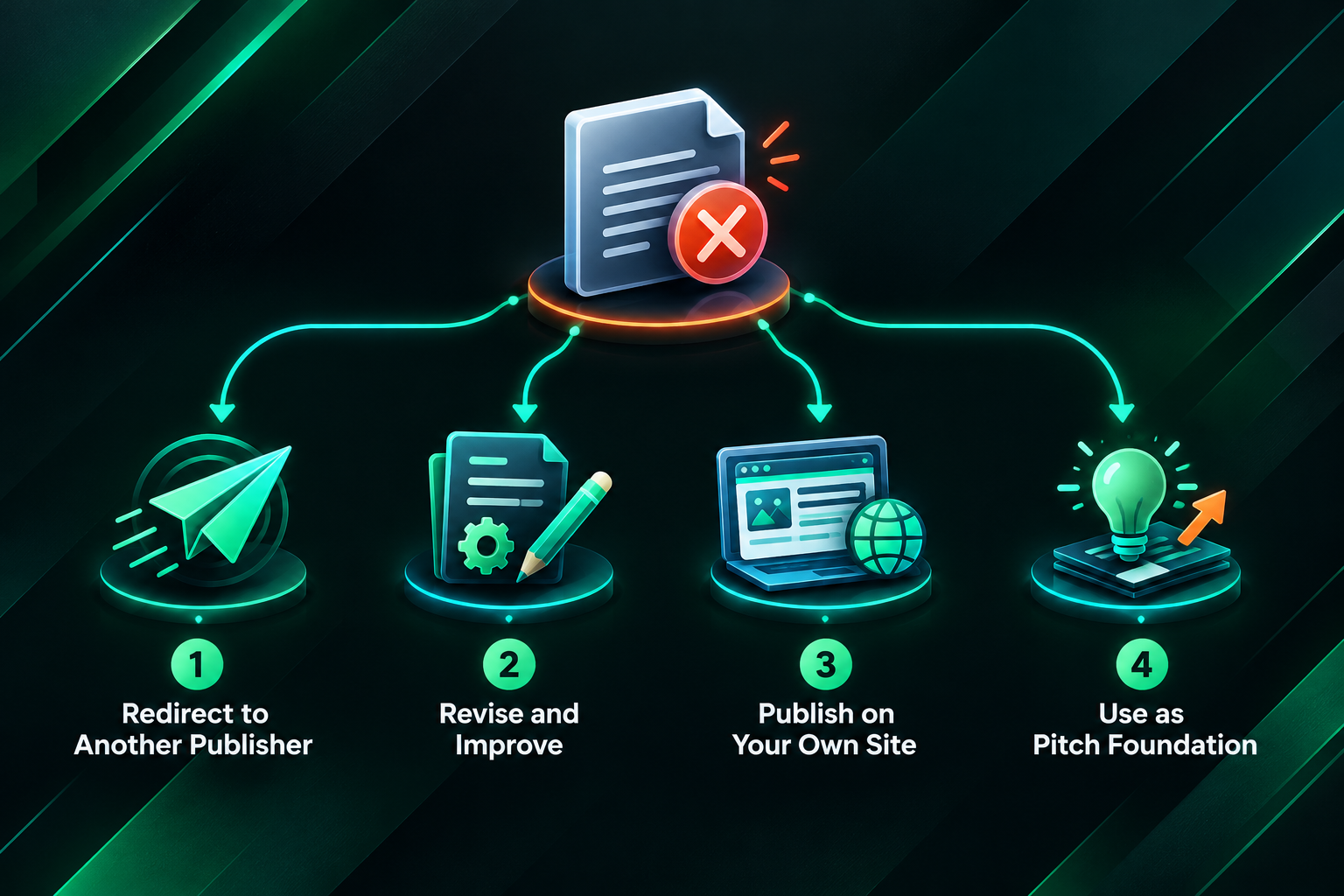
Redirect the Pitch to a More Suitable Publisher
If the rejection was primarily about topic fit rather than content quality, the same draft may be a strong candidate for a different publisher. Review your list of target sites and identify those whose editorial focus more closely matches the content you have already prepared. Before resubmitting, check that the content genuinely fits the new target’s audience and that you are not simply sending the same pitch to every site on your list without adjustment.
Revise and Improve Before Resubmitting
If the rejection included feedback about content quality, depth, or originality, use that feedback to improve the draft before sending it elsewhere. Adding original research, specific examples, updated data, or a more distinctive perspective can transform a generic submission into one that meets editorial standards. A revised draft that addresses the original weaknesses is more likely to succeed at the next target site.
Publish the Content on Your Own Platform
If the content is strong but simply not the right fit for external publication, consider publishing it on your own blog or resource section. Well-written content on your own site can support your organic search visibility, demonstrate topical authority, and serve as a reference point in future outreach. When pitching to publishers later, you can point to existing content as evidence of your writing quality and subject-matter knowledge.
Use the Draft as a Foundation for a Stronger Pitch
Sometimes a rejected draft reveals that your original angle was too broad, too basic, or too similar to content the publisher already has. Rather than discarding the work, use it as a research foundation for a more specific, differentiated pitch. Narrowing the topic, adding a unique data point, or approaching the subject from an underrepresented angle can make the next submission considerably stronger.
Improving Your Outreach Process After a Rejection
Individual rejections are less important than the patterns they reveal across your outreach programme. Tracking rejections systematically allows you to identify whether a problem is isolated or systemic.
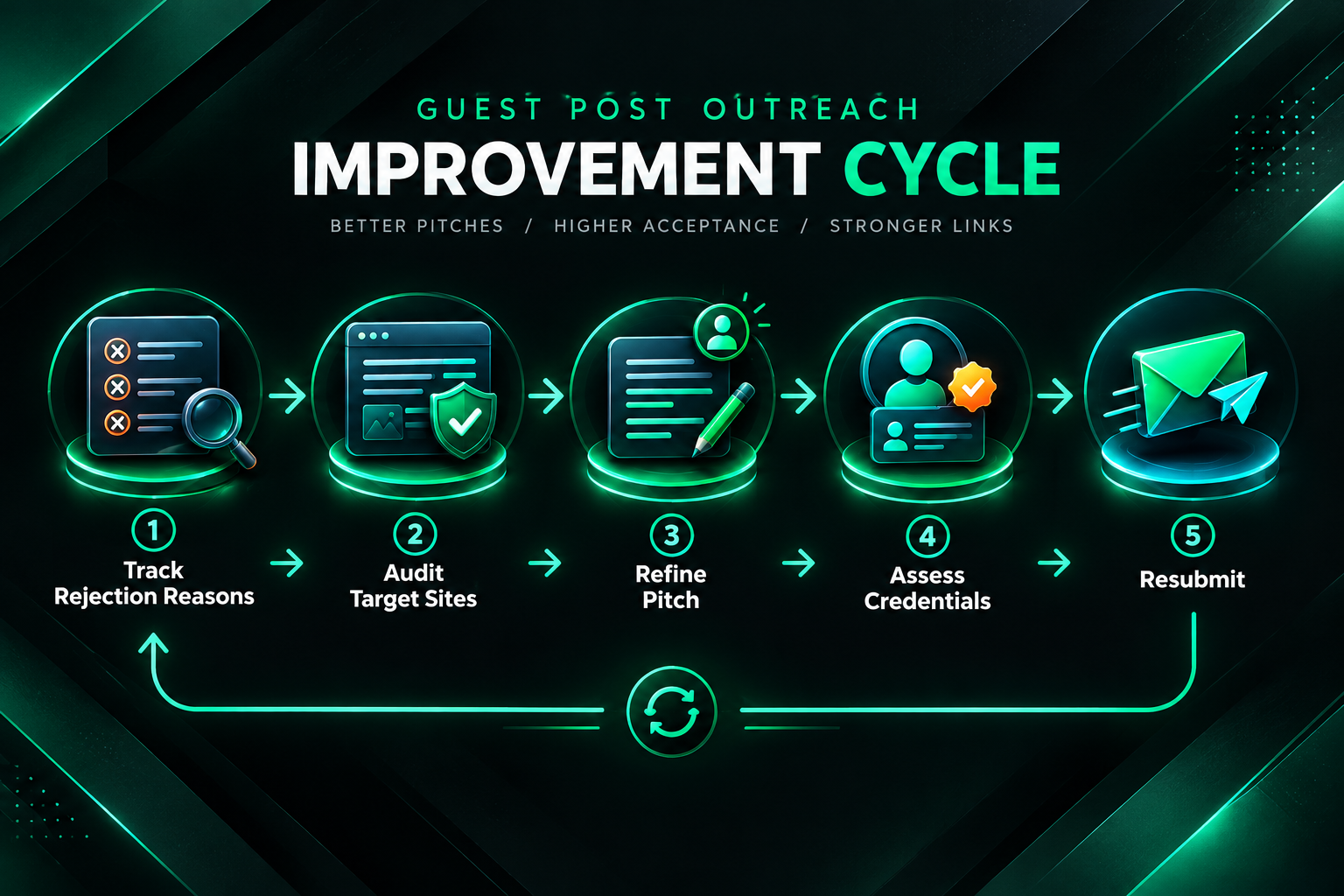
Audit Your Target Site Selection
Not every site that accepts guest posts is a suitable target for your campaign. A site’s willingness to publish external contributions does not automatically make it editorially relevant, topically aligned, or valuable from a link building perspective. When assessing potential publisher sites, consider the topical relevance of their existing content to your target pages, the quality and depth of their published articles, their apparent editorial standards, and whether their audience overlaps meaningfully with yours.
Third-party metrics such as Domain Rating from Ahrefs, Domain Authority from Moz, or Authority Score from Semrush can provide a rough indication of a site’s link profile strength, but these are proprietary estimates rather than Google-provided signals. They should inform your assessment alongside editorial quality and topical relevance rather than replace it. A high metric score on a site with poor editorial standards or no genuine audience is unlikely to produce meaningful SEO benefit.
Review Your Pitch Template and Personalisation
A pitch that reads as a template is easy for an experienced editor to identify. Effective outreach emails demonstrate that you have read the target site, understand its audience, and have a specific, relevant idea to offer. Personalisation does not mean inserting the editor’s name into a generic email; it means referencing a specific article, identifying a genuine content gap, and explaining clearly why your proposed topic would serve their readers.
Review your pitch open rates and response rates if you are tracking them. A very low response rate may indicate that your subject lines are not compelling, your pitches are too long, or your topic ideas are not differentiated enough. A high response rate but low acceptance rate may suggest that your content quality or topical fit needs attention.
Assess Your Author Bio and Credentials
Some publishers, particularly those in specialist or regulated industries, pay close attention to the contributor’s credentials and expertise. If your author bio does not clearly establish relevant experience or subject-matter knowledge, editors may be less confident in the submission. A bio that includes specific professional experience, published work, or relevant qualifications can improve your credibility with cautious editors.
Track Rejection Reasons Over Time
Maintaining a simple outreach tracker that records the target site, pitch date, topic proposed, outcome, and any feedback received allows you to identify patterns. If a significant proportion of your rejections cite the same reason, that reason deserves focused attention. If rejections are spread across different reasons, the issues may be more isolated and easier to address individually.
When to Move On and When to Try Again
Not every rejected pitch is worth pursuing further with the same publisher. Some situations call for moving on; others may justify a follow-up approach.
It may be worth attempting a revised pitch to the same publisher if the editor provided specific, actionable feedback, if the site is a high-priority target for your campaign, and if you can genuinely address the concerns raised. In this case, allow a reasonable interval before resubmitting, typically several weeks at minimum, and make the improvements substantive rather than cosmetic.
Moving on is usually the more efficient choice if the rejection was non-specific, if the editor indicated they are not currently accepting guest contributions, or if the site’s editorial focus has shifted away from your topic area. Redirecting your outreach effort toward better-matched publishers is generally more productive than repeatedly approaching a site that has already declined.
For campaigns with a large number of target sites, the volume of outreach activity means that individual rejections have a smaller proportional impact. Maintaining a healthy pipeline of prospective publishers reduces the pressure on any single submission and allows you to learn from rejections without disrupting overall campaign momentum.
Guest Post Rejection in the Context of a Broader Link Building Campaign
Guest posting is one link acquisition method among several, and its suitability depends on the website, industry, target pages, and campaign goals involved. Manual outreach for guest post placements typically involves a longer timeline than some other methods, partly because editorial review and publication scheduling are outside the outreach team’s control. Rejection rates are a normal part of this process, and realistic campaign planning should account for them.
For businesses or agencies managing outreach at scale, the administrative burden of tracking pitches, managing rejections, following up appropriately, and maintaining publisher relationships can be significant. This is one reason why some organisations choose to work with a specialist link building provider that manages the outreach process on their behalf. A provider with established publisher relationships and experience across different industries may be able to reduce rejection rates through better target selection and more refined pitch development, though outcomes still vary depending on the niche, the target site’s standards, and the quality of the content being offered.
It is also worth noting that guest posting is not always the most appropriate link acquisition method for every page or campaign goal. Niche edits, digital PR, resource page outreach, and other editorial link building approaches may be more suitable depending on the target page type, the competitive landscape, and the existing backlink profile. A site-specific assessment is generally more useful than defaulting to a single method for all link building objectives.
Quality Considerations That Affect Long-Term Value
The editorial standards that lead to guest post rejections are, in many cases, the same standards that determine whether a placed link carries meaningful value. A publisher that accepts any submission regardless of quality is unlikely to maintain the editorial credibility that makes its links useful over time. Conversely, a publisher with genuine editorial standards, an engaged audience, and consistent content quality is more likely to produce a placement that remains live, retains its context, and continues to contribute to your backlink profile.
This means that a rejection from a high-quality publisher, while frustrating in the short term, is not necessarily a negative outcome for your campaign. It may indicate that the publisher’s standards are high enough to make a successful placement genuinely valuable. Improving your submission to meet those standards is a more productive response than seeking out lower-quality alternatives that will accept content without meaningful editorial review.
Search engine guidance has consistently emphasised that links should be earned through genuine editorial merit rather than acquired purely for ranking purposes. While the practical interpretation of this guidance involves nuance, the underlying principle supports a focus on content quality and topical relevance as the foundation of a sustainable guest posting programme.
Frequently Asked Questions
Should I ask an editor why my guest post was rejected?
It is reasonable to politely ask for brief feedback if none was provided, particularly if the site is a high-priority target. Keep the request short and frame it as a genuine interest in improving your submission rather than a challenge to their decision. Many editors will not respond to feedback requests due to volume, so do not rely on receiving a detailed explanation.
How long should I wait before pitching the same site again?
A minimum of four to six weeks is generally appropriate after a rejection, and longer if the editor indicated they are not currently accepting contributions. When you do pitch again, make sure the new topic and submission are meaningfully different from the rejected one rather than a minor variation.
Can I submit the same article to multiple sites simultaneously?
Most publishers expect exclusive submissions and will reject content that has been published or is under consideration elsewhere. Simultaneous submission to multiple sites risks damaging your relationship with editors if they discover the practice. A sequential approach, where you submit to one site at a time and wait for a response before moving on, is the standard expectation in editorial guest posting.
Does a high rejection rate mean my link building strategy is not working?
Not necessarily. Rejection rates vary considerably by industry, niche competitiveness, and the quality tier of the sites you are targeting. A higher rejection rate from premium publishers may simply reflect their editorial standards rather than a fundamental problem with your approach. Tracking the reasons for rejection over time is more informative than the rejection rate alone.
Is it worth paying for guest post placements to avoid rejection?
Paid placements on sites that accept content in exchange for payment are a different category from editorially earned guest posts. Search engine guidelines generally require that paid links carry appropriate link attributes such as rel=”sponsored” or rel=”nofollow”. Sites that accept payment for followed links without disclosure may carry policy-related risks. The editorial value of a placement on a site that accepts any paid submission is also typically lower than one where content is reviewed on merit. These distinctions are worth considering when evaluating whether paid placement is an appropriate alternative to earned outreach.
How many outreach attempts should I expect before securing a placement?
Acceptance rates vary widely depending on the quality of the target sites, the relevance of the pitch, and the industry. There is no universal figure that applies across all campaigns. Experienced outreach practitioners generally plan for a meaningful proportion of pitches to be declined, and campaign timelines should reflect this reality rather than assuming a high acceptance rate from the outset.
Turning Rejection Into a More Effective Outreach Programme
Guest post rejection is an inherent part of editorial outreach, not a sign that the strategy is unsuitable. The most productive response is to treat each rejection as information: about the publisher’s standards, about the relevance of your topic, about the quality of your pitch, or about the fit between your content and the target audience. Addressing the specific reason for a rejection, rather than simply moving on without reflection, is what separates outreach programmes that improve over time from those that repeat the same mistakes at scale.
For businesses managing outreach internally, building a systematic process for tracking pitches, recording feedback, and refining submissions is a practical investment that compounds over time. For those working with an external link building provider, understanding how rejections are handled, how publisher relationships are maintained, and how content quality is assessed before submission are reasonable questions to raise during any campaign discussion. The goal in either case is a guest posting programme that earns placements on editorially credible sites, produces links that remain live and contextually relevant, and contributes to a backlink profile that supports your broader SEO objectives over the long term.