Your guest post author bio is a small section of text, but it carries more weight than most writers give it credit for. A well-crafted bio establishes your credibility with the publisher’s audience, supports the contextual relevance of your backlink, and can drive meaningful referral traffic to your website. A poorly written one, by contrast, reads like a sales pitch, gets edited down by the publisher, or fails to connect with readers at all. This guide explains what makes a guest post author bio effective, how to structure one, and how to align it with your broader link building goals.
Key Takeaways
- A guest post author bio should establish genuine credibility in two to four sentences, not summarise your entire career history.
- The anchor text and destination URL of your bio link matter for SEO; choose them deliberately rather than defaulting to your homepage.
- Topical relevance between your bio, the guest post content, and your linked page strengthens the contextual signal of the placement.
- Publisher guidelines vary widely; always check word limits, link policies, and formatting requirements before submitting.
- A bio written for one publication rarely works unchanged on another; tailor it to the audience and editorial tone of each site.
What a Guest Post Author Bio Actually Does
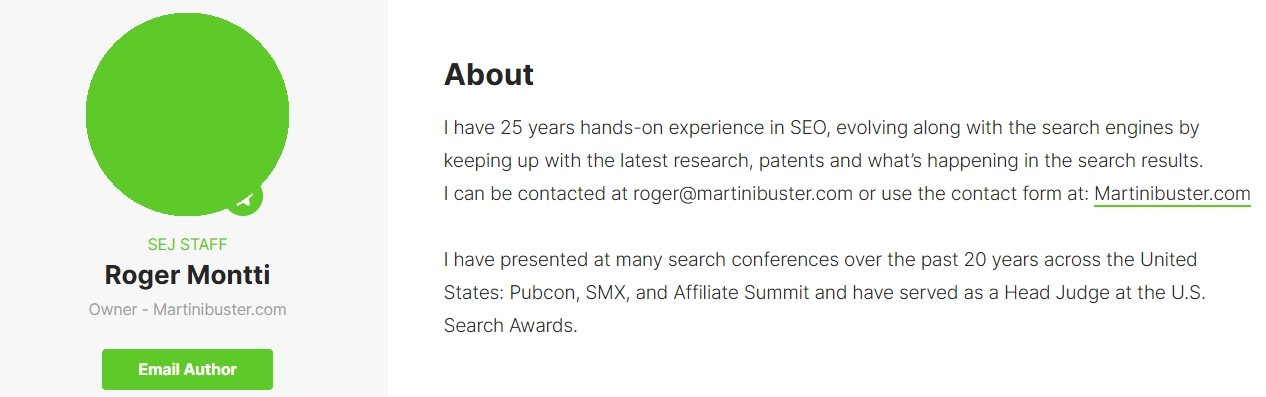
An author bio in a guest post serves three distinct functions simultaneously. For the reader, it answers the question: why should I trust this person’s advice? For the publisher, it signals that the contributor is a credible professional worth associating with. For the contributor, it is an opportunity to earn a contextually relevant backlink and, where the content resonates, referral traffic from a genuinely interested audience.
Understanding these three functions helps you avoid the most common mistake: writing a bio that serves only one of them. A bio that is purely self-promotional satisfies the contributor’s ego but alienates readers and may prompt the publisher to edit or remove it. A bio that is too vague satisfies no one. The goal is a short, honest, and relevant statement that makes the reader feel confident in the content they just read and curious enough to learn more about the author.
From a link building perspective, the author bio is also where the backlink typically lives. Unlike contextual links embedded within the body of an article, bio links are clearly attributed to the author rather than editorially endorsed within the content itself. This distinction matters when assessing the likely SEO value of a placement. A bio link on a high-quality, topically relevant publication still carries meaningful value, but it is worth understanding that its context differs from a link woven naturally into the article body.
Core Elements of an Effective Author Bio
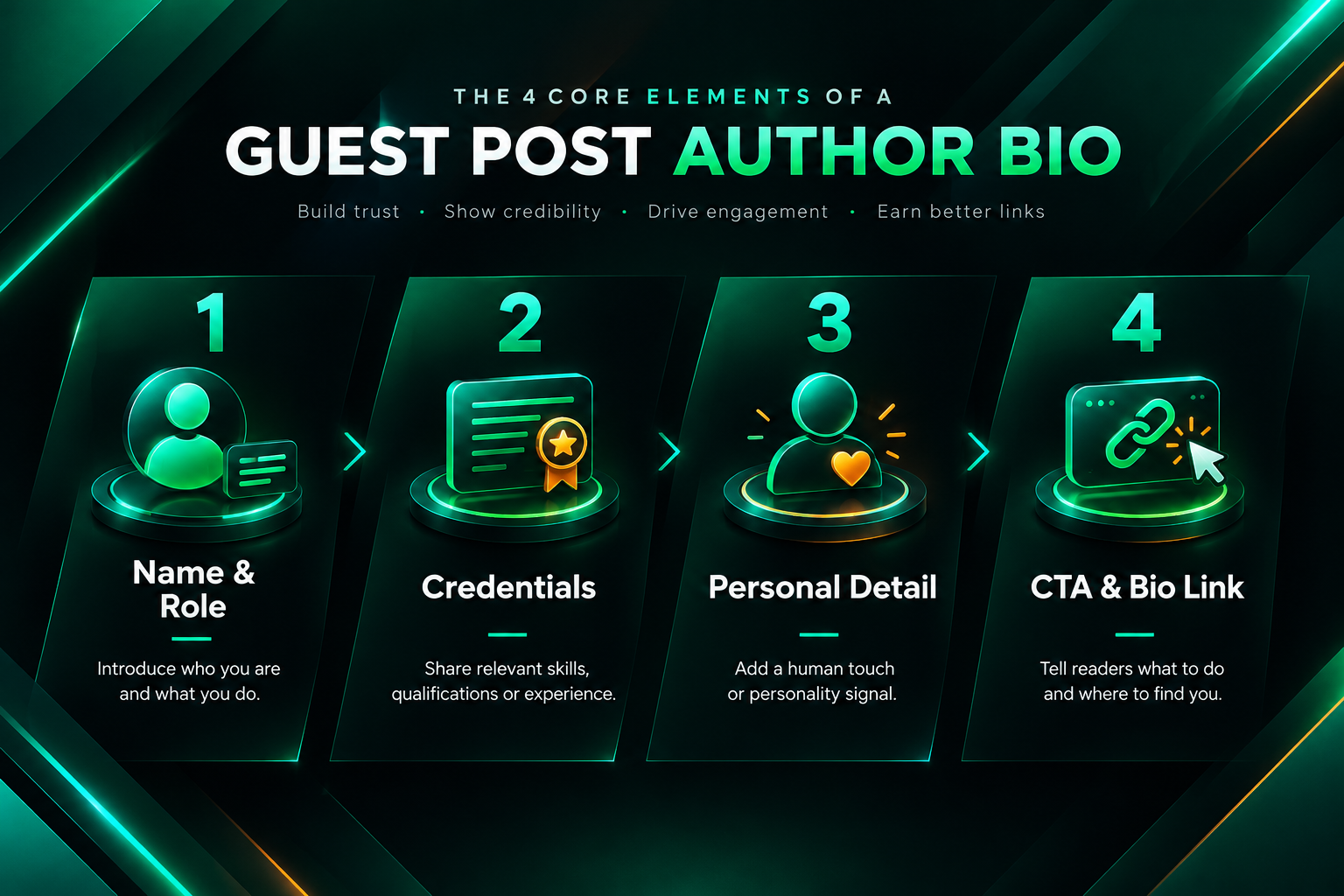
Most effective guest post author bios share a consistent structure, even when the wording and tone vary significantly between industries. The following elements are worth including in almost every bio, though the order and emphasis will depend on the publication and audience.
Your Name and Professional Role
Begin with your name and a clear, specific description of what you do. Avoid vague titles like “entrepreneur” or “digital expert” unless the publication’s audience genuinely responds to that framing. A specific role — such as “content strategist at a B2B SaaS company” or “e-commerce SEO consultant” — immediately tells the reader who you are and whether your perspective is relevant to them. If you are writing on behalf of a business rather than as an individual, clarify that relationship early.
Relevant Credentials or Experience
One or two sentences of relevant experience are usually sufficient. Focus on credentials that are directly connected to the topic of the guest post. If you wrote about technical SEO, mention your years of experience in that area or a notable project you have worked on. If you wrote about e-commerce conversion optimisation, reference your background in that field. Credentials that are unrelated to the article topic add length without adding trust.
Avoid listing every qualification you hold. Publishers often impose word limits of 50 to 150 words on author bios, and readers rarely read long biographical paragraphs in full. Prioritise the one or two facts that most directly support the credibility of the article they just finished reading.
A Human Detail or Personality Signal
Many effective author bios include one brief personal detail — a location, a hobby, or a professional interest outside the immediate topic. This is not mandatory, and it should not feel forced, but it can make a bio more memorable and more human. Publications with a conversational editorial tone tend to welcome this; more formal industry publications may not. Match the tone of the site you are writing for.
A Clear Call to Action and Your Bio Link
The final sentence of your bio should direct the reader somewhere specific. This is where your backlink lives, and the destination matters both for referral traffic and for the SEO context of the placement. Rather than defaulting to your homepage, consider linking to a page that is directly relevant to the topic of the guest post. If your article covered SaaS onboarding strategies, a link to a relevant resource, service page, or case study on your site is more useful to the reader and more contextually coherent for search engines than a generic homepage link.
The anchor text you use for this link also deserves thought. Branded anchor text — your name or company name — is the most natural choice for an author bio and carries the lowest risk of appearing manipulative. Partial-match or descriptive anchor text can work when it reads naturally in context, but exact-match keyword anchors in author bios often look unnatural and may be edited by the publisher. When in doubt, use your brand name or a simple phrase like “learn more at [Brand]” and let the destination page carry the topical relevance.
Length, Tone, and Format
Most publishers expect an author bio of between 50 and 150 words. Some high-volume content sites accept shorter bios of two to three sentences; others, particularly those with a strong community focus, may allow up to 200 words. Always check the publisher’s contributor guidelines before drafting your bio, because submitting a 200-word bio to a site that requests 75 words signals that you have not read the guidelines — which reflects poorly on the submission overall.
Write in the third person unless the publisher explicitly requests first person. Third-person bios are the standard convention for guest contributions because they read as an editorial introduction rather than a self-written advertisement. “Jane Smith is a content strategist who helps B2B companies…” reads more credibly than “I am a content strategist who helps B2B companies…” in most editorial contexts.
Tone should match the publication. A bio submitted to a technical developer blog should be precise and understated. A bio for a marketing industry newsletter can be slightly warmer and more conversational. A bio for a legal or financial publication should be formal and credential-focused. Reading several existing author bios on the target site before writing your own is one of the most practical steps you can take.
Tailoring Your Bio to Each Publication
A single generic author bio submitted to every guest post opportunity is a missed opportunity. Different publications attract different audiences, and the credential or experience that resonates with a startup founder reading a growth marketing blog may be entirely different from what resonates with a procurement manager reading a supply chain industry publication.
Tailoring does not mean rewriting your bio from scratch every time. It means identifying which one or two elements of your background are most relevant to this specific audience and leading with those. Keep a master document with your full professional background, then draft each bio by selecting the most relevant elements for the publication in question. This approach takes a few extra minutes per submission but produces noticeably better results in terms of reader engagement and publisher approval rates.
Topical alignment between your bio and the guest post content also matters for the overall coherence of the placement. If your bio describes you as a specialist in one area but your article covers a different topic, the mismatch can undermine the reader’s trust in both the content and the author. Where possible, ensure that your stated expertise in the bio directly supports the subject matter of the article.
Bio Links and Their Role in Link Building Campaigns
When guest posting is used as part of a structured link building campaign, the author bio link is one of the key deliverables of each placement. Understanding how bio links function within a broader campaign helps you make better decisions about anchor text, destination pages, and publication selection.
Bio links are generally considered less contextually powerful than links embedded within the body of an article, because they are attributed to the author rather than editorially recommended within the content. However, bio links on high-quality, topically relevant publications can still contribute meaningfully to a backlink profile, particularly when the destination page is relevant to the article topic and the publication has genuine editorial standards.
The destination page you link to from your bio should align with your campaign’s target pages. If a campaign is focused on building authority to a specific service page or resource, the bio link should point there rather than to the homepage by default. This requires some coordination between the person writing the bio and the team managing the broader link building strategy, particularly in outsourced or agency-managed campaigns where multiple contributors may be involved.
It is also worth noting that some publishers do not allow followed links in author bios, or they apply a nofollow or sponsored attribute automatically. This does not necessarily make the placement worthless — referral traffic, brand visibility, and the editorial relationship with the publisher all have value — but it is a factor to clarify before investing significant effort in a placement. Checking the link attributes on existing author bios on the target site is a straightforward way to assess this before submitting.
Common Mistakes to Avoid
Several recurring errors appear in guest post author bios across industries. Being aware of them makes it easier to avoid them in your own submissions.
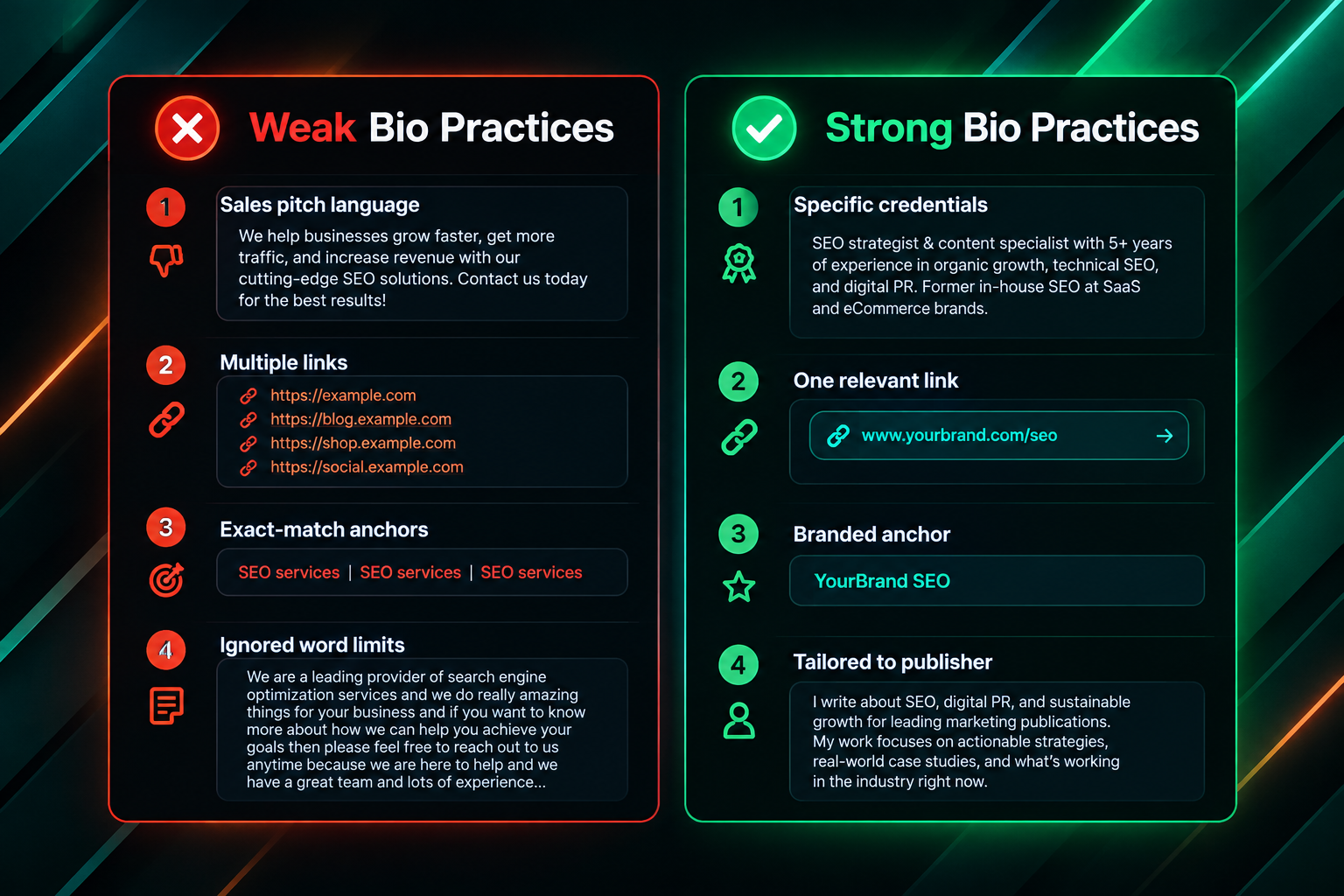
- Writing a sales pitch instead of a bio. Phrases like “award-winning,” “industry-leading,” or “passionate about helping businesses grow” are overused and unconvincing. Specific, verifiable credentials are more persuasive than superlatives.
- Including too many links. Most publishers allow one link in an author bio. Attempting to include two or three links, or embedding additional links in the bio text, is likely to result in edits or rejection. Use your one link wisely.
- Using exact-match keyword anchor text. Anchor text like “best SEO agency London” in an author bio looks manipulative and may be edited by the publisher or flagged by search engines. Branded or natural descriptive anchors are safer and more credible.
- Ignoring the publisher’s word limit. Submitting a bio that significantly exceeds the stated limit suggests the contributor has not read the guidelines. Publishers may truncate the bio arbitrarily, which can result in the link being cut.
- Using the same bio everywhere. A bio that was written for a technology publication and submitted unchanged to a healthcare industry blog will feel generic and may not pass editorial review on sites with stricter contributor standards.
- Linking to a page that is irrelevant to the article. A bio link that points to a page with no topical connection to the guest post content weakens the contextual coherence of the placement and provides less value to the reader.
Practical Bio Templates by Context
The following examples illustrate how the same professional might adapt their author bio for different publications. These are structural templates, not scripts; the specific details should always reflect genuine credentials.
Template for a Technical or B2B Publication
“[Name] is a [specific role] with [X] years of experience in [relevant field]. [He/She/They] has worked with [type of clients or companies] on [relevant area of work]. Learn more at [Brand URL].”
This format is concise, credential-focused, and appropriate for audiences who value precision over personality. It works well for software, finance, legal, and engineering publications.
Template for a Marketing or Growth Publication
“[Name] is a [role] at [Company], where [he/she/they] helps [type of clients] with [specific outcome]. When not [relevant professional activity], [he/she/they] writes about [topic] at [Brand URL].”
This format is slightly warmer and includes a light personal element. It suits marketing, entrepreneurship, and business growth publications where a conversational tone is expected.
Template for a Niche Industry Publication
“[Name] specialises in [specific niche] and has [specific credential or experience relevant to the article topic]. [He/She/They] works with [type of clients] and shares practical resources at [Brand URL].”
This format leads with the niche specialisation, which is particularly useful when writing for a tightly focused industry publication where the audience expects deep subject-matter expertise.
Updating and Managing Author Bios Across Multiple Placements
For businesses running ongoing guest posting campaigns, author bio management becomes a practical operational consideration. As your credentials, role, or target pages change over time, older bios on live placements may become outdated. Most publishers do not update author bios retroactively unless you contact them directly, so it is worth keeping a record of where each bio version was submitted and what link destination it used.
If a target page changes URL or is removed, the bio link on existing placements will point to a dead or redirected page. Monitoring your backlink profile periodically using tools such as Ahrefs, Semrush, or Google Search Console can help you identify broken or redirected bio links and, where appropriate, contact publishers to request an update.
In agency-managed or outsourced link building campaigns, the author bio is typically agreed upon during the onboarding or campaign setup phase. Providing a clear, tailored bio — along with the preferred anchor text and destination URL — at the start of a campaign reduces delays and ensures that each placement reflects the intended brand positioning. Leaving bio details vague or unspecified often results in generic placeholder text that does not serve the campaign’s goals.
Frequently Asked Questions
How long should a guest post author bio be?
Most publishers expect between 50 and 150 words. Always check the contributor guidelines for the specific publication, as limits vary. When no guidance is given, two to three focused sentences covering your role, relevant experience, and a link to your site is a safe default.
Should I write my author bio in first or third person?
Third person is the standard convention for guest post author bios. It reads as an editorial introduction rather than self-promotion. Some publications explicitly request first person; follow their guidelines if so.
Can I include more than one link in my author bio?
Most publishers allow one link. Attempting to include multiple links is likely to result in edits or rejection. Use your single link to point to the most relevant and valuable destination for the campaign goal.
Does the anchor text in my author bio affect SEO?
Anchor text in bio links contributes to the overall anchor text profile of the destination page, but bio links are generally attributed to the author rather than editorially recommended. Branded or natural descriptive anchor text is the most appropriate choice for bio links. Exact-match keyword anchors in author bios can appear manipulative and may be edited by publishers.
What page should I link to from my author bio?
Link to a page that is directly relevant to the topic of the guest post and aligned with your campaign’s target pages. This could be a service page, a resource, a case study, or a relevant blog post — not necessarily your homepage. The destination should provide genuine value to a reader who clicks through from the bio.
Do I need a different bio for every guest post?
Not entirely, but tailoring your bio to each publication improves its effectiveness. Keep a master bio document and select the most relevant credentials and framing for each specific audience. The link destination may also change depending on the topic of each guest post.
What happens if a publisher edits my author bio?
Publishers may shorten, reformat, or remove elements of your bio to fit their editorial standards. Submitting a bio that already meets their guidelines reduces the likelihood of significant edits. If a link is removed or altered, you can contact the publisher to clarify, but editorial decisions are ultimately theirs to make.
Writing a Bio That Works for Both Readers and Your Link Building Goals
A guest post author bio is a small piece of writing with a disproportionate impact on the overall value of a placement. When it is written with the reader in mind — specific, credible, and relevant to the article topic — it builds the kind of trust that makes people click through and engage with your site. When it is written purely as a vehicle for a backlink, it tends to underperform on both fronts: readers ignore it and publishers edit it.
The most effective approach treats the bio as an extension of the guest post itself. The article demonstrates your expertise; the bio confirms who you are and where to find more of your work. The link in the bio should point somewhere that genuinely continues that conversation for an interested reader, which also happens to be the most contextually coherent destination from a link building perspective.
If you are managing guest posting as part of a broader link building campaign — whether in-house or through an outsourced provider — it is worth investing time in bio templates that can be adapted efficiently for each placement. Clear guidance on preferred anchor text, destination URLs, and tone reduces friction during the outreach and publication process and ensures that each bio reflects the campaign’s strategic goals rather than being an afterthought. A well-prepared bio, submitted alongside a strong article to a relevant, quality publication, is one of the more straightforward ways to make each guest post placement work harder for your site.