Shortened URLs are everywhere — in social media posts, email newsletters, printed materials, and influencer campaigns. But when it comes to SEO, a common and reasonable question arises: do shortened URLs actually pass link equity, or does the shortening process strip away the ranking value that makes a backlink worth having? The answer depends on how the shortener works, which redirect type it uses, and where the shortened link appears. This article explains the mechanics clearly so you can make informed decisions about when shortened URLs are acceptable in an SEO context and when they are not.
Key Takeaways
- Most reputable URL shorteners use 301 permanent redirects, which generally pass link equity — but this is not guaranteed for every service or implementation.
- The redirect type matters significantly: a 301 redirect typically passes most link equity, while a 302 or JavaScript redirect may not pass equity reliably.
- Even when a shortened URL does pass link equity, the intermediate domain adds a hop in the redirect chain, which may dilute some of the signal compared to a direct link.
- For deliberate link building campaigns, a direct editorial link to your target page is almost always preferable to a shortened URL.
- Shortened URLs can serve legitimate purposes in tracking and distribution, but they should not be treated as a substitute for high-quality, direct backlinks in an SEO strategy.
How URL Shorteners Work
A URL shortener takes a long destination URL and creates a shorter alias hosted on a different domain — for example, converting a lengthy product page address into a compact link using a service like bit.ly or t.co. When a user or search engine crawler follows the shortened link, the shortener’s server responds with a redirect instruction that points to the original destination URL. The type of redirect used at that step is what determines whether link equity is passed, and how much of it reaches the destination page.
The redirect happens server-side in most cases, meaning the browser or crawler receives an HTTP status code along with the destination address. The most common status codes relevant to link equity are 301 (moved permanently), 302 (found, or moved temporarily), and 307 (temporary redirect). A 301 redirect signals to search engines that the move is permanent and that the destination URL should inherit the authority associated with the linking page. A 302 or 307 redirect signals a temporary move, and search engines have historically been more cautious about passing full link equity through temporary redirects, though documented behavior has evolved over time.
Some URL shorteners also use JavaScript-based redirects or meta-refresh redirects rather than server-side HTTP redirects. These methods are generally less reliable for passing link equity because search engine crawlers may not execute JavaScript in the same way a browser does, and meta-refresh redirects have historically been treated with less trust than clean server-side 301 redirects.
Do 301 Redirects Through Shorteners Pass Link Equity?
Google has publicly stated that 301 redirects pass PageRank, and this guidance has been consistent in official documentation and statements from Google Search representatives over many years. Based on this, a shortened URL that uses a clean 301 redirect should, in principle, pass link equity to the destination page. Services such as bit.ly have historically used 301 redirects, which is why many SEOs consider them relatively safe from a link equity perspective compared to shorteners that use 302 redirects.
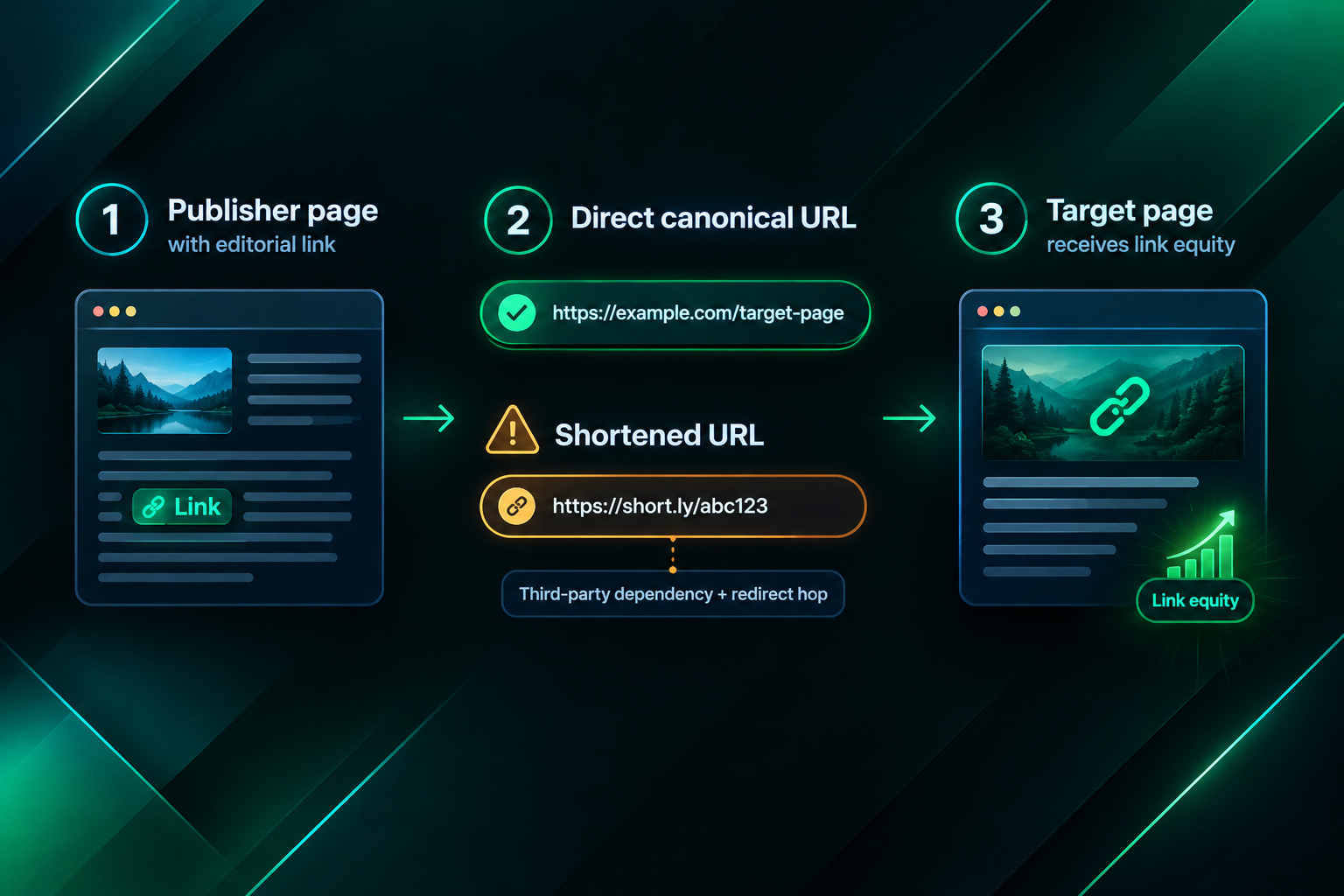
However, there are important nuances. First, every redirect hop introduces a small amount of potential signal loss. A direct link from a publisher’s page to your target URL involves one connection. A shortened URL adds an intermediate domain, meaning the crawler must follow a redirect before reaching the destination. While Google has indicated that a single clean 301 redirect should not significantly reduce PageRank, a chain of multiple redirects — for example, a shortened URL that redirects to another redirect before reaching the final page — can reduce the equity that ultimately arrives at the destination.
Second, the trustworthiness and crawlability of the shortener’s domain matters. If a URL shortening service has a poor reputation, has been used heavily for spam, or if its domain is not reliably crawled, the redirect may not be followed consistently. Google’s crawler needs to be able to access and process the redirect for any equity to flow through it. A shortener domain that is slow, frequently unavailable, or associated with low-quality content may reduce the reliability of equity transfer.
Third, some URL shorteners have changed their redirect behavior over time, switched from 301 to 302 redirects, or added intermediate pages that require user interaction before the redirect completes. Any of these changes can affect whether link equity passes reliably.
The Difference Between 301 and 302 Redirects for Link Equity
Understanding the distinction between redirect types is essential for evaluating any shortened URL in an SEO context. A 301 redirect tells search engines that the resource has permanently moved to a new location. Search engines interpret this as an instruction to consolidate signals — including link equity — to the destination URL. Over time, the destination URL should accumulate the authority that would otherwise have been associated with the source URL.
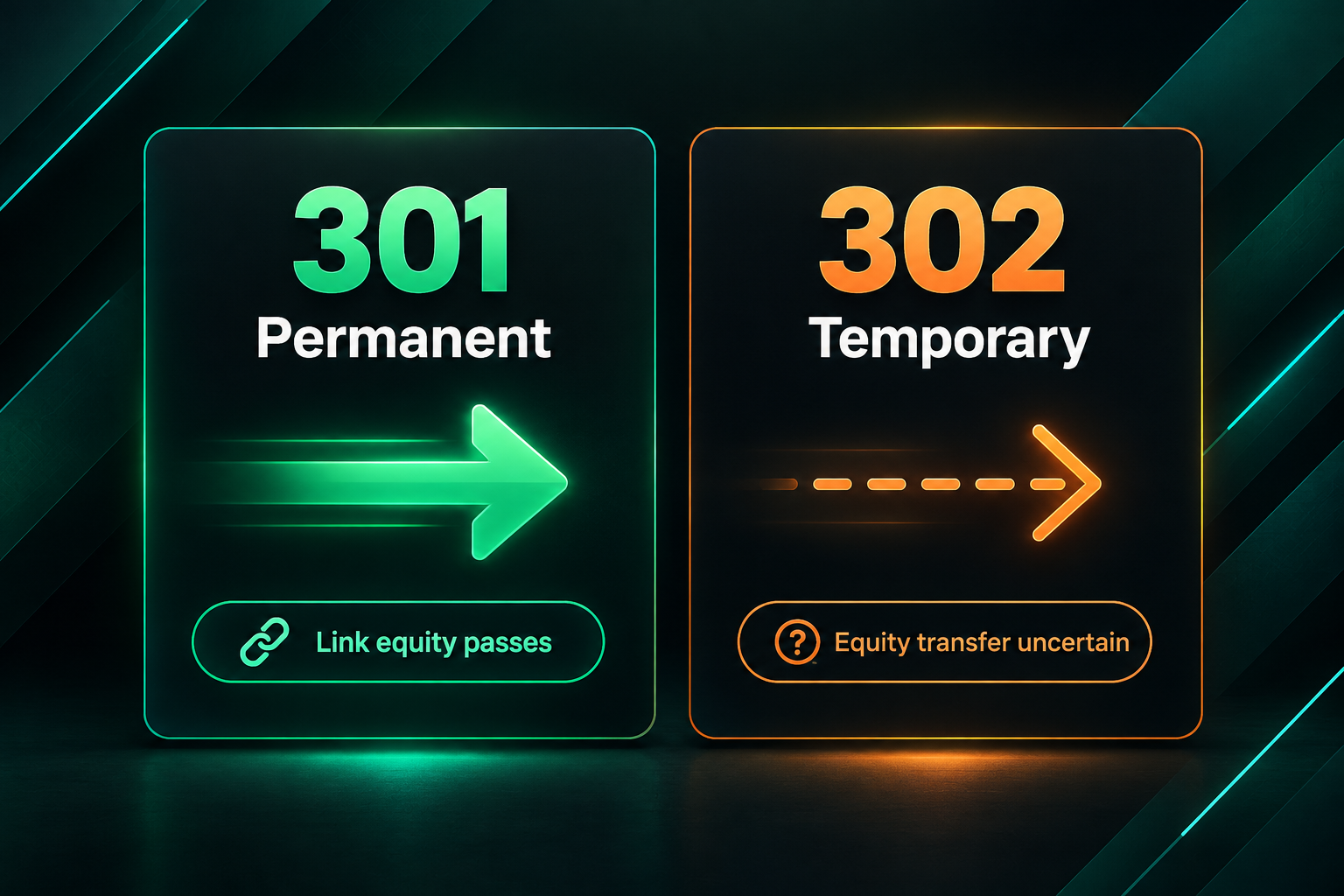
A 302 redirect tells search engines that the move is temporary and that the original URL may return. Historically, search engines were reluctant to pass full link equity through 302 redirects because the original URL was expected to remain the canonical destination. Google has acknowledged that in practice its systems sometimes treat long-standing 302 redirects similarly to 301 redirects, but this behavior is not guaranteed and should not be relied upon in a deliberate link building strategy.
A JavaScript redirect or meta-refresh redirect is even less predictable. Search engine crawlers may not execute JavaScript at the time of crawling, meaning the redirect may not be followed at all during the initial crawl. Even when crawlers do execute JavaScript, the equity transfer is less reliable than a clean server-side 301 redirect. If a URL shortener relies on JavaScript to redirect users, the shortened link may effectively be invisible to search engines from a link equity perspective.
Where Shortened URLs Typically Appear and Why It Matters
The context in which a shortened URL appears affects both its SEO value and its practical usefulness. Shortened URLs are most commonly found in social media posts, SMS messages, printed marketing materials, email campaigns, and some online forum posts. Each of these contexts has different implications for link equity.
Social media platforms such as Twitter (now X), Facebook, and LinkedIn often apply their own redirect layers on top of any shortened URL, and many social media links carry a nofollow or ugc (user-generated content) link attribute. A nofollow attribute instructs search engines not to pass link equity through the link, regardless of whether the underlying redirect is a 301. This means that a shortened URL shared on a social media platform is unlikely to contribute meaningful link equity to the destination page, even if the shortener itself uses a 301 redirect.
Editorial content on third-party websites is a different situation. If a publisher includes a shortened URL as a hyperlink within an article, the link attribute applied to that link — follow, nofollow, sponsored, or ugc — determines whether equity can flow. A followed shortened URL using a 301 redirect in an editorial context may pass some equity, but a direct followed link to the same destination page would generally be preferable because it removes the intermediate redirect hop and the associated uncertainty.
Email newsletters typically do not contribute to link equity at all, because email clients do not render pages that search engines crawl. Links in emails are valuable for referral traffic and brand awareness but are not a source of backlink equity.
Printed materials and offline media that include shortened URLs are similarly irrelevant to link equity, since search engines cannot crawl physical documents. The shortened URL in this context serves only as a convenient way for people to type a short address into a browser.
Redirect Chains and Their Effect on Link Equity
A redirect chain occurs when a URL redirects to another URL, which then redirects again before reaching the final destination. Each additional hop in the chain introduces potential signal loss and increases the risk that a search engine crawler will stop following the chain before reaching the destination. Google’s crawl budget — the number of pages Googlebot will crawl on a given website within a period — can also be affected by redirect chains, particularly on large websites.
Shortened URLs can contribute to redirect chains in several ways. If the destination URL itself has been redirected — for example, because a page was moved and a 301 redirect was set up — then a shortened URL pointing to the old address creates a two-hop chain: shortened URL → old URL → new URL. If the destination page has undergone multiple migrations, the chain can become longer. In these situations, the equity that reaches the final destination may be meaningfully reduced compared to a direct link pointing to the current canonical URL.
For link building campaigns, this is a practical reason to avoid using shortened URLs as the link destination. When a publisher places a link in an article, the link should point directly to the target page’s current canonical URL. This eliminates unnecessary redirect hops, ensures that equity flows as directly as possible, and makes it easier to verify the link using tools such as Ahrefs, Semrush, or Majestic.
How Search Engine Crawlers Handle Shortened URLs
Googlebot and other search engine crawlers follow redirects as part of the crawling process. When a crawler encounters a shortened URL, it will typically follow the redirect to the destination and index the destination page rather than the shortened URL itself. This means that in most cases, the shortened URL itself will not appear as a referring URL in backlink analysis tools — the tools will report the destination URL as the linked page, and the source will be the publisher’s page where the link appeared.
However, crawlers do not always follow every redirect immediately. Crawl frequency depends on the perceived importance of the linking page, the crawl budget allocated to the site, and the server response times of both the shortener and the destination. A shortened URL on a low-authority page may not be crawled and processed quickly, which can delay any potential equity transfer.
It is also worth noting that some URL shorteners require cookies or JavaScript to complete the redirect, which can prevent crawlers from following the link at all. Before using a shortened URL in any context where link equity matters, it is worth verifying the redirect behavior using an HTTP header checker tool to confirm the status code and destination.
Shortened URLs in Link Building Campaigns: Practical Considerations
For businesses and SEO agencies running deliberate link building campaigns — whether through manual outreach, guest posting, niche edits, or digital PR — shortened URLs are generally not recommended as the link format. The goal of a link building campaign is to acquire followed, direct editorial links that pass as much equity as possible to the target page. Introducing a shortened URL adds unnecessary complexity, potential equity loss, and a dependency on a third-party service that may change its redirect behavior or cease to operate in the future.
There are, however, legitimate reasons to use shortened URLs in adjacent marketing activities. Campaign tracking is one example: a marketer may use a shortened URL with UTM parameters embedded in the destination to track clicks from a specific email or social media post. In this case, the shortened URL serves a measurement purpose rather than an SEO purpose, and the distinction is important. Tracking clicks and measuring referral traffic is valuable, but it should not be confused with building link equity.
Another consideration is link attribution in backlink analysis. When a publisher uses a shortened URL in an article, the link may not appear in backlink analysis tools in the same way as a direct link. Some tools may report the shortened URL as the link, while others may follow the redirect and report the destination. This inconsistency can make it harder to monitor your backlink profile accurately and to verify that placements are delivering the expected equity.
Assessing Link Quality: Beyond the URL Format
Whether a link uses a shortened URL or a direct URL, the fundamental quality factors that determine its SEO value remain the same. These include the topical relevance of the linking page to the destination page, the authority and trustworthiness of the linking domain, the placement context within the content, the link attribute (followed versus nofollow), and the anchor text used. A high-quality followed editorial link from a topically relevant, authoritative publisher will generally be more valuable than a low-quality direct link from an irrelevant or low-authority source, regardless of URL format.
When evaluating backlinks, SEO professionals commonly use third-party metrics such as Domain Rating (Ahrefs), Domain Authority (Moz), Authority Score (Semrush), and Trust Flow (Majestic) as proxies for domain-level authority. These are proprietary metrics and are not provided by Google. They can be useful for comparative assessment, but they should not be treated as direct measures of how much equity a link will pass or how much a link will improve rankings. A site-specific assessment of the linking domain’s relevance, content quality, and link profile is more informative than any single metric.
For link building campaigns, the practical implication is that the URL format — shortened or direct — is a secondary concern compared to the quality of the publisher, the relevance of the placement, and the link attribute. Fixing a shortened URL to be a direct link is a worthwhile improvement, but it will not transform a low-quality placement into a high-quality one.
When Shortened URLs May Be Acceptable in an SEO Context
There are limited situations where a shortened URL may be acceptable without significant concern about link equity loss. If the shortened URL uses a verified 301 redirect, points directly to the canonical destination URL without additional redirect hops, appears on a followed editorial link on a relevant and authoritative page, and the shortener’s domain is reliably crawled, then the equity transfer is likely to be close to that of a direct link — though not identical.
Brand-owned shorteners are a specific case worth noting. Some large organizations operate their own URL shortening domains — for example, a news organization using a short version of its own domain for social sharing. In this case, the shortener domain is controlled by the same entity as the destination, the redirect behavior is predictable, and the domain is likely to be well-crawled. This is meaningfully different from using a third-party shortening service where the redirect behavior is outside your control.
For most link building purposes, however, the safest and most effective approach is to use direct links to the canonical target URL. This eliminates uncertainty about redirect behavior, avoids dependency on third-party services, and makes backlink monitoring straightforward.
Frequently Asked Questions
Does a bit.ly link pass SEO value to my website?
Bit.ly has historically used 301 redirects, which generally pass link equity. However, the equity transfer depends on whether the link is followed (not nofollow), whether the redirect chain is short, and whether the linking page itself has meaningful authority and relevance. A direct link to your page is preferable for link building purposes.
Will Google follow a shortened URL when crawling?
Googlebot generally follows server-side 301 and 302 redirects, including those used by URL shorteners. However, crawl frequency depends on the authority of the linking page and Googlebot’s crawl budget. JavaScript-based redirects may not be followed reliably during the initial crawl.
Can I use shortened URLs in a guest post for SEO?
It is not recommended. Guest post links should point directly to the canonical target URL to maximize equity transfer and simplify backlink monitoring. A shortened URL adds an unnecessary redirect hop and introduces dependency on a third-party service.
Do social media shortened URLs count as backlinks?
Most social media platforms apply nofollow or ugc link attributes to links, including shortened URLs. Nofollow links do not pass link equity in the traditional sense, though they may contribute to referral traffic and brand visibility. They are generally not counted as equity-passing backlinks in SEO analysis.
How can I check what redirect type a shortened URL uses?
You can use an HTTP header checker tool — several free options are available online — to inspect the status code returned by a shortened URL. Enter the shortened URL and the tool will show whether the server responds with a 301, 302, 307, or another status code, along with the destination URL.
Does a redirect chain from a shortened URL hurt my SEO?
A long redirect chain can reduce the equity that reaches the final destination and may slow down crawling. If a shortened URL points to a page that has itself been redirected, the chain becomes longer. For link building, pointing directly to the current canonical URL avoids this issue entirely.
Are there situations where shortened URLs are useful in SEO work?
Shortened URLs with tracking parameters are useful for measuring referral traffic from specific campaigns, but this is a measurement function rather than an SEO function. For link equity purposes, direct links are almost always preferable. Brand-owned shorteners that use clean 301 redirects to their own canonical URLs are a lower-risk exception.
What This Means for Your Link Building Strategy
The core answer to whether shortened URLs pass link equity is: they can, but with conditions and caveats that make them a poor choice for deliberate link building. A shortened URL using a clean 301 redirect on a followed editorial link from an authoritative, relevant publisher will likely pass most of its equity to the destination — but a direct link from the same publisher would pass that equity more reliably, without the intermediate hop, without dependency on a third-party service, and without the monitoring complications that shortened URLs introduce.
For businesses and agencies managing link acquisition campaigns, the practical guidance is straightforward: request direct links to canonical target URLs in all outreach, guest posting, and niche edit placements. Verify that placements use followed link attributes and point to the correct destination without unnecessary redirect chains. Use shortened URLs only where they serve a clear non-SEO purpose, such as click tracking in email or social campaigns, and keep that function separate from your link equity strategy.
If you are reviewing an existing backlink profile and find shortened URLs among your referring links, it is worth checking the redirect behavior of each one to confirm whether equity is likely flowing through. Tools such as Ahrefs, Semrush, and Majestic may report these links differently depending on whether they follow the redirect, so a manual HTTP header check can provide a clearer picture. Where a shortened URL is pointing to an outdated or redirected destination URL, reaching out to the publisher to update the link to the current canonical URL is a reasonable and often achievable improvement.
Link building is most effective when every element of the placement — the publisher quality, the topical relevance, the link attribute, the anchor text, and the destination URL — is optimized deliberately. URL format is one of the simpler factors to control, and getting it right costs nothing beyond a clear brief to your outreach team or link building partner.