Testimonial link building is a white-hat link acquisition method where a business provides a genuine review or endorsement of a product, tool, or service it uses, and in return receives a backlink from the vendor’s website. It is one of the more straightforward outreach-based strategies available to SEO teams, but like any link building tactic, its value depends heavily on execution quality, publisher relevance, and how it fits within a broader campaign.
Key Takeaways
- Testimonial link building involves writing a genuine endorsement for a vendor in exchange for a contextual backlink from their website.
- The strategy works best when the vendor’s site is topically relevant, editorially credible, and has a meaningful backlink profile of its own.
- Links acquired through testimonials are typically editorial in nature, but the arrangement should still be assessed carefully against search-engine link policies.
- Results vary depending on the authority of the linking domain, the relevance of the placement, and the overall strength of your existing backlink profile.
- Testimonial link building is most effective as one component of a diversified link acquisition strategy rather than a standalone campaign.
How Testimonial Link Building Works
The core process is straightforward. A business identifies tools, platforms, software, or services it genuinely uses and values. It then reaches out to the vendor, offering to write a short testimonial or case study in exchange for attribution — typically a backlink to the business’s website. Many vendors actively seek customer testimonials for their own marketing purposes, which makes this a mutually beneficial arrangement. The vendor gains social proof; the business gains a backlink from a live, indexed page on a real commercial website.
The backlink is usually placed within the testimonial itself, either as a link on the reviewer’s name, company name, or job title, or occasionally as a contextual link within the testimonial text. The placement is typically on the vendor’s homepage, a dedicated testimonials or case studies page, or a product landing page — all of which tend to receive meaningful internal link equity from the rest of the vendor’s site.
From an SEO perspective, the value of a testimonial link depends on several factors: the domain-level authority of the vendor’s website, the topical relevance of that site to your own, the page-level authority of the specific page where the testimonial appears, and whether the link carries a dofollow or nofollow attribute. Many vendor testimonial pages use dofollow links, though this varies by site and should be verified before investing time in outreach.
Why Businesses Use Testimonial Links
Testimonial link building appeals to businesses and SEO teams for several practical reasons. First, the outreach proposition is genuinely valuable to both parties, which makes it easier to secure placements compared with cold guest post pitches. Vendors are motivated to feature positive customer feedback, so the conversion rate on well-targeted outreach tends to be higher than with many other link acquisition methods.
Second, testimonial links are typically placed on pages that already exist and are indexed, rather than on newly created content that may take time to be discovered and crawled. This can reduce the delay between link placement and potential SEO impact, though indexing timelines still vary and are not guaranteed.
Third, the links are contextually grounded in a real business relationship. A software company linking to a marketing agency that genuinely uses its platform is a natural, editorially defensible connection. This type of link is less likely to appear manipulative to a search engine’s link evaluation systems than links acquired through purely transactional arrangements with no underlying relationship.
Finally, testimonial link building can complement other link acquisition methods — such as manual guest post outreach, digital PR, or niche edits — by adding a different type of referring domain to a backlink profile. Diversity in link types, anchor text, and linking page context is generally considered a positive characteristic of a healthy backlink profile.
Assessing Publisher Quality Before You Outreach
Not all vendor websites are equally valuable as link sources. Before investing time in writing a testimonial, it is worth assessing the quality and relevance of the vendor’s domain. Several factors are worth examining.
- Topical relevance: A link from a vendor whose product or service is closely related to your industry carries more contextual weight than a link from an unrelated commercial site. For example, a SaaS company receiving a testimonial link from a project management tool vendor is more topically aligned than one from a generic office supplies retailer.
- Domain-level metrics: Tools such as Ahrefs, Semrush, or Moz can provide domain rating, domain authority, or authority score figures. These are proprietary third-party metrics and are not direct Google ranking signals, but they can serve as a rough proxy for the strength of a site’s backlink profile. A vendor with a strong, diverse referring domain count is generally a more valuable link source than one with a thin or low-quality profile.
- Organic visibility: A vendor site that ranks for relevant commercial or informational queries and receives meaningful organic traffic is more likely to be treated as an authoritative source by search engines. You can check estimated organic traffic using tools like Ahrefs Site Explorer or Semrush’s Domain Overview.
- Link attribute: Confirm whether the vendor’s testimonial page uses dofollow or nofollow links. Nofollow links may still provide referral traffic and brand visibility, but their direct contribution to link equity is limited compared with dofollow placements.
- Page placement: A testimonial featured on the vendor’s homepage or a high-authority product page is likely to pass more link equity than one buried on a low-traffic, poorly linked internal page.
Risks and Limitations to Consider
Testimonial link building is generally considered a lower-risk strategy compared with paid link placements or private blog network links, but it is not without limitations. Understanding these honestly is important before committing resources to the approach.
Scale is limited by genuine relationships. The strategy depends on tools and services your business actually uses. Most businesses have a finite number of vendors they can credibly endorse, which means testimonial link building cannot easily be scaled to produce large volumes of links. It works well as a supplementary tactic but is unlikely to serve as the primary driver of a high-volume link acquisition campaign.
Link quality is inconsistent. The value of testimonial links varies considerably depending on the vendor. Some vendors have strong, well-linked websites; others have thin domains with little organic visibility. Without careful pre-outreach assessment, it is easy to invest time in placements that contribute little measurable SEO value.
Policy considerations exist. Google’s link spam policies focus on links that are intended to manipulate PageRank. A testimonial link that is genuinely editorial — placed because the vendor values the endorsement and the reviewer genuinely uses the product — is generally considered acceptable. However, if the arrangement becomes explicitly transactional, where a link is provided solely in exchange for a testimonial with no genuine relationship, it may be viewed differently. The distinction can be subtle, and search-engine policies evolve over time. Businesses should assess each arrangement on its merits rather than assuming all testimonial links are automatically compliant.
Results are not guaranteed. Even a high-quality testimonial link from a relevant, authoritative vendor will not guarantee a ranking improvement. Rankings depend on many factors beyond backlinks, including content quality, technical SEO health, search intent alignment, and competitive landscape. A site-specific assessment is needed to understand whether link building is the appropriate priority and what realistic outcomes might look like.
Links can be removed. Vendors update their websites, redesign testimonial pages, or remove older reviews. A link that exists today may not exist in six months. Monitoring your backlink profile regularly using tools like Google Search Console, Ahrefs, or Semrush can help identify lost links so they can be addressed.
Testimonial Link Building vs Other Link Acquisition Methods
Understanding how testimonial link building compares with other common strategies helps clarify where it fits within a broader campaign.
Guest posting involves creating original editorial content for a third-party website in exchange for a contextual backlink. Guest posts typically allow more control over anchor text, target page, and topical context, and can be scaled more readily through manual outreach to relevant publishers. However, guest posting requires more content production effort and longer outreach timelines. Testimonial links are faster to acquire but offer less control over placement context.
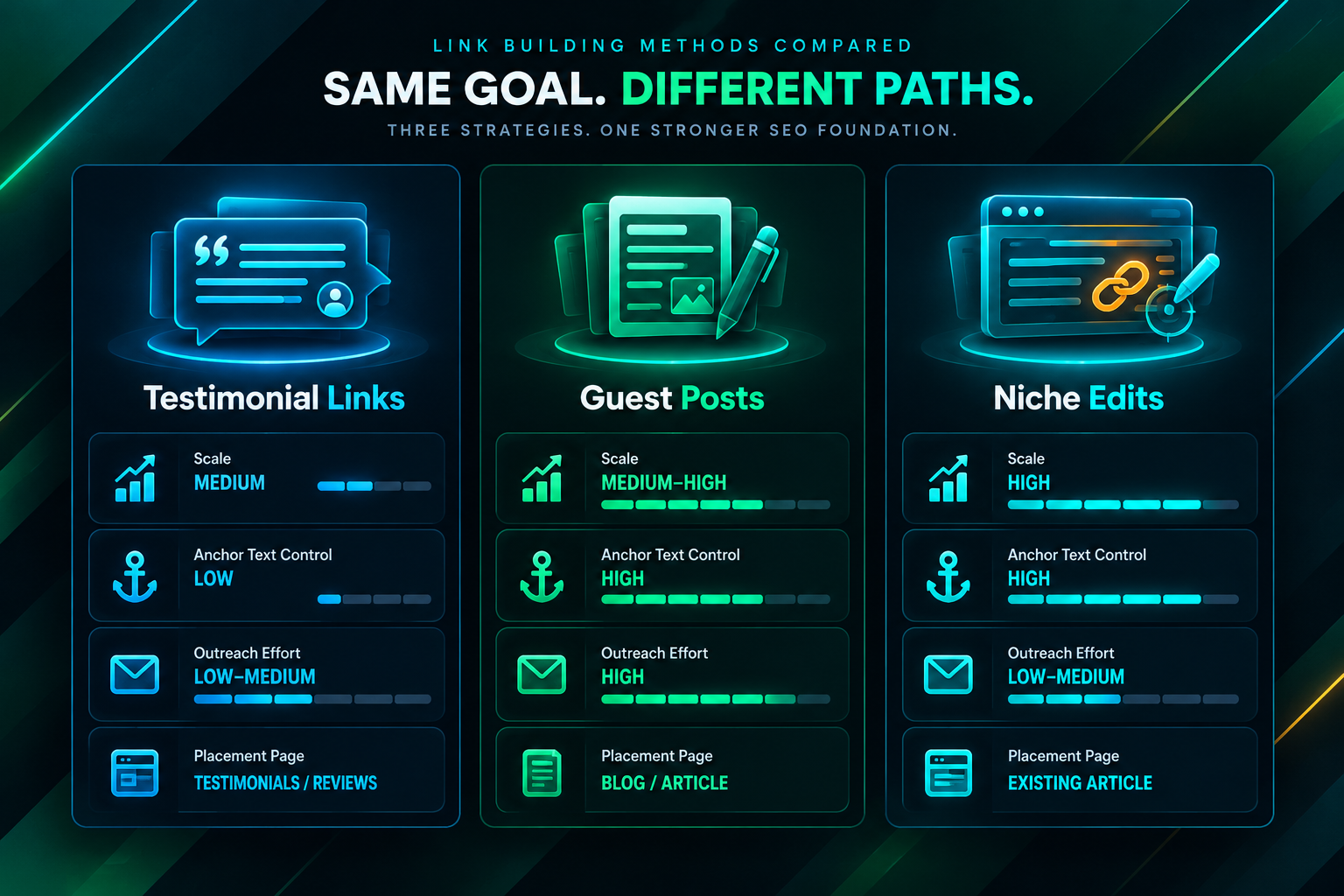
Niche edits (also called link insertions) involve adding a backlink to existing content on a third-party website. Like testimonial links, niche edits target pages that are already indexed and may already carry link equity. The key difference is that niche edits are placed within editorial content rather than on a testimonials or reviews page, which may provide stronger topical context depending on the article.
Digital PR involves earning links through newsworthy content, data studies, or media coverage. Digital PR links tend to come from high-authority news and media sites, which can be particularly valuable for domain-level authority building. However, digital PR campaigns require significant content investment and are less predictable in terms of link volume and timing. Testimonial link building is more predictable but produces fewer links per campaign.
In practice, many effective link building campaigns combine several of these methods. Testimonial links can contribute a natural, relationship-based layer to a profile that also includes guest posts, niche edits, and earned media coverage.
Who May Benefit from Testimonial Link Building
Testimonial link building may be a useful addition to a link acquisition strategy for businesses that meet certain conditions. It tends to work best when:
- The business uses a range of third-party tools, platforms, or services whose vendors have credible, well-linked websites.
- The business operates in a niche where direct outreach for guest posts is competitive or difficult, making alternative link types more valuable.
- The existing backlink profile is relatively thin and would benefit from additional referring domains, particularly from commercial or SaaS-adjacent sites.
- The business has the internal capacity to write genuine, well-crafted testimonials that vendors will want to feature prominently.
- The strategy is being used alongside other link acquisition methods rather than as the sole approach.
Businesses that use very few external tools, operate in highly niche markets with limited vendor options, or need to build links at significant scale may find that testimonial link building alone does not meet their campaign requirements. In those cases, manual guest post outreach, digital PR, or a managed outsourced link building campaign may be more appropriate.
Practical Steps for Running a Testimonial Link Building Campaign
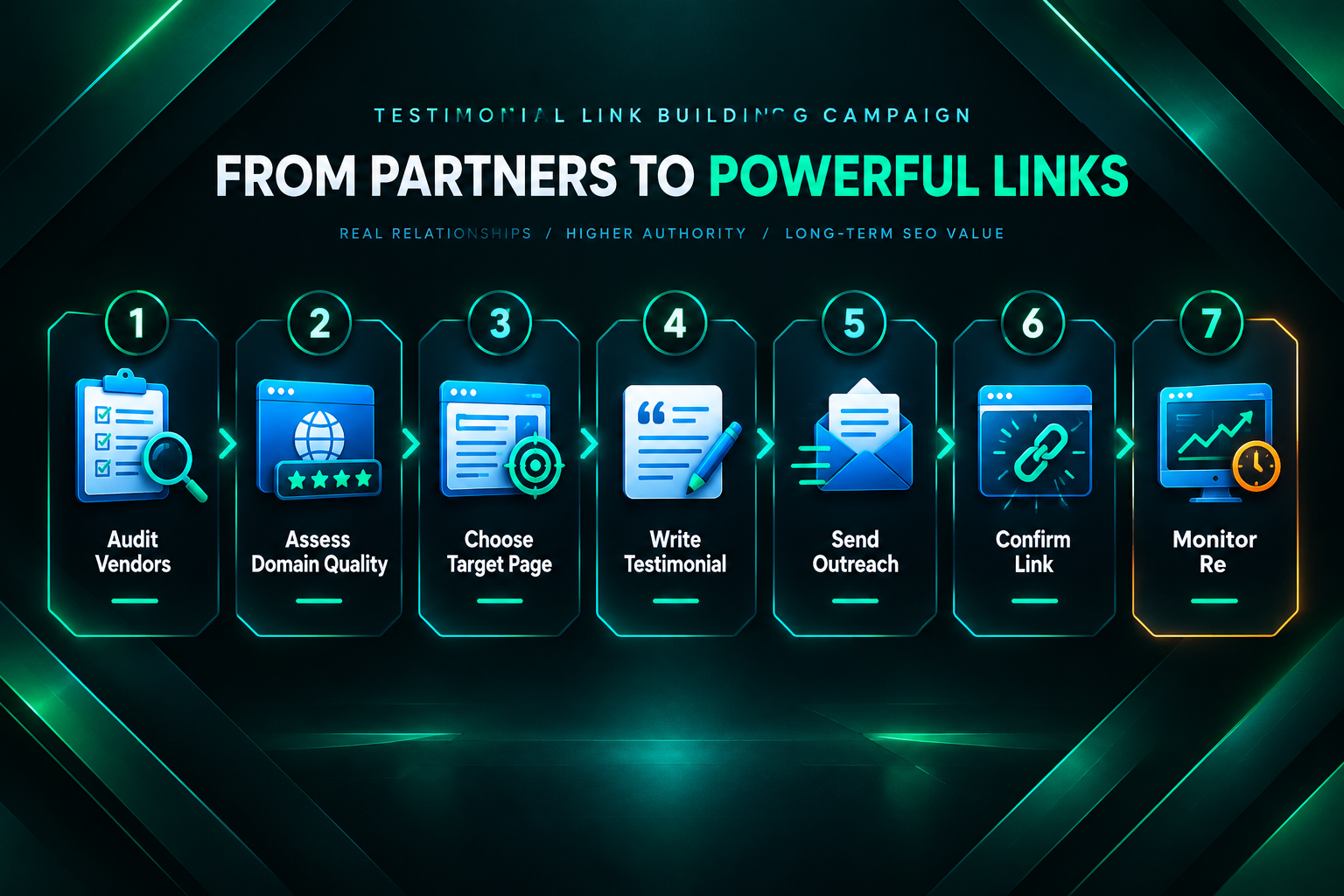
A structured approach improves the quality and efficiency of a testimonial link building campaign. The following steps outline a practical workflow.
- Audit your vendor relationships. List every tool, platform, software subscription, or service your business genuinely uses. Include both current and recent past vendors where the relationship was positive.
- Assess vendor domain quality. For each vendor, check their domain-level metrics, organic visibility, and whether their testimonial or case study pages use dofollow links. Prioritise vendors with strong, relevant backlink profiles and meaningful organic traffic.
- Identify the target page. Decide which page on your own website you want the backlink to point to. This is typically a high-priority commercial page, a key service page, or a page that is already ranking but needs additional link equity to improve its position.
- Write a genuine, specific testimonial. A vague endorsement is less likely to be featured prominently. Write a testimonial that describes a specific outcome, use case, or feature that benefited your business. Vendors are more likely to use detailed, credible testimonials in their marketing materials.
- Reach out with a clear, professional pitch. Contact the vendor’s marketing team, explain that you are a customer who would like to provide a testimonial, and specify that you would appreciate attribution with a link to your website. Keep the request straightforward and professional.
- Confirm link placement and attributes. Once the testimonial is published, verify that the link is live, points to the correct target page, and carries the expected link attribute. Add the placement to your backlink tracking records.
- Monitor for link retention. Check periodically that the link remains live. If it is removed during a site redesign or content update, consider reaching out to the vendor to request reinstatement.
Frequently Asked Questions
Is testimonial link building considered white-hat SEO?
Testimonial link building is generally considered a white-hat strategy when the testimonial reflects a genuine business relationship and the vendor chooses to include a link as part of their standard attribution practice. The key distinction is whether the link is editorially placed because the vendor values the endorsement, rather than being provided purely as a transactional exchange. As with any link acquisition method, the specific arrangement should be assessed against current search-engine link policies.
How many testimonial links can a business realistically acquire?
The number of testimonial links a business can acquire is limited by the number of vendors it genuinely uses and whose websites meet quality thresholds. For most businesses, this means a relatively small number of placements — perhaps five to twenty over the course of a campaign — rather than the volumes achievable through guest posting or digital PR. Testimonial link building is best treated as a supplementary tactic within a broader strategy.
Do testimonial links pass link equity?
Whether a testimonial link passes link equity depends on the link attribute used by the vendor. Dofollow links pass link equity; nofollow links do not, or pass it in a limited way depending on how search engines interpret the attribute. Before investing time in a testimonial outreach campaign, it is worth checking whether the vendor’s testimonial page uses dofollow links. This can be verified by inspecting the page’s HTML or using a browser extension that highlights link attributes.
How long does it take to see SEO results from testimonial links?
SEO results from any link building activity depend on multiple factors, including how quickly the new link is crawled and indexed, the authority of the linking domain, the competitiveness of the target keyword, and the overall health of the target website. In general, it may take several weeks to a few months before a new link contributes to measurable ranking changes, and even then, attributing a specific ranking movement to a single link is difficult. Results vary considerably by website, market, and campaign context.
Can testimonial link building be outsourced?
The outreach and campaign management elements of testimonial link building can be handled by an external link building team, though the testimonial content itself should reflect genuine first-hand experience with the vendor’s product. An outsourced team can assist with vendor research, domain quality assessment, outreach coordination, and link monitoring, while the client provides the authentic testimonial content. This division of labour can make the strategy more efficient without compromising the editorial integrity of the placement.
What anchor text is typically used in testimonial links?
Testimonial links most commonly use branded anchor text — the reviewer’s name, company name, or job title — rather than keyword-rich anchor text. This is a natural characteristic of the format, since vendors are attributing the testimonial to a real person or business rather than optimising for a keyword. Branded and natural anchor text is generally considered a healthy component of a diverse backlink profile, though it means testimonial links offer less control over anchor text than guest posts or niche edits.
Is Testimonial Link Building Worth Adding to Your Strategy?
Testimonial link building is a practical, relationship-based link acquisition method that can contribute genuine value to a backlink profile when executed carefully. Its main strengths are the natural editorial basis of the links, the relatively high outreach conversion rate compared with cold guest post pitches, and the fact that placements often appear on indexed, commercially active pages. These characteristics make it a credible addition to a diversified link building campaign.
Its limitations are equally real. Scale is constrained by the number of genuine vendor relationships a business holds. Link quality varies significantly depending on the vendor’s domain strength and organic visibility. And like any link building method, it cannot guarantee ranking improvements — outcomes depend on the full context of a website’s technical health, content quality, competitive environment, and existing backlink profile.
For most businesses, testimonial link building works best as one component of a broader strategy that may also include manual guest post outreach, niche edits, digital PR, or other acquisition methods suited to the site’s goals and competitive landscape. If you are considering how testimonial links might fit within a wider link acquisition campaign, discussing your specific situation with an experienced link building team can help clarify whether the approach is appropriate and how it might be prioritised alongside other tactics.