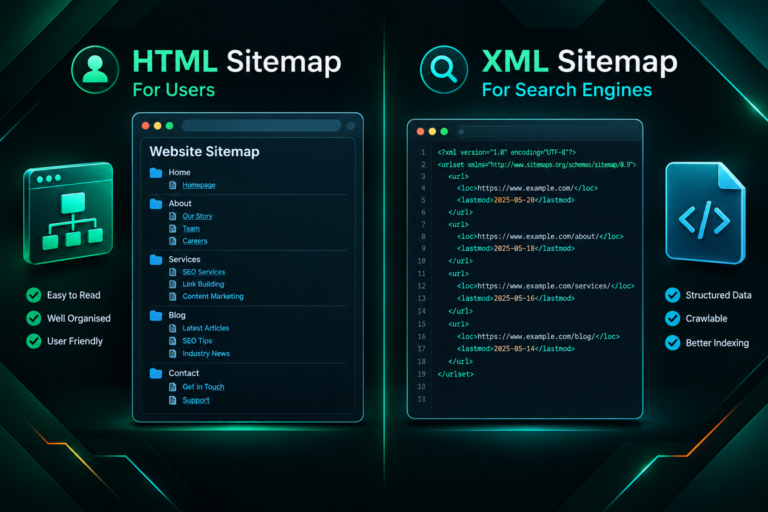
There is no universally correct number of internal links for a page. Search engines do not publish a fixed limit, and the right quantity depends on page length, site architecture, content type, and how clearly each link serves the reader. What matters more than hitting a specific count is whether every internal link you add helps users navigate your site and helps search engines understand how your pages relate to one another.
Key Takeaways
- No official internal link limit exists; Google has historically suggested keeping the number reasonable relative to page length and user value.
- Internal link quantity affects crawl budget, PageRank distribution, and how clearly topical relationships are communicated to search engines.
- Thin or irrelevant internal links dilute link equity and can confuse both users and crawlers, regardless of total count.
- Prioritising contextual, editorially placed links within body content typically delivers more SEO value than navigation or footer links alone.
- A site-specific audit is the most reliable way to identify internal linking gaps, over-linked pages, and orphaned content.
What Internal Links Actually Do for SEO
An internal link is a hyperlink that points from one page on your website to another page on the same domain. Internal links serve two distinct functions simultaneously. For users, they provide navigation pathways to related content, product pages, or supporting resources. For search engines, they signal which pages exist, how pages relate topically, and how much relative importance a page carries within the site.
Search engines use internal links to discover and crawl pages. When Googlebot visits a page, it follows the links it finds to reach other URLs on your site. Pages that receive many internal links from authoritative sections of your site are generally crawled more frequently and may be treated as more important. This concept is sometimes described as internal PageRank flow or link equity distribution, where the authority accumulated by a page is passed, in part, to the pages it links to.
Internal links also help establish topical relevance. When a pillar page about a broad subject links to several supporting cluster pages, and those cluster pages link back to the pillar, search engines receive a clearer signal about the thematic relationship between those URLs. This kind of deliberate site architecture, often called a topic cluster or content hub model, can help pages rank for related queries by reinforcing subject-matter depth across the site.
Is There an Official Internal Link Limit?
Google has not published a fixed maximum number of internal links per page. In older documentation, Google suggested keeping the number of links on a page to a reasonable amount, with some historical guidance referencing roughly 100 links as a practical ceiling. However, Google’s John Mueller has clarified in various public statements that this figure was not a hard rule and that modern crawlers handle pages with more links without technical difficulty. The more relevant question is whether each link genuinely serves the user and contributes to a coherent site structure.
What Google’s documentation does emphasise is that links should be crawlable, that anchor text should be descriptive and relevant, and that links should not be hidden or manipulative. Pages stuffed with dozens of low-value internal links, particularly in footers, sidebars, or through automated insertion without editorial judgment, are unlikely to distribute link equity effectively and may create a poor user experience. The practical concern is not a penalty for exceeding a number but rather the diminishing SEO value of each additional link as the total grows.
Bing’s Webmaster Guidelines similarly focus on crawlability and user experience rather than specifying a link count. The consistent message across search engine guidance is that internal links should be purposeful, descriptive, and proportionate to the page’s content and length.
How Internal Link Quantity Affects PageRank Distribution
PageRank, the foundational algorithm Google uses to assess page importance, is distributed across outgoing links. When a page links to ten other pages, each of those pages receives a share of the linking page’s equity. When the same page links to one hundred pages, each destination receives a proportionally smaller share. This means that adding more internal links to a page does not increase the total equity available; it divides it further.
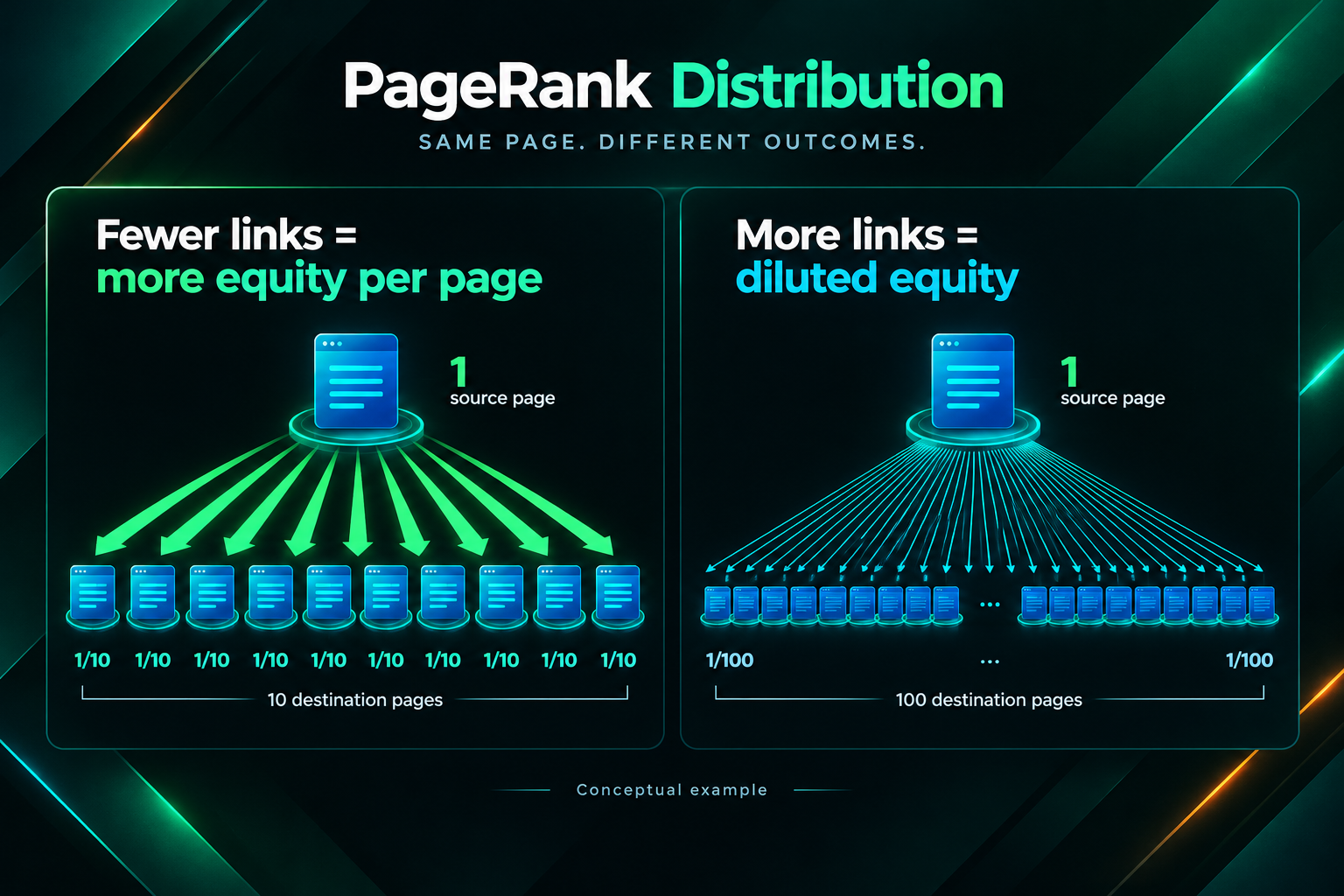
For SEO purposes, this has a practical implication: pages that are strategically important to your business, such as high-converting service pages, key product category pages, or cornerstone content, benefit from receiving internal links from multiple pages across the site rather than being buried among dozens of links on a single page. Concentrating internal links on your most commercially or editorially significant pages is generally more effective than distributing them evenly across all content.
Crawl budget is a related consideration, particularly for larger websites. Search engines allocate a finite amount of crawling resources to each site. A page with an excessive number of low-value internal links may cause crawlers to spend resources on less important URLs, potentially reducing the crawl frequency of pages that matter more. For small websites with fewer than a few hundred pages, crawl budget is rarely a limiting factor. For large e-commerce sites, news publishers, or enterprise platforms with thousands of URLs, internal link structure can meaningfully affect which pages are crawled and indexed regularly.
Practical Guidelines for Internal Link Quantity
Rather than targeting a specific number, a more useful approach is to evaluate internal links against a set of practical criteria. The following considerations can help you decide how many internal links are appropriate for a given page.
Match link quantity to page length and content depth
A long-form guide of 3,000 words covering multiple subtopics can reasonably support more internal links than a 400-word product description. Links should arise naturally from the content rather than being forced in to reach a target count. A useful test is to ask whether each link would help a reader who has just finished reading the surrounding paragraph. If the answer is no, the link may not be adding value.
Distinguish link types and their SEO contribution
Internal links appear in several locations on a typical page: the main navigation menu, breadcrumb trails, body content, sidebar widgets, related-posts modules, and footers. Search engines treat these differently. Contextual links embedded within body copy, supported by descriptive anchor text, are generally considered more editorially significant than sitewide navigation links or footer links that appear on every page. When assessing how many internal links a page has, it is worth separating these categories rather than treating all links as equivalent.
Prioritise descriptive, varied anchor text
Anchor text, the visible clickable text of a link, communicates context to both users and search engines. Repeating the same exact-match anchor text across many internal links pointing to the same destination can appear unnatural and may not provide the topical variety that helps search engines understand a page’s full relevance. Using descriptive, varied anchor text that reflects the content of the destination page is more informative and generally more effective than generic phrases such as “click here” or “read more”.
Avoid orphaned pages and over-linked pages simultaneously
Two common internal linking problems sit at opposite ends of the spectrum. Orphaned pages receive no internal links and may be difficult for search engines to discover and index, even if they are technically accessible. Over-linked pages, by contrast, may have so many outgoing links that the equity they pass to each destination is negligible. A site audit using a tool such as Screaming Frog, Ahrefs, or Semrush can identify both conditions and help you prioritise where to add or remove internal links.
Common Internal Linking Mistakes That Hurt SEO
Understanding what to avoid is as useful as knowing what to aim for. Several internal linking patterns consistently create problems for both users and search engines.
- Linking to the same page repeatedly within a single piece of content. Multiple links to the same destination URL within one page generally pass no additional equity and can clutter the reading experience. One well-placed contextual link to a destination is usually sufficient per page.
- Using generic or uninformative anchor text. Phrases like “learn more”, “this page”, or “here” tell search engines very little about the destination. Descriptive anchor text that reflects the topic of the linked page is more useful for both crawlers and readers.
- Linking to low-value or thin pages from high-authority pages. If a cornerstone page links to a thin, low-quality page, it passes equity to a destination that may not benefit from it. Internal links should generally point toward pages that deserve visibility and can satisfy user intent.
- Relying entirely on navigation and footer links. Sitewide links in navigation menus and footers are crawlable and useful for site structure, but they are not a substitute for contextual body links. A page that receives links only from the footer of every page on the site may not be treated as editorially significant.
- Ignoring internal links to newly published content. New pages often start with few or no internal links, making them difficult for search engines to discover quickly. Adding internal links from relevant existing pages to newly published content can accelerate indexing and help establish topical context from the outset.
- Automated bulk insertion without editorial review. Some content management systems and plugins can insert internal links automatically based on keyword matching. Without editorial oversight, this can produce irrelevant or repetitive links that reduce content quality and may link to pages that are no longer relevant or have been redirected.
Internal Links and Topical Authority
One of the more significant roles internal linking plays in modern SEO is supporting topical authority. Search engines assess not just individual pages but the overall depth and coherence of a site’s coverage of a subject. A website that publishes a comprehensive pillar page on a topic and supports it with multiple well-linked cluster articles covering related subtopics signals broader expertise than a site with isolated, unconnected pages on the same subject.
Internal links are the connective tissue of this architecture. When cluster pages link to the pillar and the pillar links back to the clusters, the relationship between pages becomes explicit and navigable. This structure can help a site rank for a wider range of related queries because search engines can follow the links to understand the full scope of the site’s coverage. The quantity of internal links matters here in the sense that sufficient links must exist to make the relationships clear, but quality and relevance remain the primary considerations.
For websites competing in crowded niches, a well-structured internal linking strategy can be a meaningful differentiator. It is one of the few SEO levers that is entirely within a site owner’s control and does not depend on third-party publishers or external outreach. However, internal linking alone is unlikely to overcome significant deficits in content quality, technical SEO, or external backlink authority. It works most effectively as part of a broader, coordinated SEO approach.
Internal Links vs External Backlinks: Understanding the Difference
Internal links and external backlinks both contribute to how search engines assess and rank pages, but they operate differently and serve different purposes. Understanding the distinction helps clarify why internal linking optimisation and external link acquisition are complementary rather than interchangeable strategies.
Internal links distribute equity that already exists within your site. They help search engines navigate your content, establish topical relationships, and signal which pages are most important. However, they do not introduce new authority from outside the site. The total pool of equity available to distribute internally is influenced by the external backlinks your site has accumulated over time.
External backlinks, particularly those from editorially relevant, authoritative domains, introduce new signals of trust and authority from outside your site. A page that earns a backlink from a well-regarded industry publication receives an external endorsement that internal links cannot replicate. This external authority can then be distributed more effectively across your site through a strong internal linking structure.
The practical implication is that internal linking optimisation and external link building work best together. A site with strong external backlinks but poor internal linking may fail to distribute that authority to the pages that need it most. Conversely, a site with excellent internal linking but few quality external backlinks may find that the equity being distributed internally is insufficient to compete in competitive search results. Both dimensions of link strategy deserve attention, and the appropriate balance depends on the site’s current authority, competitive landscape, and target pages.
How to Audit Your Internal Link Structure
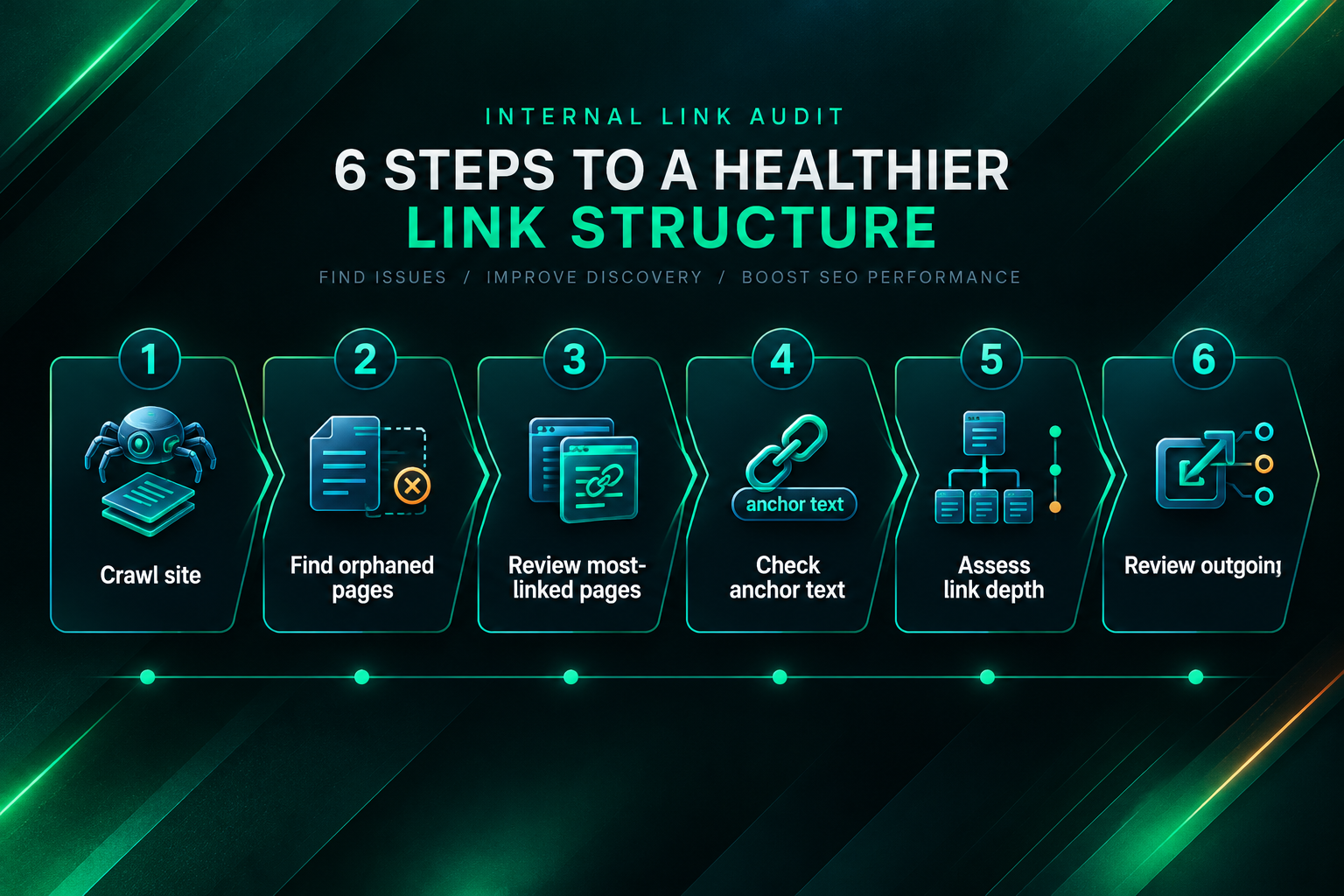
A structured internal link audit can reveal gaps, inefficiencies, and opportunities that are not visible from the content management system alone. The following process provides a practical starting point, though the specific steps and tools will vary depending on site size and available resources.
- Crawl your site with a dedicated tool. Tools such as Screaming Frog SEO Spider, Ahrefs Site Audit, or Semrush Site Audit can map every internal link on your site, showing which pages link to which, how many internal links each page receives, and which pages have no internal links at all.
- Identify orphaned pages. Pages with zero internal links pointing to them are invisible to search engines unless they appear in a sitemap or are linked from an external source. Prioritise adding contextual internal links to orphaned pages that contain valuable content.
- Review pages with the most internal links received. Compare this list against your commercially or editorially important pages. If your most-linked pages are not your most strategically important ones, consider redistributing internal links to better reflect your priorities.
- Check anchor text distribution. Review the anchor text used for internal links pointing to key pages. Look for over-reliance on generic phrases or exact-match repetition, and identify opportunities to introduce more descriptive, varied anchor text.
- Assess link depth. Pages that require many clicks from the homepage to reach are considered deep in the site architecture and may be crawled less frequently. Important pages should generally be reachable within three to four clicks from the homepage.
- Review outgoing link counts on key pages. For your highest-authority pages, assess whether the outgoing internal links are pointing to relevant, high-value destinations or whether the list has grown unwieldy over time.
Audits of this kind are most valuable when repeated periodically, particularly after significant content additions, site restructures, or migrations. A one-time audit provides a useful baseline, but internal link health requires ongoing attention as a site grows.
When Internal Linking Alone Is Not Enough
Internal linking is a powerful and controllable SEO lever, but it has clear limits. A site with well-structured internal links but thin, low-quality content is unlikely to rank competitively for meaningful queries. Similarly, a site with no external backlinks from credible sources may find that optimising internal links improves crawl efficiency and site structure without producing significant ranking improvements in competitive markets.
Low organic visibility can have multiple causes, including crawling or indexing problems, content that does not match search intent, technical SEO issues such as slow page speed or mobile usability problems, strong competition from established domains, or an insufficient external backlink profile. Internal linking optimisation addresses one part of this picture. A thorough site audit is the most reliable way to identify which factors are most limiting a site’s performance before deciding where to invest SEO resources.
For sites that have addressed technical SEO and content quality but still struggle to rank in competitive niches, external link acquisition may be a necessary complement to internal linking work. Building editorially relevant backlinks from authoritative external domains introduces the external authority signals that internal links alone cannot provide. This is where a considered external link building strategy, whether managed in-house or through a specialist provider, may become relevant depending on the site’s goals and competitive context.
Frequently Asked Questions
Does Google penalise pages with too many internal links?
Google does not apply a specific penalty for exceeding a link count threshold. However, pages with an excessive number of low-value or irrelevant internal links may provide a poor user experience and distribute link equity inefficiently. The practical risk is diminishing SEO value rather than a formal penalty, though pages that use hidden links or manipulative linking structures may be treated differently under Google’s spam policies.
Should I count navigation and footer links toward my internal link total?
Navigation menus, breadcrumbs, and footer links are crawlable and contribute to site structure, but they are generally weighted differently from contextual body links. For the purpose of assessing internal link quality on a specific page, it is more useful to evaluate body content links separately, as these carry more editorial significance in the eyes of search engines.
How many internal links should a blog post have?
There is no universally correct number. A practical approach is to include internal links wherever they genuinely help the reader find related content, typically two to five contextual links within the body of a standard blog post, though longer or more comprehensive posts may support more. The key criterion is whether each link serves the reader and points to a relevant, high-quality destination.
Can too many internal links on a page hurt my rankings?
An excessive number of internal links on a single page can dilute the equity passed to each destination, making individual links less valuable. It can also make a page harder to read and navigate. In extreme cases, a page that appears to exist primarily to distribute links rather than serve users may be assessed differently by search engines. Keeping links purposeful and proportionate to content length is the most reliable approach.
What is the difference between internal links and external backlinks for SEO?
Internal links connect pages within the same website and distribute existing site authority, help search engines navigate content, and establish topical relationships. External backlinks come from other websites and introduce new authority signals from outside the site. Both contribute to how search engines assess and rank pages, but they serve different functions and are not interchangeable.
How do I find pages on my site with no internal links?
A site crawl using a tool such as Screaming Frog SEO Spider, Ahrefs Site Audit, or Semrush Site Audit will identify pages that receive no internal links, commonly called orphaned pages. These tools map the internal link graph of your site and can filter pages by the number of internal links received, making it straightforward to find and prioritise orphaned content.
Deciding on Internal Link Quantity: A Practical Starting Point
The most useful answer to how many internal links a page should have is: enough to serve the reader and support your site architecture, but not so many that individual links lose meaning or equity. For most pages, this means a small number of well-chosen contextual links within the body content, supported by a clear navigational structure, rather than a fixed count applied uniformly across the site.
Prioritise internal links to your most strategically important pages, use descriptive anchor text that reflects the destination’s content, and audit your internal link structure periodically to identify orphaned pages, over-linked pages, and equity distribution gaps. These steps will generally deliver more SEO value than chasing a specific number.
If your site’s internal linking is already well-structured and you are still not achieving the organic visibility you need in competitive markets, the limiting factor may be external authority rather than internal architecture. In that case, a considered external link building strategy, developed with a clear understanding of your target pages, competitive landscape, and content quality, may be worth exploring with a qualified SEO professional.