Internal linking is one of the most controllable elements of on-page SEO, yet the selection of related posts is often treated as an afterthought. Choosing the wrong pages to link together can dilute topical relevance, waste crawl budget, and send users down paths that do not match their intent. Choosing well, however, can strengthen your site’s topical authority, help search engines understand content relationships, and guide visitors toward pages that matter most to your business goals.
Key Takeaways
- Related post selection for internal linking should be driven by topical relevance, user intent alignment, and the strategic value of the destination page — not by recency or arbitrary similarity.
- Internal links pass link equity between pages, so linking to high-priority pages from well-trafficked content can support their visibility in search results.
- Anchor text for internal links should be descriptive and contextually accurate; generic phrases such as “click here” reduce the SEO signal value of the link.
- Over-linking within a single post can dilute the value passed to any individual destination and create a poor reading experience.
- Internal linking strategy works alongside — not instead of — external backlink acquisition; both contribute to how search engines assess page authority and relevance.
What Internal Linking Actually Does for SEO
An internal link is a hyperlink that connects one page on your website to another page on the same domain. Search engines use these links to discover new content, understand the relationship between pages, and distribute what is commonly called link equity or PageRank across the site. When a page earns external backlinks from other websites, some of that authority can flow through internal links to connected pages. This makes the internal linking structure a meaningful factor in how well individual pages can compete in search results, particularly for pages that have few or no direct external links pointing to them.
Beyond authority distribution, internal links provide contextual signals. The anchor text used in an internal link — the visible, clickable words — tells search engines something about the topic of the destination page. A link using the anchor text “technical SEO audit checklist” signals that the linked page covers that specific subject. This contextual relationship helps search engines build a clearer picture of what each page is about and how pages within a site relate to one another topically.
For users, well-chosen internal links reduce friction. A reader who has just finished an article about content strategy may genuinely benefit from a link to a related post on keyword research or editorial planning. If the link is relevant and the destination delivers on the implied promise of the anchor text, the user is more likely to continue engaging with the site. Higher engagement signals — such as time on site and pages per session — may indirectly support SEO performance, though the direct relationship between these metrics and rankings is not straightforward.
The Core Criteria for Selecting Related Posts

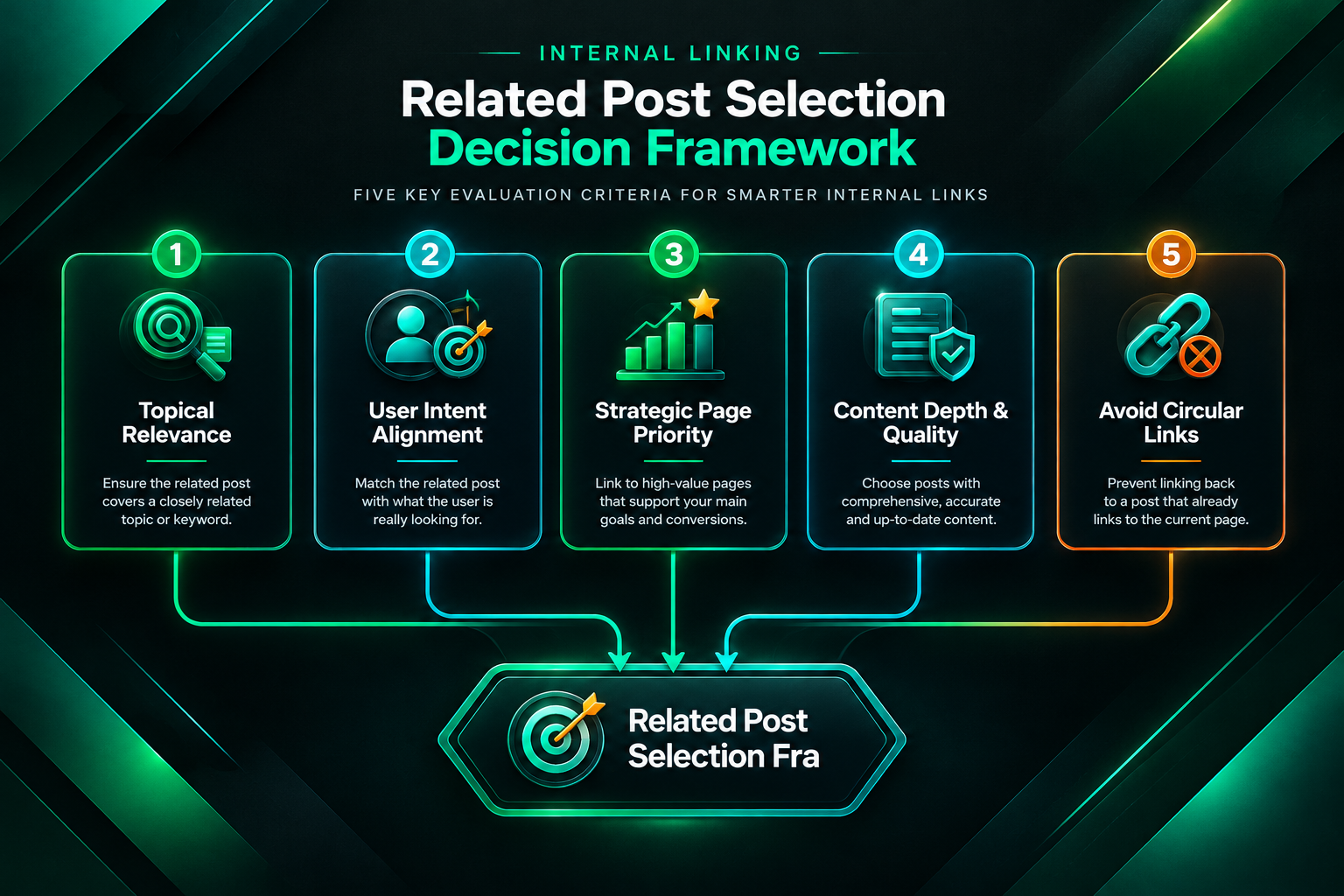
Selecting related posts for internal linking requires a deliberate framework rather than a gut-feel approach. The following criteria provide a practical basis for evaluating whether one page is a genuinely useful internal link destination from another.
Topical Relevance
The most important criterion is whether the destination page covers a topic that is meaningfully related to the source page. Topical relevance does not simply mean that two posts share a broad category. A post about link building outreach templates and a post about email deliverability for cold outreach are topically adjacent in a useful way. A post about link building outreach templates and a post about social media scheduling tools are not, even if both appear under a broad “digital marketing” umbrella. Search engines assess topical clusters — groups of pages that collectively cover a subject in depth — and internal links between genuinely related pages reinforce those clusters.
User Intent Alignment
Consider what the reader of the source page is trying to accomplish and whether the destination page serves a logical next step in that journey. A reader on an informational post about what domain authority means is likely in a research phase. Linking them to a detailed guide on how to evaluate backlink quality serves their intent well. Linking them to a service pricing page may be premature and could increase bounce rates if the user is not yet ready to make a purchasing decision. Intent alignment means thinking about the reader’s stage of awareness and matching the destination page to where they are likely to be in that journey.
Strategic Page Priority
Not all pages on a website are equally important to business goals. Pages that target high-value commercial keywords, generate leads, or support conversion deserve more internal link equity than low-priority archive or tag pages. When selecting related posts, consider whether the destination page is one that would benefit from additional authority. If a core service page or a high-priority pillar article has few external backlinks, routing internal links toward it from well-trafficked supporting content can help improve its competitive position over time. This is sometimes described as a hub-and-spoke or pillar-cluster model, where a central pillar page receives links from multiple related cluster posts.
Content Depth and Quality of the Destination
Linking to a thin, outdated, or poorly written page reflects on the source page and may frustrate users who follow the link. Before selecting a related post as an internal link destination, assess whether the destination page genuinely delivers value. If it does not, the better course of action may be to update the destination page before promoting it through internal links, rather than directing traffic to content that underperforms.
Avoiding Circular and Redundant Links
Circular linking — where page A links to page B, which links back to page A in a way that adds no navigational value — can dilute the clarity of your site’s link structure. Similarly, linking to a page that covers essentially the same topic as the source page may create keyword cannibalization concerns, where two pages compete for the same search query rather than each serving a distinct intent. When two pages cover overlapping topics, consider whether one should be consolidated into the other, or whether the internal link should be directional rather than reciprocal.
How to Identify Genuinely Related Posts
Identifying which posts are genuinely related requires a structured review of your content inventory. Several practical methods can help.
Topic Cluster Mapping
A topic cluster map is a visual or spreadsheet-based representation of how your content groups around core themes. Start by identifying your main pillar topics — the broad subjects your site covers in depth. Then list the supporting articles, guides, and posts that address specific sub-questions within each pillar. Internal links should flow between posts within the same cluster and from cluster posts up to the pillar page. This approach ensures that related posts are connected by genuine topical proximity rather than surface-level similarity.
Keyword and Semantic Overlap Analysis
Two pages that target semantically related keywords are strong candidates for internal linking. If one page targets “how to assess backlink quality” and another targets “what makes a good referring domain,” these pages share semantic overlap and a reader interested in one topic is likely to benefit from the other. SEO tools such as Ahrefs, Semrush, or Google Search Console can help identify which pages on your site rank for related keyword groups, making it easier to spot natural linking opportunities.
Reviewing Existing Organic Traffic Patterns
Google Search Console data can reveal which pages on your site attract organic visitors and which queries bring them there. If a high-traffic page covers a topic that is closely related to a lower-traffic page you want to promote, adding an internal link from the high-traffic page to the lower-traffic destination is a practical way to share some of that visibility. This approach is particularly useful for pages that have strong content but limited external backlinks, as internal links can provide a meaningful authority boost in the absence of external signals.
Content Gap Identification
Sometimes the most useful related post does not yet exist. When reviewing a page for internal linking opportunities, you may notice that a logical next step for the reader — a topic they would naturally want to explore — is not covered anywhere on your site. This is a content gap, and identifying it is valuable both for internal linking planning and for editorial strategy. Creating the missing content and then linking to it from existing related posts can strengthen your topical coverage and improve the overall depth of your site’s authority on a subject.
Anchor Text Selection for Internal Links
Anchor text is the visible, clickable text of a hyperlink. For internal links, descriptive anchor text that accurately reflects the topic of the destination page provides a clearer signal to search engines than generic phrases. Using the destination page’s target keyword or a close natural variation as the anchor text is generally considered good practice, though the anchor should always read naturally within the surrounding sentence.
Avoid over-optimizing internal anchor text by forcing exact-match keyword phrases into sentences where they sound unnatural. Search engines are capable of understanding context, and an anchor text that reads naturally while still being descriptive is preferable to one that sounds forced. For example, “learn more about evaluating referring domain quality” is more natural than repeating an exact keyword phrase verbatim if the surrounding sentence does not support it.
Vary anchor text across multiple internal links pointing to the same destination page. If ten different posts all link to the same pillar page using identical anchor text, the repetition may appear manipulative. Using natural variations — synonyms, related phrases, or slightly different descriptions of the same topic — keeps the link profile looking organic while still providing useful signals.
How Many Internal Links Should a Post Contain?
There is no universally correct number of internal links per post, and prescribing a fixed count without knowing the length, topic, and purpose of the content would be misleading. The practical principle is that every internal link should serve a genuine purpose — either helping the reader navigate to useful related content or directing link equity toward a strategically important page. Links added purely to reach a target number, or links that interrupt the reading experience without adding value, are unlikely to benefit either users or search engines.
For a long-form pillar article covering a broad topic in depth, five to ten internal links to supporting cluster posts may be entirely appropriate. For a short, focused post addressing a single specific question, two or three carefully chosen internal links may be sufficient. The key question to ask for each link is: would a reader who has just read this sentence genuinely benefit from following this link? If the answer is yes, the link is likely justified. If the answer is uncertain, the link may be unnecessary.
Internal Linking and External Backlink Strategy
Internal linking and external backlink acquisition are complementary rather than interchangeable. External backlinks from other websites introduce new authority into your domain from outside sources, while internal links distribute that authority across your pages. A site with a strong external backlink profile but a poorly structured internal linking system may find that authority is concentrated on a few pages rather than flowing to the pages that need it most. Conversely, a site with excellent internal linking but very few external backlinks has limited authority to distribute in the first place.
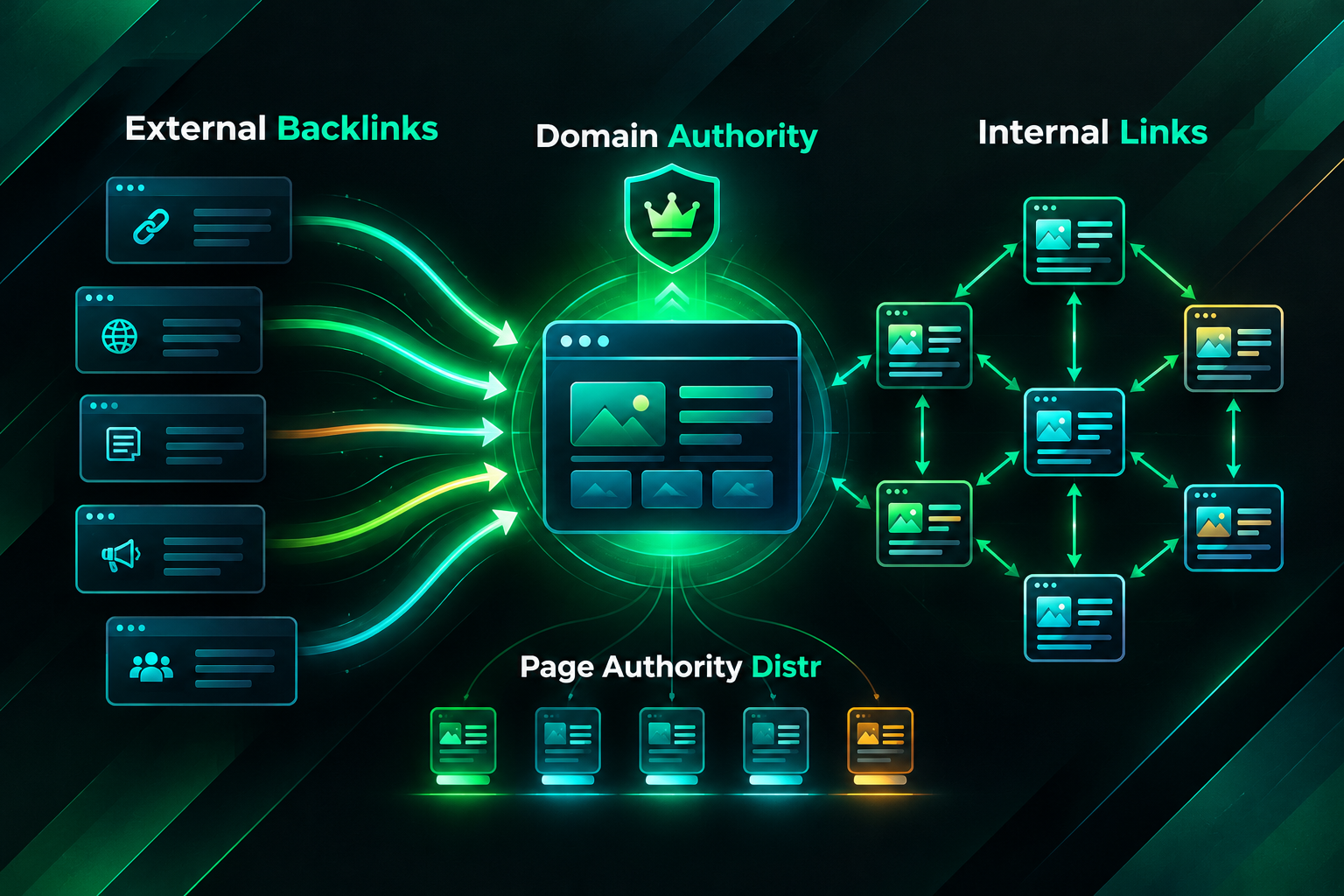
For businesses and SEO teams managing link building campaigns, understanding this relationship is practically important. When external links are acquired to a specific page — through guest posting, digital PR, or manual outreach — the internal links from that page to other priority pages can extend the benefit of those external placements further into the site. This is one reason why reviewing and updating internal links on pages that receive new external backlinks can be a worthwhile part of an ongoing link building workflow.
Pages that serve as strong internal link hubs — receiving many internal links from across the site — tend to accumulate more authority and may perform better in search results, all else being equal. Identifying which pages should serve as hubs and ensuring they receive both external backlinks and strong internal link support is a strategic decision that benefits from a site-wide content and link audit rather than a page-by-page approach.
Common Mistakes in Related Post Selection
Several recurring errors reduce the effectiveness of internal linking strategies, even on sites where the practice is taken seriously.
- Linking by recency rather than relevance: Automatically linking to the most recently published posts regardless of topical fit is a common pattern in content management systems. Recent posts are not necessarily the most relevant, and this approach can result in links that confuse rather than guide users.
- Linking to category or tag archive pages: Archive pages typically have thin content and low conversion value. Directing internal link equity toward them is usually less beneficial than linking to specific, substantive posts or pages.
- Ignoring orphan pages: An orphan page is a page that receives no internal links from other pages on the site. Search engines may struggle to discover and assess orphan pages, and they are unlikely to rank well regardless of their content quality. Regularly auditing for orphan pages and connecting them to relevant content is an important maintenance task.
- Using the same anchor text for every internal link to a page: As noted above, repetitive exact-match anchor text across many internal links can appear unnatural and may not serve the page as well as varied, contextually appropriate anchors.
- Linking to pages with thin or outdated content: Sending users and link equity to pages that do not deliver value wastes both. Updating underperforming destination pages before promoting them through internal links is a more effective sequence.
- Neglecting internal links after publishing: New posts should not only link to existing related content — existing related posts should also be updated to link to the new post where relevant. This bidirectional approach keeps the internal link structure current and ensures new content is discoverable.
Practical Workflow for Reviewing and Updating Internal Links
A structured workflow makes internal link management more consistent and less dependent on individual memory or judgment at the time of publishing.
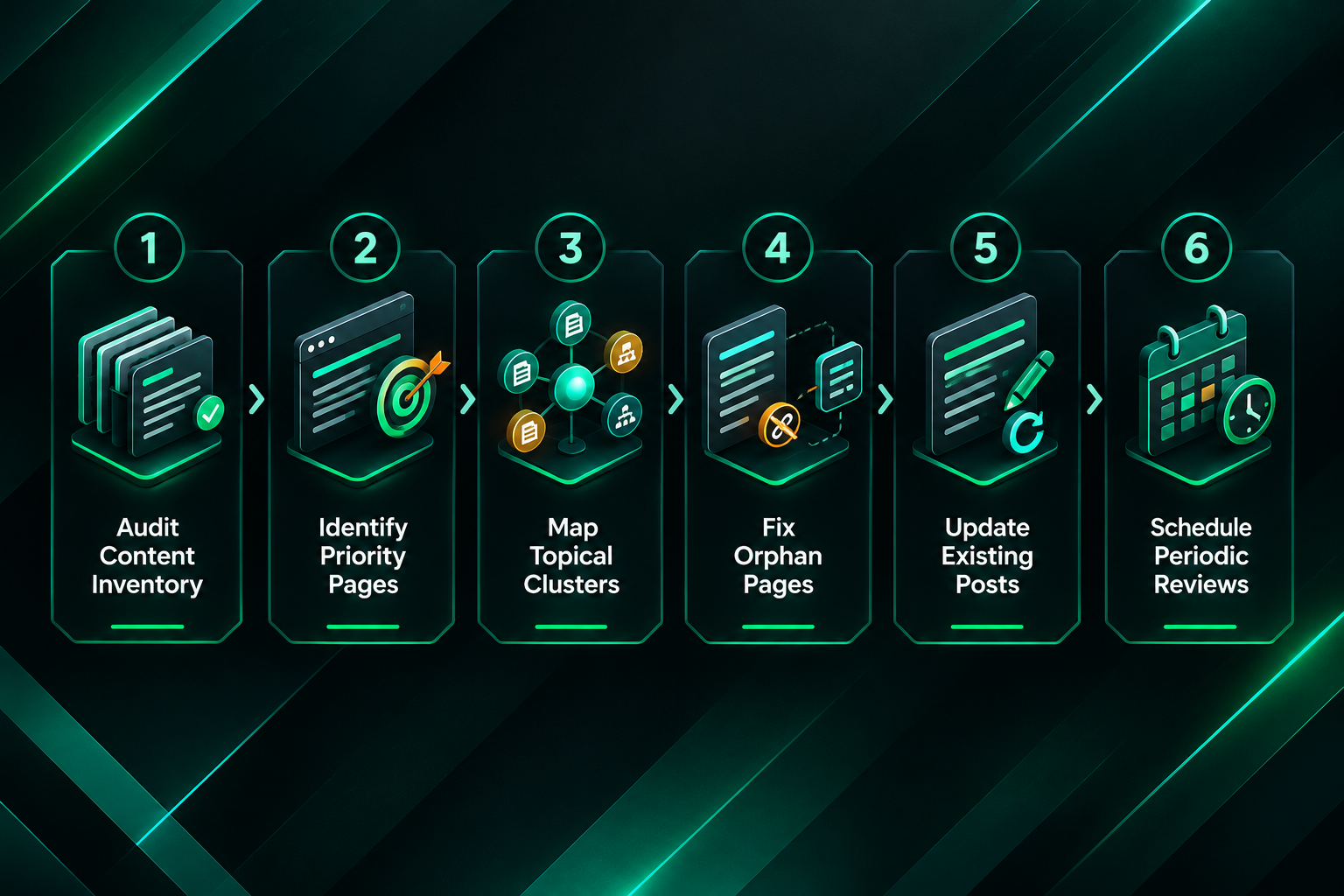
- Audit your existing content inventory: Create a spreadsheet or use an SEO crawl tool to map all published pages, their target keywords, their current internal link counts (both inbound and outbound), and their organic traffic levels. Tools such as Screaming Frog, Ahrefs Site Audit, or Semrush Site Audit can automate much of this data collection.
- Identify priority destination pages: Determine which pages are most important to your business goals — typically commercial landing pages, high-value pillar articles, and pages targeting competitive keywords with strong conversion potential.
- Map topical clusters: Group your content by theme and identify which posts belong to the same cluster. Ensure that cluster posts link to their pillar page and that related cluster posts link to one another where the connection is genuinely useful.
- Find and fix orphan pages: Identify pages with zero or very few inbound internal links and determine whether they should be connected to existing content, consolidated with another page, or removed if they no longer serve a purpose.
- Update existing posts when publishing new content: When a new post is published, search your existing content for pages that cover related topics and add internal links from those pages to the new post where appropriate.
- Review anchor text diversity: Check that pages receiving multiple internal links are not all linked with identical anchor text, and adjust where necessary to create a more natural variation.
- Schedule periodic reviews: Internal link audits should not be a one-time exercise. As content is added, updated, or removed, the internal link structure needs to be maintained. A quarterly or semi-annual review is a reasonable starting point for most sites.
When Internal Linking Alone Is Not Enough
Internal linking is a powerful on-site SEO lever, but it operates within the constraints of the authority your domain has already accumulated through external backlinks and other trust signals. If a page is struggling to rank despite strong content and good internal link support, the cause may lie elsewhere. Possible contributing factors include insufficient external backlinks to the domain or the specific page, technical issues such as slow page speed or crawlability problems, content that does not fully satisfy the search intent for the target query, strong competition from established pages with significantly more authority, or a mismatch between the page’s content and the queries it is being evaluated for.
In these situations, a site-specific SEO audit is more useful than adjusting internal links in isolation. Internal linking improvements are most effective when the site’s technical foundation is sound, the content is genuinely useful and well-structured, and there is a reasonable level of external authority to distribute. For sites with very limited external backlinks, investing in a structured external link acquisition strategy — whether through manual outreach, guest posting, or digital PR — may be a necessary complement to internal linking work.
Frequently Asked Questions
Does the position of an internal link within a page affect its SEO value?
Search engines are generally understood to give more weight to links that appear earlier in the main body content of a page compared to links in footers or sidebars, though the exact weighting is not publicly documented. Links placed naturally within the body text, where they are contextually relevant, are likely to be more useful both for users and for passing topical signals than links placed in navigation elements or boilerplate sections.
Should I use nofollow attributes on internal links?
Using nofollow on internal links is generally not recommended as a routine practice. The nofollow attribute instructs search engines not to pass link equity through the link, which defeats one of the primary SEO purposes of internal linking. There may be specific cases — such as links to login pages or user-generated content areas — where nofollow is appropriate, but applying it broadly to internal links is likely to reduce the effectiveness of your internal link structure.
How do I handle internal links when I delete or redirect a page?
When a page is deleted or redirected, any internal links pointing to it should be updated to point directly to the new destination URL rather than relying on the redirect. Redirect chains — where a link goes through multiple redirects before reaching the final page — can reduce the link equity passed and slow page loading. Auditing internal links after any significant site restructure or page removal is an important maintenance step.
Can too many internal links on a page hurt SEO?
Excessive internal links on a single page can dilute the equity passed to each destination and may create a poor user experience if the page becomes difficult to read. There is no hard limit published by search engines, but the practical test is whether each link serves a genuine purpose for the reader. Pages with hundreds of internal links — such as some archive or category pages — may distribute very little equity to any individual destination.
How does internal linking relate to crawl budget?
Crawl budget refers to the number of pages a search engine will crawl on your site within a given period. For large sites with thousands of pages, internal linking structure directly affects which pages are discovered and how frequently they are crawled. Pages with more internal links pointing to them are generally crawled more often. Ensuring that your most important pages are well-connected within the internal link structure can help prioritize their crawling and indexing.
Is it better to link to related posts manually or use an automated related posts plugin?
Manual selection of related posts generally produces more relevant and strategically useful links than automated plugins, which typically rely on tag or category matching rather than genuine topical relevance or strategic page priority. Automated plugins can be a useful starting point for large sites where manual review of every post is impractical, but the links they generate should be reviewed and supplemented with manually chosen links for priority pages.
Building a Related Post Strategy That Supports Long-Term SEO
Choosing related posts for internal linking is not a technical checkbox — it is an ongoing editorial and strategic practice that reflects how well you understand your own content, your audience’s needs, and your site’s SEO priorities. The most effective internal linking strategies are built on a clear content inventory, a defined set of priority pages, and a consistent habit of connecting new content to existing related posts and vice versa.
For businesses managing both content production and external link acquisition, integrating internal linking reviews into the broader SEO workflow — rather than treating it as a separate task — tends to produce more consistent results. When a new external backlink is earned by a page, reviewing that page’s internal links to ensure authority flows toward priority destinations is a practical step that costs little time but can meaningfully extend the value of the external placement.
If your site has significant content depth but you are unsure whether your internal linking structure is supporting or undermining your SEO goals, a structured content and link audit is a reasonable starting point. Understanding which pages are well-connected, which are orphaned, and which are receiving internal link equity disproportionate to their strategic value gives you the information needed to make deliberate improvements rather than incremental guesses.