

A well-constructed glossary can become one of the most durable linkable assets on a website. When built around genuinely useful definitions that a specific audience needs, a glossary page attracts citations from bloggers, journalists, educators, and industry publications who prefer linking to a clear, authoritative reference rather than defining every term themselves. This article explains how to plan, build, and promote a glossary designed to earn editorial backlinks, along with the realistic limitations and timelines you should expect.
Key Takeaways
- A glossary earns backlinks by serving as a reliable reference that other writers and publishers want to cite, not by existing as a list of definitions.
- Topic selection, depth of explanation, and topical authority on your domain are more important than the number of terms you include.
- Promotion through manual outreach, content partnerships, and internal linking is usually necessary; glossaries rarely attract links passively without an audience already in place.
- Results vary significantly depending on niche competitiveness, domain authority, content quality, and how actively the asset is promoted.
- A glossary is one type of linkable asset; depending on your goals and resources, other formats such as original research, tools, or data-driven guides may complement or outperform it.
Why Glossaries Can Attract Editorial Backlinks
Backlinks tend to accumulate on pages that solve a recurring problem for other content creators. A glossary solves a specific and common problem: writers covering a technical or specialised topic need to explain terminology without derailing their own article. When a well-written glossary definition exists on a credible domain, it becomes a natural citation target. This is sometimes called a reference link or definitional citation, and it tends to be editorially motivated rather than transactional, which generally makes it more durable and more consistent with search-engine link quality guidelines.
The link-earning potential of a glossary depends on several factors. The niche must have enough active content production for other writers to regularly encounter terminology they want to reference. The definitions must be meaningfully better than what already exists, whether through greater clarity, more practical examples, or coverage of terms that competitors have overlooked. And the domain hosting the glossary needs enough topical authority that publishers feel comfortable citing it. A glossary on a brand-new domain with no existing content or audience will face a much harder path than one on an established site with a relevant readership.
Choosing the Right Topic and Terminology Scope
The most common mistake when building a glossary for link acquisition is choosing terms that are already exhaustively defined elsewhere. If a term has a thorough Wikipedia entry, a dedicated Investopedia page, or a well-cited definition on a high-authority domain in your niche, competing for that citation is difficult. A more productive approach is to identify terminology that is specific enough to your industry that general reference sites have not covered it well, but common enough that other writers in your niche regularly need to explain it.
Start by auditing the content your target audience already produces. Read industry blogs, trade publications, and forum discussions to identify terms that appear frequently but are explained inconsistently or superficially. Keyword research tools such as Ahrefs or Semrush can help you identify definition-intent queries, typically phrased as “what is [term]” or “[term] meaning”, that have measurable search volume but relatively weak existing results. These represent gaps where a well-constructed definition could rank organically and attract citations simultaneously.
Scope matters as much as topic selection. A glossary covering 200 loosely related terms is less useful as a linkable asset than one covering 40 to 80 terms with genuine depth and practical examples. Narrow the scope to a coherent sub-topic within your niche. For example, a digital marketing agency might build a glossary focused specifically on link building terminology rather than all of SEO, or a SaaS company might create a glossary of product analytics terms rather than all of software development. Tighter scope makes the glossary more credible as a specialist reference and easier to promote to a relevant audience.
Structuring the Glossary for Usability and SEO
A glossary that earns backlinks must be genuinely easy to use. Alphabetical navigation with anchor links is the standard approach and remains effective because it matches how readers expect to browse a reference document. Each term should have its own anchor or, for larger glossaries, its own URL, so that a writer linking to a specific definition can point directly to the relevant entry rather than to the top of a long page. Linkable individual term pages are particularly useful for glossaries covering more than 50 terms, as they allow more precise citation and can rank independently for definition-intent queries.
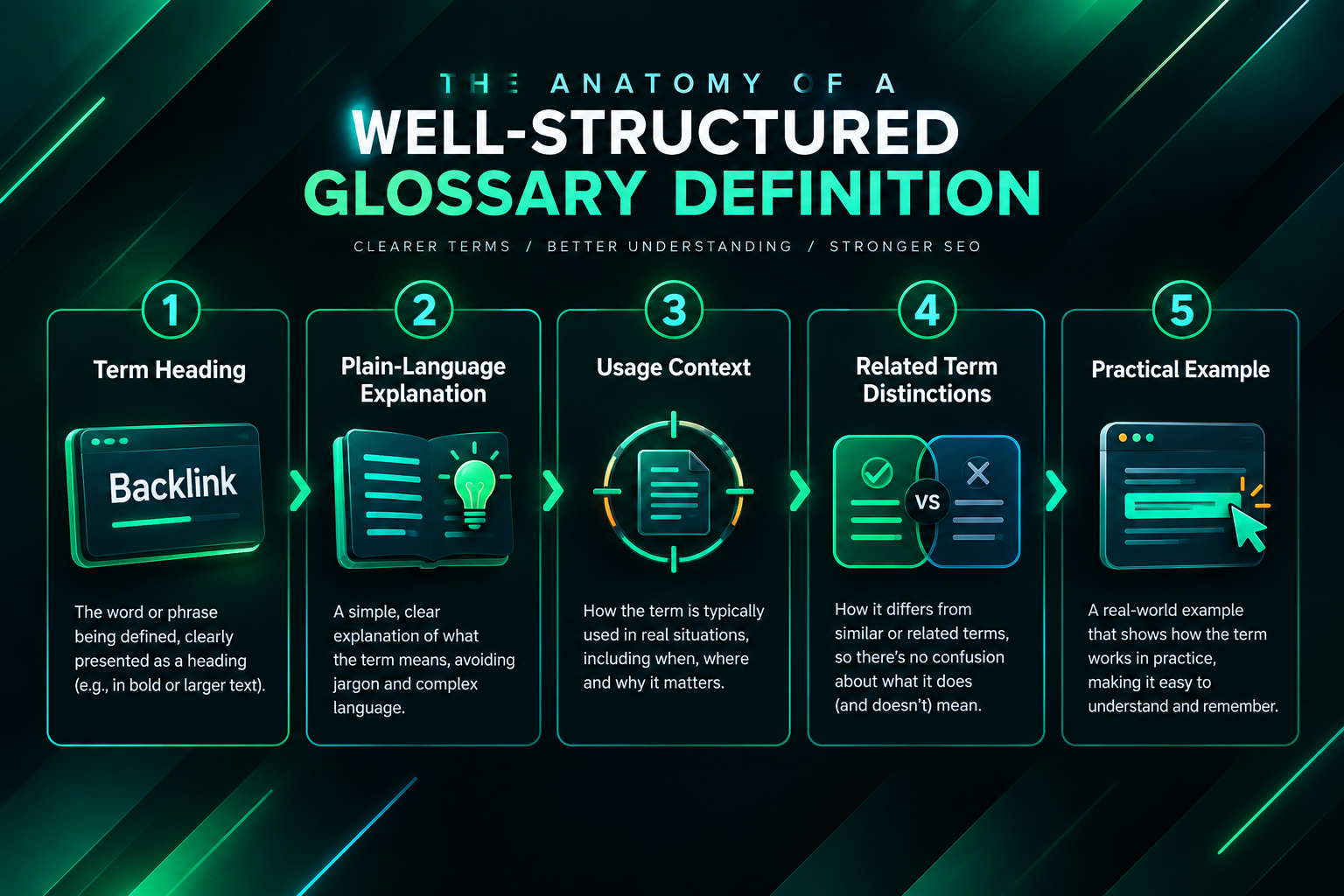
Each definition should follow a consistent structure. Begin with a concise, plain-language explanation of what the term means. Follow this with the context in which the term is used, any important distinctions from related terms, and a practical example where relevant. Avoid circular definitions that simply rephrase the term itself. Where a term has multiple accepted meanings across different contexts, acknowledge this rather than presenting one interpretation as universal. This kind of nuance signals editorial care and makes the definition more trustworthy as a citation source.
From an on-page SEO perspective, use the term as the heading for each entry, include natural variations in the body text, and ensure the page loads quickly and renders cleanly on mobile devices. Internal links from related blog posts and pillar pages to the glossary, and from the glossary back to relevant content on your site, help search engines understand the topical relationship between your content assets and can improve the crawlability of the glossary itself. Schema markup for a glossary or FAQ structure may also help search engines surface individual definitions in rich results, though the practical impact of this varies.
Writing Definitions That Other Publishers Want to Cite
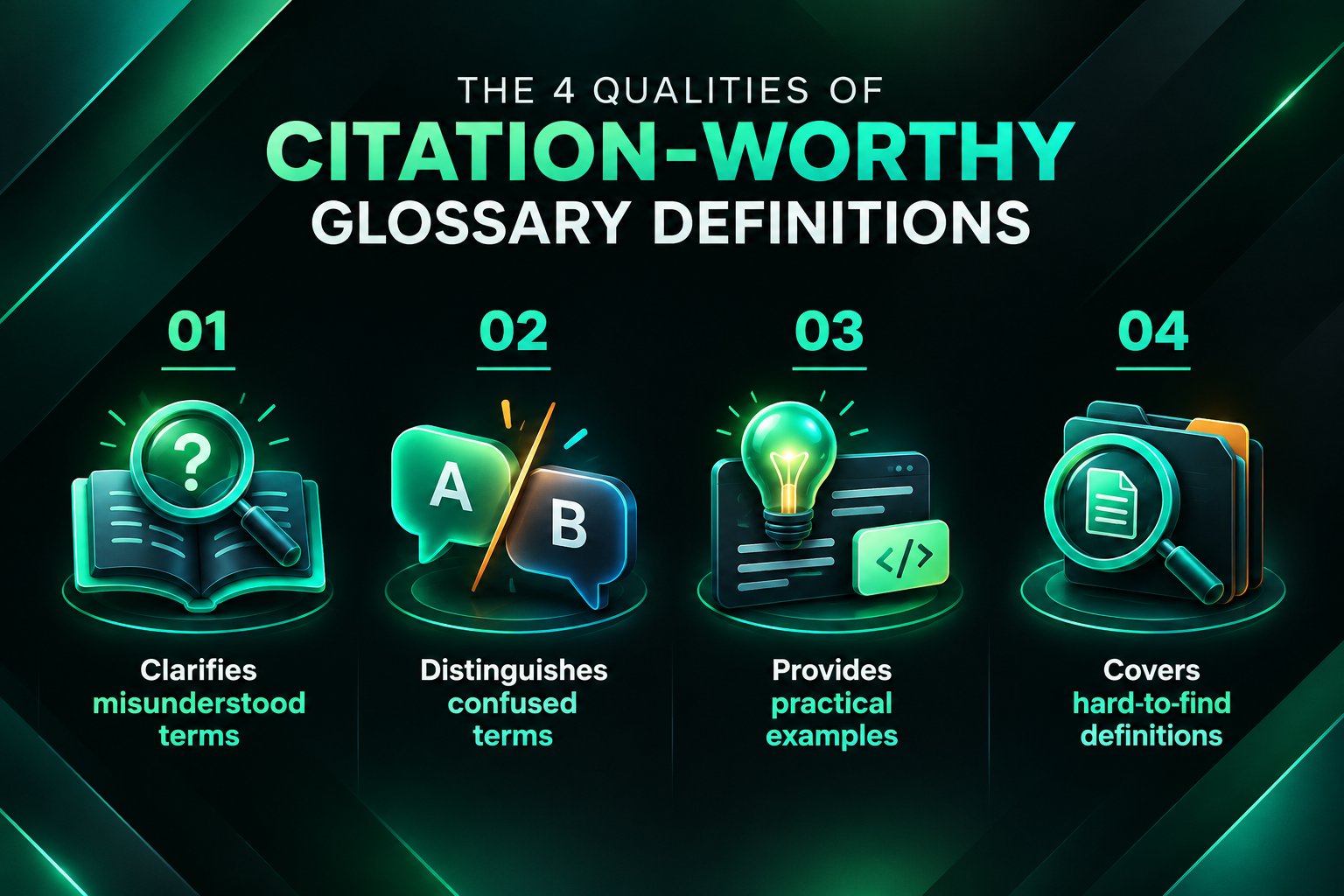
The quality of individual definitions is the primary factor that determines whether a glossary earns links. A definition that simply restates what a term means at a surface level gives another writer no reason to cite your page rather than writing their own one-sentence explanation. Definitions that earn citations tend to do one or more of the following: they clarify a term that is commonly misunderstood, they distinguish between two terms that are frequently confused, they provide a practical example that makes an abstract concept concrete, or they cover a term that is genuinely difficult to find defined clearly elsewhere.
Writing quality matters beyond accuracy. Definitions should be written in plain language accessible to the intended audience, avoiding unnecessary jargon while still being precise. If your glossary is aimed at marketing professionals, you can assume familiarity with basic digital marketing concepts but should not assume deep technical knowledge. If it is aimed at developers, the reverse may apply. Matching the language register to the audience makes the definitions more useful and more likely to be shared within that community.
Where appropriate, include cross-references between related terms within the glossary. If a definition of “domain authority” references “referring domains”, link to the referring domains entry. This improves usability for readers browsing the glossary and creates a more interconnected reference resource that publishers are more likely to recommend as a whole rather than citing a single entry in isolation.
Building the Glossary as Part of a Broader Content Strategy
A glossary is most effective as a linkable asset when it sits within a coherent content strategy rather than as a standalone page. The domain hosting the glossary should already have, or be actively building, a body of content that demonstrates topical authority in the relevant niche. A glossary on a domain that publishes nothing else related to the topic will struggle to earn citations because publishers assessing the source will find little evidence of expertise.
Plan the glossary alongside supporting content such as in-depth guides, original research, or case studies that cover the same topic area. These supporting pieces serve two purposes: they strengthen the domain’s topical authority in the eyes of search engines, and they give you additional content to reference during outreach, demonstrating that the glossary is part of a serious editorial effort rather than a link-building exercise in isolation. When a publisher sees that a domain has published a comprehensive guide on a topic alongside a detailed glossary, the glossary becomes a more credible citation source.
Consider the relationship between the glossary and your target audience’s content consumption habits. If your audience primarily reads long-form guides, the glossary can be positioned as a companion reference. If they consume short-form content on social platforms, individual term definitions formatted for sharing may generate more organic visibility. Understanding where your audience encounters new terminology helps you position the glossary where it is most likely to be discovered and cited.
Promoting the Glossary to Earn Backlinks
Most glossaries do not earn significant backlinks without active promotion, particularly in the early months after publication. Organic link acquisition tends to follow audience growth and search visibility, both of which take time to develop. A promotion strategy that combines manual outreach, content partnerships, and community engagement can accelerate this process.
Manual Outreach to Relevant Publishers
Manual outreach involves identifying websites and publications that cover your niche and reaching out to suggest the glossary as a reference resource. The most productive targets are publishers who have recently written about topics covered in your glossary and who either did not define key terms or linked to a weaker existing definition. A personalised outreach message that references a specific article and explains precisely why your glossary definition would improve it for their readers is more likely to receive a positive response than a generic pitch.
Outreach at scale requires a systematic process: prospecting for relevant publishers, assessing the quality and relevance of their sites, personalising messages, following up appropriately, and tracking responses. This is time-intensive work, and the response rates for cold outreach are typically low even with well-crafted messages. Teams that lack the capacity to run this process consistently often find that outsourcing the outreach component to a specialist provider allows them to maintain campaign momentum without diverting internal resources from other priorities.
Content Partnerships and Co-Citation
Content partnerships with complementary but non-competing publishers can generate early citations that help establish the glossary’s credibility. If you contribute a guest post to a relevant publication and naturally reference your glossary as a resource within that content, you create a citation that may be seen by other writers in the niche. Over time, a glossary that appears in multiple credible publications as a reference source tends to attract further citations as other writers encounter it through those initial placements.
Community and Industry Engagement
Sharing individual glossary definitions in relevant online communities, industry newsletters, and professional networks can generate early traffic and awareness. When a definition is genuinely useful, community members may share it or reference it in their own content. This approach works best when participation in the community is authentic and ongoing rather than limited to promotional posts about your own content.
Assessing Publisher Quality Before Pursuing Placements
Not all backlinks from glossary citations carry equal value. When pursuing outreach placements or evaluating inbound citation opportunities, it is worth assessing the quality and relevance of the linking domain. Metrics such as Ahrefs’ Domain Rating, Moz’s Domain Authority, or Majestic’s Trust Flow can provide a rough indication of a domain’s link profile strength, but these are third-party proprietary metrics rather than Google signals, and they should not be treated as guarantees of ranking impact. More important factors include the topical relevance of the linking domain to your niche, the editorial standards of the publication, the placement context within the linking content, and whether the link is followed or carries a nofollow or sponsored attribute.
A citation from a mid-authority but highly relevant industry publication is generally more valuable for topical authority than a link from a high-DR domain with no thematic connection to your content. When assessing potential outreach targets for glossary promotion, prioritise publications whose audiences overlap with yours and whose editorial standards suggest that a citation from them would be seen as credible by other publishers in the niche.
Realistic Timelines and What to Expect
A glossary built and published today is unlikely to generate meaningful backlinks within the first few weeks. The timeline from publication to measurable link acquisition depends on several variables: how actively the glossary is promoted, how competitive the niche is, how strong the domain’s existing authority is, and how well the definitions serve the needs of other content creators in the space.
For domains with an existing audience and some topical authority, a well-promoted glossary might begin attracting organic citations within three to six months of publication. For newer domains or highly competitive niches, the timeline may be considerably longer, and the volume of links earned may remain modest without sustained outreach effort. It is also worth noting that even a successful glossary is unlikely to be the sole driver of meaningful ranking improvements; backlinks are one of many factors that influence search visibility, and their impact depends on the overall quality of the site’s content, technical SEO condition, and the competitiveness of the target keywords.
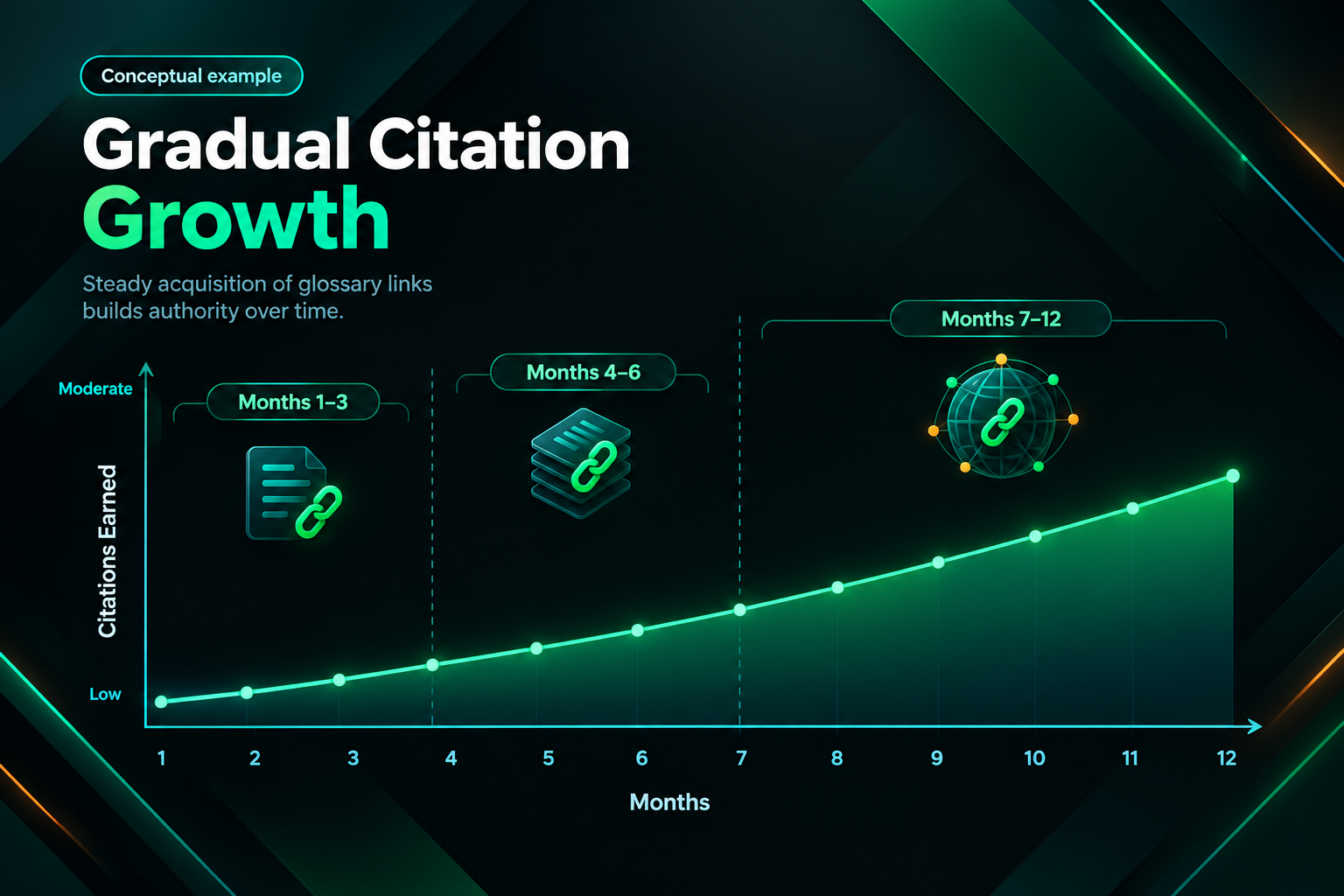
Link acquisition from a glossary tends to be gradual rather than sudden. Unlike a viral piece of original research or a data-driven study that might attract a burst of citations shortly after publication, a glossary typically accumulates links steadily over time as more writers encounter it and find it useful. This makes it a longer-term asset rather than a short-term link-building tactic.
Limitations and When a Glossary May Not Be the Right Asset
A glossary is not the right linkable asset for every website or campaign goal. In niches where terminology is already well-covered by authoritative reference sites, a new glossary will struggle to displace existing citations regardless of its quality. In industries where content production is limited and few publishers are actively writing about the topic, there may simply not be enough potential citation sources to make glossary outreach worthwhile.
Glossaries also require ongoing maintenance. Terminology evolves, new concepts emerge, and definitions that were accurate when written may become outdated. A glossary that is not updated risks losing citations as publishers find more current references. This maintenance burden is often underestimated during the planning phase.
If the primary goal is to build links to specific commercial or product pages rather than to a reference resource, a glossary may not be the most direct approach. In those cases, other linkable asset formats such as original industry research, proprietary data studies, free tools, or comprehensive comparison guides may generate links that are more easily directed toward target pages through internal linking or direct outreach. A qualified SEO professional can help assess which asset type is most likely to support your specific link acquisition goals given your domain’s current authority, content profile, and competitive landscape.
Frequently Asked Questions
How many terms should a linkable glossary include?
There is no universally correct number. A glossary of 40 to 80 well-defined, niche-specific terms with genuine depth tends to be more useful as a linkable asset than a superficial list of 200 terms. Prioritise quality and relevance over volume. If you can only write thorough definitions for 30 terms initially, start there and expand over time.
Should each glossary term have its own URL or all be on one page?
For glossaries covering more than 40 to 50 terms, individual term pages or anchor-linked sections with distinct URLs are generally preferable. They allow more precise citation, can rank independently for definition-intent queries, and make it easier for outreach targets to link to a specific definition rather than a long page. For smaller glossaries, a single well-structured page with anchor navigation is usually sufficient.
Does a glossary need to be on a high-authority domain to earn backlinks?
Domain authority helps but is not an absolute requirement. A glossary on a lower-authority domain can still earn citations if the definitions are genuinely superior to existing alternatives and the promotion strategy is active. However, publishers assessing citation sources do consider the credibility of the domain, so building topical authority through supporting content alongside the glossary improves the likelihood of earning links.
How do I find publishers to approach for glossary outreach?
Start by identifying websites that regularly publish content covering your niche. Use tools such as Ahrefs Content Explorer or Semrush to find recently published articles that include terms your glossary defines. Check whether those articles link to existing definitions and assess whether your glossary offers a meaningfully better alternative. Prioritise publishers with engaged audiences and editorial standards consistent with your own.
Can a glossary hurt my site’s SEO if it is not well-executed?
A poorly executed glossary is unlikely to cause direct harm, but it can represent a missed opportunity and may dilute topical authority if it covers terms unrelated to your core subject matter. Thin definitions that add no value over existing resources are unlikely to attract links and may not rank for definition-intent queries. The risk of a well-intentioned but underperforming glossary is primarily an opportunity cost rather than a technical SEO penalty.
How long does it take for a glossary to start earning backlinks?
This varies considerably. With active outreach and an existing audience, some citations may appear within the first few months. Without promotion, a glossary may take considerably longer to accumulate links organically, if it does so at all. Treat the glossary as a long-term asset that builds citation value gradually rather than a tactic that delivers immediate results.
Is a Glossary the Right Linkable Asset for Your Website?
A glossary can be a genuinely effective linkable asset when it is built around terminology that other publishers in your niche regularly need to explain, when the definitions are meaningfully better than existing alternatives, and when the asset is actively promoted through outreach and content partnerships. It tends to work best as part of a broader content strategy on a domain that is already building topical authority, rather than as a standalone link-building exercise on a new or thin site.
The realistic expectation is gradual, steady link acquisition over months rather than a rapid influx of citations. The asset requires ongoing maintenance as terminology evolves, and its impact on search rankings depends on many factors beyond the links it earns. In some niches and for some campaign goals, other linkable asset formats may be more effective or more efficient.
If you are considering a glossary as part of a link acquisition campaign and want to assess whether it suits your domain’s current authority, content profile, and competitive position, discussing the approach with an experienced link building specialist before committing significant resources is a reasonable step. A site-specific assessment can help determine whether a glossary, another asset type, or a combination of approaches is most likely to support your SEO and business goals.


