

When you open a backlink report in a tool such as Ahrefs, Semrush, or Majestic, two date columns appear alongside almost every link: first seen and last seen. These timestamps are among the most practically useful data points in any backlink dataset, yet they are also among the most commonly misread. Understanding what these dates actually record — and what they do not — helps you assess link health, monitor campaign progress, and avoid drawing incorrect conclusions from your backlink profile.
Key Takeaways
- First seen records the date an SEO tool’s crawler first discovered a backlink, not necessarily the date the link was published or went live.
- Last seen records the most recent date the crawler confirmed the link was still present on the page; a gap between last seen and today may indicate the link has been removed, but it can also reflect a crawl delay.
- Different tools crawl the web at different frequencies and depths, so first seen and last seen dates will often differ between Ahrefs, Semrush, Majestic, and other platforms.
- Monitoring last seen dates is a practical way to detect lost links early, which is especially useful during and after a link building campaign.
- Neither date is a direct signal used by Google to evaluate a link; they are tool-specific records of crawler activity, not search-engine timestamps.
What First Seen and Last Seen Actually Record
Every major backlink analysis tool maintains its own web crawler. That crawler visits pages across the internet, reads the HTML, and records any outbound links it finds. The first seen date is the timestamp from the first occasion the crawler encountered a specific link on a specific page. The last seen date is the timestamp from the most recent crawl on which the crawler confirmed the link was still present.
These dates are entirely tool-specific. They reflect when a particular platform’s crawler visited a page, not when a publisher added the link to their site, not when Google discovered the link, and not when the link began influencing search rankings. A link that has existed on a page for two years may show a first seen date of only six months ago if the tool’s crawler had not previously indexed that page. Conversely, a link placed last week may already show a first seen date from yesterday if the page sits within a frequently crawled domain.
This distinction matters because it prevents a common misreading: assuming that a recent first seen date means a link is new. The link may be old; the tool simply found it recently. Similarly, a first seen date from several years ago does not confirm the link has been continuously live since then — it only confirms the tool first noticed it on that date.
How Crawl Frequency Affects the Dates You See
SEO tools do not crawl every page on the internet at the same speed or with the same priority. High-authority domains with large crawl budgets tend to be revisited frequently — sometimes daily. Smaller or lower-traffic websites may be crawled far less often, sometimes only every few weeks or months. This variation in crawl frequency directly affects both first seen and last seen dates.
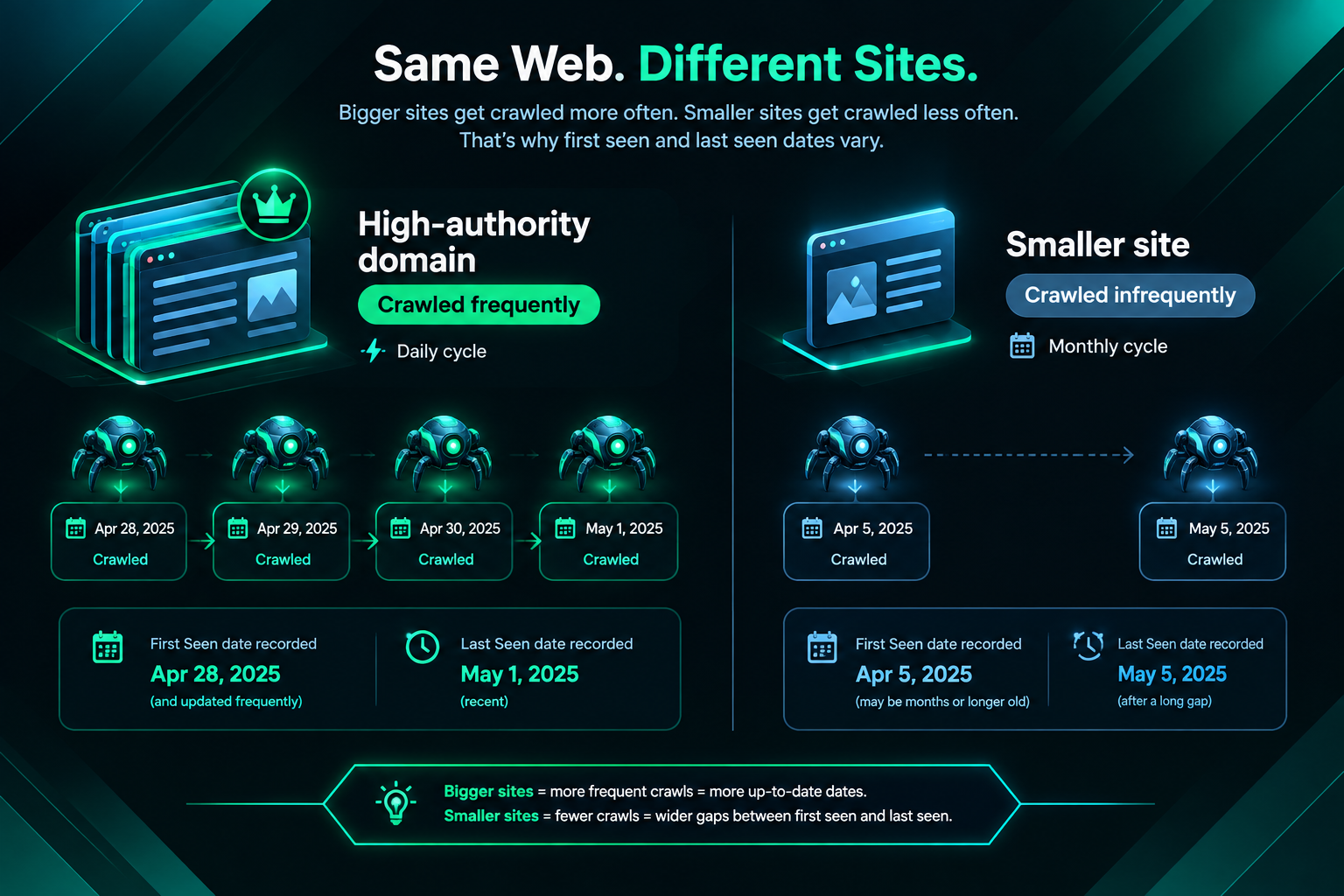
For last seen specifically, a date that is several weeks in the past does not automatically mean a link has been removed. It may simply mean the tool has not revisited that page recently. Before concluding that a link is lost, it is worth checking the page manually or waiting for the next crawl cycle to confirm. Most tools display a status indicator — such as “live”, “lost”, or “broken” — alongside the dates, and this status is generally more reliable for quick link health checks than the raw last seen date alone.
Crawl frequency also varies between tools. Ahrefs, Semrush, and Majestic each operate independent crawlers with different schedules, index sizes, and prioritization logic. A link may appear in one tool’s index with a last seen date from this week while another tool shows a last seen date from last month. Neither is necessarily wrong; they reflect different crawl histories. When monitoring a link building campaign, using a consistent tool over time produces more comparable data than switching between platforms mid-campaign.
Reading First Seen Dates in a Link Building Campaign
During an active link building campaign, first seen dates serve as a practical proxy for when placements became discoverable to SEO tools. After a guest post or niche edit goes live, there is typically a delay before the link appears in a backlink report. This delay depends on how quickly the tool’s crawler revisits the publisher’s domain. For high-authority publishers, this gap may be a matter of days. For smaller or newer sites, it could be several weeks.
Campaign managers often use first seen dates to build a rough timeline of when links entered the tool’s index. This is useful for correlating link acquisition activity with any observable changes in rankings or organic visibility, though such correlations should be interpreted carefully. Many factors influence ranking changes, and attributing a specific movement to a specific link — based on timing alone — is not reliable evidence of causation.
First seen dates are also useful for auditing historical link acquisition. If you are reviewing a backlink profile inherited from a previous agency or in-house team, the spread of first seen dates can reveal whether links were acquired gradually over time or in concentrated bursts. A large number of links with very similar first seen dates may warrant closer inspection, as it could indicate a pattern of unnatural link acquisition — though it could equally reflect a single large crawl event by the tool rather than simultaneous link placement.
Reading Last Seen Dates to Monitor Link Retention
Link retention — the proportion of acquired links that remain live over time — is a meaningful quality indicator for any link building programme. Last seen dates are the primary tool-level signal for tracking retention. When a link’s last seen date stops updating while other links on the same domain continue to refresh, it is a reasonable indicator that the link may have been removed or that the page has changed.
A practical monitoring workflow involves exporting your backlink report at regular intervals — monthly is common for active campaigns — and filtering for links where the last seen date has not updated since the previous export. These links are candidates for manual verification. Checking the live page directly confirms whether the link is still present, whether the page still exists, or whether the anchor text or destination URL has changed.
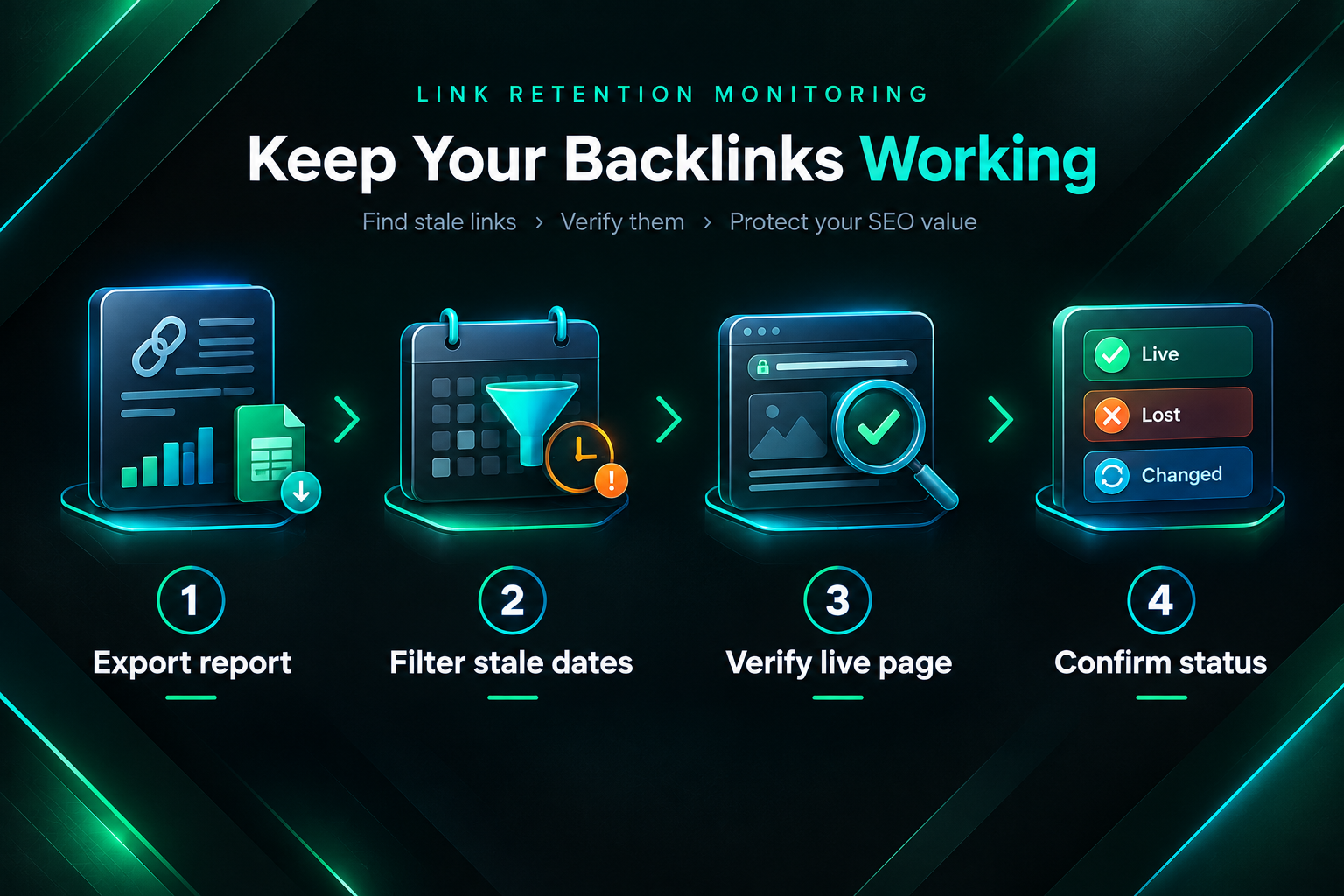
Lost links are not always the result of deliberate removal by the publisher. Common reasons include page redesigns that alter URL structures, content management system migrations, editorial updates that remove or replace sections of a page, domain expiry, and hosting issues that temporarily take a page offline. Understanding the reason for a lost link helps determine whether it is worth attempting to recover the placement or whether the effort is better directed toward new acquisition.
Some link building service providers include link replacement terms in their agreements, committing to replace links that are lost within a defined period after delivery. When evaluating such terms, it is worth understanding how the provider defines a lost link — typically using last seen status in a named tool — and what the replacement timeline looks like in practice.
First Seen vs. Last Seen: A Practical Reference
| Data Point | What It Records | What It Does Not Record | Practical Use |
|---|---|---|---|
| First Seen | Date the tool’s crawler first discovered the link | Publication date, Google discovery date, ranking impact date | Tracking when links entered the tool’s index; auditing acquisition timelines |
| Last Seen | Date the crawler most recently confirmed the link was present | Confirmation the link is currently live; Google’s last crawl of the page | Monitoring link retention; identifying potentially lost links for verification |
How Different Tools Handle These Dates
Ahrefs, Semrush, Majestic, and Moz each present first seen and last seen data in slightly different ways, and their underlying crawl methodologies differ. Ahrefs is widely regarded as having one of the largest and most frequently updated backlink indexes, which generally means its first seen dates are closer to actual publication dates for links on well-crawled domains. Majestic distinguishes between its Fresh Index and Historic Index, where the Fresh Index reflects recent crawl data and the Historic Index retains older link records that may no longer be live — a distinction that makes last seen interpretation particularly important when using Majestic data.
Semrush’s backlink database has grown substantially and provides similar first seen and last seen functionality, though the crawl schedule and index composition differ from Ahrefs. Google Search Console, by contrast, does not provide first seen or last seen dates in the same format. Its link report shows links Google has discovered, but without the granular date-level history that third-party tools offer. For detailed link monitoring, third-party backlink tools remain the more practical option.
When comparing backlink data across tools, it is important not to treat discrepancies in dates as errors. Each tool is reporting its own crawler’s history. A link that appears with a first seen date of March in one tool and May in another simply means the two crawlers visited the page at different times. Neither date is more “correct” in an absolute sense; they are both accurate records of their respective crawl events.
Common Misinterpretations to Avoid
Several misreadings of first seen and last seen dates appear regularly in backlink analysis, and each can lead to incorrect decisions about a link profile or campaign.
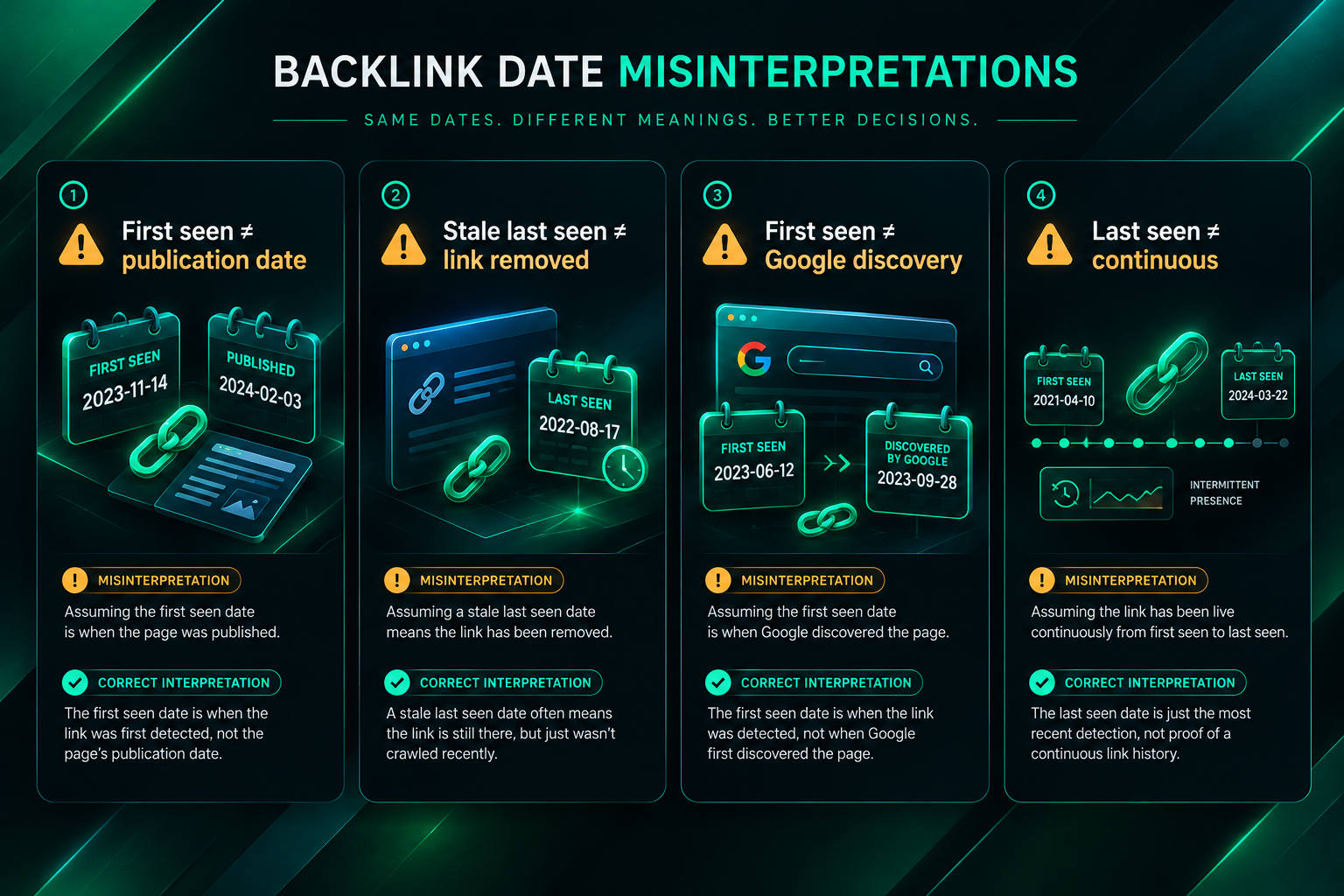
Treating first seen as the publication date. As noted above, the first seen date reflects crawler discovery, not when the publisher added the link. For links on infrequently crawled pages, the gap between actual publication and first seen can be substantial. If you need to verify when a link was actually published, checking the page’s own publication or last-modified date — or using a web archive service such as the Wayback Machine — is more reliable than relying on the tool’s first seen timestamp.
Assuming a stale last seen date means the link is gone. A last seen date from several weeks ago on a low-traffic site may simply reflect a slow crawl cycle. Manual verification of the live page is the only reliable way to confirm whether a link is still present before taking action such as requesting a replacement or updating a campaign report.
Interpreting first seen dates as evidence of ranking impact timing. There is no direct, documented relationship between when a tool first records a link and when Google discovers it, indexes it, or factors it into ranking calculations. Google’s crawl schedule is independent of third-party tool crawlers. Ranking changes observed after a first seen date may be related to the link, but they may also reflect other concurrent changes to the page, the site, or the competitive landscape.
Using last seen dates to calculate link age. Link age — the length of time a link has been live — cannot be reliably calculated from last seen dates alone. Last seen only tells you the most recent confirmation date, not the continuous history of the link’s presence. A link could have been removed and re-added between crawls without the tool detecting the interruption.
Using These Dates in Backlink Audits
Backlink audits use first seen and last seen dates to build a picture of a site’s link acquisition history and current link health. During an audit, a large cluster of links with first seen dates concentrated in a short window — particularly if those links share similar anchor text patterns or originate from similar types of sites — may indicate a historical link building campaign that warrants closer review. This is not automatically a problem, but it is a pattern worth understanding in context.
Last seen dates help distinguish between links that are actively contributing to the current backlink profile and links that are no longer live. When assessing the strength of a backlink profile, focusing on links with recent last seen dates — confirmed as live — gives a more accurate picture than including all historically recorded links regardless of their current status. Most tools allow filtering by link status, which makes this segmentation straightforward.
For websites that have undergone domain migrations, URL restructuring, or CMS changes, first seen and last seen dates can help identify links that were pointing to old URLs and may now be returning 404 errors or redirecting incorrectly. Identifying these links and either reclaiming them or ensuring redirects are functioning properly is a practical use of the date data that goes beyond simple link counting.
Applying This Knowledge to Link Building Campaign Reporting
For businesses working with a link building service provider, understanding first seen and last seen dates makes campaign reports easier to interpret. When a provider delivers a report showing newly acquired links, the first seen date in the tool confirms when those links entered the index — which may be days or weeks after the provider confirms the placement went live. This lag is normal and does not indicate a problem with the placement.
Ongoing campaign reports that include last seen status allow clients to monitor whether previously delivered links remain live. A well-structured report will flag any links whose last seen date has not refreshed recently and provide either a manual verification or a replacement where applicable. This kind of transparent reporting is a practical indicator of campaign quality and provider accountability.
When reviewing a provider’s historical performance or a sample of their previous work, checking the last seen status of links they claim to have delivered is a reasonable due diligence step. Links that show as lost or that have very old last seen dates may indicate quality or retention issues, though context matters — a link from several years ago that is no longer live is not necessarily evidence of poor practice, as publisher circumstances change over time.
Frequently Asked Questions
Does a recent first seen date mean a link is new?
Not necessarily. A recent first seen date means the tool’s crawler recently discovered the link for the first time. The link itself may have been on the page for much longer. If the publisher’s site is crawled infrequently, there can be a significant gap between when the link was added and when it first appears in a backlink tool’s index.
If a link’s last seen date is several weeks old, has it been removed?
Not necessarily. A stale last seen date may simply mean the tool has not re-crawled that page recently. Before concluding a link has been lost, check the live page manually or wait for the next crawl cycle. Most tools also provide a link status indicator — such as “live” or “lost” — which is updated based on the most recent crawl and is generally more reliable for quick checks than the raw date alone.
Do first seen and last seen dates affect Google rankings?
These dates are tool-specific records of crawler activity and are not used by Google as ranking signals. Google operates its own independent crawler with its own schedule. The dates in third-party backlink tools do not reflect when Google discovered a link or how it evaluates the link’s contribution to rankings.
Why do first seen dates differ between Ahrefs and Semrush for the same link?
Each tool operates an independent crawler with a different schedule, index size, and prioritization logic. The two crawlers simply visited the page at different times. Both dates are accurate records of their respective crawl events; neither is more correct than the other in an absolute sense.
How often should I check last seen dates during a link building campaign?
A monthly review is a practical starting point for most active campaigns. Exporting the backlink report and filtering for links where the last seen date has not updated since the previous export identifies candidates for manual verification. Higher-value placements may warrant more frequent monitoring.
Can I use first seen dates to prove when a link was published?
First seen dates are not reliable proof of publication dates. For a more accurate record of when content was published or last modified, check the page’s own metadata, the publisher’s CMS timestamps, or a web archive service such as the Wayback Machine. First seen dates are useful for understanding tool-level discovery timelines, not for establishing legal or contractual publication records.
What should I do if a link I paid for shows as lost in the backlink tool?
First, verify the link manually by visiting the live page. If the link is genuinely absent, check whether the page still exists and whether the content has been significantly changed. If the link has been removed, contact your link building provider. Reputable providers typically have a process for investigating lost links and, depending on their terms, may offer a replacement within a defined period.
Making Practical Use of Backlink Date Data
First seen and last seen dates are straightforward once you understand what they actually measure: the history of a tool’s crawler interactions with a page, not a definitive record of a link’s publication history or its relationship with Google’s index. Keeping this distinction clear prevents the most common misreadings and makes backlink reports considerably more useful.
For businesses managing or overseeing a link building programme, these dates provide a practical monitoring layer. First seen dates help you track when new placements enter the tool’s index and build a timeline of campaign activity. Last seen dates help you identify links that may need verification and support ongoing retention monitoring. Neither date tells the full story on its own, but together — alongside link status indicators and manual spot-checks — they give you a reliable view of your backlink profile’s current health.
If you are working with an outsourced link building provider, asking how they report on first seen and last seen status, and what their process is for investigating and replacing lost links, is a reasonable part of evaluating their service. Transparent, date-level reporting is a practical sign that a provider is tracking campaign outcomes rather than simply delivering placements and moving on.


