

Negative SEO refers to deliberate actions taken by a third party to harm another website’s search engine rankings. Unlike most SEO challenges, which stem from your own site’s weaknesses or strong competition, negative SEO is an external threat — someone actively working against your visibility. Understanding how these attacks work, how to spot them, and what protective measures may help is important for any business that depends on organic search traffic.
Key Takeaways
- Negative SEO involves deliberate external actions designed to damage a competitor’s search rankings, most commonly through manipulative link building, content scraping, or technical sabotage.
- Google’s algorithms have become more resilient to many low-quality link attacks, but sophisticated or sustained campaigns can still cause measurable harm in some cases.
- Early detection through regular backlink monitoring and Google Search Console alerts gives you the best chance of limiting damage before it compounds.
- The disavow tool remains available for addressing toxic backlink patterns, though it should be used carefully and is not a guaranteed remedy.
- A strong, well-diversified backlink profile built through legitimate outreach makes a site considerably harder to damage through link-based attacks.
What Is Negative SEO?
Negative SEO is the practice of using manipulative or harmful tactics against a competitor’s website with the goal of reducing its organic search visibility. The term covers a range of methods, from building large volumes of spammy backlinks pointing at a target site, to scraping and republishing its content, to more technical forms of sabotage such as triggering crawl errors or fabricating fake reviews. The underlying motivation is competitive: if a rival’s rankings drop, the attacker may benefit from the resulting traffic shift.
It is worth being precise about what negative SEO is and is not. Not every ranking drop is caused by an attack. Algorithm updates, content quality issues, technical problems, natural link loss, and stronger competition are far more common causes of declining organic visibility. Attributing a ranking decline to negative SEO without evidence can lead to wasted effort and missed opportunities to fix genuine on-site problems. A proper investigation — including a technical audit, content review, and backlink analysis — is the appropriate starting point before drawing conclusions.
Negative SEO is also not a new phenomenon, but its effectiveness has changed significantly over time. Google has stated publicly that its algorithms are designed to ignore or discount low-quality links rather than penalise the sites they point to, precisely because webmasters cannot control who links to them. In practice, this means that many unsophisticated link-based attacks have limited impact on well-established sites. However, the risk is not zero, particularly for smaller sites with thin backlink profiles or for attacks that are unusually large, targeted, or combined with other tactics.
Common Types of Negative SEO Attacks
Understanding the different forms negative SEO can take helps you monitor for the right signals and respond appropriately. The most frequently documented attack types fall into several broad categories.
Toxic or Spammy Link Building
The most widely discussed form of negative SEO involves pointing large volumes of low-quality, irrelevant, or manipulative backlinks at a target website. Attackers may use link farms, private blog networks, adult or gambling sites, foreign-language spam directories, or automated link-building tools to generate thousands of links in a short period. The intent is to trigger a manual action from Google’s spam team or to cause the site’s backlink profile to appear manipulative.
Google’s John Mueller and other representatives have repeatedly stated that the search engine is generally able to ignore such links rather than penalise the target site. This is consistent with the logic that site owners cannot control inbound links. However, in cases where the attack is very large, highly targeted at specific anchor text patterns, or directed at a site that already has a weak or inconsistent backlink profile, there is a possibility of measurable harm. The risk is higher for newer or smaller sites than for established domains with strong editorial link profiles.
Content Scraping and Duplicate Content
Content scraping involves copying a website’s pages and republishing them across multiple other domains, sometimes at scale and sometimes faster than the original can be indexed. The goal is to make search engines uncertain about which version is the original, potentially causing the legitimate site to be treated as the duplicate. This tactic is more likely to cause problems for sites that publish content infrequently or that have slow indexing, since Google’s systems generally favour the version it crawled first.
Scraping attacks can also be combined with link manipulation: the scraped content may be published on low-quality sites that then attract spammy links, creating a confusing signal environment for crawlers. Using Google Search Console’s URL Inspection tool and monitoring for duplicate content through tools such as Copyscape or Semrush’s site audit features can help identify scraping activity early.
Fake Reviews and Brand Reputation Attacks
Some negative SEO campaigns target a business’s online reputation rather than its technical backlink profile. This can involve submitting large volumes of fake negative reviews on Google Business Profile, Trustpilot, or industry-specific review platforms. While this does not directly manipulate backlinks or on-page signals, it can affect local search visibility, click-through rates, and conversion rates. Fake reviews are a violation of platform policies, and most major review platforms have processes for reporting and removing them, though the process can be slow.
Crawl and Server Attacks
A less common but more technically disruptive form of negative SEO involves sending automated bots to crawl a target site at very high rates, consuming server resources and potentially causing slowdowns or outages. If a site becomes slow or intermittently unavailable, Googlebot may struggle to crawl and index it effectively, which can indirectly affect rankings. Server-level rate limiting, bot filtering, and a content delivery network can help mitigate this type of attack.
Fake Link Removal Requests
A more sophisticated tactic involves an attacker contacting websites that host legitimate backlinks to a competitor and impersonating the competitor’s webmaster, requesting that those links be removed. If successful, this can strip a site of valuable editorial links it has earned through legitimate outreach or content. Monitoring your backlink profile regularly through tools such as Ahrefs, Semrush, or Majestic means you are more likely to notice an unusual drop in referring domains and can investigate the cause.
How to Detect Negative SEO Early
Early detection is the most practical defence against negative SEO. The longer an attack goes unnoticed, the more difficult it becomes to assess its impact and take corrective action. Several monitoring practices can help you identify unusual activity before it causes lasting harm.
Backlink Profile Monitoring
Setting up regular backlink audits — ideally weekly for competitive niches — allows you to spot sudden spikes in referring domains, unusual anchor text patterns, or links from clearly irrelevant or low-quality sources. A sudden increase of hundreds or thousands of new referring domains within a short period, particularly from unrelated industries or foreign-language spam sites, is a signal worth investigating. Tools such as Ahrefs, Semrush, and Majestic each use different crawl databases and metrics, so cross-referencing more than one can give a more complete picture.
Pay particular attention to anchor text distribution. A sudden concentration of exact-match commercial anchor text from low-quality sources can create an unnatural pattern that may attract algorithmic scrutiny, even if individual links are ignored. This is one reason why a naturally diverse anchor text profile — built through genuine editorial outreach — provides a degree of resilience against link-based attacks.
Google Search Console Alerts
Google Search Console provides several signals relevant to negative SEO detection. Manual action notifications indicate that a human reviewer at Google has identified a policy violation associated with your site. While a manual action is not always caused by a negative SEO attack — it can result from your own past link building practices — it is a clear signal that requires immediate attention. The Links report in Search Console also shows which external sites link to your pages, though its coverage is less comprehensive than dedicated third-party backlink tools.
Setting up email alerts for Search Console notifications ensures you are informed promptly if a manual action is issued or if significant crawl errors appear. Monitoring the Coverage report for unexpected indexing changes can also help identify whether scraping or technical interference is affecting how your pages appear in search results.
Organic Traffic and Ranking Monitoring
A sudden, unexplained drop in organic traffic or rankings — particularly one that does not coincide with a known algorithm update — may warrant investigation. However, it is important to rule out more common causes first: algorithm updates, technical issues such as accidental noindex tags or robots.txt changes, content quality problems, or seasonal fluctuations. Negative SEO should generally be considered after these more probable explanations have been assessed.
How to Respond to a Negative SEO Attack
If you have identified credible evidence of a negative SEO attack, a measured and methodical response is more effective than a reactive one. The appropriate steps depend on the type of attack and its apparent scale.
Using the Google Disavow Tool
Google’s disavow tool allows site owners to submit a file listing domains or URLs they want Google to ignore when assessing their backlink profile. This tool was designed primarily for situations where a site has previously engaged in manipulative link building and wants to distance itself from those links, but it can also be used in response to a negative SEO link attack. Google’s guidance is that the disavow tool should be used cautiously: disavowing legitimate links by mistake can remove signals that are helping your rankings.
Before submitting a disavow file, it is worth attempting to contact the webmasters of the most harmful linking domains and requesting removal. This is rarely successful with spam sites, but it demonstrates a good-faith effort and is recommended by Google’s documentation. The disavow file should focus on domains rather than individual URLs where possible, and should be limited to links that are clearly problematic rather than simply unfamiliar. The tool does not guarantee that Google will ignore the specified links, and its effect may take weeks or months to become apparent in rankings.
Reporting Fake Reviews
If fake reviews are part of the attack, report them directly to the relevant platform using the available flagging mechanisms. Google Business Profile, Trustpilot, and similar platforms have policies against fake reviews and processes for requesting removal, though response times vary. Documenting the reviews with screenshots before reporting is advisable. In some jurisdictions, coordinated fake review campaigns may also have legal implications worth exploring with appropriate professional advice.
Addressing Content Scraping
If your content is being scraped and republished, submitting a DMCA takedown request to the hosting provider or search engine is the standard approach. Google’s DMCA removal process allows you to request that scraped copies be removed from search results. Publishing content frequently and ensuring it is indexed quickly — for example by submitting new URLs through Search Console — can help establish your site as the original source before scrapers can republish it.
Building a Backlink Profile That Is Harder to Attack
One of the most effective long-term defences against negative SEO is a strong, diverse, and editorially earned backlink profile. A site with hundreds of high-quality referring domains from relevant, authoritative publishers is considerably more resilient to a link-based attack than a site with a thin or inconsistent profile. When Google’s systems encounter a sudden influx of low-quality links pointing at a well-established site with a healthy link history, the anomalous links are more likely to be discounted without causing harm.
Manual outreach link building — where links are acquired through genuine editorial relationships, guest contributions, digital PR, and content-driven campaigns — builds the kind of profile that provides this resilience. Links earned through these methods tend to come from topically relevant, independently operated websites, with varied anchor text and natural placement context. This diversity makes it harder for an attacker to create a pattern that stands out as manipulative, because the legitimate profile already contains a wide range of link types and sources.
It is also worth noting that the same backlink monitoring practices used to detect negative SEO attacks are valuable for managing a legitimate link building campaign. Regularly reviewing your referring domain profile, tracking new and lost links, and assessing the topical relevance of linking sites are standard practices for any well-managed SEO programme. Treating backlink monitoring as an ongoing activity rather than a reactive measure means you are better positioned to notice anomalies quickly, regardless of their cause.
What Negative SEO Cannot Do
It is equally important to understand the limits of negative SEO, both to avoid unnecessary alarm and to maintain realistic expectations about the threat. Google has invested significantly in making its systems robust against link manipulation, partly because the alternative — penalising sites for links they did not build — would be easily exploited and deeply unfair to site owners.
For well-established sites with strong content and diverse backlink profiles, a typical low-quality link attack is unlikely to cause significant ranking damage. Google’s algorithms are designed to identify and discount manipulative links, and the disavow tool provides an additional layer of protection. Content scraping is a nuisance and can cause indexing complications, but it rarely causes lasting harm to sites that publish regularly and maintain clear authorship signals. Fake reviews can affect reputation and local visibility, but they are a platform-level problem as much as an SEO one.
Negative SEO is most likely to cause measurable harm when it is sustained over a long period, when it targets a site that already has a weak or inconsistent backlink profile, when it is combined with multiple attack types simultaneously, or when it goes undetected for an extended time. This reinforces the value of proactive monitoring and a strong organic link profile as the primary defences.
Negative SEO vs. Algorithmic Penalties vs. Manual Actions
Distinguishing between a negative SEO attack, an algorithmic ranking adjustment, and a Google-issued manual action is important because each requires a different response. A manual action is a formal notification from Google’s spam team that your site has violated its policies; it appears directly in Google Search Console and requires a reconsideration request after the issue is resolved. An algorithmic adjustment — such as a core update or a spam update — affects rankings based on automated signals and does not produce a manual action notification.
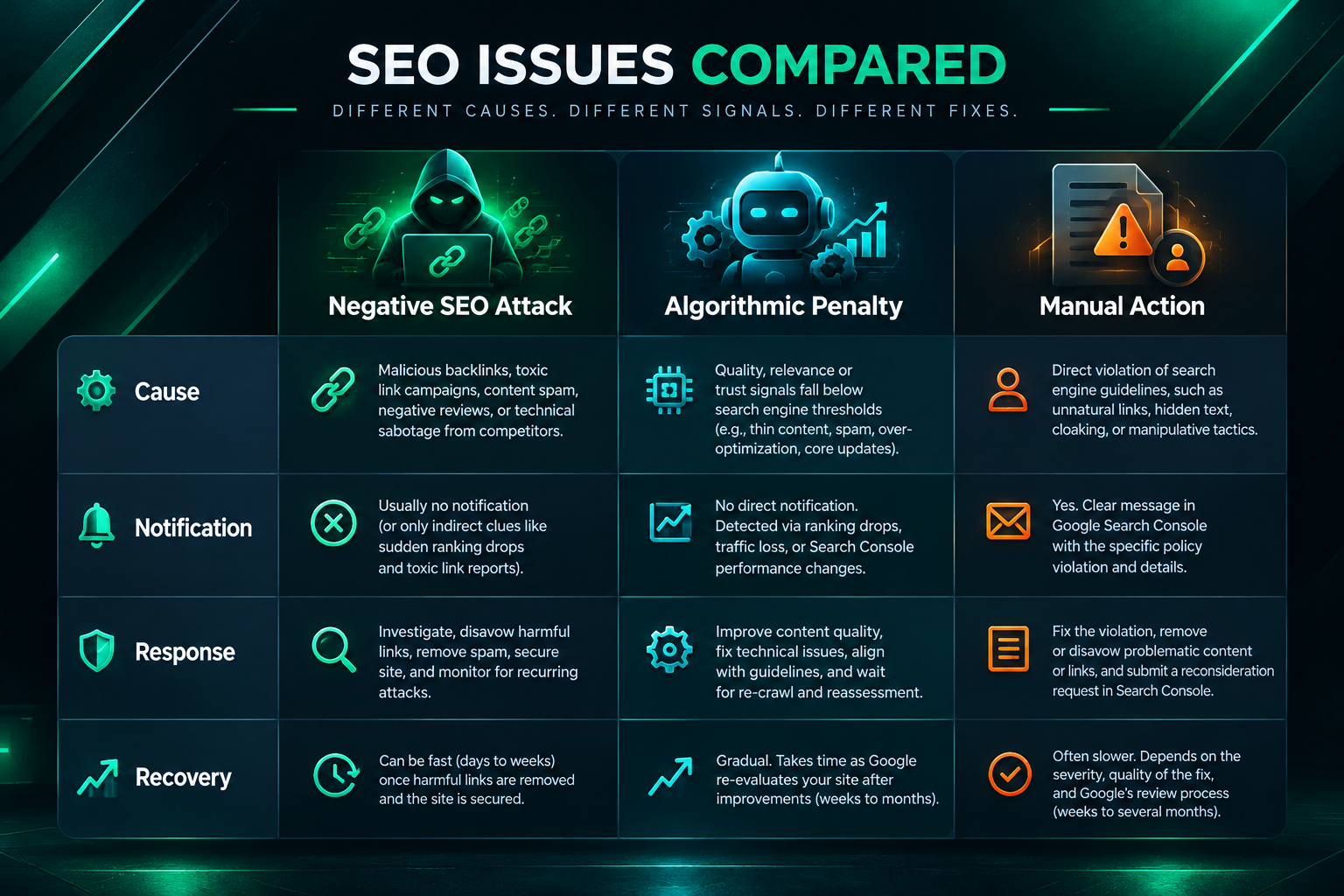
A negative SEO attack may or may not result in a manual action. If Google’s systems identify a manipulative link pattern pointing at your site and determine it is not your doing, they are more likely to ignore the links than to issue a penalty. If a manual action is issued in connection with links you did not build, you can explain this in your reconsideration request and submit a disavow file as supporting evidence. Keeping records of your legitimate link building activity — including outreach correspondence, published placements, and campaign timelines — can support this explanation.
Frequently Asked Questions
Can negative SEO actually cause a ranking drop?
It is possible, but the risk depends heavily on the site’s existing backlink profile, the scale and sophistication of the attack, and how quickly it is detected. Well-established sites with strong editorial link profiles are considerably more resilient. Google’s systems are designed to discount rather than penalise sites for links they did not build, but this protection is not absolute, particularly for smaller or newer sites.
How do I know if I am being targeted by negative SEO?
The clearest signals are a sudden, unexplained spike in low-quality referring domains, unusual anchor text patterns, a manual action notification in Google Search Console, or a ranking drop that cannot be explained by algorithm updates or on-site changes. Regular backlink monitoring using tools such as Ahrefs, Semrush, or Majestic is the most reliable way to detect these signals early.
Should I always disavow suspicious links?
Not necessarily. Google’s guidance is to use the disavow tool cautiously, as disavowing legitimate links by mistake can remove positive ranking signals. Focus disavow efforts on links that are clearly spammy, irrelevant, or part of an obvious attack pattern. If you are uncertain, consulting an experienced SEO professional before submitting a disavow file is advisable.
Is negative SEO illegal?
Negative SEO tactics may violate the terms of service of search engines and various platforms. Some tactics — such as coordinated fake review campaigns, unauthorised access to a competitor’s systems, or copyright infringement through content scraping — may also have legal implications depending on jurisdiction. However, the legal landscape varies significantly, and pursuing legal remedies is complex. Consulting a legal professional is appropriate if you believe you are the target of a sustained or damaging campaign.
Does a strong backlink profile really protect against negative SEO?
A diverse, editorially earned backlink profile does provide meaningful resilience. When Google’s systems encounter anomalous low-quality links pointing at a site with a well-established and varied link history, those links are more likely to be discounted. This is one practical reason why investing in legitimate link acquisition through manual outreach and content-driven campaigns has long-term defensive value beyond its direct ranking benefits.
How long does it take to recover from a negative SEO attack?
Recovery timelines vary depending on the type of attack, whether a manual action was issued, how quickly the issue was identified, and the actions taken in response. If a disavow file is submitted, Google’s documentation indicates that effects may take weeks or months to become apparent. Manual action reconsideration requests are reviewed by a human and can take several weeks. There is no guaranteed recovery timeline, and outcomes depend on the specific circumstances of each case.
Protecting Your Site from Negative SEO: A Practical Perspective
Negative SEO is a real threat, but it is also one that is frequently overstated. For most businesses, the more pressing SEO priorities are content quality, technical health, and building a genuine backlink profile through legitimate outreach — and these same investments also provide the strongest defence against external attacks. A site that earns links through editorial relationships, publishes original content consistently, and monitors its backlink profile regularly is both better positioned to rank and harder to damage through manipulation.
If you are concerned about your site’s vulnerability to negative SEO, the most useful starting point is a thorough backlink audit and a review of your current monitoring practices. Understanding what your existing link profile looks like — its diversity, topical relevance, and anchor text distribution — gives you a baseline against which anomalies become visible. From there, setting up automated alerts and scheduling regular reviews means you are unlikely to be caught off guard by a sustained attack.
For businesses managing link building campaigns or working with an external provider, maintaining clear records of all legitimate placements is also valuable. If you ever need to demonstrate to Google that a suspicious link pattern was not your doing, documented evidence of your actual outreach activity is a meaningful asset. A qualified SEO professional or link building specialist can help you assess your current exposure and put appropriate monitoring and response processes in place.


