Noindex and nofollow are two of the most commonly misunderstood directives in technical SEO. Both influence how search engines interact with your website, but they operate at different levels and solve different problems. Confusing them — or applying them incorrectly — can quietly damage your crawl budget, strip link equity from pages that need it, or leave low-quality content indexed when it should be hidden from search results. This article explains what each directive does, how they differ, when each one is appropriate, and how they interact with link building and backlink strategy.
Key Takeaways
- Noindex tells search engines not to include a page in their index; nofollow tells them not to pass link equity through a specific link.
- Applying noindex to the wrong pages can remove valuable content from search results; misusing nofollow can waste link equity across your site.
- Neither directive is a penalty or a negative signal by itself — both are legitimate tools when used for the right purpose.
- Nofollow on external links affects how link equity flows out of your site; it does not prevent crawling of the linked page.
- Understanding both directives is important for link building campaigns, because they determine whether backlinks you earn actually pass value to your target pages.
Quick Comparison
| Characteristic | Noindex | Nofollow |
|---|---|---|
| Where it is applied | Page-level (meta tag or HTTP header) | Link-level (individual anchor tag attribute) |
| Primary function | Removes or prevents a page from appearing in search results | Signals that link equity should not pass through a specific link |
| Effect on crawling | Does not prevent crawling; only affects indexing | Does not prevent crawling of the linked page |
| Effect on link equity | Pages with noindex can still pass equity through their outbound links | Instructs search engines not to pass equity through that link |
| Common use cases | Thank-you pages, admin areas, duplicate content, staging environments, thin content | Paid or sponsored links, user-generated content, untrusted external links |
| Search engine treatment | Treated as a directive by Google; page removed from index | Treated as a hint by Google since September 2019; may still be followed |
| Impact on link building | Backlinks from noindexed pages may still pass some equity, but value is uncertain | Backlinks with nofollow attribute do not reliably pass equity to your site |
| Robots.txt alternative | Robots.txt blocks crawling but does not remove indexed pages | No direct robots.txt equivalent at link level |
What Does Noindex Mean?
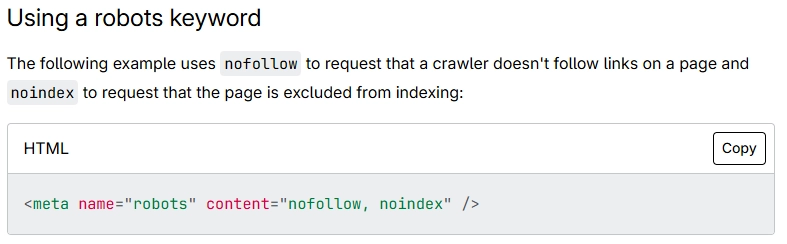
The noindex directive is a page-level instruction that tells search engines not to include a specific page in their search index. When Google’s crawler visits a page carrying a valid noindex signal, it processes that instruction and removes the page from search results — or prevents it from appearing there in the first place. The directive is most commonly implemented as an HTML meta robots tag placed in the <head> section of a page, written as <meta name="robots" content="noindex">. It can also be delivered via an HTTP response header, which is particularly useful for non-HTML files such as PDFs.
An important distinction that many site owners miss: noindex does not prevent a search engine from crawling the page. Google’s crawler may still visit a noindexed URL, read its content, and follow its outbound links. The directive only affects whether the page appears in search results. This means that if you want to prevent crawling entirely — for example, to protect server resources or hide sensitive content from the crawler — you need robots.txt disallow rules instead. However, using robots.txt to block a page that also carries a noindex tag creates a conflict: if the crawler cannot access the page, it cannot read the noindex instruction, and the page may remain indexed.
Noindex is appropriate for pages that exist for functional or administrative reasons but should not compete for organic search visibility. Common examples include checkout confirmation pages, internal search results, duplicate product filter pages in e-commerce, staging or development environments, login and account management pages, and thin or auto-generated content that adds no search value. Applying noindex to these pages keeps your indexed content focused on pages that genuinely serve search users.
What Does Nofollow Mean?
The nofollow attribute is a link-level signal applied to individual anchor tags. When added to a hyperlink — written as rel="nofollow" — it instructs search engines not to pass link equity, sometimes called PageRank or link juice, through that specific link. Unlike noindex, nofollow does not affect the page it appears on; it only affects the relationship between the linking page and the destination URL.
Google introduced the nofollow attribute in 2005 primarily to combat comment spam, where low-quality websites were flooding blog comment sections with links to manipulate rankings. Over time, its use expanded to cover paid links, sponsored content, and any link that a publisher did not want to editorially endorse. In September 2019, Google updated its treatment of nofollow, reclassifying it as a hint rather than a strict directive. This means Google may choose to follow a nofollow link and consider it for ranking purposes, though it is not obligated to do so. The practical implication is that nofollow links are not completely worthless for SEO, but they are significantly less reliable for passing link equity than standard followed links.
Google also introduced two additional link attributes alongside this update: rel="sponsored" for paid or affiliate links, and rel="ugc" for user-generated content such as forum posts and comments. These more specific attributes help search engines better understand the nature of a link, though nofollow remains widely used and is still recognized across all major search engines including Bing.
How Noindex and Nofollow Interact with Link Building
Understanding the difference between noindex and nofollow is directly relevant to any link building campaign, because both directives affect whether the backlinks you earn actually deliver SEO value to your target pages.
When you acquire a backlink from an external website, the link’s ability to pass equity depends partly on whether the linking page applies a nofollow attribute to your link. A dofollow link — meaning a standard link with no nofollow, sponsored, or ugc attribute — is the type that most link building campaigns aim to secure, because these links are more likely to pass authority signals to your site. A nofollow backlink from a high-quality, relevant source may still provide referral traffic and brand visibility, and Google’s hint-based treatment means some equity may pass, but the outcome is less predictable than with a followed link.
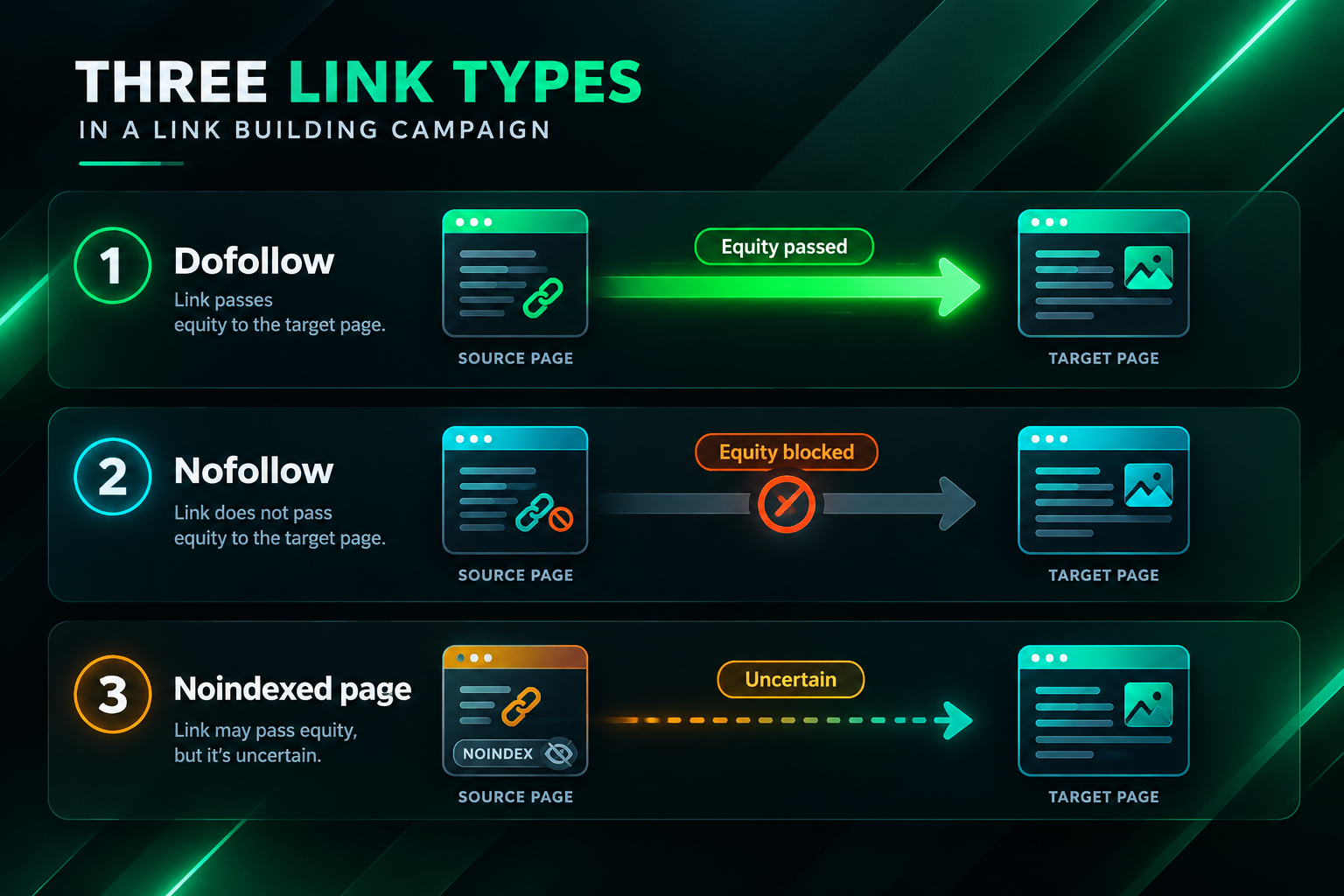
The indexation status of the linking page also matters. If a referring page is noindexed, search engines may still crawl it and follow its outbound links, but the long-term value of a link from a noindexed page is uncertain. Google has indicated that links from pages it does not index may carry less weight, because those pages are not considered part of the indexed web. When evaluating backlink quality during a campaign, checking whether a referring domain’s linking page is actually indexed is a useful quality signal alongside metrics such as Domain Rating in Ahrefs or Authority Score in Semrush.
For link building campaigns focused on building topical authority and improving rankings for specific target pages, the practical priority is earning dofollow links from indexed, editorially relevant pages on authoritative domains. Nofollow links from major publications, news sites, or highly trafficked platforms can still contribute to a natural-looking backlink profile and may drive meaningful referral traffic, but they should not be the primary measure of a campaign’s link equity impact.
Common Mistakes When Using Noindex and Nofollow
Several recurring errors appear when site owners or developers apply these directives without a clear understanding of their effects.
Blocking important pages with noindex
One of the most damaging mistakes is accidentally applying noindex to pages that should rank in search results. This can happen when a staging environment’s noindex configuration is carried over to a live site, when a CMS plugin applies noindex to category or tag pages by default, or when a developer adds a blanket noindex to a section of the site during development and forgets to remove it. The result is that pages with strong content and backlinks disappear from search results, causing traffic drops that can be difficult to diagnose without checking Google Search Console’s Coverage or Indexing reports.
Using nofollow on internal links
Applying nofollow to internal links — links between pages on your own website — was once recommended as a way to sculpt PageRank flow. Google has since clarified that this approach does not work as intended and may waste crawl budget. Internal links should generally be standard followed links, allowing equity to flow naturally through your site’s architecture to the pages you want to prioritize.
Assuming nofollow prevents crawling
Nofollow does not prevent a search engine from crawling the destination URL. If a URL is linked from multiple places across the web without nofollow, it will likely be crawled regardless of whether some links carry the attribute. Nofollow is a signal about link equity, not a crawl barrier.
Confusing noindex with robots.txt disallow
Robots.txt disallow rules prevent crawling but do not remove a page from the index. If a page has been indexed and you then block it with robots.txt, Google may retain the URL in its index without being able to read the page’s content. To remove a page from the index, a noindex tag must be accessible to the crawler — which means the page must not be blocked by robots.txt at the same time.
When to Use Noindex
Noindex is appropriate when a page needs to exist on your website for functional, technical, or user experience reasons, but should not appear in organic search results. The following situations typically warrant noindex:
- Duplicate or near-duplicate content: Faceted navigation pages, filtered product listings, and paginated archives can create large numbers of near-duplicate URLs. Noindexing these pages keeps your indexed content focused and avoids diluting the authority of your primary category or product pages.
- Thin or low-value content: Pages with minimal original content — such as tag archives, author pages with few posts, or auto-generated location pages — may be better noindexed if they do not provide genuine value to search users.
- Transactional or functional pages: Order confirmation pages, cart pages, login screens, and account dashboards serve users after they have already arrived on your site. They have no search intent value and should not consume crawl budget or appear in results.
- Staging and development environments: Any non-production version of a site should carry noindex to prevent accidental indexation of test content or duplicate versions of live pages.
- Internal search results pages: Search engines generally discourage indexing of internal site search results, as these pages are generated dynamically and rarely provide useful content to external searchers.
When to Use Nofollow
Nofollow is appropriate when you are linking to an external destination that you do not want to editorially endorse, or when search engine guidelines require it for certain link types. The following situations typically warrant nofollow or its more specific equivalents:
- Paid or sponsored links: Google’s spam policies require that paid links — including affiliate links and sponsored placements — carry a nofollow or sponsored attribute. Failing to do so can expose a site to manual action for selling or buying links that pass PageRank.
- User-generated content: Links posted by users in comments, forums, or community sections should carry nofollow or ugc attributes, as the site owner cannot verify the quality or intent of every user-submitted link.
- Untrusted or low-quality external links: If you need to reference a source that you do not want to endorse — for example, when citing a claim you are disputing — nofollow allows you to link without passing equity.
- Widget or embedded content links: Links that appear in widgets, templates, or embeddable content distributed across multiple sites should carry nofollow to avoid appearing as a link scheme.
It is worth noting that nofollow should not be applied to links simply because they point to external websites. Linking editorially to high-quality, relevant external sources is a normal and acceptable practice. Overusing nofollow on legitimate outbound links does not provide a meaningful SEO benefit and may reduce the usefulness of your content for readers.
How These Directives Affect Backlink Quality Assessment
When evaluating the backlink profile of a website — whether during an SEO audit, a competitor analysis, or a link building campaign review — noindex and nofollow status are two of the quality signals worth examining alongside domain-level authority metrics.
Third-party SEO tools such as Ahrefs, Semrush, and Majestic report on whether individual backlinks are followed or nofollowed. These tools use their own crawl data and proprietary metrics — Domain Rating, Authority Score, and Trust Flow respectively — which are useful for relative comparisons but are not Google-provided signals and do not directly predict ranking outcomes. A link reported as dofollow in these tools may still be treated differently by Google depending on factors such as the linking page’s indexation status, the topical relevance of the linking domain, and the surrounding content context.
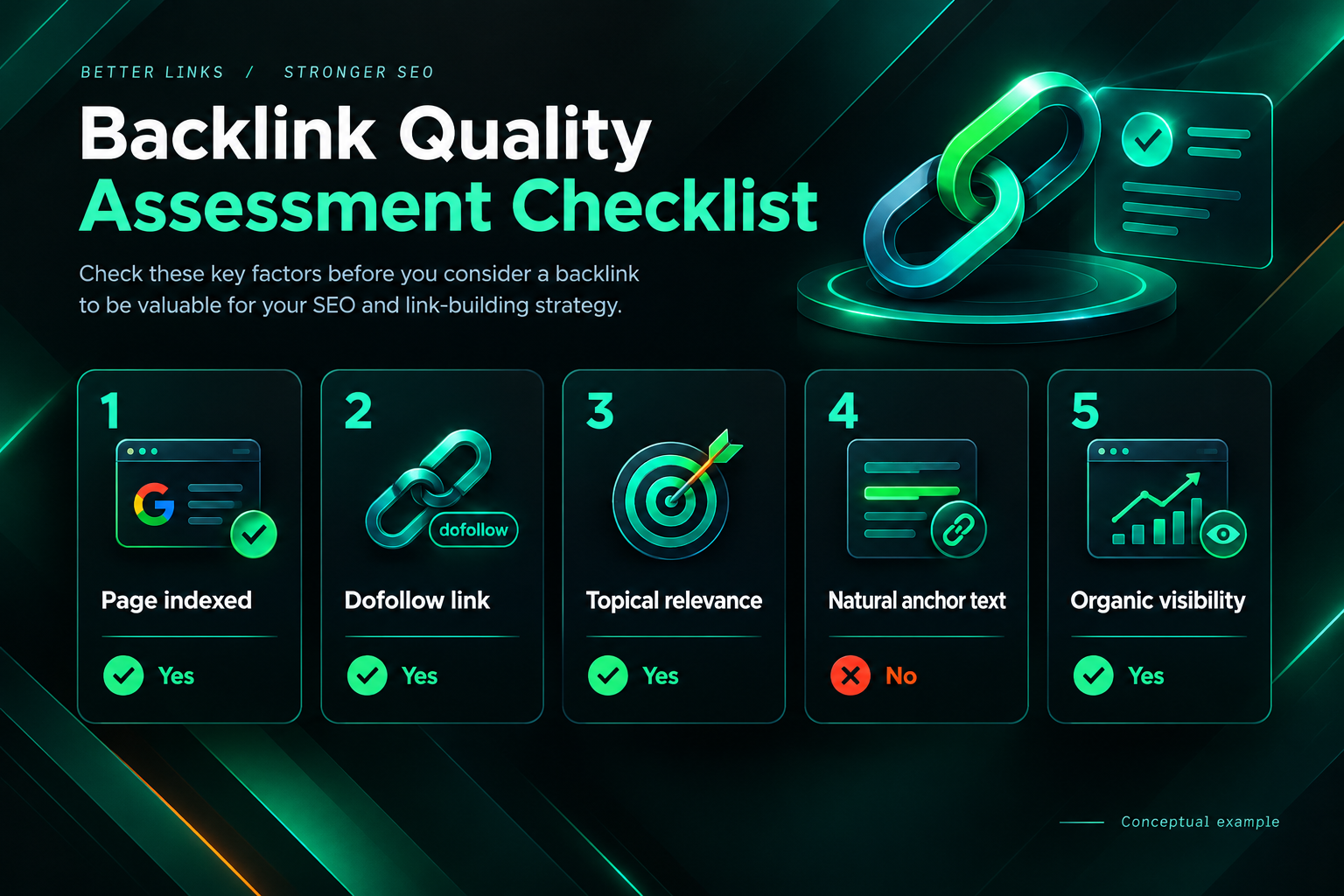
When assessing backlinks for a link building campaign, a useful quality checklist includes: whether the linking page is indexed in Google, whether the link carries a dofollow attribute, whether the linking domain is topically relevant to the target site, whether the anchor text is natural and contextually appropriate, and whether the linking page itself has meaningful organic visibility. A backlink that passes all of these checks is more likely to contribute positively to a campaign than one that fails several of them, though no individual link can be guaranteed to produce a specific ranking outcome.
Noindex, Nofollow, and Crawl Budget
Crawl budget refers to the number of URLs a search engine is willing to crawl on a given site within a specific time period. For large websites — particularly e-commerce sites with thousands of product and filter pages, or content sites with extensive archives — managing crawl budget efficiently can influence how quickly new and updated content is discovered and indexed.
Noindex can help preserve crawl budget by signaling to search engines that certain pages do not need to be re-crawled frequently for indexing purposes, though Google has noted that noindexed pages may still be crawled periodically to check for changes to the directive. Robots.txt disallow rules are more effective at preventing crawling entirely, but as noted earlier, they should not be applied to pages that carry noindex tags.
Nofollow on internal links does not meaningfully improve crawl budget management and is not recommended for this purpose. A well-structured internal linking architecture — with clear navigation, logical hierarchy, and XML sitemaps — is a more effective approach to guiding crawlers toward your most important pages.
Frequently Asked Questions
Does a nofollow backlink have any SEO value?
Since Google reclassified nofollow as a hint in 2019, some nofollow links may be followed and considered for ranking purposes, though this is not guaranteed. Nofollow links from high-traffic, authoritative sources can still deliver referral traffic and contribute to a natural-looking backlink profile. However, for campaigns focused on passing link equity to target pages, dofollow links from indexed, relevant pages are more reliable.
Can a page with noindex still pass link equity through its outbound links?
Google has indicated that links from noindexed pages may carry less weight over time, because those pages are not part of the indexed web. A noindexed page may still be crawled and its outbound links followed, but the long-term equity value of links originating from noindexed pages is uncertain and generally considered lower than links from indexed pages.
Should I use nofollow on all external links?
No. Nofollow is intended for paid links, sponsored content, user-generated links, and links you do not want to editorially endorse. Applying nofollow to all external links is unnecessary and does not provide a meaningful SEO benefit. Linking naturally to relevant, high-quality external sources is a normal editorial practice.
What happens if I accidentally noindex an important page?
The page will be removed from Google’s search index, typically within the next crawl cycle. You will likely see a drop in organic traffic to that URL. To fix the issue, remove the noindex tag and ensure the page is not blocked by robots.txt. Google Search Console’s URL Inspection tool can be used to request re-indexing after the tag is removed. Recovery time varies depending on how frequently Google crawls your site.
Is nofollow required for affiliate links?
Google’s spam policies require that affiliate links carry a nofollow or sponsored attribute, as these are considered paid or commercially motivated links. Failing to attribute affiliate links correctly can expose a site to a manual action for unnatural links. Most affiliate programs also specify this requirement in their terms.
How do I check whether my backlinks are followed or nofollowed?
SEO tools such as Ahrefs, Semrush, and Majestic report the follow status of backlinks in their link databases. You can also inspect individual links manually by viewing the page source of the linking page and checking the anchor tag for a rel="nofollow", rel="sponsored", or rel="ugc" attribute. Google Search Console’s Links report shows which external pages link to your site, though it does not currently display follow status directly.
Can I use both noindex and nofollow on the same page?
Yes. A meta robots tag can combine multiple directives, such as <meta name="robots" content="noindex, nofollow">. This tells search engines not to index the page and not to follow its outbound links. This combination is sometimes used for pages that contain links you do not want to pass equity through and that should not appear in search results, such as certain gateway or redirect pages. However, applying nofollow at the page level via the meta tag affects all outbound links on that page, not individual links.
Choosing the Right Directive for Your SEO Goals
Noindex and nofollow are precise tools, and their value depends entirely on applying them to the right situations. Noindex belongs at the page level, used deliberately to keep low-value, duplicate, or functional pages out of search results while preserving your indexed content’s relevance and focus. Nofollow belongs at the link level, used to comply with search engine guidelines for paid and sponsored links, to manage user-generated content, and to avoid editorially endorsing links you cannot verify.
For businesses running link building campaigns or working with an outsourced link building provider, understanding these directives helps you evaluate the quality of the backlinks you are earning. A link from a well-indexed, topically relevant page without a nofollow attribute is meaningfully different from a link on a noindexed page or one carrying a sponsored tag. Neither directive is inherently harmful when used correctly, but both can create problems when applied without a clear understanding of their effects.
If you are unsure whether your site’s current use of noindex or nofollow is helping or hindering your SEO performance, a technical audit is the appropriate starting point. Similarly, if you are planning a link building campaign and want to ensure the links you acquire are structured to deliver genuine equity to your target pages, working with a provider who understands these distinctions — and who can assess publisher quality beyond surface-level metrics — is worth considering before committing to a campaign strategy.