

Creating a free online tool and publishing it on your website is one of the more durable approaches to earning backlinks without relying entirely on outreach volume. When a calculator, checker, generator, or interactive resource genuinely helps people, other websites tend to reference it repeatedly over time. This article explains how the strategy works, what makes a tool worth linking to, how to promote it effectively, what realistic outcomes look like, and where the approach has meaningful limitations.
Key Takeaways
- Free online tools can function as linkable assets, attracting editorial backlinks from blogs, resource pages, and industry publications when they solve a genuine problem.
- The quality and utility of the tool matters more than its technical complexity; a simple, accurate, well-presented tool often outperforms a feature-heavy one that is difficult to use.
- Tool-based link building requires upfront investment in development and ongoing promotion; links rarely accumulate without deliberate outreach and distribution.
- Results vary considerably depending on niche competitiveness, tool uniqueness, and the quality of the websites that link to it; third-party metrics alone do not confirm ranking improvement.
- This strategy works best alongside other link acquisition methods and a strong content foundation, not as a standalone fix for organic visibility problems.
What Is a Linkable Asset and Why Do Tools Qualify?
A linkable asset is any piece of content or resource that other websites find genuinely useful enough to reference with a hyperlink. Common examples include original research, comprehensive guides, data visualisations, and free tools. Free online tools occupy a particularly strong position in this category because they offer ongoing utility rather than a single read. A mortgage repayment calculator, an SEO keyword difficulty estimator, a readability scorer, or a carbon footprint calculator can attract links from multiple sources over months or years, provided the tool remains accurate and accessible.
The mechanism behind tool-based link acquisition is straightforward. A blogger writing about personal finance may link to a loan calculator because it adds practical value for their readers. A marketing publication may reference a headline analyser when discussing copywriting. Resource pages, which are curated lists of useful links maintained by educational institutions, industry associations, and niche blogs, frequently include free tools because they serve their audiences without requiring a purchase. Each of these link types tends to be editorially placed, meaning the linking site chose to include the reference based on perceived value rather than a paid arrangement.
From a search engine perspective, editorially placed links from relevant, authoritative pages are generally considered more valuable than links acquired through directories or low-quality placements. Google’s publicly available guidance on link quality emphasises relevance and editorial context, though the precise weight assigned to any individual link is not disclosed. Building a tool that earns these kinds of references is therefore a strategy aligned with documented link quality principles, even if outcomes cannot be guaranteed for any specific website.
Types of Free Tools That Tend to Attract Backlinks
Not every free tool will earn links. The tools most likely to attract consistent backlinks share a few characteristics: they address a specific, recurring need; they produce a result the user can act on; and they are easy to use without requiring registration or payment. The following categories have demonstrated link-earning potential across a range of industries, though performance in any given niche will depend on existing competition and the quality of execution.
- Calculators: Financial calculators such as compound interest tools, mortgage estimators, and tax liability calculators attract links from personal finance blogs, comparison sites, and educational resources. Industry-specific calculators, such as carbon offset estimators for sustainability sites or project cost estimators for construction businesses, can earn links from niche publications and trade associations.
- Checkers and validators: Tools that check a URL, analyse a piece of text, validate a code snippet, or assess a file for errors are frequently referenced by technical blogs and developer communities. An SEO meta tag checker or a broken link finder, for example, may attract links from SEO resource pages and marketing blogs.
- Generators: Password generators, invoice template generators, colour palette tools, and similar utilities earn links because they save time on repetitive tasks. These tools are often referenced in productivity roundups and software comparison articles.
- Data lookup tools: Tools that pull publicly available data and present it in a useful format, such as a domain age checker, a WHOIS lookup, or a postcode finder, attract links from webmaster communities and local business resources.
- Quizzes and assessments: Interactive assessments that help users understand their situation, such as a readiness quiz for a software purchase or a skills assessment for a training provider, can earn links from industry blogs and learning resources when the results are genuinely informative.
The common thread is utility. A tool that produces a result the user would otherwise need to calculate manually, look up elsewhere, or pay for has a clear reason to be shared and referenced. A tool that duplicates something already available in a more polished form from a well-established competitor will struggle to earn links regardless of how well it is promoted.
How to Build Backlinks Using a Free Tool: The Core Workflow
Publishing a tool and waiting for links to arrive organically is rarely sufficient, particularly for newer websites or competitive niches. A structured approach to tool-based link building typically involves four stages: tool selection and development, on-page optimisation, targeted outreach, and ongoing monitoring.

Stage 1: Identifying the Right Tool Concept
Effective tool selection starts with understanding what your target audience needs and what already exists. Searching for existing tools in your niche using Ahrefs, Semrush, or a manual Google search reveals which tools are already attracting backlinks and whether there is a gap your tool could fill. Ahrefs’ Site Explorer can show the referring domains pointing to a competitor’s tool page, giving a realistic indication of link-earning potential. If a similar tool already has thousands of referring domains from high-quality sites, building a marginally better version may not generate meaningful additional links. A more differentiated concept, or a tool serving a sub-niche that is currently underserved, is likely to perform better.
Stage 2: Development and On-Page Presentation
The tool itself does not need to be technically complex, but it does need to be accurate, fast, and easy to use on both desktop and mobile. A slow-loading tool or one that produces incorrect results will generate negative feedback rather than links. Surrounding the tool with explanatory content, such as a guide to interpreting the results, a methodology note, or a FAQ section, improves both user experience and the page’s relevance for organic search. This supporting content also gives linking sites more context when deciding whether to reference the tool.
On-page SEO for the tool page follows standard principles: a descriptive title tag, a clear meta description, a logical URL structure, and structured heading hierarchy. If the tool addresses a query with measurable search volume, optimising the page for that query can generate organic traffic that supplements link-building outreach. Google Search Console can help identify whether the tool page is being indexed and which queries are driving impressions.
Stage 3: Outreach and Distribution
Manual outreach is the primary driver of early link acquisition for most tool-based campaigns. The outreach process involves identifying websites that already link to similar tools or maintain resource pages in your niche, then contacting the relevant editor or webmaster with a personalised message explaining why your tool would be useful to their audience. Resource page link building is a well-established outreach method that pairs naturally with free tools because resource page curators are actively looking for useful references to add.
Beyond direct outreach, distributing the tool through relevant online communities, industry newsletters, and social platforms can generate initial visibility and referral traffic. Some of this visibility converts into organic links from writers and bloggers who discover the tool independently. Submitting the tool to relevant directories, product listing sites such as Product Hunt for software tools, and niche aggregators can also contribute early referring domains, though the link quality from these sources varies and should be assessed individually.
Stage 4: Monitoring and Maintenance
Tracking which sites have linked to the tool, whether those links remain live, and how the tool page is performing in search results is an ongoing responsibility. Ahrefs, Semrush, and Majestic all provide referring domain data that can be monitored over time. Google Search Console shows indexing status and organic query performance. If the tool relies on external data sources or APIs, those dependencies need to be maintained to prevent the tool from breaking, which can result in link loss if linking sites notice the tool is no longer functional.
Assessing the Quality of Links a Tool Attracts
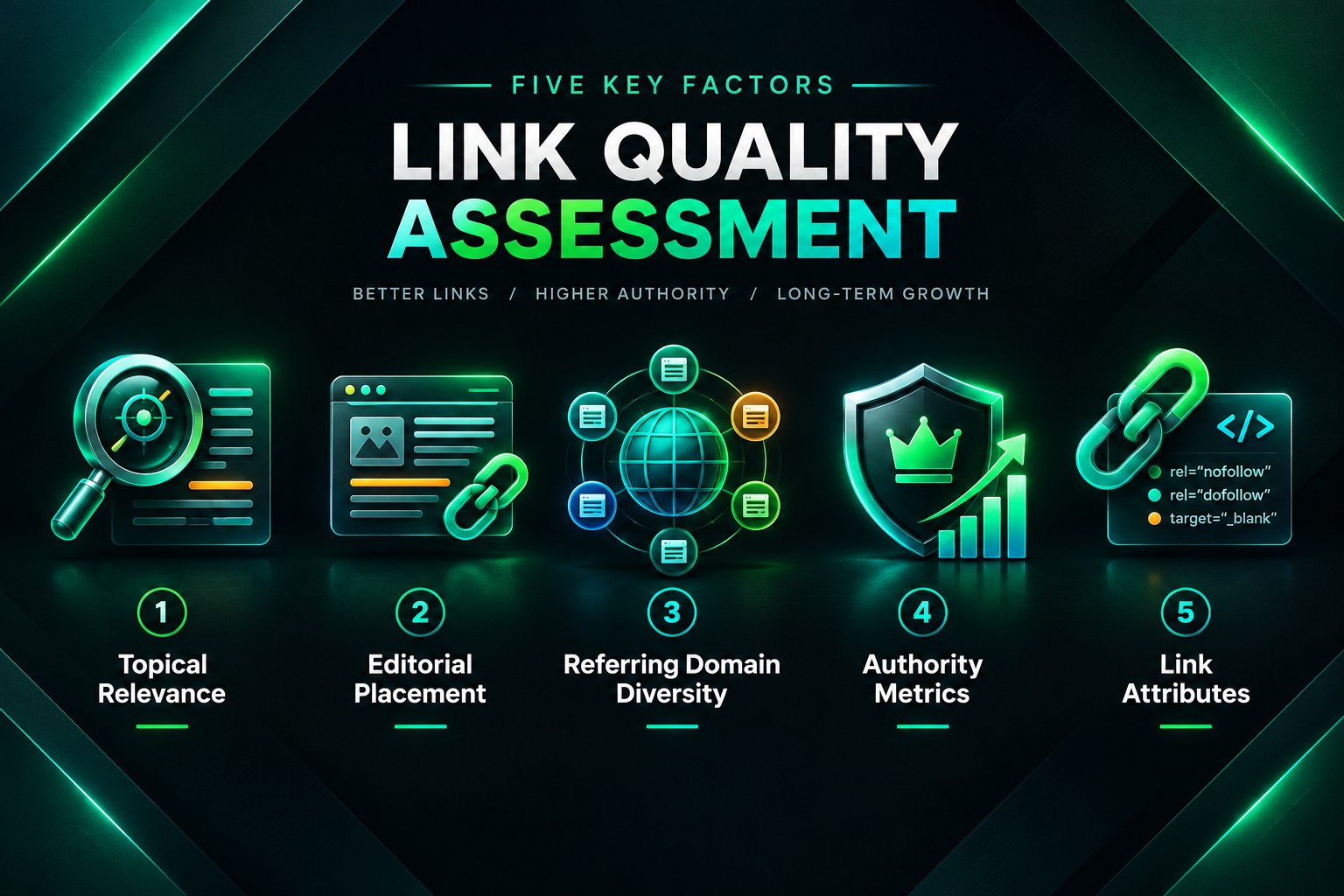
Not all backlinks earned by a free tool will contribute equally to organic visibility. Links from topically relevant, editorially maintained websites with genuine organic traffic are generally considered more valuable than links from low-quality directories, link farms, or sites that exist primarily to host outbound links. When evaluating the links your tool attracts, consider the following factors rather than relying on a single metric.
- Topical relevance: A link from a personal finance blog to a mortgage calculator is more contextually relevant than a link from a general web directory. Relevance between the linking page’s topic and your tool’s subject matter is a meaningful quality indicator.
- Editorial placement: Links placed within the body of an article or resource page, where the editor has chosen to reference your tool, carry more weight than links in footers, sidebars, or automated link lists.
- Referring domain diversity: A tool that attracts links from many different root domains is generally in a stronger position than one with many links from a small number of sources. Referring domain count is a more meaningful indicator than raw backlink count.
- Third-party authority metrics: Domain Rating from Ahrefs, Domain Authority from Moz, and Authority Score from Semrush are proprietary estimates of a domain’s link profile strength. These metrics can help prioritise outreach targets and assess link quality, but they are not Google metrics and do not directly predict ranking outcomes. A high Domain Rating on a linking site does not guarantee that the link will improve your rankings.
- Link attributes: Most editorially placed links are followed by default, meaning they pass link equity. Some sites apply nofollow or sponsored attributes to all outbound links. A mix of followed and nofollowed links from relevant sources is a natural pattern; a profile consisting entirely of one type may warrant closer review.
Realistic Outcomes, Timelines, and Limitations
Tool-based link building can be an effective long-term strategy, but it is important to approach it with realistic expectations. The timeline from tool publication to measurable SEO impact is typically longer than many businesses anticipate. Initial outreach may generate a handful of links within the first few weeks, but the compounding effect of a well-promoted tool, where links accumulate gradually as more people discover and reference it, usually takes several months to become visible in referring domain data.
Ranking improvements, if they occur, depend on many factors beyond the backlinks the tool attracts. The technical condition of the website, the quality and relevance of existing content, the competitiveness of target keywords, and the overall authority of the domain all influence whether additional backlinks translate into measurable ranking changes. A tool that earns twenty high-quality referring domains may produce a noticeable improvement for a mid-authority website in a moderately competitive niche, while the same links may have a smaller observable effect for a newer domain competing in a highly contested market. Results vary, and a site-specific assessment is needed before drawing conclusions about likely impact.
There are also meaningful limitations to acknowledge. Building a useful tool requires upfront investment, whether that means developer time, a no-code tool builder subscription, or the cost of a freelance developer. Ongoing maintenance is necessary to keep the tool functional and accurate. Outreach requires consistent effort; a tool that is published without promotion will typically earn very few links. And in competitive niches, well-resourced competitors may already have established tools with large referring domain profiles that are difficult to displace.
Tool-based link building is also not a solution for every organic visibility problem. If a website has crawling or indexing issues, thin or outdated content, a search-intent mismatch on key pages, or an existing manual action from Google, acquiring additional backlinks is unlikely to resolve those underlying issues. A technical SEO audit and content review are appropriate first steps before investing heavily in any link acquisition strategy.
When to Consider Professional Support for Tool-Based Campaigns
Managing a tool-based link building campaign in-house is feasible for teams with the time and skills to handle outreach, prospect research, and link monitoring consistently. However, the outreach component in particular is time-intensive. Identifying relevant resource pages and editorial contacts, personalising outreach messages, following up, and tracking responses requires sustained effort that competes with other marketing priorities.
Outsourcing the outreach and campaign management to a specialist link building service can make sense when internal capacity is limited, when the campaign needs to scale beyond what a small team can manage, or when the business lacks experience with manual outreach workflows. A professional link building provider can bring an existing network of publisher relationships, established outreach processes, and experience assessing link quality across different niches. For agencies managing campaigns on behalf of multiple clients, white-label link building arrangements allow the outreach and placement work to be delivered under the agency’s brand without requiring the agency to build that operational capacity internally.
When evaluating a link building provider for a tool-based campaign, it is worth asking how they identify outreach targets, how they assess publisher quality, what link attributes are typical for their placements, and how they handle link monitoring and replacement if a placed link is removed. Providers who can explain their process clearly and set realistic expectations are generally more reliable than those who promise specific link counts or ranking outcomes within fixed timeframes.
Alternatives and Complementary Strategies
Free tools are one category of linkable asset, but they are not the only option. Depending on the website’s niche, resources, and existing content, other linkable asset formats may be more practical or more effective.
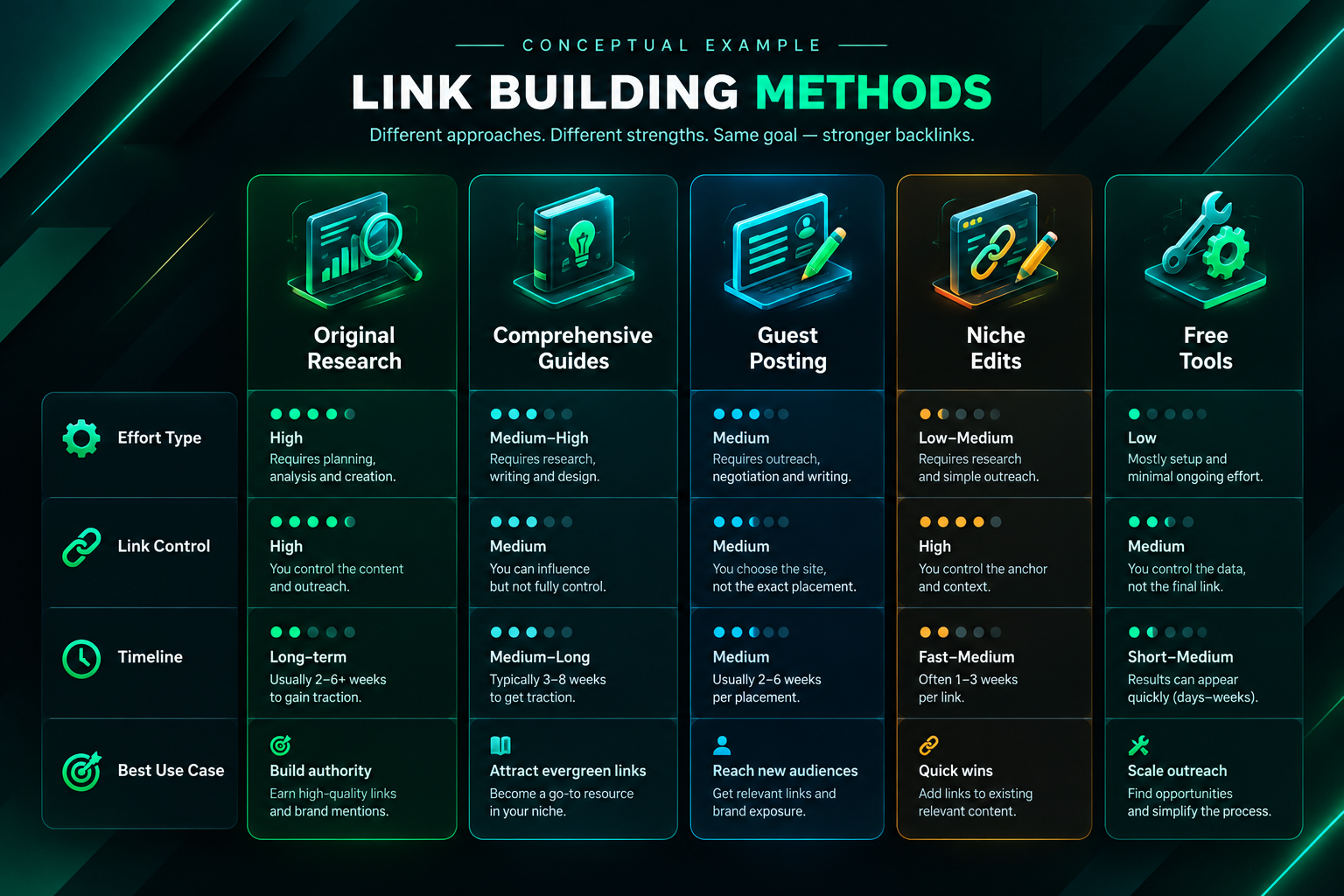
- Original research and data studies: Publishing original survey data, industry statistics, or proprietary data analysis can attract links from journalists, bloggers, and industry publications that cite the findings. This approach requires data collection and analysis but does not require software development.
- Comprehensive guides and reference content: Long-form, well-researched guides on topics with sustained search demand can earn links over time as they become go-to references in a niche. These require significant writing and editorial investment but no technical development.
- Interactive content: Quizzes, assessments, and interactive infographics share some characteristics with tools and can attract links from content roundups and educational resources.
- Guest posting: Manual outreach for guest post placements on relevant industry publications allows a business to earn contextual backlinks to specific target pages. Unlike tool-based link building, guest posting gives more direct control over which pages receive links and what anchor text is used, though it requires consistent content production and outreach effort.
- Niche edits: Placing a link within an existing published article on a relevant website is another outreach-based method that can complement a tool-based campaign by directing links to pages that the tool itself may not naturally attract links to.
- Digital PR: Pitching newsworthy stories, data, or expert commentary to journalists and online publications can earn high-authority editorial links, though the process is less predictable than structured outreach campaigns.
In practice, the most effective link building programmes tend to combine multiple methods rather than relying on a single approach. A free tool can serve as a central linkable asset that attracts passive links over time, while guest posting and niche edit outreach build links to commercial or service pages that the tool alone may not reach.
Frequently Asked Questions
How long does it take for a free tool to start attracting backlinks?
With active outreach, a well-designed tool in a moderately competitive niche may begin attracting links within the first four to eight weeks of publication. Organic link accumulation, where sites discover and reference the tool without direct outreach, typically develops over several months. The timeline depends heavily on niche competitiveness, the quality of the tool, and the consistency of the outreach effort.
Do I need a developer to build a free online tool?
Not necessarily. No-code and low-code platforms allow relatively simple calculators, quizzes, and checkers to be built without custom development. For more complex tools, a freelance developer or a development agency may be required. The appropriate approach depends on the tool concept and the technical resources available.
Will links from a free tool improve my search rankings?
Links from relevant, editorially placed sources may contribute to improved rankings over time, but outcomes depend on many factors including the website’s existing authority, the competitiveness of target keywords, the technical condition of the site, and the quality of the content on target pages. No link building strategy can guarantee specific ranking improvements.
How do I find websites to approach for outreach?
Tools such as Ahrefs and Semrush allow you to search for resource pages in your niche and identify websites that already link to similar tools. Searching Google for queries such as “useful tools for [your industry]” or “resources for [your topic]” can surface relevant resource pages and blogs. Manual review of each prospect is important before outreach to confirm relevance and editorial quality.
Can a free tool attract links on its own without outreach?
Occasionally, a highly useful tool in an underserved niche will attract organic links without active promotion, particularly if the tool page ranks well for relevant queries. In most cases, however, deliberate outreach is necessary to generate the initial referring domains that help the page gain visibility and attract further organic links over time.
What is the difference between a linkable asset and a link bait strategy?
The terms overlap but carry different connotations. A linkable asset is any resource designed to earn links through genuine utility or value. Link bait historically referred to content designed primarily to attract attention and links, sometimes through controversy or novelty rather than lasting usefulness. A free tool is generally considered a linkable asset because its value is functional and ongoing rather than dependent on a single moment of attention.
Should I use a free tool as my only link building strategy?
Relying on a single link acquisition method is generally less effective than combining complementary approaches. A free tool can be a strong central asset, but pairing it with guest posting, niche edit outreach, or digital PR allows a campaign to build links to a wider range of pages and through a more diverse set of referring domains.
Deciding Whether a Tool-Based Link Building Strategy Fits Your Situation
A free online tool can be a genuinely effective linkable asset when it addresses a real need, is well-executed, and is supported by consistent outreach. The strategy is particularly well-suited to businesses in niches where calculators, checkers, or generators are naturally useful, and where resource pages and industry blogs actively curate useful references for their audiences. It is less likely to deliver meaningful results for businesses in highly competitive niches where established tools already dominate, for websites with significant technical SEO issues that need to be resolved first, or for campaigns that lack the resources for sustained outreach and maintenance.
Before committing to tool development and a link building campaign, it is worth assessing whether the tool concept is genuinely differentiated, whether the target niche has realistic link-earning potential, and whether the website’s existing technical and content foundation is strong enough to benefit from additional backlinks. If those conditions are in place, a tool-based approach can complement other link acquisition methods and contribute to a more diverse, editorially earned backlink profile over time.
If managing outreach and campaign logistics in-house is not practical, discussing the strategy with a specialist link building provider can help clarify what is realistic for your specific website, niche, and goals. A qualified provider should be able to assess your existing backlink profile, identify suitable outreach targets, and set expectations that reflect the actual competitive landscape rather than generic promises.


