

Key Takeaways
- Link reclamation recovers SEO value from backlinks that have been broken, lost, or left uncredited — without requiring you to build new links from scratch.
- The most common opportunities include broken backlinks returning 404 errors, editorially removed links, unlinked brand mentions, and incorrectly redirected URLs.
- Link reclamation is widely regarded as one of the highest-ROI link activities because it targets authority that already existed and can often be recovered through a single outreach email or a 301 redirect.
- Tools such as Ahrefs Site Explorer, Google Search Console, and SEMrush make it possible to identify and prioritize opportunities systematically.
- A monthly monitoring cadence prevents small losses from compounding into significant damage to your backlink profile.
What Is Link Reclamation?
Link reclamation is the practice of identifying backlinks that once pointed to your website — or should point to it — and taking action to restore or capture the SEO value they carry. Rather than building new links from the ground up, link reclamation focuses on recovering authority that already exists but is currently being wasted.
A backlink loses its value in several ways: the page it lives on may link to a URL on your site that no longer exists, returning a 404 error; the linking site may have removed the link during a redesign; a journalist or blogger may have mentioned your brand without including a hyperlink at all. In each case, potential link equity is sitting idle. Link reclamation is the systematic process of finding and fixing those situations.
The concept is distinct from traditional link building, which involves persuading entirely new publishers to link to your content. Link reclamation is about protecting and restoring what you have already earned — making it both faster and more cost-effective in most cases.
Why Link Reclamation Matters for SEO
Backlinks remain one of the strongest signals search engines use to assess a page’s authority and relevance. When links break or disappear, the domain authority and ranking potential they supported can quietly erode — a phenomenon known as link decay. Left unaddressed, link decay gradually weakens a site’s backlink profile even if no negative action has been taken on the site itself.
Every broken backlink represents a referring domain that already chose to link to your content. That editorial decision is valuable. Recovering the link typically requires far less effort than convincing a new publisher to link to you for the first time, which is why link reclamation is often described as having the highest return on investment of any link activity. The referring domain is already warm; in many cases, the fix is as simple as correcting a URL or sending a single personalized outreach email.
Beyond SEO authority, broken backlinks also affect user experience. Visitors who click a link and land on a 404 error page receive no value and are unlikely to return. Resolving broken backlinks therefore improves both crawlability and the practical experience of anyone following an inbound link to your site.
Types of Link Reclamation Opportunities
Not all lost link equity looks the same. Understanding the distinct categories helps you prioritize effectively and choose the right recovery method for each situation.
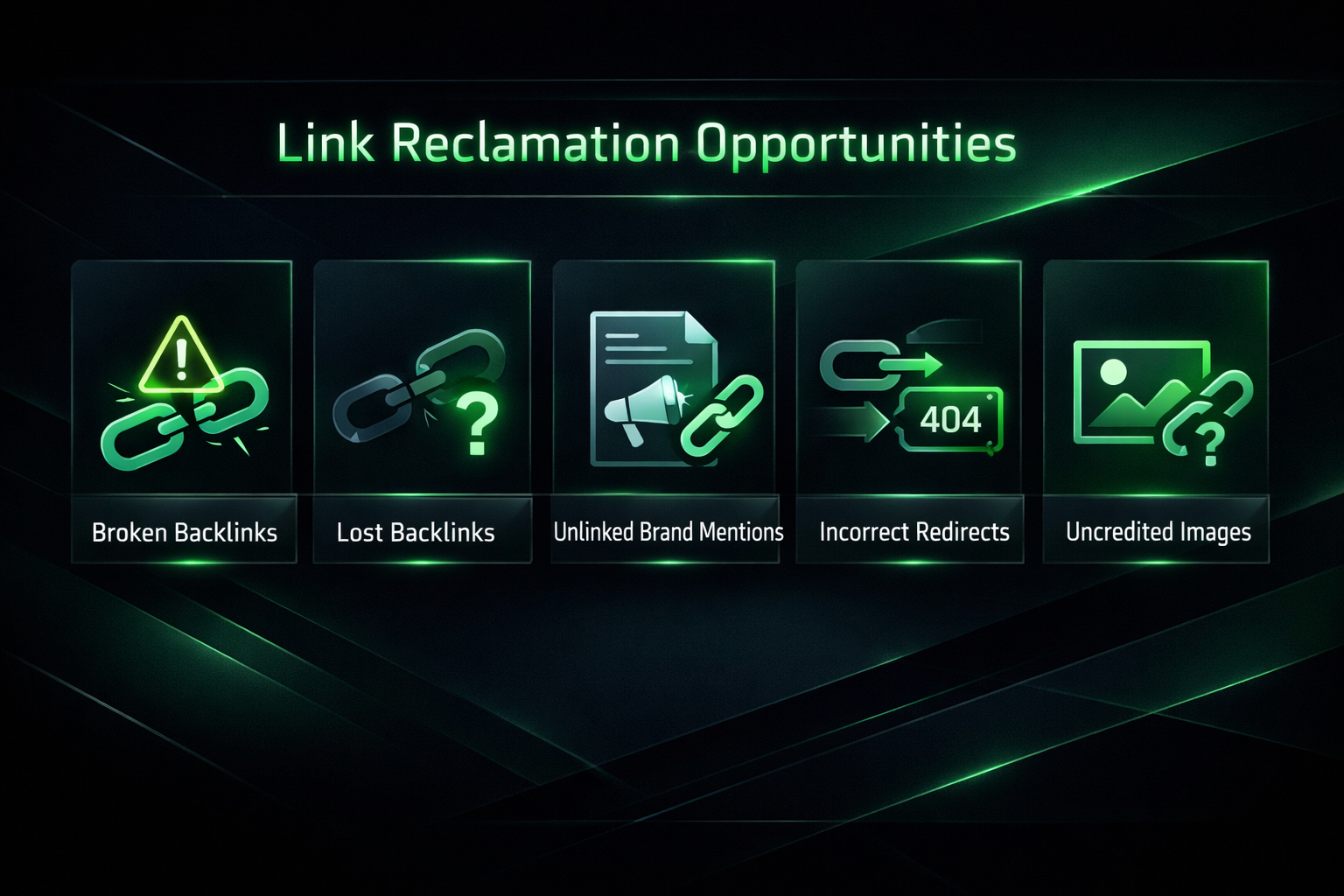
Broken Backlinks (404 Errors)
A broken backlink occurs when a referring domain links to a URL on your site that no longer exists, typically because the page was deleted, the URL structure changed during a site migration, or a typo was introduced. The linking site sends its users — and search engine crawlers — to a dead end. The fix is usually straightforward: implement a 301 redirect from the old URL to the most relevant current page, or contact the webmaster and ask them to update the link to the correct destination.
Lost Backlinks
Lost backlinks are links that previously existed and have been removed. This can happen for several reasons: the referring page was updated or redesigned, the linking site changed its editorial policy, or the content containing your link was deleted entirely. Lost backlinks are harder to recover than broken ones because no technical fix exists — recovery depends entirely on outreach and the webmaster’s willingness to reinstate the link.
Unlinked Brand Mentions
Unlinked brand mentions occur when a website references your brand, product, or content by name but does not hyperlink to your site. These represent a significant opportunity because the author has already demonstrated awareness of and some affinity for your brand. A polite, personalized outreach message asking them to convert the mention into a live link has a reasonably high success rate compared with cold link-building outreach.
Incorrectly Redirected Links
During a site migration or URL restructure, redirects are sometimes pointed to irrelevant pages, or redirect chains are created that dilute link equity before it reaches the intended destination. Auditing redirect behavior is an underappreciated part of link reclamation, particularly after any major technical change to the site.
Uncredited Image Links
If you create original graphics, charts, or photographs that other sites use without attribution, you may be losing image link reclamation opportunities. A reverse image search can identify where your visuals are being used. When found without a link back to the source, a straightforward outreach message requesting credit is generally well received.
Common Causes of Link Loss
Understanding why links disappear helps both with prevention and with crafting the right recovery approach. The most frequent causes include:
- Site migrations and redesigns: Changing URL structures without implementing comprehensive 301 redirects is the single largest cause of mass link loss. A site migration that moves hundreds of URLs without a redirect map can destroy years of accumulated backlink value overnight.
- Content deletion: Removing underperforming pages without redirecting their inbound links transfers none of their link equity to any other page.
- Editorial decisions by the linking site: Publishers update content regularly. A link may be removed because the anchor text no longer fits the revised article, because the linking page was deleted, or because the publisher’s editorial standards changed.
- Domain expiry of the referring site: When a referring domain expires and is not renewed, the pages containing your links vanish entirely.
- Technical errors: Server misconfigurations, accidental page unpublishing, or CMS updates can cause pages to disappear temporarily or permanently.
How to Find Link Reclamation Opportunities
A structured backlink audit is the starting point for any link reclamation effort. Several tools make this process significantly more efficient.
Ahrefs Site Explorer
Ahrefs Site Explorer provides a dedicated Lost Backlinks report that shows every backlink your site has lost within a chosen date range, along with the referring domain’s rating, the anchor text used, and the reason for the loss. Filtering by domain rating allows you to prioritize high-authority opportunities. The Broken Backlinks report identifies URLs on your site that are receiving external links but currently return a 404 error.
Google Search Console
Google Search Console’s Links report shows which external pages link to your site and which of your URLs they point to. Cross-referencing this data with the Coverage report — which flags pages returning errors — reveals broken backlinks that Google has already identified. Google Search Console is free and provides first-party data directly from the search engine, making it a useful baseline even when paid tools are also in use.
SEMrush Backlink Audit
SEMrush offers a Backlink Audit tool and a dedicated Lost and Found report. It also flags potentially toxic links and supports direct disavow file management, making it useful for combining reclamation work with backlink profile health maintenance.
Screaming Frog
Screaming Frog crawls your own site and identifies internal broken links and redirect chains. While it does not directly report external backlinks, it is particularly valuable after a site migration for confirming that all redirects are implemented correctly before lost links accumulate.
Brand Mention Monitoring
To find unlinked brand mentions, tools such as Google Alerts, Ahrefs Content Explorer, BuzzSumo, and Mention.com can be configured to notify you when your brand name appears in new content. Filtering results to exclude pages that already contain a link to your site surfaces the unlinked mention opportunities worth pursuing.
A Step-by-Step Link Reclamation Process
A repeatable workflow makes link reclamation more effective and ensures that opportunities are not missed between audits.
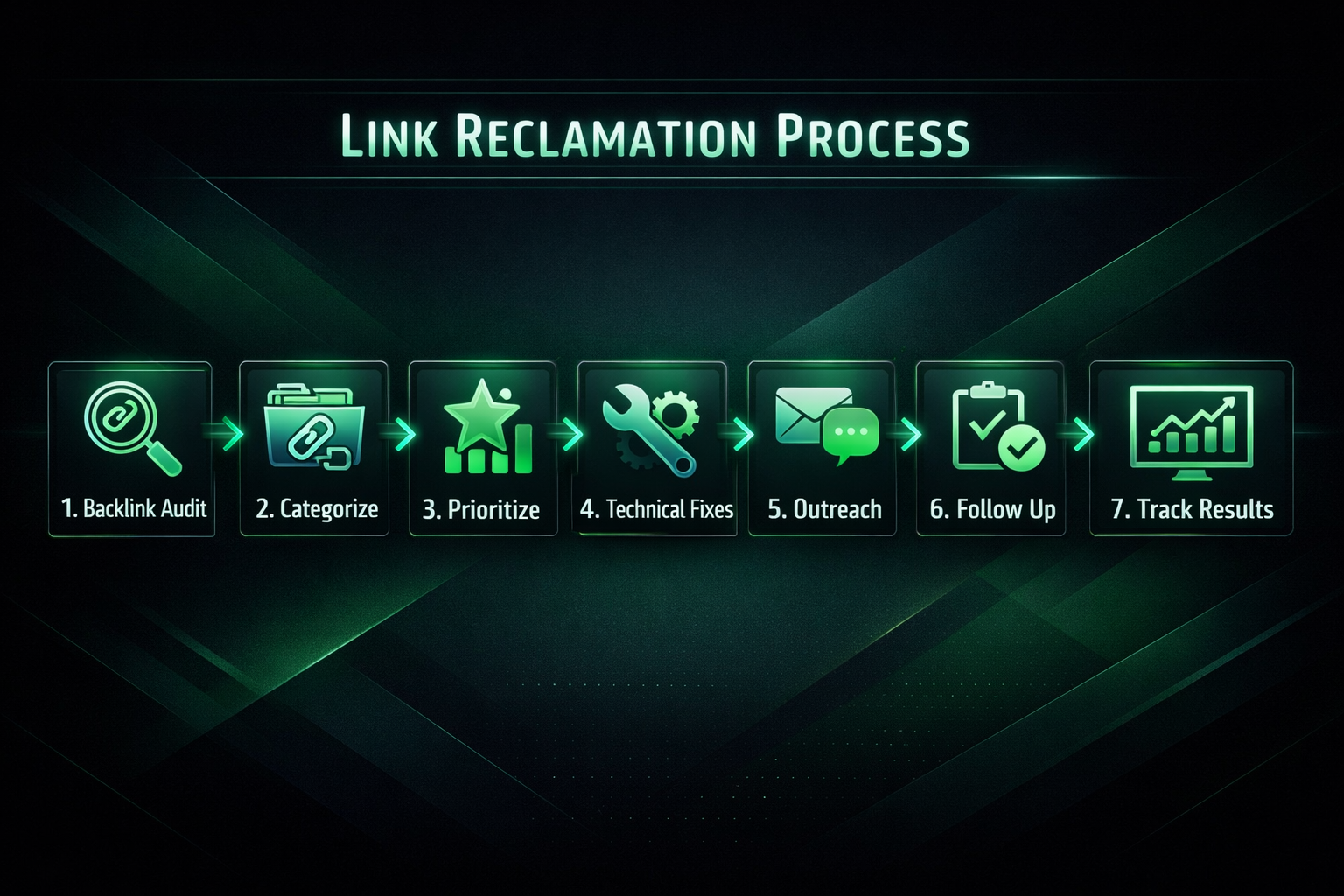
- Run a backlink audit: Use Ahrefs, SEMrush, or Google Search Console to export your current and recently lost backlinks. Note the domain authority or domain rating of each referring domain, whether the link is dofollow, and when the link was lost.
- Categorize the opportunities: Separate broken backlinks, lost backlinks, and unlinked brand mentions into distinct lists. Each category requires a different recovery method.
- Prioritize by value: Focus first on high-authority referring domains with dofollow backlinks that were lost recently — these have the greatest potential impact and the highest likelihood of recovery. Links from low-DR or spammy sources are generally not worth reclaiming.
- Apply technical fixes: For broken backlinks pointing to deleted or moved pages, implement 301 redirects from the old URL to the most relevant live page. This is often the fastest recovery method and requires no outreach at all.
- Conduct personalized outreach: For lost links and unlinked brand mentions that cannot be resolved technically, contact the relevant webmaster or author. Personalize each message by referencing the specific article, the context in which your brand or content appeared, and a clear, easy action for them to take.
- Follow up appropriately: A single follow-up email sent five to seven days after the initial message is reasonable. More than two outreach attempts for the same opportunity is generally counterproductive and risks damaging the relationship.
- Track and document: Maintain a spreadsheet or CRM record of every opportunity, outreach date, response, and outcome. This prevents duplicate contact and provides data on your recovery rate over time.
Writing Effective Outreach Emails
The quality of outreach communication directly affects recovery rates. A message that is generic, overly long, or focused on your own SEO goals rather than the recipient’s needs is unlikely to succeed. Effective personalized outreach for link reclamation typically shares several characteristics.
For a broken backlink, the message should briefly identify the specific article on the linking site, describe the broken URL, and provide the correct replacement URL. Framing the request as helpful — you are alerting them to a problem their readers may encounter — tends to generate a better response than framing it as a link-building request.
For an unlinked brand mention, acknowledge the article, express genuine appreciation for the mention, and make a simple request to add a hyperlink. Keep the message short. The webmaster has already demonstrated goodwill by mentioning you; the ask should feel minimal.
For a lost backlink, approach with care. If the link was removed editorially, a direct request to reinstate it may feel presumptuous. Where possible, explain why the content remains relevant and offer to answer any questions or update the linked piece if their editorial needs have changed. Recovery rates for editorially removed links are generally lower than for technically broken ones.
Outreach sent mid-week — Tuesday through Thursday — tends to receive higher response rates than messages sent on Mondays or Fridays, though the effect is modest compared with the quality of the message itself.
What Not to Reclaim: Prioritizing Intelligently
Not every lost backlink is worth pursuing. Investing time in low-value reclamation opportunities reduces the overall efficiency of the process. Links from referring domains with very low authority, spammy link profiles, or irrelevant topical context are unlikely to provide meaningful SEO value even if recovered. Nofollow backlinks from low-traffic pages contribute minimal direct link equity and are generally a lower priority than dofollow backlinks from authoritative, relevant referring domains.
Similarly, if a link was lost because the content it appeared in was removed entirely and the linking site is no longer active, no practical recovery path exists. Documenting these as closed opportunities prevents them from cluttering your active outreach list.
Link Reclamation vs. Link Building
Link building vs. link reclamation is a common point of confusion. Both activities aim to strengthen a site’s backlink profile, but they operate differently and suit different situations.
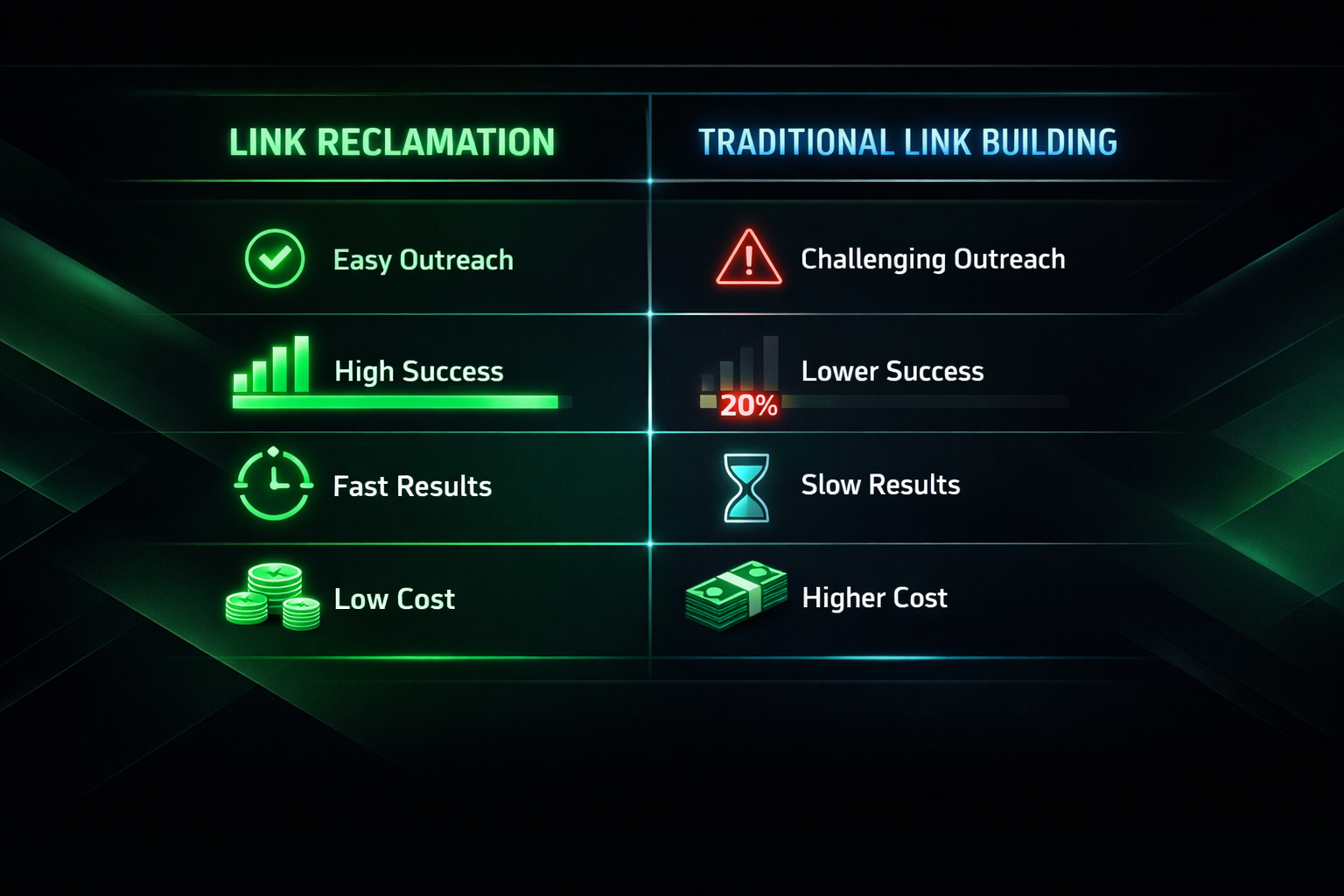
| Factor | Link Reclamation | Traditional Link Building |
|---|---|---|
| Starting point | Previously earned or mentioned links | No prior relationship with publisher |
| Outreach difficulty | Lower — link or mention already exists | Higher — requires convincing from scratch |
| Typical success rate | Relatively higher for broken links | Varies widely; often under 10% |
| Time to results | Faster — often days to weeks | Slower — weeks to months |
| Cost and effort | Generally lower per recovered link | Higher per new link acquired |
| Dependency | Requires an existing backlink profile to audit | Can be pursued by any site |
Link reclamation and link building are complementary rather than competing strategies. Reclamation protects the authority a site has already earned; link building expands it. For most established sites, both activities belong in the same SEO workflow.
How to Prevent Future Link Loss
Prevention reduces the volume of reclamation work required over time. Several practices significantly lower the rate at which backlinks are lost.
Consistent URL conventions: Establishing and maintaining a predictable URL structure from the outset minimizes the number of URLs that need to change during future updates. When changes are unavoidable, documenting every affected URL and its new destination before the change goes live is essential.
Comprehensive redirect implementation during site migrations: A site migration without a thorough redirect map is one of the fastest ways to lose accumulated backlink value. Before any migration, export your full backlink profile and map every linked URL to its new equivalent. Test all redirects before and after launch.
Regular backlink monitoring: A monthly review of your backlink profile using Ahrefs or Google Search Console catches losses before they compound. Small, consistent audits are more effective than infrequent large-scale reviews because recently lost links — particularly broken ones — are easier to recover quickly.
Content updates rather than deletion: When a page is underperforming, updating and improving it is generally preferable to deleting it. If deletion is necessary, redirect the URL to the most relevant active page rather than allowing it to return a 404 error.
Publisher relationships: Maintaining good relationships with key publishers who link to your site gives you a direct channel if a link is removed in error or if a content update inadvertently breaks a reference to your work.
Frequently Asked Questions
How long does link reclamation take to show results?
Results depend on the type of reclamation and the speed of implementation. A 301 redirect resolving a broken backlink can be crawled and processed by search engines within days to a few weeks. Outreach-based recovery depends on how quickly the webmaster responds and makes the change. In practice, most observable ranking improvements from a focused reclamation campaign become visible within four to eight weeks, though this varies by site size, authority, and the number of links recovered.
Is link reclamation worth the effort for smaller sites?
Yes, provided the site has an existing backlink profile with meaningful referring domains. For very new sites with few inbound links, traditional link building may deliver more immediate results. For established sites — even moderately sized ones — recovering even a handful of high-authority dofollow backlinks can have a measurable effect on domain authority and SERP visibility.
What response rate should I expect from outreach?
Response rates vary by link type and outreach quality. Broken backlink outreach — where you are alerting a webmaster to a problem — tends to have the highest success rates, sometimes exceeding 20–30% for well-crafted messages sent to relevant contacts. Unlinked brand mention outreach typically falls in the 10–20% range. Requests to reinstate editorially removed links have lower rates, often in the single digits, because the removal was a deliberate decision.
Can I reclaim links after a site migration?
Yes, and this is one of the highest-priority reclamation scenarios. After a migration, use Ahrefs Site Explorer or Google Search Console to identify any URLs that are receiving inbound links but are now returning 404 errors. Implement 301 redirects from those old URLs to their new equivalents as quickly as possible to minimize the period during which link equity is being lost.
Should I try to reclaim nofollow backlinks?
Nofollow backlinks contribute little or no direct link equity in most cases. Reclaiming them is generally a low priority unless they drive significant referral traffic or come from a high-profile publication where the relationship itself has value. Prioritize dofollow backlinks from authoritative referring domains first.
What is the difference between link reclamation and broken link building?
Link reclamation recovers links that previously pointed to your own site or referenced your brand. Broken link building is a separate outreach strategy in which you identify broken links on other websites — pointing to any content, not just yours — and suggest your own relevant content as a replacement. Both involve broken backlinks, but link reclamation is defensive while broken link building is a new link acquisition tactic.
Making Link Reclamation a Sustainable Part of Your SEO Strategy
Link reclamation is most effective when treated as an ongoing practice rather than a one-off project. Backlink profiles decay continuously — links break, pages are updated, and mentions accumulate without attribution every month. A site that audits its backlink profile monthly and addresses losses promptly will consistently outperform one that conducts annual reviews and attempts large-scale recovery campaigns infrequently.
Integrating link reclamation into a broader SEO workflow means combining monthly backlink monitoring with immediate technical fixes for broken backlinks, a rolling queue of personalized outreach for lost links and unlinked mentions, and a pre-migration checklist that prevents mass link loss during technical changes. The tools required — Ahrefs Site Explorer, Google Search Console, Screaming Frog — are largely the same tools most SEO teams already use for other purposes, so the incremental effort is manageable.
For sites that have experienced a recent site migration, significant URL restructuring, or a period of inconsistent content management, a dedicated reclamation audit is a worthwhile starting point. Identifying and recovering the highest-value lost backlinks first can deliver measurable improvements to SERP visibility and referral traffic relatively quickly, providing a clear demonstration of ROI before expanding into broader link building activities.


