Key Takeaways
- Listicle link building earns backlinks by getting your brand featured inside curated “best of” and “top X” roundup articles on third-party websites.
- A well-executed brand placement in a high-authority listicle can pass significant link equity, drive high-intent traffic, and strengthen your domain’s backlink profile.
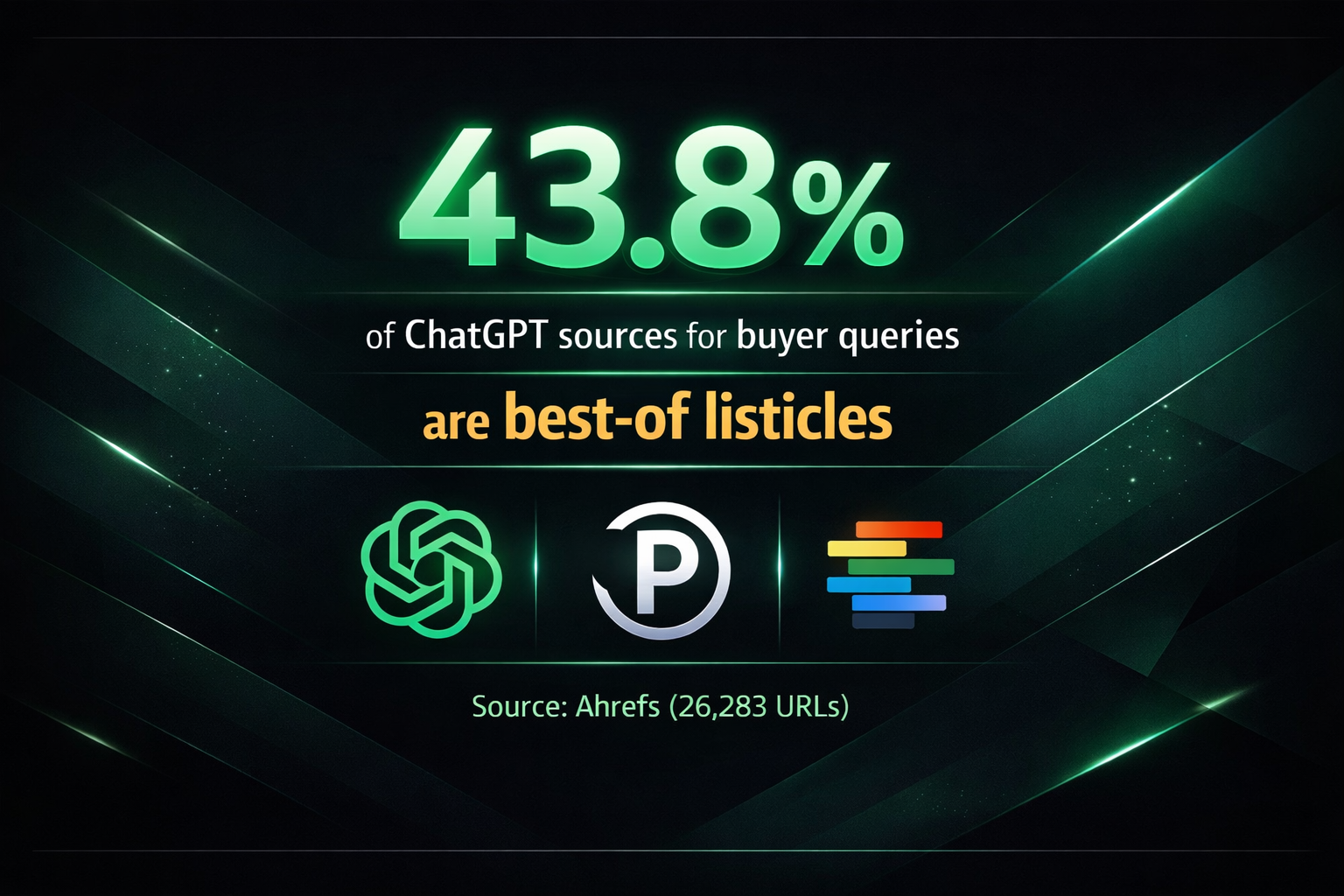
- An Ahrefs study of over 26,000 source URLs found that 43.8% of pages cited by ChatGPT for buyer-style searches are best-of listicles — making this tactic directly relevant to AI search visibility.
- Successful execution requires prospect scoring, personalized outreach, and a well-crafted entry blurb — not mass email templates.
- The tactic carries genuine risks if approached carelessly; staying compliant with Google’s spam policies requires targeting editorially maintained, people-first content rather than pay-to-play directories.
What Is Listicle Link Building?
Listicle link building is a form of link acquisition in which a brand, product, or service earns a backlink by securing inclusion inside a list-style article published by a third-party website. These articles — commonly titled “Best X Tools,” “Top 10 Agencies,” or “X Alternatives to [Competitor]” — already rank for high-intent keywords and attract readers who are actively comparing options before making a purchase decision. The goal is to appear inside these curated roundups as a named, linked entry, ideally with a dofollow placement that passes link equity directly to your domain.
The tactic sits within the broader discipline of link building but differs meaningfully from guest posting or digital PR. Rather than creating a new piece of content, the brand identifies existing listicles that are already performing well in search results and pitches for inclusion. The barrier to entry is typically lower than earning a standalone editorial mention, and — when the target publication is relevant and authoritative — the SEO benefit can be substantial.
Listicle link building is distinct from paying for placements in low-quality directories. The defining characteristic of a legitimate placement is that the listicle genuinely serves readers, the article is editorially maintained, and your brand belongs on the list based on merit. This distinction matters both for SEO value and for compliance with Google’s link spam guidelines.
Why Listicle Links Work for SEO
Search engines treat backlinks as editorial signals of trust and authority. A link from a well-trafficked, topically relevant curated roundup on a high-domain-authority website can meaningfully improve your site’s backlink profile and contribute to better organic rankings. The benefit is amplified when the linking page itself ranks well, because it is more likely to pass consistent referral traffic alongside link equity.
Homepage authority is one specific benefit worth noting. Many “best of” listicles link directly to a brand’s homepage or primary product page rather than to a niche internal article. These homepage links carry particular weight because they signal broad brand credibility to search engines rather than topical relevance for a single keyword.
Topical relevance also matters enormously. A dofollow placement inside a roundup about the best project management software is far more valuable to a SaaS company than a generic backlink from an unrelated blog. Search engines assess whether the linking content is contextually appropriate, so targeting listicles within your niche consistently produces better results than chasing high domain ratings in unrelated categories.
Evergreen backlinks are another practical advantage. A “best of” article that ranks and continues to attract traffic over months or years provides ongoing referral value and sustained link equity. This is different from a one-time press mention that quickly drops out of public view. Well-maintained curated roundups are frequently updated rather than deleted, which means a legitimate placement tends to persist.
Listicle Link Building and AI Search
The relevance of listicle link building has grown considerably with the rise of AI-powered search. Google’s AI Overviews, ChatGPT, Perplexity, and Gemini frequently draw on existing web content to construct their answers. According to an Ahrefs study of 26,283 source URLs, 43.8% of the pages that ChatGPT references for buyer-intent queries are best-of listicles. This single data point has significant practical implications.
If your brand is included inside a listicle that a large language model treats as a credible source, your brand name may appear in AI-generated answers even when a user has not searched for you directly. This is the core logic behind generative engine optimisation (GEO) — the emerging discipline of optimising content and brand presence specifically so that AI systems cite your brand in their responses. Listicle link building is one of the most accessible routes into this new visibility layer, because the source material LLMs draw on is largely the same content that already ranks well in traditional search.
For brands investing in GEO, the strategy is straightforward: earn placements in listicles that are already cited by AI systems, or that are strong enough candidates to be cited. This requires the same prospect scoring and outreach discipline as traditional listicle link building, but with an additional qualification criterion: assess whether the target publication is the kind of authoritative, regularly updated resource that AI systems are likely to treat as reliable.
Types of Listicles Worth Targeting
Not every list-style article on the internet offers meaningful link acquisition value. Focusing on the right content types makes outreach significantly more efficient.
- “Best X” roundups: Articles ranking the best tools, services, platforms, or products in a specific category. These are the most common and typically the highest-value targets because they attract readers with clear purchase intent.
- “Top X” niche lists: Similar to “best” roundups but often more narrowly defined — for example, “Top 7 Email Marketing Platforms for Small Businesses.” Niche specificity often correlates with higher topical relevance and more qualified referral traffic.
- “Alternatives to X” articles: Articles targeting readers who are dissatisfied with a dominant competitor and are actively evaluating other options. These attract high-intent audiences and are particularly valuable for challenger brands.
- Comparison guides and buyer’s guides: Longer-form structured content that walks readers through evaluating multiple options. Inclusion in a buyer’s guide signals legitimacy to prospective customers and often includes a more detailed entry blurb with greater brand exposure.
- Niche roundups and curated resource lists: Industry-specific compilations published by blogs, media outlets, or authoritative organizations. These may have lower search volume but often deliver strong topical relevance and referral traffic from a precisely targeted audience.
How to Find Listicle Opportunities
Identifying suitable targets is the first practical step. The most reliable method is direct search using the keywords your audience already uses when looking for options in your category.
Use search operators such as “best [your product category]”, “top [your service type]”, and “[competitor name] alternatives” to surface the listicles already ranking on page one. These are your highest-priority targets because they receive the most organic traffic and are most likely to be read by your prospective customers. Tools like Ahrefs and SEMrush allow you to assess the domain rating, estimated traffic, and backlink profile of each result, which is essential for qualifying opportunities before investing outreach time.
A secondary method is to identify which listicles already feature your direct competitors. If a curated roundup includes three of your main competitors but not your brand, you have a natural argument for inclusion. Tools such as Ahrefs’ Content Explorer and BuzzSumo can help you filter listicles by topic, publication date, and authority metrics at scale, making it possible to build a substantial prospect list efficiently.
When building your prospect list, record key attributes for each target: domain rating, estimated monthly traffic, publication or last-update date, whether the article links to competitors, and whether the site appears in AI-generated answers for relevant queries. This information feeds directly into prospect scoring.
Prospect Scoring: Qualifying Before You Pitch
Not every listicle deserves outreach effort. A simple prospect scoring framework allows you to prioritize high-value targets and avoid wasting time on placements that will deliver little SEO benefit.
Evaluate each prospect against the following criteria before beginning outreach:
- Domain rating or domain authority: Higher-authority publications pass more link equity. As a practical threshold, many SEO practitioners prioritize sites with a domain rating above 50, though relevant lower-authority sites in tightly defined niches can still be worthwhile.
- Estimated organic traffic: A site with strong domain authority but minimal traffic may have limited referral value. Prioritize publications that demonstrably attract readers.
- Topical relevance: The listicle should cover a category directly related to your product or service. Irrelevant placements produce weak SEO signals and unlikely conversions.
- Recency and update frequency: A listicle last updated three years ago is less valuable than one updated in the past twelve months. Frequently updated roundups also signal that the publisher actively maintains the content, making them more receptive to adding new entries.
- Dofollow vs. nofollow link status: A dofollow placement passes link equity directly. Nofollow placements do not pass PageRank but can still deliver referral traffic and brand exposure, and are worth considering for high-traffic publications even without the direct SEO benefit.
- AI citation potential: Does the publication appear in AI Overviews or AI-generated answers for relevant queries? If so, a placement increases your likelihood of being recommended by AI search systems.
How to Pitch for Listicle Inclusion
Outreach quality is the most important variable in determining your outreach acceptance rate. Generic mass-email templates are immediately recognizable and almost universally ignored. Personalized, concise, and relevant pitch emails consistently outperform template campaigns.

A well-structured pitch email should do several things: demonstrate that you have read the specific article, explain clearly why your brand belongs on the list, and make it easy for the publisher to say yes. Keep the email short. Publishers receive many pitches and will not read a lengthy promotional message. State your value proposition in two or three sentences and attach or inline a pre-written entry blurb the publisher can use directly if they choose to include you.
The entry blurb is the practical heart of the pitch. It is a short, editorially appropriate description of your product or service — typically 30 to 80 words — written in the same tone and format as the existing entries in the target listicle. A strong entry blurb makes inclusion frictionless for the publisher. It should describe what you offer, who it is for, and why it belongs alongside the other entries, without reading like an advertisement. Match the style of the existing list closely: if existing entries are neutral and factual, write yours the same way.
Follow up once after approximately five to seven business days if you receive no response. A brief, polite follow-up noting that you wanted to ensure the email was received is acceptable. Do not send multiple follow-ups or escalating messages, as this damages your relationship with the publication.
Listicle Link Building vs. Other Link Building Tactics
| Tactic | Effort Level | Authority Potential | Scalability | Risk Level | Typical Timeline |
|---|---|---|---|---|---|
| Listicle link building | Medium | Medium–High | High | Low (if done correctly) | 2–8 weeks per placement |
| Guest posting | High | Medium–High | Medium | Medium (quality dependent) | 4–12 weeks per placement |
| Niche edits | Low–Medium | Medium | High | Medium–High | 1–4 weeks per placement |
| Digital PR | Very High | Very High | Low | Low | 6–16 weeks per campaign |
Listicle link building occupies a practical middle ground: it is more scalable than digital PR, less time-intensive than guest posting, and carries lower risk than niche edits when targeting editorially maintained publications. The tactic is particularly effective for brands that need to build a backlink profile efficiently and that operate in product or service categories that lend themselves naturally to “best of” comparisons.

Common Mistakes and Risks to Avoid
Listicle link building carries genuine risks when executed carelessly, and it is important to understand where the tactic can cross into territory that Google’s spam policies prohibit.
The most significant risk is targeting or participating in low-quality, paid-placement lists that exist solely to sell backlinks. These sites typically have thin content, publish entries indiscriminately, and are not maintained by genuine editorial teams. Google’s spam policies explicitly address manipulative link schemes, and placements on sites operating as link farms can result in penalties that harm your overall search visibility. The test is straightforward: would the listicle publish a genuinely bad product if it paid? If yes, the site does not meet the standard of people-first content and should be excluded from your prospect list.
Mass email outreach using identical templates is another common failure point. Beyond producing a poor outreach acceptance rate, it can damage your brand’s reputation with publishers you might legitimately want to work with in the future. Invest in personalization even when it limits the volume of pitches you can send in a given week.
A third mistake is neglecting placement maintenance. Once a brand placement is secured, it is worth monitoring to confirm the link remains active, the page continues to rank, and the anchor text is correct. Link monitoring tools such as Ahrefs Alerts or SEMrush’s backlink audit can flag lost or changed placements so you can follow up if needed.
Finally, avoid over-concentrating your anchor text. If the majority of your backlinks use the same keyword-rich anchor text, this pattern can appear manipulative. Branded anchors — your company name or website URL — are the natural default for listicle placements and carry lower risk.
Listicle Link Building for Different Business Types
The tactic applies across verticals but the execution differs by business type. SaaS companies have the most direct path because “best software” roundups are among the most common listicle formats online and attract buyers at precisely the moment they are evaluating options. Established publications such as HubSpot, G2, and Capterra publish and regularly update curated roundups in virtually every software category.
eCommerce brands can target “best products” roundups published by media outlets, affiliate publishers, and niche review sites. The challenge here is that many high-traffic product roundups operate on an affiliate basis, meaning placements may carry nofollow tags. These placements still deliver referral traffic and brand credibility, but SEO practitioners should account for the difference when setting expectations.
Local businesses and service providers benefit less from national roundups but can extract significant value from locally or regionally specific listicles — for example, “Best Marketing Agencies in [City]” or “Top Physiotherapy Clinics in [Region].” These lists often have lower domain ratings but deliver highly qualified local traffic and support local search rankings.
B2B service businesses should focus on industry-specific publications and professional association resources rather than general-audience roundups. A placement in a niche trade publication’s curated roundup may deliver fewer total visits but a far higher proportion of decision-makers with relevant purchasing authority.
Realistic Timelines and What Success Looks Like
Listicle link building produces results more quickly than many other link building tactics, but it is not instantaneous. A typical outreach-to-placement timeline ranges from two to eight weeks, accounting for the time required to identify and score prospects, write personalized pitches and entry blurbs, send follow-ups, and wait for publisher responses.
The SEO effect of individual placements may take additional weeks or months to manifest in rankings, depending on how quickly search engines crawl and process the new links. For brands starting from a low domain rating, a sustained programme of listicle outreach over six to twelve months is a more realistic expectation for meaningful ranking improvements than expecting immediate results from a handful of placements.
A meaningful measure of success is not simply the number of placements secured but the quality-weighted impact on your backlink profile: are you earning links from topically relevant, high-authority publications? Are those placements generating referral traffic in addition to link equity? Are any of the linked pages appearing in AI Overviews or AI-generated answers? Tracking these metrics over time provides a clearer picture of the tactic’s cumulative contribution than monitoring individual keyword rankings week to week.
Frequently Asked Questions
Do listicle placements need to be dofollow to be valuable?
A dofollow placement passes PageRank and is generally preferable for pure link equity value. However, a nofollow link from a high-traffic, authoritative publication still delivers meaningful referral traffic, brand exposure, and potential AI citation value. For high-visibility publications, a nofollow placement can still be worth pursuing even if the direct SEO benefit is limited.
How do I know if a listicle is editorially maintained or a link scheme?
Editorially maintained listicles are regularly updated, cover a clear topic with genuine reader value, link to products or services based on merit, and are published by sites with identifiable editorial teams. Link schemes tend to accept any brand that contacts them, have thin content with minimal editorial voice, rarely update their lists, and sometimes charge fees for inclusion. Sites requiring payment for placement should be treated with caution unless the payment is clearly disclosed as advertising and the publication is otherwise legitimate.
Can a brand be featured in multiple listicles on the same website?
Yes, and this can be valuable if each listicle targets a distinct keyword and audience segment. However, having every link from a single domain provides diminishing returns compared to earning links from a diverse range of relevant publishers. A varied backlink profile across multiple domains is more beneficial than many placements on a single site.
Is listicle link building suitable for new websites with low domain authority?
Yes, and it is often one of the more accessible link building tactics for newer brands precisely because the pitch focuses on the product’s merit rather than the brand’s existing authority. Starting with mid-tier publications (domain rating 30–60) and building upward as your brand gains recognition is a practical approach.
How does listicle link building affect visibility in AI search results like ChatGPT or Perplexity?
AI systems like ChatGPT and Perplexity draw heavily on well-established web content when constructing their answers. Appearing in listicles that these systems already treat as credible sources increases the probability that your brand will be cited in AI-generated responses for relevant queries. This is the core connection between listicle link building and generative engine optimisation (GEO), and it makes high-authority listicle placements particularly valuable as AI search continues to grow.
Is Listicle Link Building the Right Tactic for Your Brand?
Listicle link building is one of the more practical and scalable forms of link acquisition available to brands across a wide range of industries and sizes. When executed correctly — with careful prospect scoring, personalized outreach, a well-crafted entry blurb, and a focus on editorially maintained people-first content — it can meaningfully improve a site’s backlink profile, drive high-intent traffic, and increase the likelihood of appearing in AI Overviews and AI-generated answers.
The tactic is not a shortcut or a guaranteed path to rankings. It requires consistent effort over time, genuine topical relevance between your brand and the listicles you target, and a commitment to quality over volume. Brands that treat it as a systematic, long-term programme rather than a one-off campaign will see the strongest cumulative results.
If your brand operates in a category where “best of” and “top X” comparisons are actively searched — which covers the majority of SaaS, eCommerce, professional services, and B2B categories — listicle link building deserves a place in your broader SEO strategy. The combination of evergreen backlinks, referral traffic from engaged buyers, and growing importance in AI search makes it a tactic with compounding returns when maintained over time.